

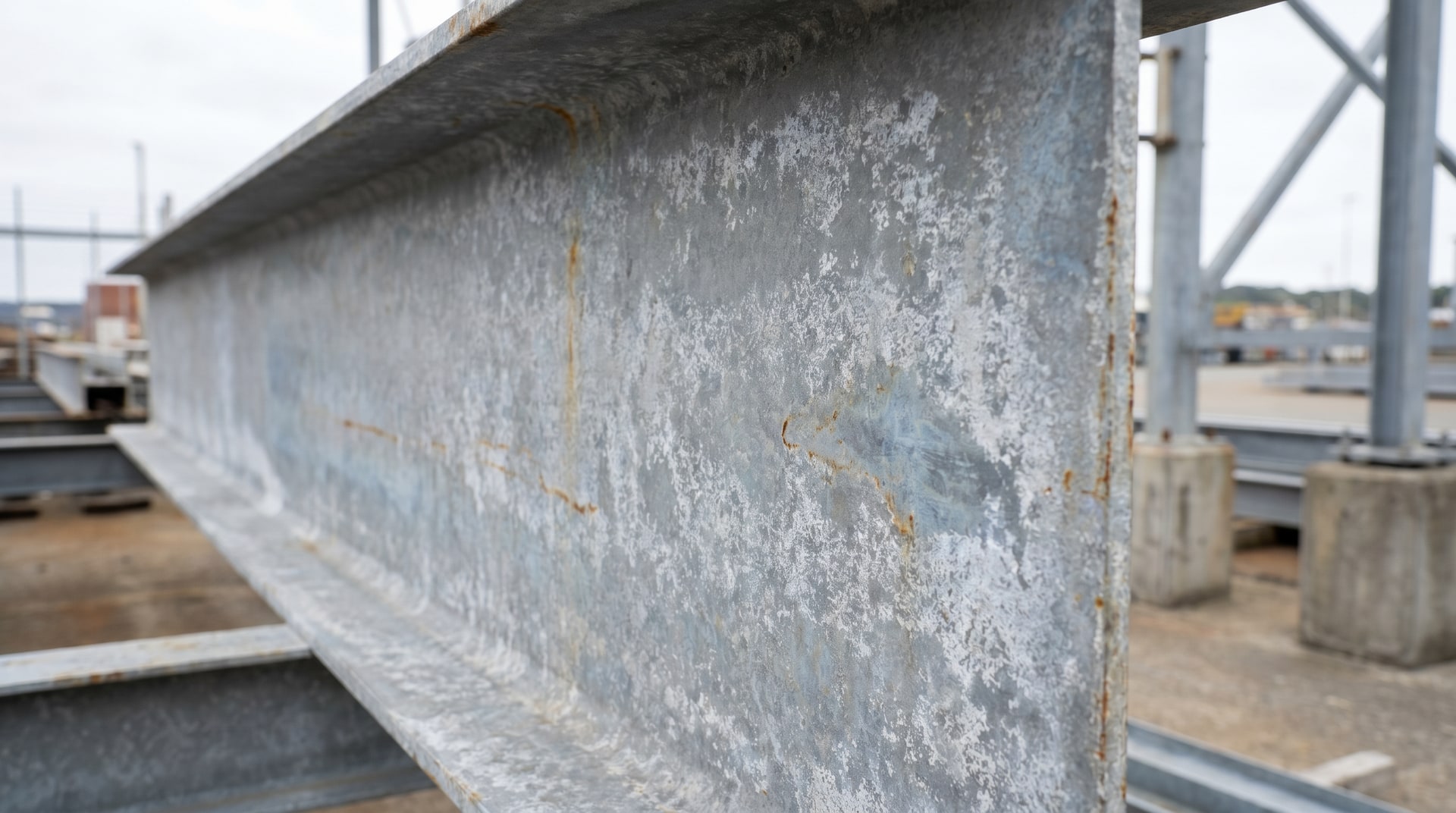
When a customer hands you a spec sheet and asks how hot-dip galvanized steel will hold up in a salt spray test, the honest answer isn't a number of hours. It's an explanation of why that test doesn't apply. That disconnect creates real friction on projects, particularly when specifiers are more familiar with painted or electroplated coatings that were designed with accelerated lab testing in mind. Galvanized steel operates through a fundamentally different protective mechanism, and that mechanism doesn't get a fair representation under a continuous sodium chloride fog.
The American Galvanizers Association addresses this directly in their article on HDG steel in salt spray testing. At V&S Galvanizing, we expand on that foundation to explain what is actually happening at the material level, how zinc patina formation influences long-term corrosion performance, and why this is often misunderstood in the field.
The Purpose of Salt Spray Testing and Where It Comes From
Salt spray testing was developed as an accelerated method for estimating how a coated surface might behave when exposed to corrosive environments over time. The appeal is obvious: instead of waiting years to see how a coating performs outdoors, you expose the sample to a concentrated corrosive atmosphere in a controlled chamber and observe what happens in a matter of days or weeks.
ASTM B117, titled Standard Practice for Operating Salt Spray (Fog) Apparatus, is the most widely referenced standard governing this type of test. Under ASTM B117, the coated steel is exposed to a continuous fog of 5% sodium chloride solution at room temperature. The test runs uninterrupted, with the salt mist contacting the surface without interruption and without any period of drying.
That continuous, uninterrupted exposure is precisely what makes it a poor fit for hot-dip galvanized steel. The test was built around coatings that provide purely barrier protection. Galvanized steel relies on something more nuanced.
How Hot-Dip Galvanized Steel Actually Protects Itself
Fresh galvanized steel has a bright, metallic zinc surface. When that surface is first exposed to the atmosphere, zinc begins reacting with oxygen and moisture to form zinc oxide and zinc hydroxide. Over time, as the surface continues cycling through wet and dry conditions, those initial compounds react further with carbon dioxide in the air to produce zinc carbonate, commonly called the zinc patina.
This zinc patina is the real protective layer. It's dense, stable, and nearly insoluble. Once established, it dramatically slows the rate of zinc consumption and gives hot-dip galvanized steel its long service life in most atmospheric environments. The patina doesn't just sit passively on the surface either. It actively resists further corrosion by limiting the electrochemical reactions that would otherwise continue consuming the zinc.
The critical point is that zinc patina formation depends on wet/dry cycling. The coating needs time exposed to moisture, followed by time to dry out. That sequence drives the chemical reactions that convert reactive zinc compounds into stable zinc carbonate. Take away the drying phase and the patina never fully develops.
Why ASTM B117 Targets the Wrong Material
Under ASTM B117 conditions, the salt fog is continuous. There is no drying cycle. The coating stays wet with a saline solution throughout the entire test duration. This matters enormously for zinc because zinc carbonate formation requires that alternating sequence of wetting and drying. Deny the zinc that cycle and you prevent the patina from forming.
What the test ends up measuring instead is the corrosion behavior of bare metallic zinc under continuous salt exposure. That's a very different material than the zinc carbonate patina that would be present on the same coating after several months of real outdoor exposure. The test is essentially attacking a surface that wouldn't exist in service. In real-world conditions, the patina forms relatively quickly after initial atmospheric exposure and becomes the dominant interface between the coating and the environment.
This is not a subtle distinction. It fundamentally changes what the test is measuring. When customers report that galvanized steel performed poorly in salt spray testing, they're reporting on the behavior of reactive metallic zinc, not on the galvanized system as it actually functions in the field. The test gives a pessimistic and technically misleading picture.
What the Test Was Designed For vs. How It Gets Applied
ASTM B117 was developed primarily to evaluate barrier coatings: paints, epoxies, and similar systems that protect steel by physically blocking moisture and ions from reaching the substrate. For those coatings, continuous salt fog exposure does reveal meaningful information. You can compare coating formulations, assess adhesion performance, or evaluate whether a coating was applied correctly.
Hot-dip galvanizing works through a combination of barrier protection and galvanic (sacrificial) protection. The zinc-iron alloy layers bonded metallurgically to the steel provide barrier resistance, while the outer zinc layer provides cathodic protection. Neither of these mechanisms is well-represented by a test that strips away the patina and continuously attacks the zinc with a solution that wouldn't be present in normal service.
The problem in practice is that many specifications and procurement processes default to salt spray testing because it's a familiar, standardized metric. Specifiers who work with multiple coating types often apply a single testing framework to all of them. When galvanized steel produces results that look unfavorable compared to a high-build epoxy in a 500-hour salt spray test, that comparison is not technically valid. The coatings are operating through different mechanisms, and the test only suits one of them.
The Role of Environment in Predicting Galvanized Steel Performance
Because the zinc patina's behavior depends on the specific atmospheric conditions it encounters, service life prediction for hot-dip galvanized steel is inherently tied to environment. A galvanized structure installed in a dry inland industrial setting will behave differently from one exposed to marine air on a coastal pier. Temperature, humidity, rainfall patterns, sulfur dioxide concentration, and chloride levels in the air all influence how quickly zinc is consumed and how stable the patina becomes.
This is why real-world performance data, gathered from structures in actual service across diverse environments, is far more useful than any laboratory simulation for understanding how galvanized coatings behave. Decades of field data from galvanized structures around the world have been documented, analyzed, and compiled specifically to support service life estimation.
The Zinc Coating Life Predictor, a free tool available through the AGA, draws on that body of real-world case studies. By inputting atmospheric data for the location where a structure will be installed, users can get a personalized estimate of the time to first maintenance for hot-dip galvanized steel. That kind of location-specific, data-driven estimate is grounded in how the coating actually performs, not in how fresh metallic zinc behaves under a continuous chloride fog.
Addressing Customer Questions in Practice
When a customer or specifier asks for salt spray test results, they're usually trying to answer a legitimate underlying question: will this coating last in my environment? That's a reasonable thing to want to know, and the request for salt spray data is an attempt to use a familiar metric to answer it. The path forward isn't to push back defensively; it's to redirect toward a more technically appropriate answer.
Explaining why salt spray testing doesn't apply to galvanized steel requires walking through the zinc patina mechanism clearly. Most engineers and architects respond well to a materials-level explanation once it's framed as a fundamental property of how zinc protects steel, not as an excuse to avoid testing. Showing them the Zinc Coating Life Predictor and demonstrating how it uses real atmospheric data and field case studies tends to be far more persuasive than any lab number.
For projects where a formal written justification is needed, the AGA Technical Department maintains studies and technical documentation that explain in scientific terms why salt spray testing is inappropriate for hot-dip galvanized steel. Having that documentation available during specification discussions can smooth the path considerably.
Real-World Performance Data as a Technical Foundation
The alternative to salt spray testing isn't an absence of data. It's a richer, more representative dataset. The field performance record for hot-dip galvanized steel spans many decades, many countries, and many exposure environments. Structures galvanized in the mid-twentieth century are still in service, providing direct evidence of long-term behavior that no accelerated lab test could replicate.
That accumulated performance history is the foundation of tools like the Zinc Coating Life Predictor and the ISO corrosivity classification system used to categorize atmospheric aggressiveness. When zinc coating thickness is known, when the corrosivity category of the environment is established, and when field data from similar exposures is available, service life prediction becomes a technically defensible engineering calculation rather than an extrapolation from an artificial test condition.
At V&S Galvanizing, we work on projects across a range of environments and applications. Understanding how galvanized coatings perform in the environments where our customers' structures will actually live is central to what we do. Salt spray numbers can't answer that question for galvanized steel. The zinc patina can, given the right conditions to form.
Work With a Team That Understands the Mechanism
Hot-dip galvanizing is a mature, well-documented corrosion protection system with a performance record that speaks for itself. When that performance is evaluated using tools suited to how zinc actually functions, including real-world case studies, atmospheric corrosivity data, and service history from similar structures, the results are compelling. When it's evaluated using a test designed for barrier coatings that denies the zinc patina the conditions it needs to form, the results are misleading and technically unsound.
We encourage engineers, fabricators, and specifiers to push back on the reflexive application of ASTM B117 to galvanized steel, not because the data looks bad, but because the test doesn't measure what it claims to measure for this coating system. Better methods exist, and we're equipped to help you use them. If you're navigating a specification discussion, responding to a customer question about corrosion performance, or trying to build a technically grounded case for galvanizing on a project, reach out to us through our contact page and we'll work through it with you.
Frequently Asked Questions About Salt Spray Testing and Hot-Dip Galvanized Steel
Why does ASTM B117 salt spray testing give inaccurate results for hot-dip galvanized steel?
ASTM B117 exposes coated steel to a continuous 5% sodium chloride fog with no wet/dry cycling. Hot-dip galvanized steel depends on the zinc patina (zinc carbonate) for its long-term corrosion resistance, and that patina can only form when the surface alternates between wet and dry conditions. Because the test never allows the surface to dry, the patina never forms, meaning the test is measuring the corrosion of bare metallic zinc rather than the actual protective surface that would exist in real-world service.
What is the zinc patina and why does it matter for galvanized steel performance?
The zinc patina is a layer of zinc carbonate that forms on the surface of galvanized steel after atmospheric exposure. It develops through a series of reactions: zinc reacts with oxygen and moisture to form zinc oxide and zinc hydroxide, which then react with carbon dioxide to produce zinc carbonate. This patina is dense, stable, and nearly insoluble, which slows further zinc consumption significantly. It is the primary reason hot-dip galvanized steel achieves long service life in most atmospheric environments.
What is the correct method for predicting hot-dip galvanized steel service life?
The most technically appropriate approach is to use real-world performance data from galvanized structures in similar environments. The Zinc Coating Life Predictor, available through the American Galvanizers Association, draws on global field case studies and allows users to input location-specific atmospheric data to estimate time to first maintenance. This method reflects how the coating actually behaves in service rather than under artificial lab conditions.
Is salt spray testing ever appropriate for any zinc-coated products?
Salt spray testing can have limited comparative value for some zinc-containing coating systems, particularly when evaluating consistency between batches or screening paint topcoats applied over zinc. However, for predicting the service life of hot-dip galvanized steel in atmospheric environments, it is not an appropriate tool because it does not allow the zinc patina to develop, which is the coating's primary long-term protective mechanism.
How should I respond when a project specification requires salt spray test data for galvanized steel?
The best approach is to explain the zinc patina mechanism directly and redirect the specifier toward more appropriate performance data. The AGA Technical Department maintains scientific documentation specifically addressing why salt spray testing is inappropriate for hot-dip galvanized steel. Pairing that documentation with a Zinc Coating Life Predictor estimate tailored to the project's location typically provides a technically credible alternative that satisfies the specifier's underlying concern about corrosion performance.
Does continuous salt fog exposure ever occur in real-world environments for galvanized steel?
No. Even in aggressive marine environments, steel surfaces experience alternating wet and dry cycles driven by tidal patterns, rainfall, humidity fluctuations, and wind. The continuous 5% sodium chloride fog of ASTM B117 does not replicate any realistic atmospheric exposure condition. Real environments allow the zinc patina to form and stabilize, which is why field performance data from actual coastal or industrial installations is a far better predictor of service life than a continuous-fog lab test.
What environmental factors most influence hot-dip galvanized steel service life?
The primary factors are atmospheric corrosivity category, which reflects the concentration of moisture, chlorides, and sulfur dioxide in the air, along with temperature and time of wetness. Marine and industrial environments with high chloride or sulfur dioxide levels are more aggressive than dry inland or rural atmospheres. These variables are captured in real-world classification systems and tools like the Zinc Coating Life Predictor, giving a far more nuanced and accurate service life estimate than any single accelerated test.
Can a galvanized steel coating that performs poorly in salt spray still have a long service life in the field?
Yes. Because salt spray testing prevents the zinc patina from forming, galvanized steel will appear to corrode relatively quickly under those conditions. That result does not reflect field performance. In actual atmospheric service, the zinc patina develops within the first months of exposure and substantially reduces the zinc consumption rate. Decades of field data from galvanized structures in service confirm that real-world performance is not predictable from ASTM B117 results.
