

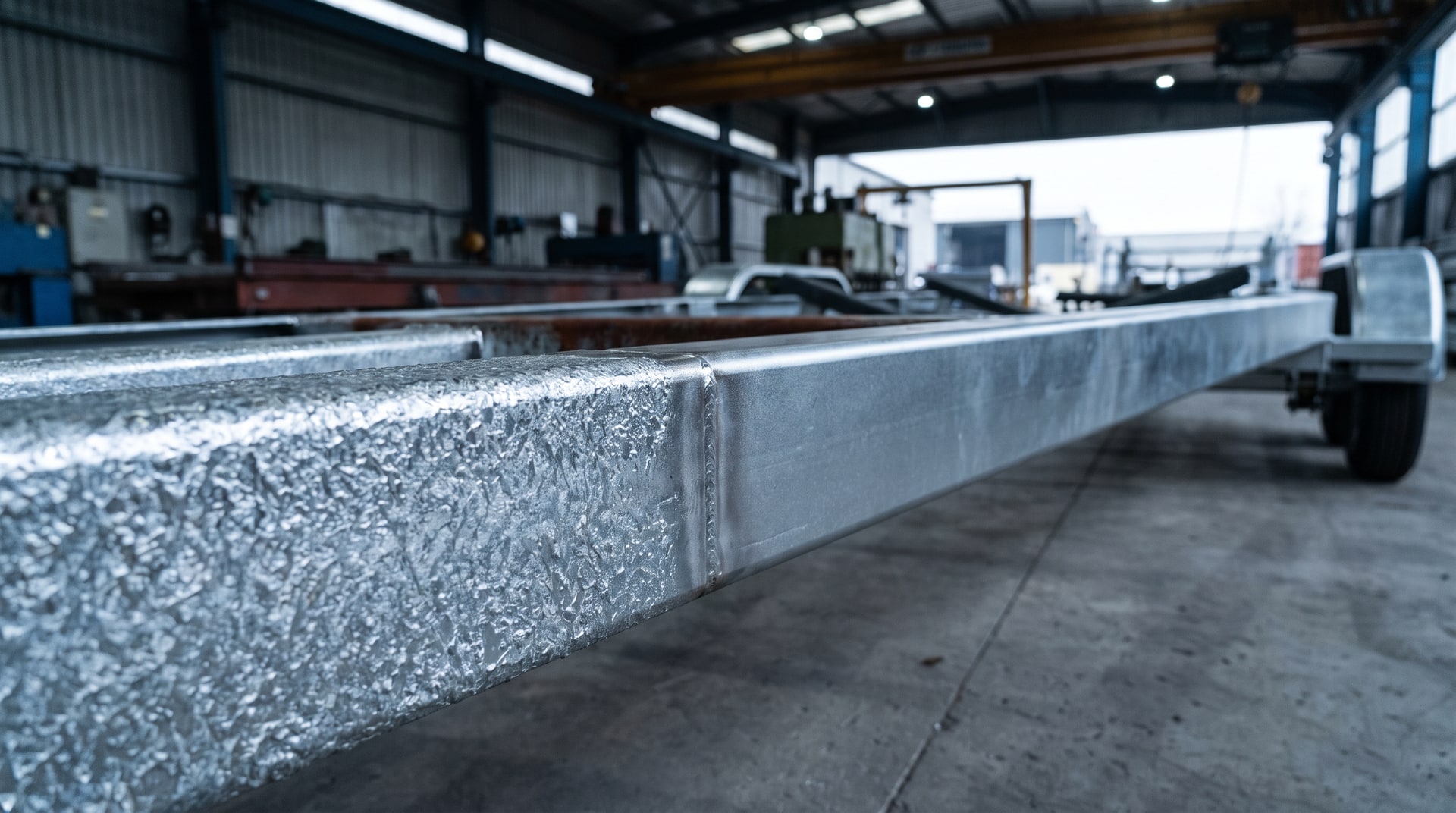
A galvanized boat trailer comes out of the kettle and most of it looks exactly right: smooth, bright, uniform zinc coverage. Then there is a section in the middle that looks like it was coated with a completely different process. The zinc is thick, rough, and almost granular in appearance. The rest of the assembly is fine. No process variables changed. The bath temperature was correct, the flux was performing normally, and the dwell time was consistent. So what happened?
This kind of outcome is not a galvanizing failure in the conventional sense. It is a materials problem, and the root cause is almost always the chemistry of the steel itself. The reactive elements silicon and phosphorus, even at levels that appear well within acceptable ranges on a mill certification, can behave unpredictably when other factors come into play. The result is a coating that provides full corrosion protection but creates significant appearance problems, particularly for components like handrails where surface smoothness is a functional requirement.
The American Galvanizers Association addresses this directly in their article on rough coatings on boat trailers and handrails caused by silicon and phosphorus. At V&S Galvanizing, we expand on that foundation to explain what is actually happening at the material level, how reactive steel chemistry influences coating formation, and why this is one of the most difficult coating quality issues to diagnose and prevent in the field.
How Steel Chemistry Determines Coating Behavior
Hot-dip galvanizing works through a series of metallurgical reactions between the steel surface and the molten zinc bath. Under normal conditions with low-reactivity steel, those reactions proceed in a controlled way, producing a layered coating structure that transitions from iron-zinc alloy phases at the steel interface to relatively pure zinc at the outer surface. The result is a coating with predictable thickness and a reasonably smooth finish.
When silicon or phosphorus is present in the steel above certain thresholds, those interfacial reactions accelerate significantly. The iron-zinc alloy layer grows much faster and in a less controlled manner. Instead of a thin, stable alloy layer capped by a zinc overlay, the coating becomes thick and uneven throughout its depth. The outer surface reflects that internal instability, producing the rough, irregular texture that galvanizers and their customers can clearly see.
This accelerated reactivity is not a defect introduced during processing. It is a property of the steel. The galvanizer cannot change the steel chemistry once the fabrication is complete, which means there is very little that can be done about the appearance after the fact.
The Sandelin Curve and the Problem of Threshold Reactivity
The relationship between silicon content and zinc coating thickness is not linear. It follows what metallurgists call the Sandelin curve, named after the researcher who first characterized it. Steel with very low silicon content (generally below about 0.04%) galvanizes normally. As silicon climbs through what is known as the Sandelin peak, coating thickness and surface roughness increase dramatically. Above that peak range, reactivity can actually moderate somewhat before climbing again at higher silicon levels.
The challenge in practice is that steel sitting right at the edge of the Sandelin peak, with silicon around 0.06%, occupies the most unpredictable position on that curve. Small variations in actual silicon content from piece to piece, or even along the length of a single piece of tubing, can push one section into reactive behavior while leaving adjacent sections unaffected. This is precisely the scenario described in the source case: the steel chemistry places it on the leading edge of the Sandelin peak, where behavior is inconsistent and difficult to predict before galvanizing.
Phosphorus adds its own complication. It can produce similar thick and rough coatings through a related but distinct mechanism, and the two elements can interact in ways that compound the reactivity. A steel with borderline silicon and borderline phosphorus may behave worse in combination than either element alone would suggest.
Why the Problem Appears in the Center of an Assembly
One of the more puzzling aspects of this issue is that the rough coating often appears only in the middle section of a fabricated assembly, with the ends appearing normal. For a boat trailer, this pattern has a straightforward explanation rooted in both material processing and the thermal behavior of the galvanizing dip.
Steel tubing used to bend a boat trailer frame is cold worked during forming. The bends and curves that give the trailer its shape introduce residual stress and localized work hardening in the steel. Cold working is known to increase the reactivity of borderline-silicon steel, because it alters the grain structure and surface energy in ways that accelerate zinc-iron interdiffusion during galvanizing.
The center section of a long assembly also experiences a different thermal cycle than the ends when it enters and exits the zinc bath. Depending on how the part is racked and immersed, the center may heat more slowly, remain at bath temperature longer, or cool at a different rate. Each of these variations affects how long the reactive alloy-layer growth continues. Even a modest increase in dwell time at temperature, combined with the residual stress from cold working and silicon content sitting at the Sandelin threshold, is enough to tip the coating behavior from acceptable to visibly rough.
Mill Certifications and the Gap Between Certified Chemistry and Actual Chemistry
Fabricators specifying low-reactivity steel for galvanizing often rely on mill certifications to verify that the material will perform acceptably. This is a reasonable approach, but it has a structural limitation that is easy to overlook. Mill certifications represent the heat chemistry of a batch of steel, meaning they reflect an average composition taken from samples of the molten heat before casting. The actual chemistry of any given tube, plate, or section cut from that heat can vary from the certified average.
In the case documented by the AGA, the certified chemistry appeared to show silicon and phosphorus well within acceptable ranges. When galvanizers had the actual tubing samples analyzed, the results told a different story. The measured silicon was higher than the mill cert suggested and landed the material squarely on the edge of the Sandelin peak. This is not necessarily evidence of fraud or negligence on the part of the steel producer; it reflects the inherent variability of bulk steel production, where chemistry is verified at the heat level rather than at the level of individual pieces.
For fabricators producing assemblies where appearance is critical, particularly handrails where surface smoothness is a functional and safety consideration, relying solely on the mill cert may not provide adequate assurance. Requesting piece-level chemical analysis or working with a steel supplier who can provide tighter chemistry controls is a more conservative approach when the application demands it.
| Element | Mill Certification Chemistry (Appears Low-Reactivity) | Actual Tubing Chemistry (Measured from Sample) |
|---|---|---|
| Silicon (Si) | Below reactive threshold (appears acceptable) | 0.06% - at leading edge of Sandelin peak |
| Phosphorus (P) | Below reactive threshold (appears acceptable) | Higher than certified average (exact value not specified in source) |
| Coating Result | Expected: smooth, normal thickness | Actual: rough, thick coating on affected sections |
When the Rough Coating Stops at a Weld Line
A related but distinct version of this problem occurs when a fabricator incorporates different pieces of steel in a single assembly. A boat trailer might use one steel specification for the main frame members and a different heat or supplier for brackets, clips, or cross members. If that secondary material has elevated silicon or phosphorus content, its galvanized coating will look noticeably different from the surrounding steel.
The diagnostic signal here is abruptness. When the rough coating stops sharply at a weld joint or an assembly interface, it almost always points to a material chemistry difference rather than a process variation. A process issue, such as flux contamination or temperature inconsistency, would not typically produce a coating change that aligns exactly with a weld line. Material chemistry differences, by contrast, stop at exactly the boundary between two different pieces of steel.
This pattern is worth understanding because it changes the conversation with the customer and the fabricator. The issue is not how the part was galvanized. It is what material was used to build it. That distinction matters for determining responsibility and for deciding what, if anything, can be done differently on subsequent orders.
Corrosion Protection Is Not Compromised
A rough or thick galvanized coating looks different, but it is important to be clear about what that difference does and does not mean for performance. A coating that formed through accelerated reactivity is still zinc. It still provides cathodic protection to the underlying steel. In many cases, the coating is actually thicker than a standard galvanized coating, which means it represents more zinc mass and, in purely theoretical terms, a longer service life before the zinc is consumed.
The problem is cosmetic and, in some applications, functional. For a boat trailer frame that will spend its life in a marine environment, the rough appearance may be entirely acceptable to the end user. The corrosion resistance is there. For a handrail in a public space, the calculus is different. Handrails are touched constantly, and a rough or irregular surface creates a tactile problem that can lead to rejection of the assembly regardless of how well it will perform in service. Building codes and project specifications for handrails typically require smooth, continuous surfaces precisely because rough edges and textures are a safety concern for users.
Understanding this distinction helps set appropriate expectations at the outset. When a fabricator is ordering steel for a handrail system, the appearance requirements are tighter and the chemistry tolerances need to be specified more carefully. When the application is a structural component where appearance is secondary to performance, the rough coating is a non-issue from an engineering standpoint.
What Galvanizers Can and Cannot Control
This is where the practical conversation often becomes difficult. When a customer receives a rough-coated assembly, the natural assumption is that something went wrong during galvanizing. The galvanizer is frequently the first party to field that complaint. But when the cause is steel chemistry, the galvanizer has very limited recourse.
Bath temperature adjustments, withdrawal speed changes, and flux chemistry modifications can have marginal effects on how reactive steel behaves, but they cannot override the fundamental thermodynamics driving the accelerated iron-zinc reaction. A galvanizer who suspects reactive steel chemistry can request samples for spectrographic analysis to confirm, but that analysis happens after the coating has already formed. It is diagnostic, not preventive, once the parts are already in the shop.
Prevention requires action earlier in the supply chain. Fabricators need to understand the reactivity implications of their steel specification and communicate those requirements clearly to their steel suppliers. When assemblies are designed for applications where appearance matters, specifying steel with silicon below 0.04% and phosphorus below 0.02% gives the galvanizer the best possible starting point. That specification should be applied to every piece of steel in the assembly, not just the primary structural members, because a single reactive bracket or clip can create rejection-level appearance problems on an otherwise acceptable assembly.
Our team at V&S Galvanizing can work with fabricators to identify potential chemistry concerns before work begins, and we encourage customers producing appearance-critical assemblies to share mill certifications with us in advance. It does not eliminate all risk, given the gap between heat chemistry and piece chemistry, but it is a meaningful step toward catching problems before they become finished-product rejections.
Work With a Team That Understands the Steel Behind the Coating
Rough galvanized coatings on boat trailers and handrails are not random events. They follow a consistent logic rooted in steel chemistry, the Sandelin peak, cold working effects, and the thermal dynamics of immersion galvanizing. When you understand that logic, the coating tells you what material was used to build the part, where the reactive steel begins and ends, and whether the issue is one piece of the assembly or the entire steel specification.
At V&S Galvanizing, we bring that diagnostic perspective to every job. We know what reactive steel looks like and we understand the mechanisms behind it. When something unexpected comes out of the kettle, we can explain why, trace it to its source, and work with fabricators on a path forward, whether that means adjusting the steel specification for the next order, managing customer expectations around corrosion performance versus appearance, or identifying which piece of the assembly introduced the problem. For fabricators producing assemblies where appearance requirements are tight, that kind of upstream collaboration is worth far more than a post-processing fix that cannot address the underlying cause. Reach out through our contact page to talk through your next project before it reaches the kettle.
Frequently Asked Questions About Rough Galvanized Coatings From Reactive Steel
Why does a rough galvanized coating appear only on one section of a boat trailer and not the rest?
The most common cause is that one section of the assembly was fabricated from a different piece of steel with higher silicon or phosphorus content. When the reactive section sits adjacent to normal steel in the same assembly, the rough coating stops abruptly at the weld joint or assembly interface, which is a reliable diagnostic indicator. Cold working during tube bending and thermal differences during immersion can also concentrate the rough coating in specific zones, particularly the center of long assemblies.
What is the Sandelin peak and why does it matter for galvanizing?
The Sandelin peak describes a range of silicon content, roughly centered just below 0.10% silicon, where the iron-zinc reaction during hot-dip galvanizing accelerates dramatically. Steel with silicon in this range produces thick, rough, and uneven coatings. Steel at the lower edge of the peak, around 0.06%, sits in the most unpredictable zone, where coating behavior varies from piece to piece depending on minor chemistry differences, cold working, and thermal history during galvanizing.
Does a rough galvanized coating mean the corrosion protection is compromised?
No. A rough coating formed from reactive steel chemistry is still a zinc coating providing full cathodic protection. In many cases it is thicker than a standard coating, which means more zinc mass. The problem is cosmetic and potentially functional for touch-sensitive applications like handrails, but the underlying corrosion resistance of the steel is not reduced by coating roughness.
Why can't the mill certification be trusted to predict galvanizing behavior?
Mill certifications report heat chemistry, which is an average composition of the entire molten batch before casting. Individual pieces cut from that heat can have local chemistry that differs from the certified average. A piece of tubing can measure higher silicon than the cert shows, placing it on the Sandelin peak even when the certification suggests it should be low-reactivity material. This variance is inherent to bulk steel production and is not necessarily a certification error.
Can the galvanizer adjust the process to prevent rough coatings on reactive steel?
To a very limited degree. Bath temperature and withdrawal speed have minor influences on how reactive steel behaves, but they cannot override the fundamental thermodynamic drivers of accelerated zinc-iron reaction. Once reactive steel is in the shop, the galvanizer has few practical options. Prevention requires selecting lower-reactivity steel upstream, before fabrication is complete.
What silicon and phosphorus levels should fabricators specify to avoid reactive galvanizing behavior?
Steel with silicon below 0.04% and phosphorus below 0.02% provides the lowest reactivity risk and the most predictable galvanizing outcome. This specification should apply to every component in the assembly, including brackets, clips, and secondary members, not just the primary structural steel, since a single reactive piece can create appearance problems across the entire assembly.
Why does cold working increase the reactivity of borderline-silicon steel during galvanizing?
Cold working, such as bending tubing to form trailer frames, introduces residual stress and alters the grain structure of the steel at and near the surface. These changes increase surface energy and accelerate zinc-iron interdiffusion when the steel enters the molten zinc bath. For steel already sitting on the edge of the Sandelin peak, this additional factor is often enough to push coating behavior from acceptable into visibly rough.
Is a rough galvanized handrail always a rejection-level defect?
From a corrosion protection standpoint, no. From an application and specification standpoint, it frequently is. Handrails require smooth surfaces because people run their hands along them continuously. A rough galvanized surface creates a tactile hazard and typically fails project specifications requiring smooth, continuous surface finishes. This is why steel chemistry control matters more for handrail fabrication than for many other galvanized assemblies.
