
When a fabricator or engineer specifies hot-dip galvanizing on a project, the assumption is often that a single standard governs everything. That assumption is understandable but not entirely accurate. ASTM A123 is the dominant specification for after-fabrication hot-dip galvanizing, but its scope is deliberately defined to cover certain steel products and not others. Understanding exactly where that boundary sits, and which standards pick up where A123 leaves off, is essential for writing accurate specifications, conducting meaningful inspections, and avoiding costly rework when expectations and reality diverge at the job site.
The practical confusion tends to emerge at the procurement stage. A project may involve structural beams, pipe, hardware, and reinforcing steel all in the same scope of work, and if the specification simply says 'galvanize per ASTM A123,' some of those materials may not be correctly addressed. The distinction is not just administrative. Different product types are galvanized by fundamentally different processes, and each process produces a coating with different characteristics. The standard that applies reflects those differences.
The American Galvanizers Association addresses this directly in their article on what steel products are covered by ASTM A123. At V&S Galvanizing, we expand on that foundation to explain what is actually happening at the material level, how product geometry and process method influence which standard applies, and why this is often misunderstood in the field.
The Core Purpose of ASTM A123
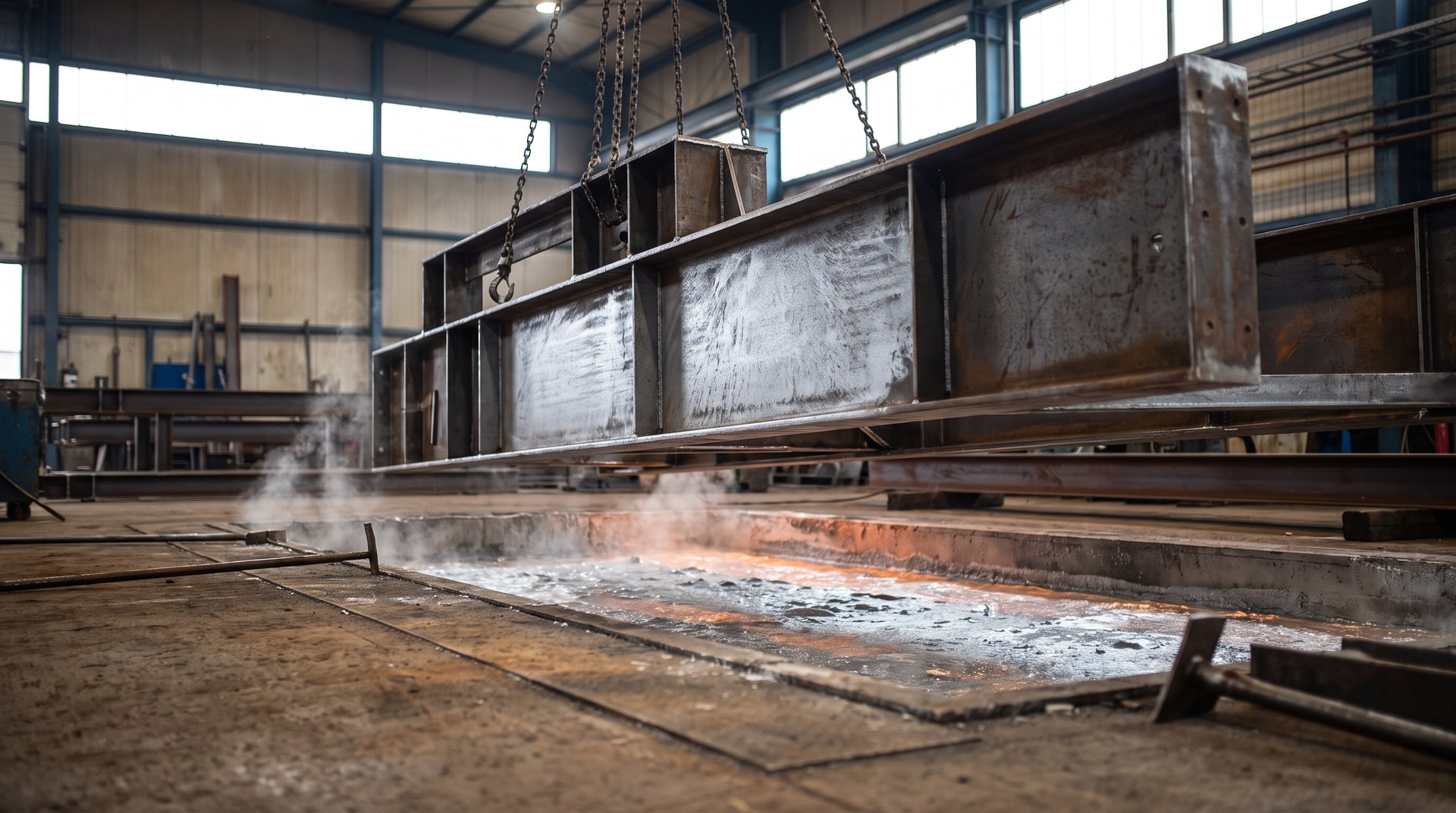
ASTM A123 is a specification focused on after-fabrication hot-dip galvanizing. That phrase is worth pausing on. After-fabrication means the steel has already been formed, cut, welded, or assembled into its final or near-final shape before it enters the galvanizing kettle. This is the batch galvanizing process, where individual pieces or assembled structures are cleaned, fluxed, and then immersed in a bath of molten zinc. The zinc metallurgically bonds to the steel surface, forming a layered zinc-iron alloy coating topped by free zinc.
The specification governs the coating that results from this process: how thick it must be, how it must look, what inspection procedures apply, and how sampling should be conducted to determine compliance. Because batch galvanizing is inherently a dip process applied to discrete pieces, A123 is written around the physical realities of that method. Coating thickness requirements, for instance, are tied to steel thickness categories, because thicker steel contains more silicon and reactive surface area, producing a thicker metallurgical bond zone.
This is distinct from continuous galvanizing, where coil steel or wire is fed through a zinc bath at high speed in a production line. The coating that results from that process is thinner, more uniform, and governed by different standards because the mechanism and application context are different.
What ASTM A123 Actually Covers
The scope of A123 is intentionally broad when it comes to fabricated steel. The standard covers zinc coatings applied by hot-dip galvanizing on iron and steel products in both unfabricated and fabricated form. In practice, this encompasses a wide range of structural and industrial steel: assembled steel products, structural steel fabrications, bent or welded tubes, wire work, grating, expanded metal, pipe, handrail, steel forgings, and iron castings.
That breadth reflects the variety of products that pass through a batch galvanizing operation. A structural beam going into a highway bridge, a welded handrail for a pedestrian walkway, a fabricated equipment frame for a water treatment facility, a cast iron fitting on an industrial piping system: all of these fall within A123's coverage. What they share is that they arrive at the galvanizing plant as discrete items that are immersed as a unit in molten zinc.
Expanded metal, grating, and wire work are worth noting specifically because their geometry creates surface area complexity. Open mesh structures have interior surfaces, wire intersections, and varying cross-sections that affect how zinc flows and where it accumulates. A123 accounts for this by setting coating requirements based on the steel category, not just the nominal thickness of a single member.
Pipe and bent or welded tubes are also covered, which sometimes surprises people who think pipe falls entirely under other standards. The key distinction is process method. Pipe galvanized on a batch line after fabrication, perhaps a custom assembly or a section of pipe with welded fittings, falls under A123. Pipe galvanized by continuous methods during manufacturing does not.
Where A123 Stops and Other Standards Begin
The exclusions in A123 are as technically meaningful as its inclusions. Each excluded product category is directed toward a different standard that better fits the product's geometry, application method, or end-use requirements.
Wire is one clear example. Wire galvanized on continuous lines falls under ASTM A641, not A123. The continuous galvanizing process used for wire operates at different speeds and with different coating control parameters than batch galvanizing. The resulting coating profile is different, and the specification reflects that. When wire appears in an assembly with other steel products, the assembly itself may fall under A123, but the wire component is evaluated differently.
Pipe and tube produced to ASTM A500 and galvanized on continuous production lines also fall outside A123's scope. Here again, the exclusion is process-driven. Structural tube manufactured to A500 and continuously galvanized before it leaves the mill is a very different product from a custom-welded tubular assembly sent to a batch galvanizer after fabrication. The former is governed by its own product standard; the latter falls under A123.
Steel sheet galvanized continuously, such as corrugated roofing or flat sheet product, falls under ASTM A653. Sheet galvanizing is a high-speed, tightly controlled process that produces a thinner, spangled coating used in forming and stamping applications. The sheet coating is not designed for the same service conditions as structural batch-galvanized steel, and comparing coating requirements between A653 and A123 directly would be misleading.
Small parts and hardware items that can be centrifuged to remove excess zinc fall under a different standard entirely. The centrifuging process, where small items like nuts, bolts, and small brackets are spun after withdrawal from the zinc bath to shed excess zinc, produces a different coating profile than simply draining large structural pieces. ASTM A153 governs those products. The exclusion matters because hardware items are often part of a larger project specification, and if the drafter defaults to A123 for everything, the inspection criteria being applied to bolts and small brackets will not be correct.
Reinforcing steel has its own standard as well: ASTM A767. A767 governs zinc-coated reinforcing bars intended for concrete reinforcement. The exception written into A123 is worth noting carefully: reinforcing steel is excluded from A123 unless it is used in an assembly with other types of steel products. This is a practical carve-out for situations where rebar is welded into a larger fabrication, such as a composite assembly or a precast concrete connection detail. In that case, the assembly as a whole can fall under A123, even though the rebar component alone would normally be covered by A767.
Why These Distinctions Matter in Engineering Practice
Specifying the wrong standard is not a minor clerical issue. Inspection criteria, minimum coating thickness requirements, test methods, and sampling procedures vary between these standards. If a project specification calls for ASTM A123 on hardware that should be evaluated under A153, an inspector applying A123 coating thickness requirements to centrifuged fasteners will be using the wrong acceptance criteria. The hardware might technically meet A153 and fail A123, or it might appear to meet A123 without actually meeting the process requirements that A153 implies.
The same logic applies to structural fabrications that include pipe purchased off a production line versus pipe that has been welded into a custom assembly. The production-line pipe may already have a continuous galvanized coating from the mill. Adding it to an assembly that is then batch galvanized is a different situation entirely, one that involves coating over an existing coating and raises questions about adhesion, zinc buildup at threads and joints, and whether the existing coating counts toward the A123 thickness requirement.
Fabricators who work with mixed-product assemblies need to think carefully about how each component enters the process and which standard governs the end result. Our team regularly works through these questions with engineers during the design and specification phase, because it is far easier to address them before fabrication begins than to resolve a compliance dispute during inspection.
Coating Properties and Inspection Under A123
For products that do fall within its scope, A123 defines specific coating properties that must be met. Minimum coating thickness is tied to steel thickness categories, with thicker steel requiring greater minimum coating weight. The standard also addresses finish and appearance requirements, establishing what constitutes an acceptable surface condition and what defects are cause for rejection versus those that are cosmetic and acceptable.
Sampling procedures under A123 are structured around inspection lots, with the number of samples required depending on the size of the lot. This is important for large projects where not every piece can be individually measured but where the coating on the lot as a whole must be demonstrated to meet minimums. The standard specifies how many pieces must be sampled, how many measurements must be taken per piece, and what constitutes a passing result at both the individual measurement and lot average levels.
Test methods under A123 include magnetic thickness gauging for in-the-field measurement and weigh-strip-weigh testing as a laboratory reference method. These are not interchangeable approaches; they are used at different stages of verification and by different parties. Understanding which method applies in a given inspection context is part of working effectively within the standard.
Steel Forgings and Iron Castings: A Note on Material Variation
A123 explicitly includes steel forgings and iron castings within its scope, and this inclusion deserves some attention because these materials behave differently in the galvanizing bath than rolled steel. Cast iron, in particular, has a higher silicon content and a more heterogeneous surface than structural steel. Silicon is a strong driver of zinc-iron reaction kinetics. Higher silicon content accelerates the growth of the alloy layers in the coating, often producing a thicker, matte gray coating with more pronounced alloy layer structure and less free zinc at the surface.
This does not make the coating inferior in corrosion performance, but it does affect appearance and can influence how the coating responds to mechanical contact. Engineers specifying galvanizing on cast iron components should understand that the visual result will likely differ from adjacent rolled steel members, and that this difference is expected and within the range of normal coating performance under A123.
Forgings present a different consideration. The forging process compresses and refines the steel grain structure, which can reduce the surface reactivity compared to as-rolled material. In some cases this produces a thinner coating, and fabricators should account for that in the design if a specific minimum thickness is critical for the service environment.
Practical Implications for Specification Writers
Writing an accurate galvanizing specification requires matching each product type to its governing standard before the project goes out to bid. For structural fabrications, assembled steel products, grating, handrail, and most custom-fabricated items, A123 is the right reference. For hardware and small parts that will be centrifuged, A153 should be specified. For reinforcing steel used in concrete applications, A767 applies. For pipe or tube from a continuous mill, check whether A500 covers the product. For sheet steel products, A653 is the relevant standard.
When a project involves a mix of product types, the specification should call out each category explicitly rather than defaulting to a single standard and hoping it covers everything. This protects the fabricator, the galvanizer, the inspector, and ultimately the owner, because everyone is working from a shared and accurate set of expectations. Ambiguity in specifications tends to surface at the worst possible moment, usually during inspection or when a warranty question arises in service.
Our team can help review galvanizing specifications during the design phase as part of our technical support work. It is not uncommon for a well-intentioned specification to call out A123 for every galvanized item on a project, and a brief review can identify where that creates compliance issues before the steel is in production.
Work With a Team That Understands the Full Scope of Galvanizing Standards
ASTM A123 is the cornerstone of after-fabrication hot-dip galvanizing, but it is one specification within a broader framework that addresses the full range of zinc-coated steel products. Knowing where it applies, where it hands off to A153, A641, A767, A500, or A653, and why those boundaries exist, is the foundation of accurate galvanizing specification and effective quality control. The distinctions are grounded in real differences in process, product geometry, coating behavior, and end-use performance. Treating them as interchangeable leads to specification errors that are entirely avoidable with the right knowledge.
If you are working through a galvanizing specification, evaluating a mixed-product assembly, or trying to understand which standard governs a specific material in your project, we are glad to help. Reach out through our contact page and one of our technical team members will work through the details with you.
Frequently Asked Questions About ASTM A123 and Steel Product Coverage
Does ASTM A123 apply to pipe that has already been galvanized at the mill?
No. Pipe galvanized on a continuous production line, such as pipe produced to ASTM A500, is excluded from A123's scope. A123 applies to pipe that is batch-galvanized after fabrication. If mill-galvanized pipe is incorporated into an assembly that is then batch-galvanized, the situation becomes more complex and should be reviewed carefully before proceeding.
Can reinforcing steel be inspected under ASTM A123?
Generally, reinforcing steel is governed by ASTM A767, not A123. The exception is when the rebar is part of an assembly that includes other steel products, such as a welded composite fabrication. In that case, the assembly as a whole can fall under A123. If the rebar is being galvanized for standalone use in concrete, A767 is the correct standard.
What is the difference between ASTM A123 and ASTM A153 for galvanized hardware?
A153 governs small parts and hardware items that are centrifuged after withdrawal from the zinc bath to remove excess zinc. Centrifuging produces a different coating profile than simply draining large structural members. A123 does not cover items that are centrifuged. Using A123 inspection criteria on centrifuged fasteners means applying the wrong acceptance thresholds, which can result in incorrect acceptance or rejection decisions.
Why does steel thickness matter for minimum coating requirements under A123?
Thicker steel reacts more extensively with the molten zinc bath, producing thicker zinc-iron alloy layers. A123 sets minimum coating thickness requirements based on steel thickness categories because the coating that forms is partly a function of the steel's available reactive surface and the duration of immersion. Thinner steel produces thinner coatings under the same conditions, so the minimums are tiered accordingly rather than set at a single flat value for all products.
Does A123 cover iron castings, and will they look the same as galvanized structural steel?
Yes, A123 includes iron castings within its scope. However, the coating on iron castings typically looks different from the coating on rolled structural steel. Cast iron's higher silicon content accelerates the zinc-iron reaction, producing a thicker alloy layer structure and a matte gray appearance with less bright free zinc at the surface. This is normal and does not indicate a defect. Specifiers should anticipate appearance variation between cast and rolled components in the same assembly.
If a project has both structural steel and grating, does A123 cover both?
Yes. Both structural steel fabrications and grating are specifically included within A123's scope. The same coating thickness requirements, sampling procedures, and inspection methods apply. The geometry of grating can create some complexity in measurement since individual bars vary in cross-section, but A123 provides guidance on how to evaluate coating on these product forms.
What does A123 say about coating appearance and finish?
A123 addresses finish and appearance by establishing what constitutes an acceptable surface condition and identifying defects that are cause for rejection versus those that are cosmetic and within normal variation. Bare spots, blistering, and inclusions that reduce effective coating thickness are rejection criteria. Surface roughness, color variation, spangling, and minor dross marks that do not affect coating continuity or thickness are generally considered acceptable under the standard.
Can wire mesh or wire work be covered under A123?
Wire work is included in A123's scope when it is part of a fabricated assembly galvanized as a batch. However, wire galvanized on continuous production lines falls under ASTM A641. The distinction is process method. If loose wire is woven or welded into an assembly before batch galvanizing, A123 governs the result. If the wire itself is the product and is continuously galvanized during manufacturing, A641 is the applicable standard.
