

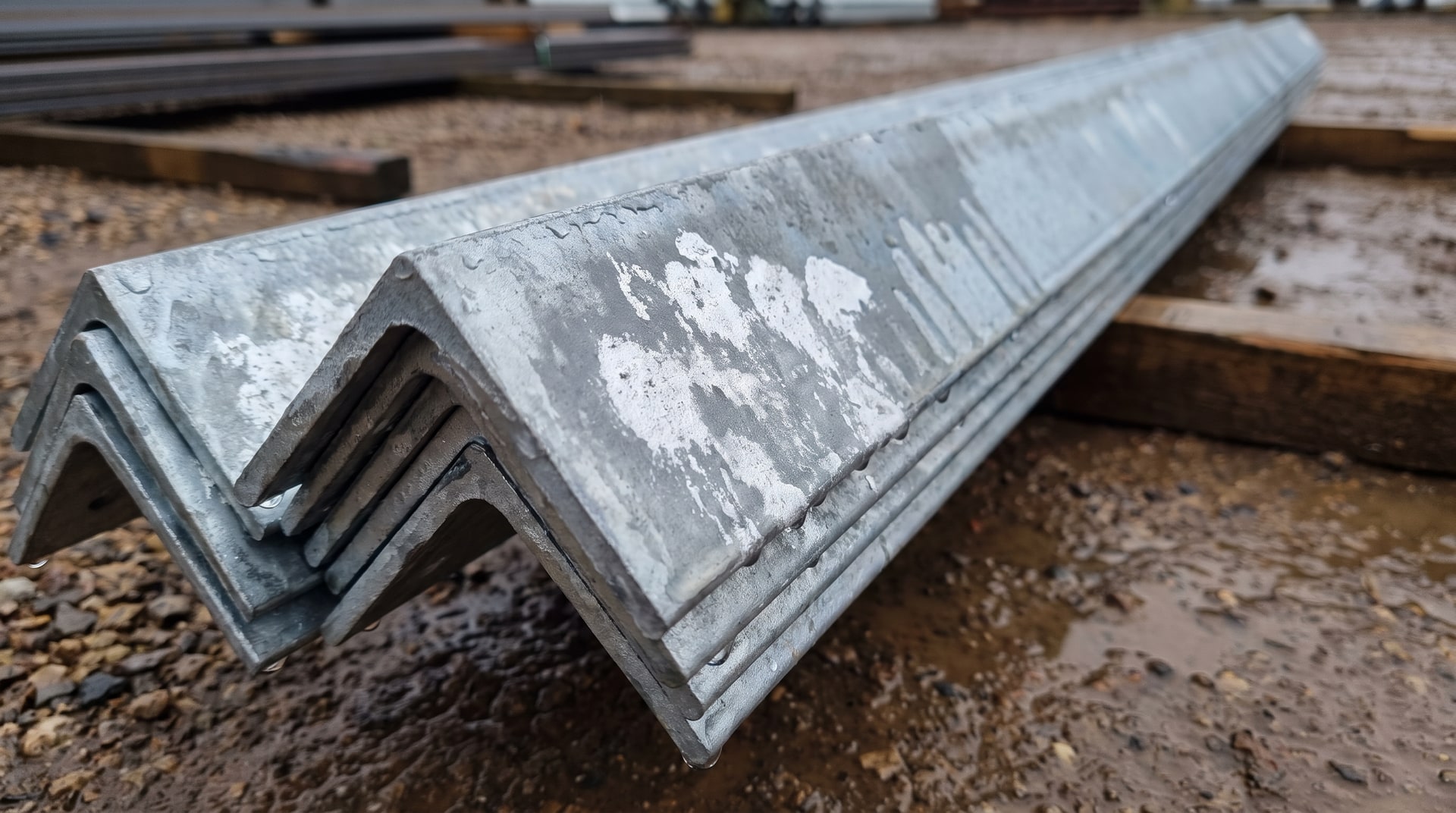
Walk through almost any fabrication yard or steel storage area and you will eventually encounter galvanized material wearing a chalky, white powdery residue on its surface. The instinct is to assume something went wrong, either with the coating process or during transit. In many cases, that white material is wet storage stain, a surface condition that looks alarming but is fundamentally different from the corrosion it superficially resembles. In a smaller number of situations, that white buildup is something else entirely: white rust, a problem with a distinct origin, a distinct chemistry, and a very different set of implications.
The two terms get used interchangeably in the field, sometimes by experienced people who should know better. That confusion matters because the corrective action, the severity of concern, and the underlying mechanism are not the same for both conditions. The American Galvanizers Association addresses this directly in their article on wet storage stain vs. white rust. At V&S Galvanizing, we expand on that foundation to explain what is actually happening at the material level, how moisture and oxygen availability influence zinc behavior, and why this distinction is often misunderstood in the field.
The Chemistry Behind Wet Storage Stain
To understand wet storage stain, you have to understand what freshly galvanized zinc is doing in its early days of life. When steel exits a galvanizing kettle, the outermost layer of the coating is pure zinc. That zinc is reactive and begins forming a passive oxide layer almost immediately on exposure to air. Under normal atmospheric conditions, this process progresses through a predictable sequence: zinc oxide forms first, then zinc hydroxide, and eventually zinc carbonate, which is the stable, tightly adherent patina that gives hot-dip galvanized steel its long-term corrosion resistance.
Wet storage stain disrupts this sequence. The problem begins when moisture, either from rain, condensation, or humidity, becomes trapped between galvanized surfaces that are packed too tightly together. The issue is not the moisture itself but what that moisture does to oxygen availability. When water bridges the gap between two closely spaced zinc surfaces, it creates a localized environment where oxygen is depleted. The zinc cannot complete its normal passivation process because the oxygen supply needed to form a stable oxide is restricted at exactly the points where the surfaces are in close contact or nearly so.
What results is a galvanic cell at those moisture-bridged zones. The oxygen-deficient areas act as anodes and the better-ventilated zinc nearby acts as the cathode. This electrochemical imbalance drives rapid zinc dissolution at the contact points. The zinc that dissolves does not disappear; it recombines with the available hydroxide ions in the moisture film to produce a loose, voluminous zinc hydroxide, which is the white powdery residue we recognize as wet storage stain. Unlike the dense, adherent zinc carbonate patina that protects long-term, this material is porous, weakly bonded to the surface, and offers essentially no barrier protection.
Why Tight Packing and Humid Storage Are the Primary Culprits
The mechanism described above explains why the two most commonly cited causes of wet storage stain, tight packing and humid storage, produce the same outcome through the same pathway. Tight packing creates the geometry that traps moisture and excludes oxygen from forming. Humid storage provides the moisture needed to initiate the cell in the first place. When both conditions are present simultaneously, the problem develops quickly and can cover large surface areas of galvanized material before anyone notices.
Newly galvanized steel is particularly vulnerable because the zinc surface has not yet had time to develop even a partial passive film. An older coating that has already formed stable zinc carbonate in the atmosphere is substantially more resistant to this kind of attack because the patina itself is less reactive. Fresh zinc, by contrast, is still highly reactive, which is precisely why it is so effective as a sacrificial coating long-term but also why it needs careful handling in the period immediately after galvanizing.
Storage orientation matters too. Material bundled horizontally with no separation between pieces creates horizontal pools of standing moisture with nowhere to drain. Vertical racking or the use of spacers to maintain an air gap between pieces allows both moisture drainage and air circulation, which keeps oxygen available at the zinc surface and short-circuits the galvanic cell before it can develop.
Identifying Wet Storage Stain in the Field
Wet storage stain presents as a white, powdery or bulky deposit that is typically concentrated at contact points, bundle ties, or any location where pieces were touching during storage. When you wipe or brush the material away, you will usually find intact zinc beneath it, sometimes slightly dulled but continuous and adhered. The deposit itself is loose and comes away without significant effort.
The distribution pattern is a useful diagnostic. If the white residue appears in geometric patterns that correspond to where pieces were stacked or banded, wet storage stain is the most likely explanation. If it appears uniformly across open, well-ventilated surfaces, something else may be at work. The depth of coating loss, if any, is also informative. Wet storage stain involves only the surface zinc and, in mild cases, does not meaningfully reduce coating thickness at the affected points.
One practical test used in the field is to rub the affected area with a damp cloth. Wet storage stain residue is soft and disperses easily. It is not mechanically bonded to the coating below. This behavior distinguishes it from other surface phenomena that may require abrasive removal or chemical treatment.
White Rust: A Different Problem With a Different History
White rust shares a visual similarity with wet storage stain but its origin and context are entirely different. White rust is specifically associated with galvanized cooling towers, and the story of how it became a recognized problem is instructive on its own terms.
Cooling towers were first galvanized in 1965. For roughly two decades, white rust was not a documented concern. The towers galvanized during that period, and those that remained unaffected later, had one thing in common: they all received a chromate treatment after galvanizing. Chromate passivation creates a thin chemical film on the zinc surface that suppresses early reactivity and allows the zinc to develop its stable protective patina without interference from the aggressive water chemistry typical of cooling tower environments.
In the mid-1980s, tightening environmental regulations eliminated chromate treatments from the galvanizing process. The industry moved away from chromate not because it was ineffective but because its use raised legitimate health and environmental concerns. With chromate gone, newly galvanized cooling towers were exposed to the circulating water in their systems without the protection that chromate had previously provided. White rust appeared and was subsequently identified as basic zinc carbonate.
It is worth pausing on that identification for a moment. Basic zinc carbonate is the same material that constitutes the desirable long-term patina on atmospheric galvanized steel. The difference in the cooling tower context is that the formation conditions, particularly the water chemistry and constant wet exposure, produce it in a form that is bulky and poorly adherent rather than dense and protective. The chemistry is similar; the outcome and the protective value are not.
How Cooling Tower Water Chemistry Drives White Rust Formation
The environment inside a recirculating cooling tower is aggressive in ways that most galvanizing exposures are not. The water is continuously cycled, often warmed, and concentrated through evaporation. Depending on the makeup water quality and treatment regimen, it may carry dissolved minerals, biocides, and other treatment chemicals at elevated concentrations.
The removal of chromate passivation left the fresh zinc surface vulnerable to this environment before it could naturally stabilize. In a well-controlled atmospheric exposure, freshly galvanized zinc has time to form zinc oxide, then progress to zinc carbonate at a pace governed by the ambient carbon dioxide concentration and moisture cycling. In a cooling tower, that orderly progression is overwhelmed by continuous wet contact and a water chemistry that does not favor stable film formation. The result is an uncontrolled and disorganized zinc carbonate precipitation that deposits as a loose, white buildup rather than the tight, adherent film that makes galvanized steel durable.
The practical implication is that white rust in cooling towers is not simply a cosmetic problem. Because it involves active and ongoing zinc consumption under conditions that resist stable passivation, it can represent a genuine reduction in coating service life if not managed. This distinguishes it from mild wet storage stain, which typically involves surface zinc loss that does not significantly impair the coating's protective function.
Prevention Strategies: What Actually Works for Each Condition
Preventing wet storage stain comes down to controlling the two conditions that create it: moisture entrapment and oxygen exclusion. For galvanized material leaving our facility or arriving on a job site, the most effective measures are straightforward. Material should be stored in well-ventilated locations, ideally under cover but with airflow. Pieces should be separated with spacers rather than stacked in direct contact. If outdoor storage is unavoidable, the material should be oriented so that water drains freely rather than pooling at contact surfaces. Temporary covering that traps moisture is frequently worse than no covering at all, since it combines humidity with restricted airflow.
For cooling towers and similar continuously wet industrial applications, the historical answer was chromate treatment, which is no longer available. Modern alternatives include alternative passivation chemistries, modified water treatment programs designed to encourage stable zinc film formation rather than disrupt it, and in some cases, the use of alternative coating systems for the most aggressive zones. The specific approach depends on the water chemistry, the tower design, and the service environment, and it warrants evaluation by someone familiar with industrial water treatment and galvanized coating performance.
For galvanized steel entering service in atmospheric applications, the natural weathering process handles passivation reliably over time. Our team at V&S Galvanizing often reminds customers that the zinc coating on hot-dip galvanized steel is designed for long-term environmental exposure, and once the patina develops, the surface becomes highly stable. The vulnerability window is narrow, concentrated in the period between galvanizing and full atmospheric exposure.
When Wet Storage Stain Requires Attention and When It Does Not
One of the most practical questions engineers and inspectors face is whether wet storage stain on received material constitutes a defect that requires remediation. The answer depends on the extent and depth of the staining and the coating thickness that remains after it is removed.
Light wet storage stain that brushes away to reveal continuous, adequately thick zinc beneath is generally not a functional problem. The zinc that was lost to form the stain was consumed, but if the remaining coating meets specification requirements, the material is still serviceable. In many cases, the affected areas will weather and develop patina normally once exposed to the atmosphere.
Heavier staining that involves significant coating loss, particularly if it reduces thickness below the minimum required by the applicable specification, is a different matter. In those situations, touch-up or repair of the affected areas may be necessary before the material is put into service. The relevant question is always the thickness and continuity of the remaining zinc, not the presence of the white residue itself.
Inspection after removing wet storage stain typically involves magnetic thickness measurements at the affected locations to confirm that adequate zinc remains. If coating thickness is within acceptable limits and the zinc surface beneath the stain is intact, the material can generally proceed to use without further treatment beyond normal weathering.
Work With a Team That Understands Zinc Surface Behavior
Distinguishing wet storage stain from white rust, and understanding what each condition means for the performance of a galvanized coating, is the kind of knowledge that prevents unnecessary rejection of serviceable material and ensures that genuinely compromised coatings get the attention they need. These are not academic distinctions. They affect procurement decisions, inspection outcomes, project schedules, and long-term asset performance.
At V&S Galvanizing, our team works with engineers, fabricators, and contractors who rely on us not just to apply a coating but to help them understand it. Whether you are evaluating material that arrived with surface discoloration, specifying storage requirements for freshly galvanized components, or planning a project where cooling tower or continuously wet exposure is involved, we can help you work through what the zinc surface is telling you and what, if anything, needs to be done about it. Reach out to us through our contact page to discuss your project or ask a technical question directly.
Frequently Asked Questions About Wet Storage Stain and White Rust on Galvanized Steel
Is wet storage stain the same thing as white rust?
No. Wet storage stain is a white zinc oxide and zinc hydroxide deposit that forms on newly galvanized steel when moisture becomes trapped between tightly packed pieces, restricting oxygen and triggering a localized galvanic reaction. White rust is specifically associated with galvanized cooling towers and has been identified as basic zinc carbonate. The two conditions share a similar appearance but have different causes, different contexts, and different implications for coating performance.
Does wet storage stain mean the galvanized coating has failed?
Not necessarily. Light wet storage stain is a surface condition that can form on fully compliant galvanized coatings under unfavorable storage conditions. The critical question is whether adequate zinc thickness remains after the stain is removed. If the coating beneath the stain is continuous and meets specification thickness requirements, the material is generally still serviceable and will weather normally once put into atmospheric service.
Why did white rust become a problem in cooling towers only after the mid-1980s?
Cooling towers have been galvanized since 1965, but white rust was not documented as a problem until 1986. The difference is that towers galvanized before the mid-1980s received a chromate treatment after galvanizing, which suppressed the early reactivity of the zinc surface and allowed stable passivation to develop. When environmental regulations eliminated chromate treatments in the mid-1980s, freshly galvanized cooling towers were exposed to aggressive recirculating water without that protective chemical film, and white rust developed as a result.
What is white rust chemically, and how does it differ from the normal zinc patina?
White rust has been identified as basic zinc carbonate, which is chemically similar to the stable patina that forms on galvanized steel after normal atmospheric exposure. The difference is structural and functional. The long-term atmospheric patina is dense, tightly adherent, and protective. The white rust found in cooling tower environments is bulky, loosely adherent, and porous, offering little barrier protection. The formation conditions, specifically continuous wet contact with aggressive water chemistry, produce a disorganized deposit rather than the ordered protective film that develops in atmospheric service.
How do you prevent wet storage stain on freshly galvanized steel?
The key is preventing moisture from becoming trapped between zinc surfaces while also ensuring adequate oxygen is available at the zinc surface during the early passivation period. Practical measures include storing material with spacers or separators to maintain air gaps between pieces, ensuring storage locations are well-ventilated, orienting material so water drains freely rather than pooling at contact points, and avoiding covers that trap humidity without allowing airflow. These measures are particularly important in the days immediately after galvanizing when the zinc surface is most reactive.
Can wet storage stain be removed, and what does the zinc surface look like underneath?
Yes. Wet storage stain is loosely bonded to the zinc surface and can typically be removed with a stiff brush or light mechanical cleaning. In mild cases, the zinc beneath is intact and continuous, sometimes appearing slightly dulled compared to unaffected areas. After cleaning and exposure to the atmosphere, the surface will continue its normal passivation and eventually develop the standard zinc carbonate patina. Heavier staining may involve more measurable zinc loss, which is why coating thickness should be verified after cleaning in significant cases.
At what point does wet storage stain become a rejection criterion?
Wet storage stain itself is not a direct rejection criterion; the condition of the zinc beneath it is. If cleaning the stain reveals that coating thickness has fallen below the minimum required by the applicable specification, that coating loss is the basis for rejection or repair, not the presence of the white residue. Magnetic thickness measurements at affected locations after cleaning are the standard way to evaluate whether the remaining zinc meets specification requirements.
Is newly galvanized steel more vulnerable to wet storage stain than older galvanized steel?
Yes, significantly. Freshly galvanized zinc is highly reactive and has not yet developed the stable passive film that protects mature galvanized coatings. Once zinc carbonate patina has formed through normal atmospheric exposure, the surface becomes far more resistant to the conditions that cause wet storage stain. The vulnerability is concentrated in the period between galvanizing and full atmospheric stabilization, which is why storage conditions immediately after galvanizing are so important.
