

When a steel component cannot be submerged in a galvanizing kettle, or when a section of galvanized steel has been cut, welded, or damaged in the field, corrosion protection still has to be restored. One of the most established methods for doing exactly that is zinc spray, also called metallizing. It is a process that has been in use for decades, and while it is often described as a repair technique, it is also applied as a primary coating in situations where hot-dip galvanizing is not practical. Understanding how it works, what it produces, and what its limitations are is important for anyone specifying or inspecting zinc-coated steel.
The American Galvanizers Association addresses this directly in their article on zinc spray. At V&S Galvanizing, we expand on that foundation to explain what is actually happening at the material level, how coating thickness and application method influence performance, and why this process is often misunderstood in the field when compared to conventional hot-dip galvanizing.
What Zinc Spray Actually Is
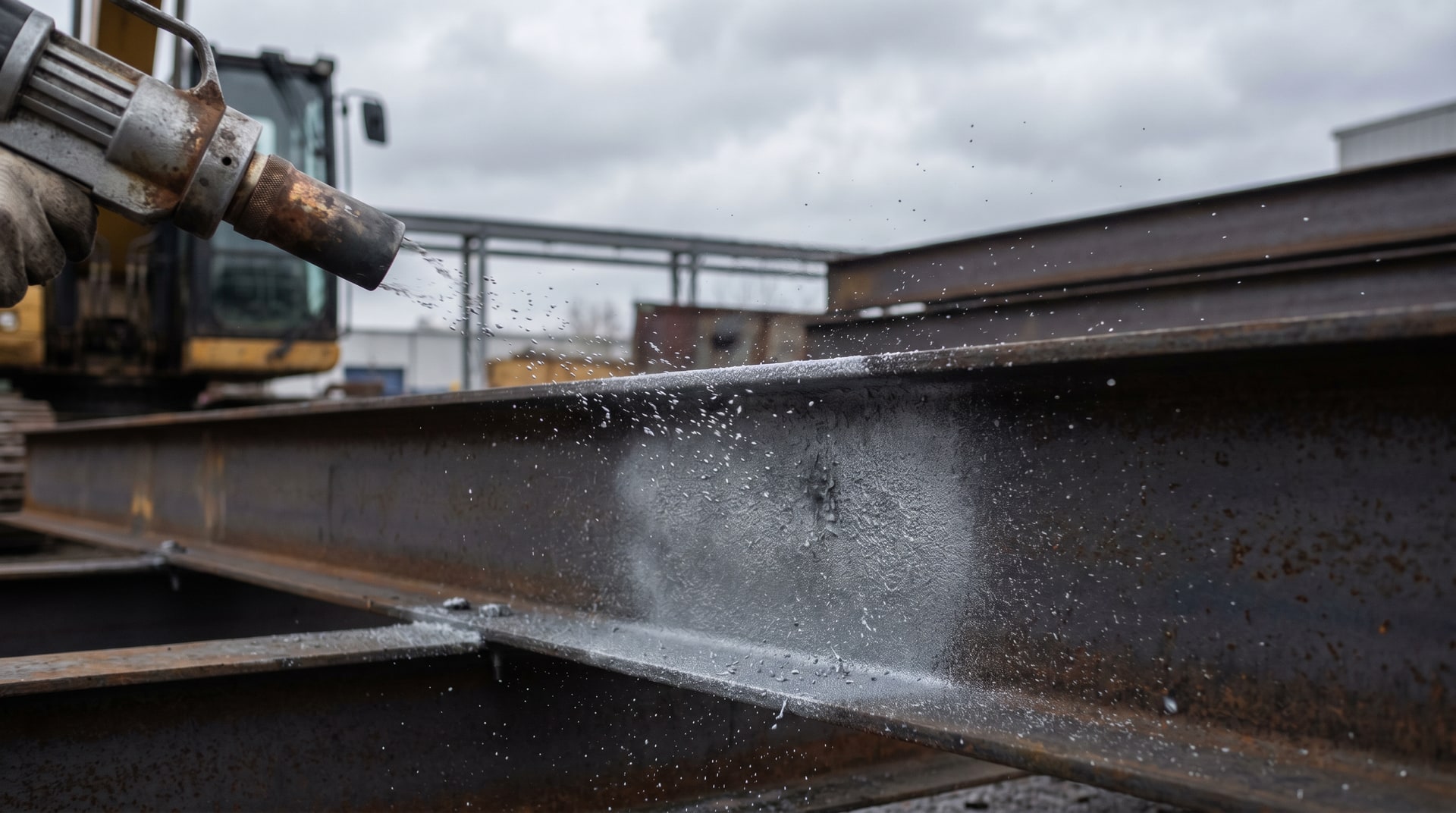
Zinc spray metallizing involves melting zinc, either in powder or wire form, and then projecting the resulting molten droplets onto a prepared steel surface using a carrier medium of compressed air or gas. The zinc used in this process is nominally 99.5% pure or better, which puts it on par with the zinc chemistry used in hot-dip galvanizing baths.
Two heat sources are commonly used to melt the zinc before application. In flame spray systems, a combustion flame (typically fed by oxygen and a fuel gas) melts the zinc wire or powder as it feeds through the spray gun. In electric arc spray systems, two zinc wires are fed simultaneously toward a central point where an electric arc is struck between them, generating the heat needed to melt the tips of both wires. The molten material is then atomized and propelled onto the steel surface by a stream of compressed air.
The result in both cases is a layered deposit of overlapping zinc splats that cool and solidify on contact with the steel. That layered structure is physically distinct from a hot-dip galvanized coating, and it has real implications for both how the coating performs and how it should be measured.
The Corrosion Protection Mechanism
Despite the difference in application method, the corrosion protection mechanism behind zinc spray is the same as that behind hot-dip galvanizing. Zinc is anodic relative to steel in most natural environments, meaning zinc will corrode sacrificially before the underlying steel is attacked. As the zinc coating oxidizes, it forms stable zinc corrosion products, primarily zinc carbonate, that act as a physical barrier and slow further zinc consumption. This combination of sacrificial protection and barrier protection is what makes zinc coatings so durable in outdoor and industrial environments.
The AGA notes that the corrosion resistance of a metallized zinc coating is approximately equal to that of a hot-dip galvanized coating. That equivalence holds because the purity and chemistry of the zinc itself drives the electrochemical protection, not the specific method used to apply it. Given equal thickness, both coatings will provide comparable service life in a given environment. What changes between the two processes is the coating structure, the adhesion mechanism, and how the coating responds to certain site conditions.
How Metallized Zinc Differs From Hot-Dip Galvanizing Structurally
In hot-dip galvanizing, the steel is immersed in molten zinc and a series of iron-zinc alloy layers form through a metallurgical reaction at the steel surface. These intermetallic layers bond to the steel at the atomic level. The outermost layer is relatively pure zinc, and the whole coating is essentially a single continuous metallurgical system.
A metallized zinc coating does not form intermetallic alloy layers. Instead, the molten zinc droplets strike the steel surface, flatten, cool rapidly, and mechanically interlock with the substrate. The adhesion is largely mechanical rather than metallurgical. This is not a weakness in the context of corrosion protection, but it does mean the two coatings behave differently under mechanical stress. It also means that surface preparation is especially critical for metallizing: the steel surface must be clean and have enough surface profile (roughness) for the droplets to anchor properly. Inadequate blasting or contamination will compromise adhesion in ways that are far less likely to occur with hot-dip galvanizing, where the immersion itself and the chemical flux process promote bonding.
The layered, slightly porous structure of a metallized coating also means it can benefit from a sealer applied over the zinc. Many specifiers use a thin coat of vinyl or other penetrating sealer immediately after metallizing to fill the voids in the zinc layer before significant oxidation occurs. This is not always required, but in aggressive environments it extends the effective service life of the metallized system.
Where Metallizing Fits Into the Repair Workflow
For galvanized steel that is already in service or has just come out of fabrication, zinc spray is one of the primary tools for restoring corrosion protection to areas where the original hot-dip coating has been compromised. Welding burns through the zinc coating and creates a heat-affected zone where the zinc has volatilized or partially alloyed in ways that compromise protection. Cutting and drilling produce bare steel edges. Field modifications, mechanical damage, or abrasion during erection can all strip the coating locally.
In all of these situations, the question becomes how much zinc needs to be replaced and how. Zinc spray is well-suited for larger repair areas where a paint-on zinc-rich compound would be applied in an inconvenient number of coats to reach the required thickness, or where the repair area is large enough that the self-healing capacity of the surrounding zinc cannot be relied upon to protect the bare steel through sacrificial action alone.
The AGA's guidance on repair specifies that the renovated area must carry a zinc coating thickness at least as thick as what ASTM A123/A123M requires for the thickness grade applicable to the material category being repaired. This is not a suggestion; it is a performance threshold. If the repair coating is thinner than the original specification, the repaired area will have a shorter service life than the surrounding galvanized steel, which defeats the purpose of the repair.
ASTM A123/A123M and Thickness Compliance
ASTM A123/A123M is the governing specification for hot-dip galvanized coatings on iron and steel products, and it establishes minimum average coating thickness requirements based on the steel thickness category and material type. When zinc spray is used as a repair or replacement coating, the same thickness grades apply. The renovated surface is held to the same minimum as the original galvanized coating would have been.
This matters for a practical reason. Zinc spray coatings can be built up in multiple passes, and a skilled applicator can achieve the required thickness reliably. But because the coating is applied by hand with a spray gun rather than by controlled immersion, uniformity across a surface is more variable than with hot-dip galvanizing. An applicator who does not understand the thickness requirements or who does not take measurements during application can produce a coating that looks adequate visually but does not meet the A123 minimum in thin spots.
This is why the AGA specifies that thickness measurements for metallized coatings should be taken with either a magnetic or electromagnetic gauge. These instruments measure the distance between the gauge probe and the steel substrate beneath the coating, which translates directly to coating thickness. They are non-destructive and appropriate for use in the field. Visual assessment alone is not a substitute.
Measurement in Practice: Magnetic and Electromagnetic Gauges
Coating thickness measurement is a routine part of galvanizing inspection, and the same instruments used for hot-dip galvanized steel apply to metallized zinc coatings. Magnetic pull-off gauges use a calibrated spring to measure the force required to pull a permanent magnet away from the coated surface. The thicker the coating, the weaker the magnetic attraction and the less force required, which corresponds to a measurable thickness reading.
Electromagnetic (eddy current or magnetic induction) gauges use a probe that generates a magnetic field. When held against the coated surface, the instrument reads the variation in that field caused by the underlying steel, and converts that variation into a coating thickness value. These gauges are faster for multi-point inspections and are widely used in both shop and field environments.
For metallized coatings specifically, it is worth noting that the slightly porous, layered structure of the coating does not significantly affect the accuracy of either gauge type. The instruments measure total coating depth from probe to substrate, regardless of how that depth was built up. What does matter is calibration: gauges should be calibrated on the same material type (carbon steel vs. stainless, for example) as the part being measured, and readings should be taken at multiple points distributed across the repair area, not just at the center.
When to Specify Zinc Spray vs. Zinc-Rich Paint
Zinc-rich paint (also called zinc-rich compound or organic zinc repair compound) is the other common repair option for damaged galvanized steel. Both have their place, and understanding which to use requires thinking about the area being repaired, the environment, and the access available to the applicator.
Zinc-rich paints are simpler to apply and require no specialized equipment. They are appropriate for small repairs, touch-ups on minor abrasion damage, and situations where the surrounding zinc coating can provide supplemental sacrificial protection to the repair zone. Because zinc-rich paints contain zinc dust in a binder rather than pure deposited zinc, their zinc content and conductivity are lower than a metallized coating, which affects the degree of electrochemical protection they provide.
Zinc spray is the stronger technical choice for larger repair areas, for environments where corrosion pressure is high, and for situations where a coating thickness equivalent to the original A123 specification is required. A metallized coating can be applied to a much greater thickness than zinc-rich paint in a reasonable number of passes, and its pure zinc content provides more reliable electrochemical performance. The tradeoff is that metallizing requires specialized equipment, more thorough surface preparation, and a more skilled applicator.
Surface Preparation: The Non-Negotiable Step
No zinc spray application will perform as intended without proper surface preparation, and the preparation required for metallizing is more demanding than what is needed for zinc-rich paint. The steel surface must be abrasive blast cleaned to a near-white or white metal finish before application. This serves two purposes: it removes rust, mill scale, and any remaining zinc from the original coating that might interfere with adhesion, and it creates the surface profile that the molten zinc droplets need to mechanically interlock with the substrate.
A surface that has been blast cleaned but then allowed to oxidize before metallizing is applied will produce a coating with compromised adhesion. The window between blasting and metallizing should be kept as short as possible, particularly in humid environments where flash rusting can occur within minutes. In practice, this means metallizing equipment and blast equipment should be set up together and the sequence should move quickly from one step to the next without interruption.
For work coming through a galvanizing plant like ours, this sequencing is manageable in a controlled shop environment. For field repairs on structures already in service, the logistics of bringing blast and spray equipment to the same location at the same time require planning. Shortcuts in surface preparation are the most common cause of metallized coating failure in the field, which is why they deserve explicit attention in any repair specification.
Work With a Team That Understands the Full Zinc Coating System
Zinc spray metallizing is a technically sound and well-established method for both primary coating and field repair of steel. When the zinc is pure, the surface preparation is thorough, the coating is applied to the correct thickness, and measurement is performed with the right instruments, the corrosion protection produced is equivalent to that of a hot-dip galvanized system. The AGA's guidance on this process is clear, and the ASTM A123/A123M thickness requirements provide a measurable standard against which any repair coating can be evaluated.
At V&S Galvanizing, we work with engineers, fabricators, and contractors to ensure that every step of the zinc coating process, whether it happens in our plant or in the field, meets the specifications that the project requires. If you have questions about repair methods, inspection requirements, or whether zinc spray is the right solution for a specific application, reach out through our contact page and our team will work through the details with you.
Frequently Asked Questions About Zinc Spray Metallizing
Is the corrosion protection from zinc spray metallizing as good as hot-dip galvanizing?
Yes, according to the AGA, the corrosion resistance of a metallized zinc coating is approximately equal to that of a hot-dip galvanized coating when comparable thicknesses are applied. Both rely on the same electrochemical mechanism: zinc corrodes sacrificially to protect the underlying steel. The zinc purity used in metallizing, nominally 99.5% or better, is equivalent to what is used in hot-dip galvanizing. Differences in coating structure do not meaningfully change the corrosion protection outcome at equivalent thickness.
What thickness does a zinc spray repair coating need to meet?
The repaired area must have a zinc coating thickness at least as thick as what ASTM A123/A123M requires for the applicable thickness grade and material category. This means the repair is held to the same minimum as the original specification for that piece of steel, not a reduced standard. Applying a thinner coating in a repair area results in a shorter service life for that zone compared to the surrounding galvanized steel.
What instrument should be used to measure a metallized zinc coating?
The AGA specifies that thickness measurements for metallized coatings should be taken with either a magnetic or electromagnetic gauge. Both types measure coating thickness non-destructively by detecting the distance between the gauge probe and the steel substrate. Multiple readings distributed across the repair area are needed to identify thin spots, since metallized coatings are more variable in thickness than immersion-applied coatings.
Why does surface preparation matter more for metallizing than for zinc-rich paint?
A metallized coating adheres mechanically: the molten zinc droplets interlock with the roughness created by abrasive blasting. Without adequate surface profile and cleanliness, that mechanical bond does not form properly. Zinc-rich paint, by contrast, uses a resin binder that can achieve adhesion on a somewhat less aggressive surface profile. For metallizing, near-white or white metal blast cleaning is required, and the coating must be applied before flash rusting occurs.
Can zinc spray be used as a primary coating, or is it only for repairs?
Zinc spray can function as a primary protective coating, not just a repair medium. It is particularly useful when a steel component is too large for a galvanizing kettle, when the structure is already in place and cannot be moved, or when other constraints make hot-dip galvanizing impractical. In those cases, metallizing applied to the correct thickness provides equivalent corrosion resistance to a hot-dip system.
Does the porous structure of a metallized coating affect its performance?
The slightly porous, layered structure of a metallized coating means it can benefit from a penetrating sealer applied immediately after the zinc is sprayed, particularly in aggressive environments. The sealer fills voids in the zinc layer before significant oxidation begins, extending service life. However, the porosity does not prevent the coating from functioning as a corrosion barrier and sacrificial anode, and for many applications an unsealed metallized coating performs adequately at the required thickness.
How does zinc spray compare to zinc-rich paint for field repair of galvanized steel?
Zinc spray produces a higher-purity zinc deposit and can be built up to greater thickness than zinc-rich paint, making it the preferred choice for larger repair areas or environments with high corrosion pressure. Zinc-rich paint is simpler to apply and appropriate for small, localized damage where the surrounding galvanized zinc can assist through sacrificial protection. For repairs where meeting the full A123 thickness minimum is required, zinc spray is the more reliable technical solution.
What zinc purity is used in zinc spray metallizing?
The zinc used in metallizing is nominally 99.5% pure or better. This is the same purity standard used in hot-dip galvanizing, which is one reason the corrosion performance of the two coating types is considered approximately equal at equivalent thicknesses.
