

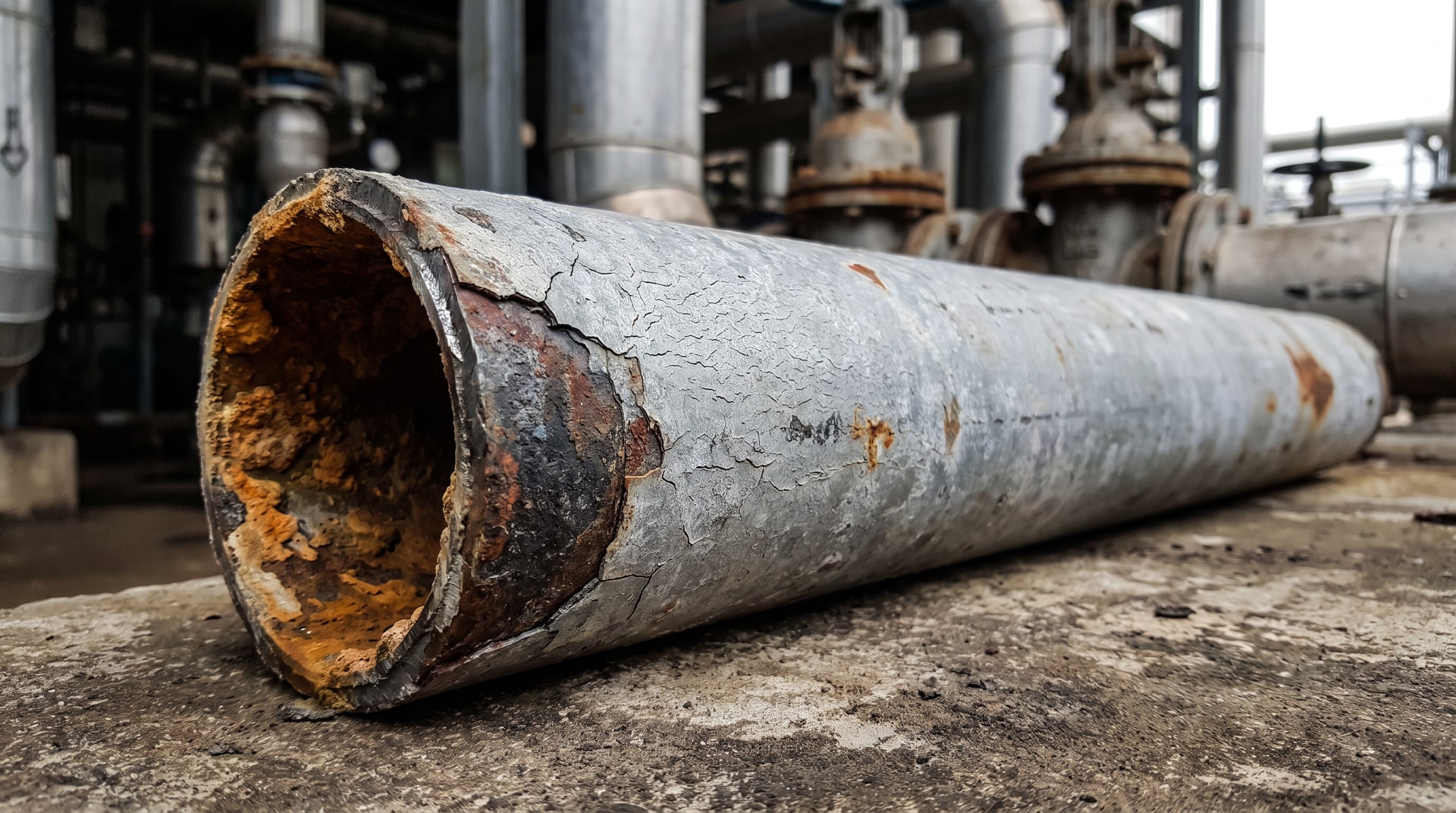
Few misconceptions in the corrosion protection industry are as persistent as the idea that galvanized steel cannot be used in any high-temperature environment. The specific claim usually sounds something like this: once the temperature exceeds 140°F (60°C), the zinc coating "reverses polarity" and starts corroding the steel it was supposed to protect. It gets passed around in specifications, conversations on job sites, and occasionally even in engineering reviews. The problem is that the statement, taken as a blanket rule, is simply not accurate.
Polarity reversal is a real electrochemical phenomenon, but it is not triggered by heat alone. It requires a very particular combination of conditions, and those conditions are far more specific than "any environment above 140°F." Understanding the actual mechanism is what separates informed engineering decisions from reflexive, overly conservative specifications that unnecessarily limit the use of a highly effective coating system.
The American Galvanizers Association addresses this directly in their article on polarity reversal in hot-dip galvanized steel. At V&S Galvanizing, we expand on that foundation to explain what is actually happening at the material level, how water chemistry influences the electrochemical behavior of zinc, and why this effect is so frequently overgeneralized in the field.
Where the Misconception Comes From
The origin of this misunderstanding traces back to a genuine failure mode discovered in residential and commercial hot water heaters. Hot-dip galvanized tanks were failing prematurely, sometimes within just a few years of installation, through the development of leaks. When investigators examined the failed units, they found cracking in the zinc coating and significant depletion of the underlying steel material beneath those cracks. The zinc appeared to be largely intact in places while the steel had corroded away, which was the opposite of how galvanic protection is supposed to work.
This was a legitimate engineering problem. The response, however, was a generalization that has caused confusion ever since. Because the failure happened in a hot water application, the conclusion drawn by many was that heat above 140°F was the culprit. Laboratory work quickly complicated that story. When researchers simply heated galvanized steel to those same temperatures in air, nothing unusual happened to the coating. The heat alone was not the issue.
The Role of Water Chemistry in Triggering Reversal
What the lab work revealed was that immersion in specific types of water at elevated temperatures was the actual precondition. When galvanized steel was submerged in soft water heated to the 140 to 180°F (60 to 82°C) range, the coating cracked and the steel beneath those cracks corroded preferentially. The zinc, rather than sacrificing itself to protect the steel, had effectively flipped roles and was being protected at the steel's expense.
The electrochemical explanation comes down to ionic content. In a water solution, the relative electrical potential of zinc compared to steel determines which metal acts as the anode (the one that corrodes) and which acts as the cathode (the one that is protected). Under normal conditions, zinc sits at a more negative electrochemical potential than steel, making it anodic. This is the whole basis of galvanic protection: the zinc corrodes slowly and sacrificially while the steel remains intact.
Dissolved oxygen, bicarbonate ions, and nitrate ions change that balance. Their presence causes the electrochemical potential of zinc to shift in the positive direction. The steel's potential does not shift in the same way, so the gap narrows and eventually inverts. Zinc becomes cathodic, steel becomes anodic, and the steel begins to corrode in order to protect the zinc. This is polarity reversal in its electrochemical sense.
Ions That Drive the Effect Versus Ions That Prevent It
Not all dissolved ions behave the same way in this context, and understanding the difference is critical to evaluating whether any given water application poses a risk.
Bicarbonates and nitrates are the problematic species. Their presence in solution elevates zinc's electrochemical potential relative to steel, increasing the likelihood of reversal. Soft water tends to carry meaningful concentrations of dissolved oxygen and relatively low concentrations of chlorides and sulfates, which makes it the more dangerous medium when heated.
Chlorides and sulfates behave in the opposite direction. Rather than driving zinc's potential upward, they push it lower, reinforcing zinc's natural anodic relationship with steel. Hard water, by definition, contains higher concentrations of these ionic salts, along with bicarbonates. So hard water presents a mixed picture: the chlorides and sulfates work against reversal while the bicarbonates work in its favor. Whether reversal ultimately occurs in hard water at elevated temperatures depends on the relative concentrations and the temperature of the solution.
Soft water, which is low in chlorides and sulfates but high in dissolved oxygen, is the most favorable environment for polarity reversal to develop. This is consistent with the original hot water heater failures, which occurred in regions with soft water supply.
Temperature as an Accelerant, Not a Root Cause
Temperature plays an important but secondary role in polarity reversal. It does not initiate the effect by itself. What it does is control how quickly the reversal manifests once the other chemical preconditions are present.
At temperatures just above 140°F (60°C) in a water solution that contains the necessary ions, the reversal may take approximately a month to appear. At temperatures approaching 180°F (82°C), that same reversal can develop in a matter of hours. The temperature compresses the timeline dramatically, but only because the ionic chemistry is already in place to enable the phenomenon.
This distinction has real engineering consequences. A galvanized component exposed to water at 150°F that lacks dissolved oxygen or bicarbonate ions is not at risk of polarity reversal. A galvanized component exposed to soft water at 160°F with dissolved oxygen and bicarbonate content is at meaningful risk, and that risk increases significantly if the temperature climbs toward 180°F.
The Four Conditions That Must All Be Present
Polarity reversal is not a probabilistic phenomenon with a continuous risk gradient. It is a conditional one. All four of the following must be true simultaneously for the effect to occur:
The galvanized component must be in direct contact with a water solution. Polarity reversal does not occur in dry heat, in air, in atmospheric exposure, or in non-aqueous environments. Second, the water must contain dissolved oxygen. Deaerated water or oxygen-depleted solutions show no sign of the reversal. Third, the water must contain bicarbonate or nitrate ions. Without one of these species, the necessary shift in zinc's electrochemical potential does not occur. Fourth, the temperature of the solution must fall within the range of 140 to 180°F (60 to 82°C).
Remove any one of these conditions and the mechanism breaks down. This is why the broad generalization that galvanized steel cannot be used above 140°F is so misleading. Elevated temperature is one of four required factors, and in isolation it carries no special risk.
What This Means for Real-World Applications
For the vast majority of high-temperature applications, polarity reversal is simply not a relevant concern. Galvanized steel used in elevated-temperature structural applications, exhaust environments, industrial process areas, or outdoor environments exposed to solar heat does not meet the conditions required for polarity reversal. None of those scenarios involve prolonged immersion in soft water with dissolved oxygen and bicarbonate ions.
The applications that genuinely warrant scrutiny are those involving potable or process water storage and distribution at elevated temperatures. Hot water tanks, galvanized pipes carrying heated soft water, and similar equipment where the combination of immersion, soft water chemistry, dissolved oxygen, and operating temperatures above 140°F all coexist deserve careful evaluation. In those specific cases, the selection of a galvanized coating requires a more detailed review of the water chemistry to determine whether the ionic composition of the water supply could trigger reversal.
In regions with predominantly hard water, the risk is lower because the chlorides and sulfates in the water work against the reversal mechanism. In regions with very soft water, the risk is higher and should factor into material selection for heated water containment.
How Galvanized Coatings Behave in Other High-Temperature Environments
It is worth clarifying what does happen to zinc coatings at elevated temperatures outside of the polarity reversal scenario, because performance changes are real even when reversal is not a factor.
At temperatures above roughly 390°F (200°C), the zinc-iron intermetallic layers that form during the galvanizing process begin to grow more rapidly. Sustained exposure at elevated temperatures can eventually cause the outer free-zinc layer to diffuse further into the alloy layers, changing the coating structure and appearance. At very high continuous temperatures, this can reduce the practical service life of the coating. However, this is a separate phenomenon from polarity reversal and involves entirely different mechanisms. It is not an electrochemical effect driven by water chemistry.
For structures operating in high-temperature atmospheric conditions, say near industrial heat sources or in desert climates with extreme solar loading, the zinc coating continues to provide its standard corrosion protection without polarity reversal being a relevant concern. The coating may experience accelerated weathering in aggressive atmospheric environments, but that is governed by pollution levels, humidity, and atmospheric chemistry rather than temperature alone.
Work With a Team That Understands Coating Performance in Depth
Polarity reversal is one of the more nuanced topics in hot-dip galvanizing, not because the mechanism is complicated, but because the misapplication of the concept is so widespread. The key takeaway is precise: polarity reversal is a real effect, it has a specific electrochemical explanation, and it occurs only when all four of its preconditions are met simultaneously. Elevated temperature alone is not sufficient to trigger it. Immersion in soft water with dissolved oxygen and bicarbonate ions is required, and the effect is strongly influenced by how close the temperature is to the upper end of the 140 to 180°F range.
For engineers and fabricators specifying galvanized coatings for applications involving heated water, that means doing a chemistry evaluation of the water source rather than defaulting to a blanket prohibition. For everyone else specifying galvanized steel in elevated-temperature environments that do not involve this specific combination of conditions, the concern is not applicable.
At V&S Galvanizing, we work alongside engineers, fabricators, and contractors who need technically grounded answers, not oversimplified rules. If you are evaluating whether hot-dip galvanizing is appropriate for a specific application or environment, our team can help you work through the relevant variables. Reach out through our contact page to start that conversation.
Frequently Asked Questions About Polarity Reversal in Galvanized Steel
Does polarity reversal happen in any hot-dip galvanized steel exposed to temperatures above 140°F?
No. Temperature alone does not cause polarity reversal. The effect requires simultaneous immersion in water that contains dissolved oxygen and bicarbonate or nitrate ions at temperatures between 140 and 180°F (60 to 82°C). A galvanized steel component exposed to dry heat, atmospheric conditions, or even warm water that lacks these specific ions will not experience polarity reversal.
What specific ions are responsible for triggering polarity reversal?
Dissolved oxygen is a necessary precondition, and the presence of bicarbonate or nitrate ions significantly increases the risk. These species cause the electrochemical potential of zinc to shift upward relative to steel, narrowing and eventually inverting the normal anodic relationship that gives zinc its protective function.
Why does soft water carry more risk than hard water for polarity reversal?
Soft water typically has higher dissolved oxygen content and lower concentrations of chlorides and sulfates. Chlorides and sulfates actually suppress polarity reversal by keeping zinc's electrochemical potential low relative to steel. Hard water contains these ions in greater concentrations, which provides a degree of protection against reversal, even though hard water also contains bicarbonates that work in the opposite direction.
How quickly does polarity reversal develop once the conditions are present?
Temperature determines the rate. At temperatures just above 140°F (60°C) with the necessary water chemistry present, the reversal may take approximately one month to manifest. At temperatures close to 180°F (82°C), the reversal can develop within a few hours. This is why the upper end of the temperature range is significantly more dangerous than the lower threshold.
Does removing dissolved oxygen from the water prevent polarity reversal?
Yes. Water solutions that do not contain dissolved oxygen show no signs of polarity reversal regardless of bicarbonate or nitrate content. This is consistent with the electrochemical mechanism: dissolved oxygen is a required participant in the ionic shift that elevates zinc's potential above that of steel.
Is polarity reversal the same thing as the general degradation of zinc coatings at high temperatures?
No, these are separate phenomena. Polarity reversal is a specific electrochemical effect that occurs in heated water with particular ionic chemistry. General thermal degradation of zinc coatings, such as the accelerated growth of zinc-iron intermetallic layers at sustained temperatures above roughly 390°F (200°C), involves entirely different mechanisms and is not driven by water chemistry.
What types of applications should engineers evaluate most carefully for polarity reversal risk?
The primary concern is heated water containment and distribution, particularly hot water tanks and piping systems that operate in the 140 to 180°F range and are supplied by soft water sources with meaningful dissolved oxygen and bicarbonate content. Structural applications, atmospheric exposures, and non-aqueous high-temperature environments do not present polarity reversal risk.
Can polarity reversal be avoided by changing water chemistry rather than switching coating materials?
In principle, yes. Eliminating dissolved oxygen from the water, or increasing chloride and sulfate content relative to bicarbonate content, would reduce or eliminate the conditions necessary for reversal. In practice, water chemistry modification in potable water systems is constrained by regulatory and operational factors, so material selection decisions often need to account for the existing water chemistry rather than assuming it can be adjusted.
