
When a steel fabrication leaves a galvanizing bath, the question that follows quickly is: how much zinc actually went onto that part? That question matters because the zinc coating is the entire basis of the corrosion protection. Too thin, and the steel won't reach its intended service life. Too thick in critical areas, and dimensional tolerances or fit-up on assemblies can become a concern. Coating weight is the metric that answers this question at a fundamental level, expressing the mass of zinc deposited per unit of surface area rather than a simple linear thickness measurement.
The American Galvanizers Association addresses this directly in their article on coating weight. At V&S Galvanizing, we expand on that foundation to explain what is actually happening at the material level, how measurement method selection influences what the numbers represent, and why this is often misunderstood in the field.
What Coating Weight Actually Represents
Coating weight is defined as the mass of hot-dip galvanized coating applied to a product for a given surface area. That phrasing is precise and worth unpacking. It is not simply a measure of how many ounces of zinc went into the kettle, nor is it the same as a thickness reading taken by a magnetic gauge at a single point. Coating weight is a surface-density value, typically expressed in units like ounces per square foot (oz/ft²) or grams per square meter (g/m²), and it describes the average zinc contribution across the full surface being evaluated.
This distinction matters in practice because steel surfaces are not perfectly uniform. The metallurgical interaction between zinc and steel during hot-dip galvanizing produces a layered alloy structure, and the thickness of that structure varies based on steel chemistry, surface geometry, immersion time, bath temperature, and withdrawal rate. Coating weight captures the net result of all those variables as a mass-per-area figure, which is why it is used as the basis for comparing against specification requirements.
The Two Recognized Measurement Methods
There are exactly two methods recognized for measuring coating weight on hot-dip galvanized steel, and each serves a specific purpose with specific limitations. Neither is a field technique in the conventional sense. Both are laboratory procedures suited to single specimen samples, and understanding why they exist as separate approaches is essential for anyone writing or interpreting galvanizing specifications.
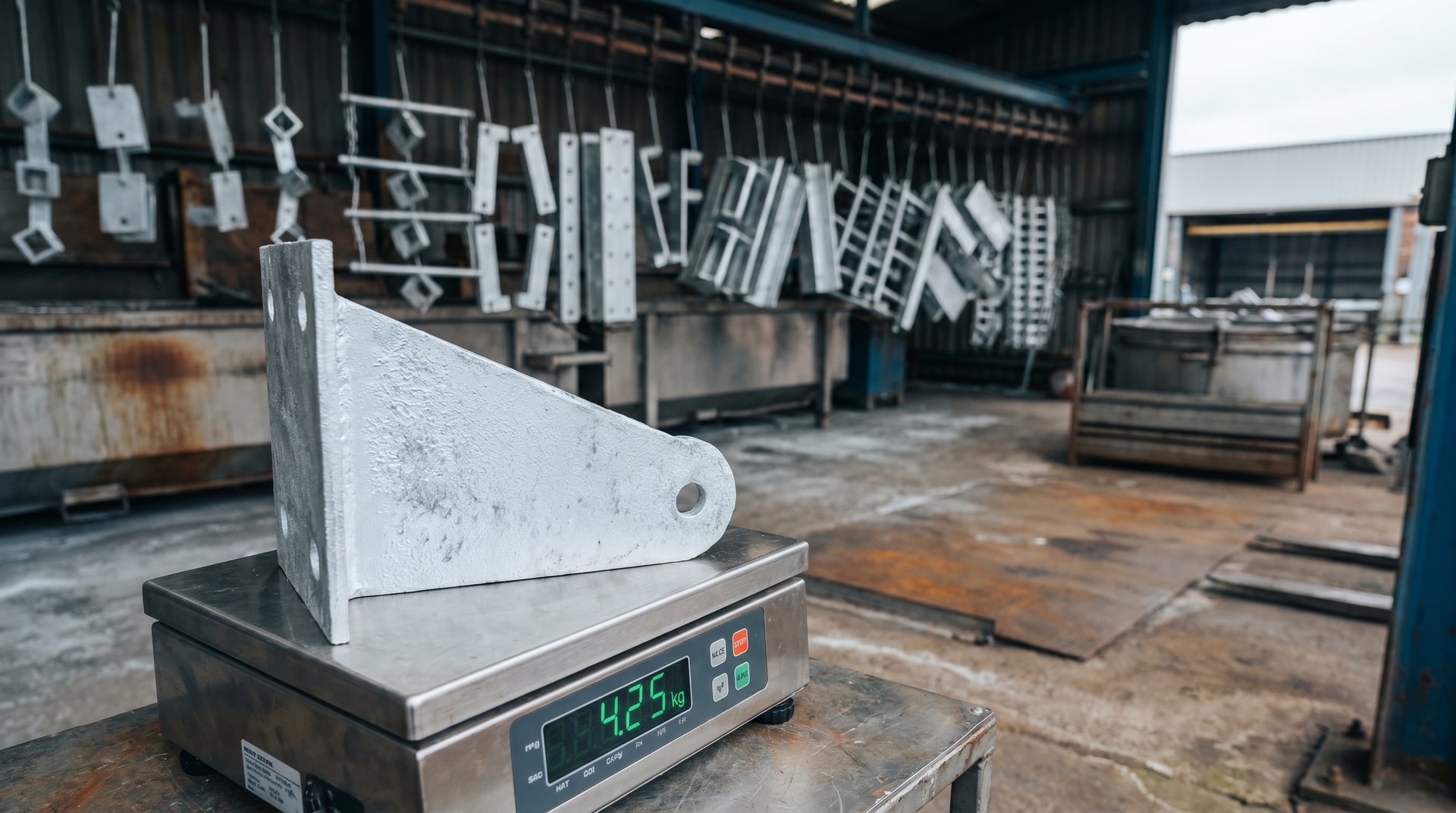
The first method is called weigh-galvanize-weigh. The name describes the procedure exactly: a steel specimen is cleaned, weighed, sent through the galvanizing process, and then weighed again after cooling. The difference in mass is attributed to the zinc coating that has been applied. This is a straightforward gravimetric approach and requires no destructive action on the finished part after galvanizing.
The second method, weigh-strip-weigh, works from the opposite direction. The part is weighed immediately after galvanizing, and then the zinc coating is chemically stripped from the steel using an acid solution. The part is weighed again once stripped. The difference represents the mass of coating that was removed. Unlike weigh-galvanize-weigh, this procedure renders the part unusable because the coating is entirely removed during the process.
Why Weigh-Galvanize-Weigh Underestimates Coating Weight
This is the detail that most engineers and inspectors miss the first time they work with coating weight data, and it has meaningful implications for how results are interpreted against specification thresholds.
Weigh-galvanize-weigh measures only the zinc metal added to the steel. What it does not capture is the iron that migrates out of the steel surface and into the coating during the galvanizing reaction. That iron becomes part of the alloy layers within the coating itself. Because iron is denser than zinc, its presence in the coating adds to the total coating weight in a way that the simple before-and-after zinc mass measurement cannot detect.
The result is that weigh-galvanize-weigh will underestimate the true total coating weight by up to 10 percent. That may not sound significant in isolation, but when a specification sets a minimum coating weight and a part is borderline, a 10 percent underestimate could lead to a false conclusion that the coating is deficient when it actually meets the requirement. Anyone relying on weigh-galvanize-weigh data alone should be aware of this systematic underestimation and account for it accordingly.
Weigh-strip-weigh does not have this limitation because the acid strip removes the entire coating, including the iron-zinc alloy layers. The mass difference measured in that method reflects the complete coating as it actually existed, iron content included. That is why weigh-strip-weigh is considered the more accurate of the two methods for establishing true coating weight, even though it destroys the specimen in the process.
Converting Mass Difference to a Specification-Comparable Value
Regardless of which method is used, the raw output is a mass difference in grams or ounces. That number by itself cannot be compared to a specification requirement because coating weight specifications are always expressed as a mass-per-area value. The conversion step is straightforward but must be done correctly.
The mass difference must be divided by the total surface area of the steel specimen. Surface area calculation needs to account for all surfaces that were exposed to the zinc bath, including edges and any interior surfaces of hollow sections or holes. Errors in surface area calculation translate directly into errors in the reported coating weight, so accuracy here is not optional.
Once the mass-per-area figure is established, it can be compared directly against the applicable specification requirement. This is the step that determines whether a batch of fabricated steel meets the standard it was galvanized to, and it is the reason that both measurement methods are conducted on carefully dimensioned specimens rather than arbitrary pieces pulled from a production run.
Where Coating Weight Fits in the Broader Inspection Picture
In everyday production and field inspection, magnetic thickness gauges are the far more common tool. They are non-destructive, fast, and do not require laboratory conditions. For most hot-dip galvanized structural steel, ASTM standards for hot-dip galvanizing permit thickness measurements in lieu of coating weight measurements, and the two values can be related through zinc density when a direct comparison is needed.
Coating weight measurement is more commonly specified when the geometry of the part makes thickness measurement difficult or unreliable, or when the specification for the product class is written in mass-per-area terms rather than mils or microns. Wire, fasteners, and certain hardware products fall into this category, where the small diameter or complex geometry makes point-by-point thickness gauging impractical.
Understanding the gravimetric methods also matters for specification writing and procurement. If an engineer or owner is drafting acceptance criteria for a custom fabrication with unusual geometry, specifying coating weight rather than coating thickness may yield more defensible results because it integrates over the entire surface rather than depending on gauge placement at representative points.
Common Misconceptions in Practice
One misconception we encounter regularly is the assumption that coating weight and coating thickness are interchangeable terms or that one can always be precisely derived from the other. They are related through the density of zinc (approximately 7.133 g/cm³ for pure zinc), but the alloy layers within a hot-dip galvanized coating contain iron, and their density differs from pure zinc. This means the conversion is an approximation, not an exact transformation. For compliance purposes, if a specification states coating weight requirements, coating weight measurements should be used, not thickness values converted through a zinc density factor.
Another common confusion involves the scope of the two gravimetric methods. Both weigh-galvanize-weigh and weigh-strip-weigh are described as appropriate only for single specimen samples. This means they are not production-line tools for batch qualification in the way that magnetic gauging is. They are validation and research techniques, used when a precise gravimetric determination is specifically required, or when calibrating or verifying magnetic gauge readings against a known standard.
There is also a tendency to treat the weigh-strip-weigh result as the only acceptable reference and to dismiss weigh-galvanize-weigh data entirely. That is not quite right either. Weigh-galvanize-weigh has legitimate uses when the known 10 percent underestimation is accounted for in how the data is interpreted, particularly in research settings or when tracking comparative coating performance across different steel compositions or processing parameters.
Why This Matters for Steel Specification and Design
Engineers and architects who specify hot-dip galvanizing as a corrosion protection system are ultimately specifying a minimum service life for steel in a given environment. That service life is a direct function of the zinc available at the surface to corrode sacrificially in place of the base steel. Coating weight, in essence, is a proxy for the zinc reservoir that has been deposited.
A heavier coating weight means more zinc per unit area, which means a longer time before the steel substrate is exposed to the corrosive environment. Understanding the measurement methods behind coating weight helps designers and specifiers write requirements that are actually verifiable, and it helps inspectors and fabricators understand what the numbers they are producing actually represent at the metallurgical level.
It also informs decisions about when to request coating weight data versus when standard magnetic gauging is sufficient. For structural steel in typical atmospheric exposures, magnetic gauging against established ASTM minimums is appropriate and practical. For specialty products, hardware, or components where the geometry or product standard requires gravimetric measurement, knowing the capabilities and limitations of each method prevents misinterpretation of results and potential disputes over compliance.
Work With a Team That Understands What the Numbers Mean
Coating weight is one of those technical concepts that seems simple on the surface but has enough nuance in its measurement methods and interpretation to cause real problems when it is misunderstood. The difference between measuring only the zinc metal added versus measuring the full iron-zinc coating system, the up-to-10-percent gap between the two methods, and the requirement to divide by surface area correctly all represent points where errors can enter and specification compliance can be incorrectly evaluated.
At V&S Galvanizing, our team works with engineers, fabricators, and inspectors on exactly these kinds of technical questions. Whether you are writing a procurement specification, evaluating whether a finished part meets requirements, or trying to understand why two measurement approaches produced different results on the same piece, we can help clarify what the data actually means and how to apply it correctly. Reach out through our contact page to start a conversation with our technical team.
Frequently Asked Questions About Coating Weight in Hot-Dip Galvanizing
What is coating weight in hot-dip galvanizing?
Coating weight is the mass of the hot-dip galvanized coating applied to a steel part per unit of surface area, typically expressed in ounces per square foot or grams per square meter. It reflects the total zinc-bearing material deposited on the steel and is used to verify compliance with coating specifications.
Why does weigh-galvanize-weigh underestimate coating weight?
Weigh-galvanize-weigh measures only the zinc metal added to the steel by comparing mass before and after galvanizing. It does not account for iron that migrates from the steel into the coating during the galvanizing reaction. Because that iron becomes part of the alloy layers and contributes to total coating mass, the method systematically underestimates true coating weight by up to 10 percent.
Which coating weight measurement method is more accurate?
Weigh-strip-weigh is the more accurate method because it removes and measures the entire coating, including the iron-zinc alloy layers. Weigh-galvanize-weigh only captures zinc metal added and can underestimate total coating weight by up to 10 percent. However, weigh-strip-weigh destroys the part by chemically stripping the coating off using acid.
Can coating weight be calculated from coating thickness measurements?
Coating weight and coating thickness are related through zinc density, but the conversion is an approximation rather than an exact relationship. The alloy layers within a hot-dip galvanized coating contain iron, which changes the effective density relative to pure zinc. For specification compliance purposes, if the requirement is stated in coating weight terms, a gravimetric measurement should be used rather than a thickness-based conversion.
Are both coating weight methods appropriate for production batch testing?
No. Both weigh-galvanize-weigh and weigh-strip-weigh are designed for single specimen samples and are laboratory techniques, not production-line batch testing tools. Magnetic thickness gauging is the standard non-destructive method used for batch inspection on structural steel. Gravimetric methods are used when a precise mass-per-area determination is specifically required or when the product standard mandates it.
When would an engineer specify coating weight rather than coating thickness?
Coating weight is more appropriate when the geometry of the part makes magnetic thickness gauging difficult or unreliable, such as with wire, fasteners, or complex hardware. It is also the correct metric when the applicable product standard is written in mass-per-area terms. For typical structural steel in atmospheric service, coating thickness measured by magnetic gauge against ASTM minimums is generally sufficient.
Why must the mass difference be divided by surface area to get coating weight?
Coating weight specifications are always expressed as mass per unit area, so the raw mass difference from either gravimetric method only becomes a meaningful, comparable value once it is normalized by the surface area of the specimen. Inaccurate surface area calculations, such as omitting edges or interior surfaces, introduce direct errors into the reported coating weight and can lead to incorrect compliance determinations.
Does a higher coating weight always mean better corrosion protection?
In general, a higher coating weight means more zinc deposited per unit area, which translates to a larger zinc reservoir and a longer time before the steel substrate is exposed to corrosion. However, excessively heavy coatings can affect dimensional tolerances and fit-up on assemblies. The goal is to meet the minimum specified coating weight for the intended service environment, not to maximize coating mass beyond what the application requires.
