
When fabricated steel goes into the galvanizing kettle, the zinc reacts with the steel surface through a well-understood metallurgical process. What many engineers and fabricators underestimate is how dramatically welding decisions made days or weeks before galvanizing can shape the final coating appearance. A weld that looks clean and flush on the fabrication floor can produce a rough, raised, or void-riddled coating after hot-dip galvanizing, and the root causes are almost always traceable to either surface contamination or electrode chemistry.
The American Galvanizers Association addresses this directly in their article on welding appearance after HDG. At V&S Galvanizing, we expand on that foundation to explain what is actually happening at the material level, how silicon content in welding electrodes influences coating formation, and why this is often misunderstood in the field.
Why the Weld Zone Behaves Differently Than the Parent Steel
Hot-dip galvanizing works by immersing clean steel in molten zinc at approximately 840°F (449°C). The zinc reacts with iron in the steel to form a series of zinc-iron alloy layers, topped by a layer of relatively pure zinc. This reaction is highly sensitive to surface chemistry. The weld zone is not the same material as the surrounding base steel. It has been melted, resolidified, and in many cases infused with filler metal that may have a different elemental composition. That difference in chemistry can produce a visibly different coating.
The two factors that dominate coating quality and appearance at the weld are cleanliness of the weld area and metallic composition of the weld itself. These two variables operate independently, and both need to be addressed. A weld that is chemically clean but made with the wrong electrode can still produce a poor result, and a weld made with the right electrode can fail completely if slag or flux remains on the surface.
The Problem With Welding Slag and Flux Residues
The chemical cleaning steps that precede hot-dip galvanizing, typically acid pickling in hydrochloric or sulfuric acid, are highly effective at removing mill scale, rust, and surface oxides from steel. What they cannot do is dissolve welding flux residues. Flux compounds are chemically inert in these pickling solutions. They simply sit on the surface, blocking the zinc from reaching the steel beneath.
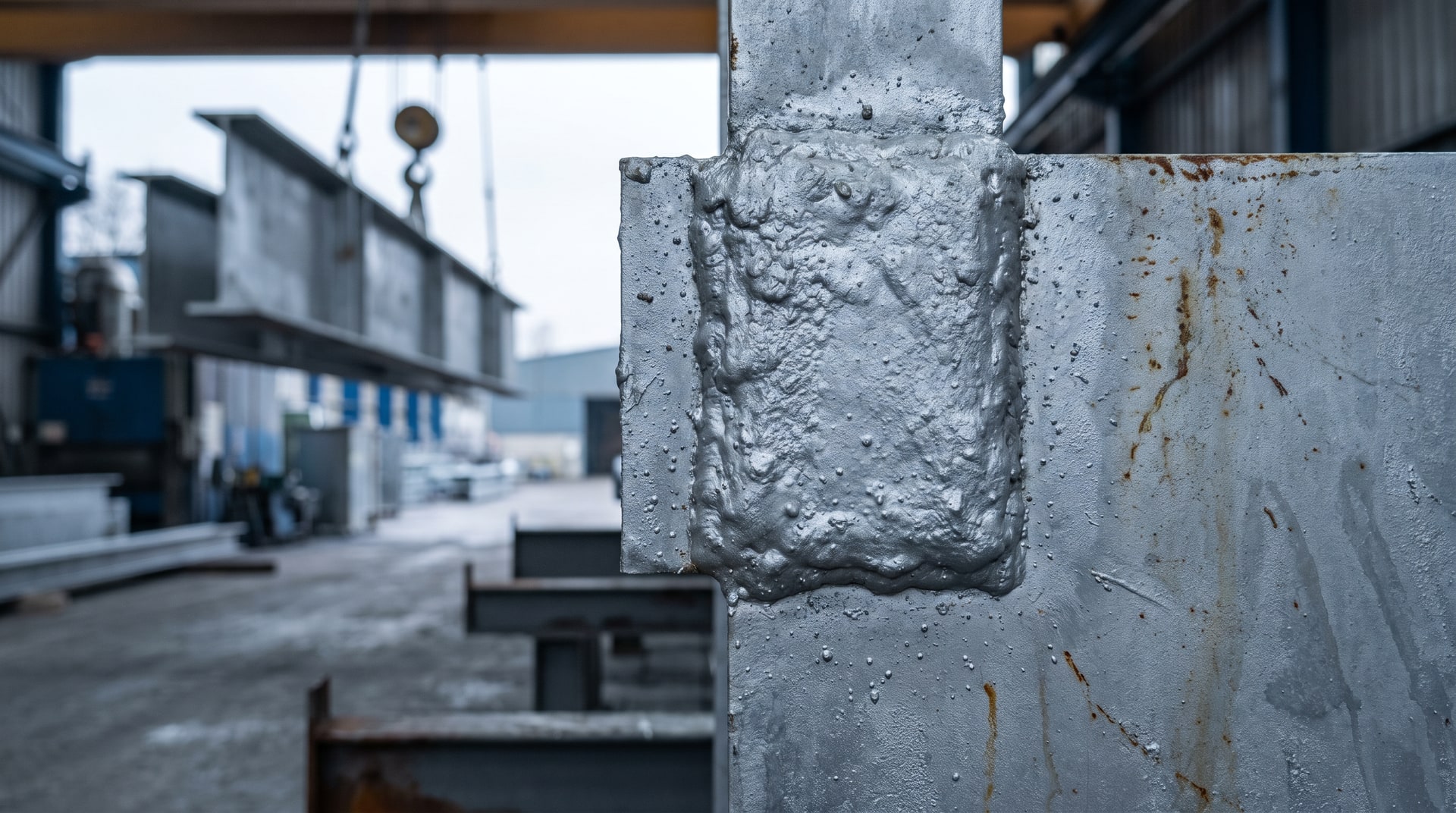
The result is predictable and visually obvious: bare spots and coating voids directly adjacent to or over the weld, along with rough surface texture wherever spatter was not fully removed. These are not galvanizing failures in the process sense. The galvanizing line did exactly what it was supposed to do. The problem was introduced during fabrication.
When coated electrodes are used, all welding flux residues must be removed before the part reaches the galvanizer. Wire brushing alone is rarely sufficient for heavy deposits. More reliable methods include chipping, grinding, pneumatic needle gun descaling, or abrasive blast cleaning. Each of these methods has practical trade-offs in terms of time, access to the weld area, and effect on the surrounding base metal surface. In situations where joint geometry makes slag removal difficult, using an uncoated electrode where the welding process permits it eliminates the flux deposit problem at the source.
Weld spatter is a related but distinct issue. Spatter droplets that adhere to the steel surface create raised imperfections that carry through to the galvanized coating. Water-soluble anti-spatter sprays are compatible with the galvanizing pre-treatment process, but solvent-based or oil-based anti-spatter products must not be used, as they can contaminate the surface and interfere with zinc adhesion across a much broader area than the spatter itself.
Silicon Content and the Reactive Weld: Understanding the Mechanism
This is where the chemistry becomes particularly important, and where the most common misunderstanding in the field occurs. Silicon is a deoxidizer commonly added to welding electrodes to stabilize the arc and improve weld pool fluidity. It does its job well from a welding standpoint. But silicon has a pronounced effect on the kinetics of the zinc-iron reaction during galvanizing.
When silicon content in the weld metal exceeds approximately 0.25% by weight, the rate of zinc-iron alloy layer growth accelerates significantly. This is the same reactive behavior seen with certain silicon-containing base steels, sometimes called the Sandelin effect, but localized to the weld zone. The alloy layers continue to grow thicker than they do on the surrounding base metal, and the result is a coating over the weld that is both thicker and typically darker in color than the surrounding zinc.
On a product that would otherwise have a smooth, uniform appearance, such as a hollow structural section (HSS) assembly or an architectural element, this produces what is commonly called a raised weld or swollen weld. The weld bead, even if it was ground completely flush before galvanizing, visibly reasserts itself through the zinc coating. The galvanized surface reflects the metallurgical boundary between the weld metal and the base steel, not just the physical contour of the weld.
This is a critical point for specifiers to understand: grinding welds smooth before galvanizing does not prevent the raised weld condition when high-silicon electrodes are involved. The thickening happens because of the chemistry of the weld metal, not because of the weld geometry. A flush weld made with a high-silicon electrode will still produce a raised area in the galvanized coating. Grinding may be specified to minimize visible weld show-through when a reactive electrode cannot be avoided, but it should not be presented as a reliable fix for the appearance problem.
Electrode Selection: The Most Effective Point of Control
The most reliable way to achieve a uniform coating appearance across a welded assembly is to select a welding electrode with a silicon content and overall chemistry as close as possible to the parent steel. When the weld metal and the base steel respond similarly to molten zinc, the resulting coating grows at comparable rates across the joint, minimizing the visual transition.
| Welding Process | Lincoln Electric Welding Electrode | AWS Designation | Silicon (Weight %) |
|---|---|---|---|
| SMAW | Jetweld 2 | E6027 | 0.22-0.26% |
| SMAW | Fleetwood 35 LS | E6011 | 0.10-0.18% |
| SAW | L60-860 | F6A2-EL12 | 0.24% |
| FCAW | NR-203 NiC+ | E71T8-K2 | 0.06% |
| FCAW | NR 203 MP | E71T-8J | 0.22-0.26% |
| FCAW | NR 233 | E71T-8 | 0.19-0.20% |
| FCAW | NR 311 | E70T-7 | 0.12-0.13% |
For shielded metal arc welding (SMAW), electrodes like the Lincoln Electric Fleetwood 35 LS with an E6011 designation and silicon content in the 0.10-0.18% range represent a better choice for galvanizing applications than higher-silicon alternatives. The Jetweld 2 (E6027) runs slightly higher at 0.22-0.26% silicon, which puts it near the threshold where reactivity begins to increase noticeably.
For submerged arc welding (SAW), the L60-860 electrode with an F6A2-EL12 designation carries 0.24% silicon, which is workable but worth monitoring in appearance-critical applications.
Flux-cored arc welding (FCAW) presents a particular challenge. Low-silicon electrode options in FCAW-G processes are uncommon. Of the options listed, the NR-203 NiC+ with an E71T8-K2 designation stands out with only 0.06% silicon. The NR 311 (E70T-7) at 0.12-0.13% silicon is also a reasonable option. The NR 203 MP and NR 233 electrodes both run higher and should be used with the understanding that some coating variation at the weld is more likely.
It is worth noting that this table represents a specific set of Lincoln Electric products. Other manufacturers produce electrodes with similar AWS designations and silicon ranges. The governing principle is silicon content relative to the 0.25% threshold, not brand loyalty. When working with a different electrode manufacturer, reviewing the product data sheet for silicon content before specifying is a straightforward step that can prevent a costly appearance problem.
Pre-Galvanizing Smoothing: What It Can and Cannot Accomplish
There is a reasonable expectation among fabricators and specifiers that grinding and blasting a weld before galvanizing will produce a smooth, uniform appearance afterward. The reality is more nuanced. Surface preparation before galvanizing can improve appearance, but it cannot overcome the metallurgical differences between weld metal and base steel when high-silicon electrodes are used.
Grinding alone leaves grinder marks in the steel surface. These marks are shallow enough that they do not affect corrosion protection, but they are visible in the galvanized coating, particularly at certain lighting angles. When grinding is followed by commercial blast cleaning, the grind marks are largely erased and the surface takes on a more uniform texture before zinc contact. The galvanized result is meaningfully better than grinding alone, but it is still not the same as a smooth base steel surface made with a compatible electrode in the first place.
HSS seams are a specific case worth examining. The longitudinal seam on a cold-formed HSS member is formed by a welding process during tube manufacture, and it often has a slightly different surface character than the rest of the tube. Unground HSS seams are visibly apparent after galvanizing. Grinding and commercial blast cleaning before hot-dip galvanizing minimizes this, but does not eliminate it entirely. For projects where HSS seam visibility is a concern, this should be communicated clearly between the designer, fabricator, and galvanizer at the start of the project.
The practical takeaway is that pre-galvanizing smoothing is a useful tool for improving appearance but should be treated as a complement to good electrode selection, not a substitute for it. Specifying ground and blasted welds without also addressing electrode chemistry is likely to produce disappointing results on appearance-critical work.
Common Misconceptions in the Field
One misconception we encounter regularly is the assumption that coating defects near welds are caused by galvanizing process errors. In most cases, they are not. Bare spots and voids at the weld zone are almost always the result of flux residue or slag that was not removed before the part arrived at the galvanizing plant. By the time the part leaves the kettle, the outcome is already determined. Our pre-treatment line cannot dissolve flux compounds that pickling acid cannot touch.
A related misconception is that specifying a smooth weld, whether ground flush or fully blended, will produce a uniform galvanized surface regardless of electrode chemistry. As discussed, this is not the case when silicon content is elevated. The thickening and darkening of the coating over a reactive weld are driven by metallurgical kinetics during galvanizing, not by surface geometry going into the bath.
A third misconception involves anti-spatter products. Not all anti-spatter coatings are compatible with galvanizing pre-treatment chemistry. Using the wrong product can create broad contamination that affects the coating well beyond the weld zone. Water-soluble anti-spatter products are the appropriate choice when they are needed.
Design and Specification Considerations for Appearance-Critical Projects
For projects where weld appearance after galvanizing matters, the earlier these issues are addressed in the design and specification process, the better the outcome. Calling out electrode requirements in the fabrication specification, rather than leaving electrode selection entirely to the fabricator, gives the project team control over one of the two primary variables affecting weld appearance.
The specification language does not need to be complex. Requiring that welding electrodes have silicon content below 0.25% by weight and that all flux residues, slag, and spatter be removed prior to delivery to the galvanizer covers the essential requirements. If additional smoothing is required for aesthetic reasons, specifying grinding followed by commercial blast cleaning is more effective than grinding alone.
For assemblies that include HSS members, acknowledging in the design documentation that seam visibility may be reduced but not eliminated by grinding and blasting sets realistic expectations for all parties. Architects and engineers who are aware of this limitation early can make informed decisions about orientation, finish specifications, or alternative section choices before the steel goes to fabrication.
Our team at V&S Galvanizing is available to review fabrication drawings and flag potential appearance concerns before steel is cut. Pre-galvanizing consultation is one of the more useful steps a project team can take on work where surface aesthetics matter. You can learn more about our hot-dip galvanizing services and what we look for during incoming inspection.
Work With a Team That Understands Weld Chemistry and Coating Outcomes
Welding decisions and galvanizing outcomes are more tightly connected than most project teams realize at the start of a job. Silicon content in electrodes, flux residue on the weld surface, spatter, HSS seam geometry, and pre-galvanizing surface prep all feed directly into what the coating looks like when it comes out of the kettle. The good news is that all of these variables are controllable when the right information reaches the right people before fabrication begins.
At V&S Galvanizing, we work with engineers, fabricators, and contractors who want to understand these connections rather than troubleshoot them after the fact. If you have a project with appearance requirements, specific electrode or surface prep questions, or concerns about how your fabricated assemblies will respond to galvanizing, reach out through our contact page and we will work through the details with you.
Frequently Asked Questions About Welding Appearance After Hot-Dip Galvanizing
Why does my weld look raised or swollen after hot-dip galvanizing even though it was ground flush before processing?
Grinding the weld flush before galvanizing addresses the physical geometry of the weld, but not its chemistry. When a welding electrode with silicon content above approximately 0.25% by weight is used, the zinc-iron alloy layers grow significantly faster over the weld metal than over the surrounding base steel. This accelerated reaction produces a thicker, often darker coating over the weld zone regardless of how smooth the surface was before galvanizing. The fix is electrode selection, not surface preparation.
What silicon content threshold should I specify to avoid reactive weld behavior in hot-dip galvanizing?
Welding electrodes with silicon content at or below 0.25% by weight are generally considered lower risk for the raised or swollen weld condition. Electrodes at the lower end of that range, such as the Lincoln Electric Fleetwood 35 LS at 0.10-0.18% silicon (E6011), provide more margin. Always verify silicon content on the electrode manufacturer's product data sheet, as AWS designation alone does not specify silicon content precisely enough for galvanizing applications.
Can welding flux residue cause bare spots in a galvanized coating?
Yes. Welding flux residues are chemically inert in the acid pickling solutions used during galvanizing pre-treatment. Because the acid cannot dissolve or remove them, they remain on the steel surface and prevent zinc from bonding to the steel in those areas. The result is bare spots, coating voids, and rough surface texture near the weld. All flux residue must be mechanically removed before the part is delivered to the galvanizer.
What methods are effective for removing welding flux and slag before galvanizing?
Wire brushing is the minimum, but it is often insufficient for heavy slag deposits or in tight joint geometries. More effective methods include chipping, grinding, pneumatic needle gun descaling, and abrasive blast cleaning. Commercial blast cleaning after grinding is particularly effective because it both removes remaining residue and erases grind marks that would otherwise be visible in the finished coating. Where joint access makes mechanical removal difficult, using an uncoated electrode eliminates the flux deposit problem entirely.
Does specifying ground and blasted welds before galvanizing guarantee a uniform appearance?
No. Pre-galvanizing smoothing improves appearance but does not guarantee uniformity, particularly when high-silicon electrodes have been used. The metallurgical difference between weld metal and base steel persists regardless of surface prep. For the most uniform result, the correct approach is to combine low-silicon electrode selection with appropriate surface preparation, treating the two as complementary requirements rather than alternatives.
Are HSS seams always visible after hot-dip galvanizing?
On unground HSS, the longitudinal seam is typically visible in the galvanized coating. Grinding and commercial blast cleaning before galvanizing can significantly reduce seam visibility, but it does not eliminate it entirely. Project teams specifying HSS in appearance-sensitive applications should account for this limitation and communicate expectations clearly between designer, fabricator, and galvanizer before fabrication begins.
Is FCAW a good welding process choice for work that will be hot-dip galvanized?
FCAW is not ideal for galvanizing applications requiring consistent appearance because low-silicon electrode options are uncommon in flux-cored gas-shielded (FCAW-G) processes. When FCAW must be used, the NR-203 NiC+ electrode (E71T8-K2) at 0.06% silicon is the lowest-silicon option identified in AGA guidance. Other FCAW electrodes in that guidance run between 0.12% and 0.26% silicon, which increases the likelihood of coating variation at the weld. Where process flexibility exists, SMAW or SAW with a carefully selected low-silicon electrode typically produces more predictable galvanizing results.
Are all anti-spatter sprays compatible with hot-dip galvanizing pre-treatment?
No. Only water-soluble anti-spatter sprays are compatible with the chemical pre-treatment process used in hot-dip galvanizing. Solvent-based or oil-based anti-spatter products leave residues that are not removed by acid pickling, creating contamination that can interfere with zinc adhesion across a broad area around the weld zone. If anti-spatter products are needed, the product must be confirmed as water-soluble before use on steel destined for galvanizing.
