

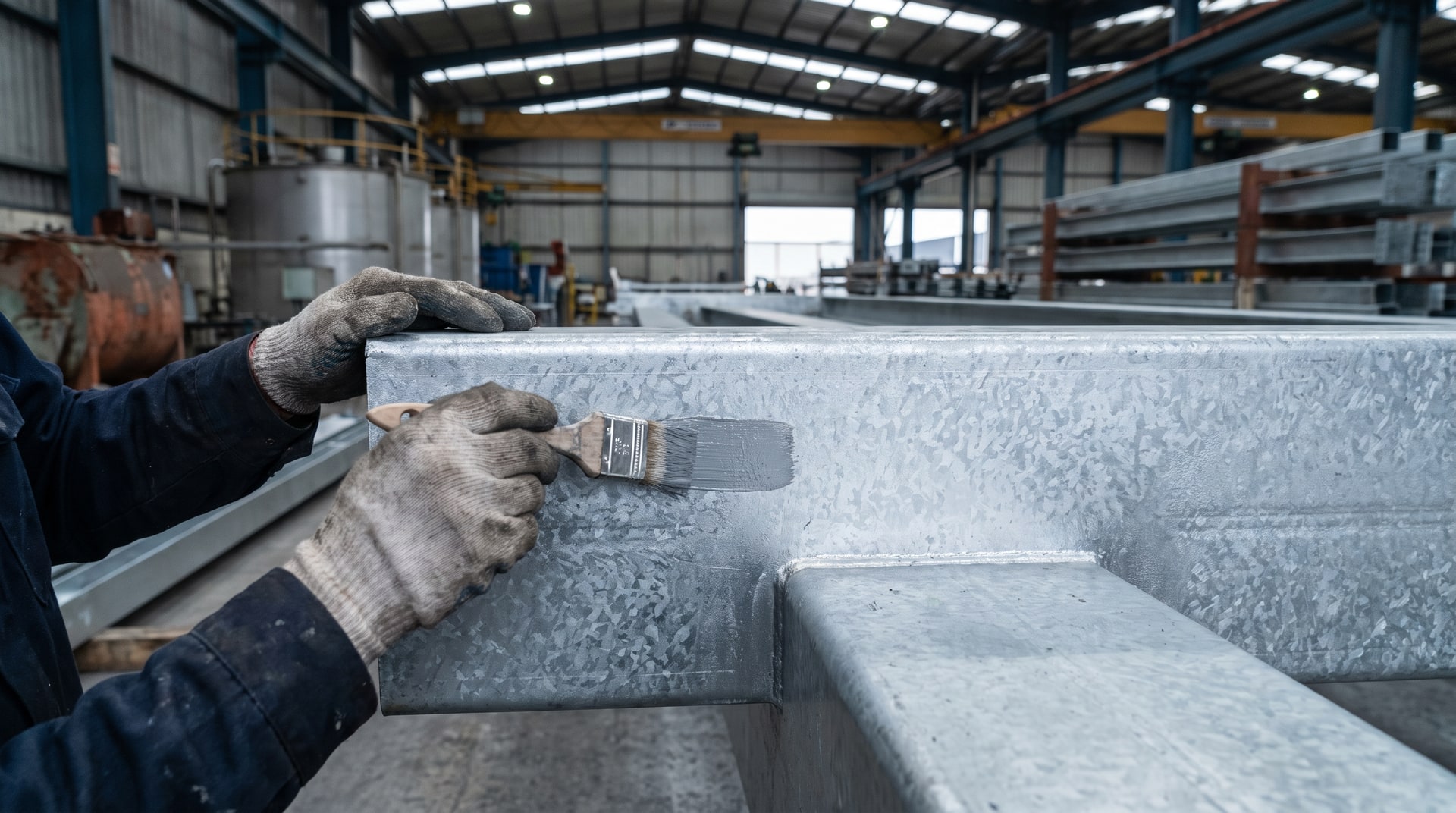
Even in the best-controlled galvanizing operation, a finished piece occasionally comes off the line with a small bare spot, a handling mark, or a weld area that needs attention before it leaves the facility. These imperfections are normal and, in most cases, straightforward to address. What is not always straightforward is deciding which touch-up method to use, and why, especially when customers, specifiers, or competing service providers each have a different opinion on what constitutes the right answer.
The question of touch-up method has become more complicated in recent years as some specifiers push specifically for metallizing (hot zinc spray) instead of the zinc-rich paint that most galvanizers use as a standard repair material. The American Galvanizers Association addresses this directly in their article on touch-up methods for hot-dip galvanized coatings. At V&S Galvanizing, we expand on that foundation to explain what is actually happening at the material level, how method selection influences performance, and why the debate between zinc-rich paint and metallizing is often misunderstood in the field.
What ASTM A780 Actually Governs
ASTM A780 is the governing standard for repair and restoration of damaged hot-dip galvanized coatings. It explicitly recognizes three acceptable touch-up methods: zinc-rich paint, metallizing (also called thermal spray or flame spray zinc), and zinc solder. Critically, the standard does not rank these methods or declare one superior to another. It establishes performance requirements for each and leaves the selection to the specifier and galvanizer based on the specific situation.
This is an important point that often gets lost in field conversations. When a customer insists that metallizing is categorically better, they are making a claim the standard itself does not support. ASTM A780 treats all three methods as legitimate repair options. The standard's intent is to ensure that whatever method is chosen, it is applied correctly and achieves adequate protection over the area being repaired.
Zinc-rich paint, the method the galvanizing industry relies on most heavily and has used for many decades, is fully compliant with this standard. The widespread adoption of zinc-rich paint is not a compromise or a shortcut. It reflects the practical reality that zinc-rich paint is effective, economical, and consistently available across essentially every galvanizing facility in the country.
Why Specifiers Sometimes Ask for Metallizing Instead
Understanding why metallizing requests have increased requires looking at two separate forces, one technical and one commercial.
The technical argument typically goes something like this: metallizing uses 100% zinc metal, so it must be better than a zinc-rich paint that contains only 65%-69% zinc in the dry film (or above 92% for high-zinc formulations). Since the galvanizing industry itself promotes the relationship between coating thickness and longevity, saying that performance and durability are linearly related to zinc thickness, it is an understandable logical leap to conclude that a 100% zinc repair coating must outperform one with a lower zinc content.
The problem with this reasoning is that zinc content percentage alone is not the only variable that determines repair effectiveness. Bond strength, the mechanics of adhesion to the existing HDG surface, the thickness achievable with each method, and how the repair coating integrates with the surrounding galvanized layer all factor into long-term performance. When those variables are accounted for, the comparison between zinc-rich paint and metallizing becomes considerably less clear-cut than the percentage numbers suggest on their own.
The commercial force is more straightforward. Some of the pressure for metallizing comes from parties with a direct financial interest in that method. Companies whose primary business is metallizing, not galvanizing, have an obvious incentive to position their service as superior. Some galvanizers maintain small metallizing units in-house, which gives them a competitive edge if they can convince customers that metallizing is the premium option and charge accordingly. Neither of these is inherently wrong, but it is worth recognizing that some advocacy for metallizing is market-driven rather than technically driven.
The Mechanics of Zinc-Rich Paint as a Repair Coating
Zinc-rich paint provides corrosion protection through two mechanisms. The first is barrier protection: the dried paint film physically separates the steel surface from moisture and oxygen. The second, and more important in this context, is galvanic protection. The zinc particles in the dry film are electrically conductive and in contact with one another and with the steel substrate beneath. When a corrosion cell begins to form at the edge of a repair area, the zinc particles sacrifice themselves preferentially, protecting the underlying steel just as the zinc in a hot-dip galvanized coating would.
The effectiveness of galvanic protection in zinc-rich paint depends heavily on the zinc particle concentration in the dry film. This is why ASTM A780 specifies minimum zinc content thresholds: below a certain concentration, the particles may not be in sufficient contact to maintain electrical continuity across the film, and galvanic protection becomes unreliable. High-zinc formulations with above 92% zinc in the dry film are specifically intended to maximize this electrical contact and bring the paint's galvanic behavior closer to that of a continuous zinc metal coating.
None of this means zinc-rich paint is indistinguishable from metallizing in every respect. But it does mean the protection mechanism is real, well-understood, and validated by decades of field performance across a wide range of environments.
How Metallizing Works and Where It Fits
Metallizing, sometimes called thermal spray zinc or flame spray metallizing, involves feeding a zinc wire or powder through a torch or arc gun that melts the material and propels it onto the steel surface as a spray of molten droplets. Those droplets flatten on impact and solidify rapidly, building up a coating of nearly pure zinc metal. The resulting coating is porous at the micro level, but that porosity is typically not a functional concern because the zinc corrodes preferentially to form zinc oxide and zinc carbonate, which fill the pores over time and create a densely protective surface.
The bond in a metallized repair is primarily mechanical rather than metallurgical. On a freshly prepared steel surface, the molten zinc droplets key into surface irregularities created by abrasive blasting. The bond strength achieved this way can be quite good, but it is not the same as the intermetallic alloy bond formed during the hot-dip galvanizing process itself, where iron and zinc diffuse into each other at the molecular level under elevated temperature. This distinction matters when evaluating long-term adhesion under mechanical stress or thermal cycling.
Metallizing is genuinely valuable in certain repair scenarios, particularly for large areas, field repairs on structural assemblies that cannot be returned to a galvanizing facility, or situations where the specifier has a contractual or project-specific requirement for thermal spray. It is also useful when a galvanizer needs to offer touch-up on a piece where the repair area is unusually large or where zinc-rich paint may not achieve the required dry film thickness in a single application.
Practical Considerations for Galvanizers Without In-House Metallizing
Most galvanizing facilities do not own or operate thermal spray equipment. The capital investment for a metallizing unit starts at roughly $20,000 and can go considerably higher depending on the system's capacity and the level of portability required. For many operations, that investment does not fit the business model, particularly if demand for metallizing touch-up is infrequent or limited to one or two persistent customers.
When a customer specifically requests metallizing and the galvanizer does not offer it, there are a couple of practical paths forward. The first is to walk the customer through the ASTM A780 framework, clarifying that zinc-rich paint is an equally approved repair method under the standard and that the industry has relied on it successfully for years. In many cases, customers requesting metallizing are simply acting on the assumption that more zinc means better performance. A clear, factual explanation often resolves the issue without any change to the galvanizer's standard practice.
The second path is to subcontract the work. Metallizing contractors, sometimes listed under terms like thermal spray metallizing or flame spray metallizing, operate in most major industrial markets. A simple internet search using those terms alongside a city name will typically turn up qualified providers. If none are available locally, expanding the search regionally is usually productive. Bringing a metallizing contractor on-site for a specific job is a reasonable way to satisfy the customer without purchasing equipment.
It is also worth noting that charging a premium for metallizing touch-up, whether in-house or subcontracted, is entirely appropriate given the additional cost and coordination involved. Customers who understand the process and specifically want metallizing generally expect to pay more for it.
Surface Preparation: The Variable That Matters Most
Regardless of which touch-up method is used, the quality of surface preparation on the repair area is the single most important factor in how well the repair performs. Zinc-rich paint applied over a surface that still has mill scale, rust, or contamination will not bond effectively and will fail prematurely. Metallizing applied to an inadequately blasted surface will not achieve the mechanical key needed for a durable bond.
For both methods, the repair area should be clean and free of zinc oxides, oils, and surface contaminants before any material is applied. In practice, this typically means mechanical cleaning, wire brushing, or light abrasive blasting of the bare area, followed by application of the repair coating within the time window specified by the product manufacturer or the ASTM A780 standard for that method. Rushing surface preparation to save time is the most common reason touch-up repairs underperform.
This is one place where the galvanizer's experience and attention to process makes a meaningful difference. A repair that is applied correctly to a properly prepared surface will provide protection that matches or closely approximates the surrounding coating. A repair applied carelessly, regardless of whether it uses zinc-rich paint or metallizing, will be a weak point in the coating system.
Appearance Over Time: Why the Method Distinction Often Becomes Irrelevant
One aspect of touch-up repairs that does not always get adequate attention is appearance. Fresh zinc-rich paint and fresh metallizing will both look noticeably different from the surrounding hot-dip galvanized surface, which may have a spangled, matte gray, or bright silver appearance depending on its age and the steel chemistry. A repair area will stand out initially regardless of the method used.
Over time, however, the zinc on all three surfaces, the original HDG coating, the zinc-rich paint repair, and any metallized area, will begin to weather and patinate through the same general process. The zinc reacts with moisture and atmospheric carbon dioxide to form a dull gray zinc carbonate layer. As that patina develops across all surfaces, the visual differences between the repair and the surrounding coating become progressively less noticeable. In most practical applications, particularly structural steel exposed to the elements, the appearance distinction largely disappears within a reasonable weathering period.
For projects where appearance is critical from day one, such as architectural elements or exposed steel in a high-visibility installation, it is worth having a candid conversation with the customer about what to expect. Any repair, regardless of method, will be visible initially. That is a material reality, not a defect.
Work With a Team That Knows the Standards and the Material
Touch-up repair for hot-dip galvanized steel is not a simple binary choice between methods. It involves understanding what ASTM A780 actually requires, recognizing the legitimate strengths and practical limitations of each repair option, and being able to explain that clearly to customers who may be working from assumptions that do not hold up under technical scrutiny. Zinc-rich paint is not a compromise; it is an industry-standard, code-compliant repair material with decades of demonstrated performance. Metallizing has its place, particularly for large areas or specific project requirements. Neither is universally superior, and the standard that governs both makes that explicit.
At V&S Galvanizing, our team works through these decisions with customers every day. If you have questions about touch-up requirements for an upcoming project, need guidance on what ASTM A780 requires for a specific application, or want to discuss how repairs are handled as part of our standard process, we invite you to reach out through our contact page. Getting the repair method right from the start protects your project and avoids rework down the line.
Frequently Asked Questions About Touch-Up Methods for Hot-Dip Galvanized Steel
Does ASTM A780 specify which touch-up method is best for hot-dip galvanized coatings?
No. ASTM A780 recognizes three acceptable repair methods: zinc-rich paint, metallizing, and zinc solder. The standard establishes performance requirements for each but does not rank them or claim one outperforms the others. Method selection depends on the specific repair scenario, area size, and project requirements.
What zinc content is required in zinc-rich paint used to repair galvanized coatings?
ASTM A780 specifies minimum zinc content thresholds for repair paints. Formulations with 65%-69% zinc in the dry film and those with above 92% zinc in the dry film are both recognized. Higher zinc content improves electrical contact between particles, which is essential for galvanic protection of the underlying steel.
Why do some specifiers request metallizing instead of zinc-rich paint?
The most common reason is the assumption that 100% zinc metal must outperform a paint with lower zinc content. This logic is understandable given how the HDG industry communicates the relationship between coating thickness and longevity, but it overlooks factors like bond strength, adhesion mechanics, and achievable film thickness that make the comparison more nuanced than zinc percentage alone suggests.
Is the bond in a metallized repair equivalent to the bond in a hot-dip galvanized coating?
No. The HDG bond is metallurgical: iron and zinc diffuse into each other under heat to form intermetallic alloy layers. The bond in a metallized repair is primarily mechanical, relying on the molten zinc droplets keying into surface irregularities from abrasive blasting. Both can be durable, but they are fundamentally different bonding mechanisms.
What is the most important factor in the long-term performance of any touch-up repair?
Surface preparation. Regardless of whether zinc-rich paint or metallizing is used, the repair area must be clean and free of zinc oxides, mill scale, oils, and other contaminants before any repair material is applied. Inadequate surface preparation is the most common cause of premature repair failure, outweighing the choice of repair method itself.
What should a galvanizer do if a customer requests metallizing but the facility does not have thermal spray equipment?
There are two practical options. First, explain that zinc-rich paint is a fully ASTM A780-compliant repair method with a long track record, which often resolves the issue. Second, if the customer still requires metallizing, subcontract the work to a local thermal spray contractor. Searching for terms like metallizing, thermal spray metallizing, or flame spray metallizing in your area will typically identify qualified providers.
Will a touch-up repair always be visually obvious on a galvanized surface?
Initially, yes. Fresh repair coatings, whether zinc-rich paint or metallized zinc, will look different from the surrounding HDG surface. Over time, as all zinc surfaces weather and develop a zinc carbonate patina, the visual contrast diminishes significantly. For structural applications, this is rarely a long-term concern, but for high-visibility architectural installations it is worth discussing realistic appearance expectations with the customer upfront.
Is charging a premium for metallizing touch-up appropriate?
Yes. Metallizing requires either specialized equipment or coordination with a subcontractor, both of which add cost and logistical complexity compared to zinc-rich paint touch-up. A premium is reasonable and generally expected by customers who specifically request thermal spray repair over the standard zinc-rich paint method.
