

When fabricated steel goes through the hot-dip galvanizing process, the chemistry involved is unforgiving of surface contamination. The zinc coating bonds metallurgically with clean steel, and that bond depends entirely on the surface being free of oxides, grease, mill scale, and anything else that interrupts contact between bare steel and molten zinc. For most fabricated structures, the chemical pretreatment sequence, typically degreasing, pickling in hydrochloric acid, and fluxing, handles the majority of surface preparation requirements without any additional mechanical work. Weld areas, however, are a different story.
The challenge is not the weld itself. A properly formed weld bead, cleaned of surface oxidation by the pickling bath, will galvanize as readily as the surrounding base metal. The problem is weld slag, the glassy, fused residue left behind when flux-coated electrodes or flux blankets are used during welding. Weld slag does not dissolve in acid. It does not react with flux solutions. It simply sits on the surface of the weld and blocks zinc from reaching the steel beneath, producing bare spots that are functionally unprotected and visually obvious.
The American Galvanizers Association addresses this directly in their article on weld slag cleanup requirements prior to galvanizing. At V&S Galvanizing, we expand on that foundation to explain what is actually happening at the material level, how welding process selection influences the need for slag removal, and why this requirement is often misunderstood or overlooked in the field.
Why Chemical Cleaning Cannot Remove Weld Slag
A common assumption among fabricators encountering this requirement for the first time is that the galvanizing plant's chemical pretreatment line will handle all surface contamination, including weld residue. That assumption is understandable given how effective the pickling process is at removing mill scale and rust, but it does not hold for slag.
Weld slag is formed when the flux coating on a welding electrode melts and fuses during the welding arc. As the weld pool cools, this molten flux solidifies into a hard, glassy or ceramic-like layer over the weld bead. Chemically, it is composed largely of silicates, oxides, and other compounds that are highly resistant to the hydrochloric acid solutions used in galvanizing pretreatment. The acid does not meaningfully attack slag at normal pickling concentrations or exposure times. The result is that slag-covered weld areas arrive at the zinc kettle still coated in a chemically inert barrier that the molten zinc cannot penetrate or wet. The zinc simply does not adhere, and the result is a bare spot.
This is not a failure of the galvanizing process. It is a predictable outcome when the surface condition does not meet the requirements for metallurgical bonding. Responsibility for slag removal rests with the fabricator, before parts are sent to the galvanizing facility.
Which Welding Processes Produce Slag
Not every welding method creates slag. The distinction comes down to whether the process uses flux, either as a coating on the electrode or as a granular blanket applied over the weld zone.
Shielded Metal Arc Welding (SMAW), also known as stick welding or Manual Metal Arc (MMA), uses a flux-coated consumable electrode. As the arc burns, the flux melts and serves multiple functions: shielding the molten weld pool from atmospheric contamination, stabilizing the arc, and adding alloying elements. After the weld solidifies, a layer of slag covers the bead. This process reliably produces slag and requires mechanical cleaning before galvanizing.
Flux Cored Arc Welding (FCAW) works similarly in terms of slag production. The flux is carried inside the hollow core of the wire rather than as an external coating, but the result on the weld surface is the same. Slag forms over the bead and must be removed.
Submerged Arc Welding (SAW) takes a different approach. The arc is completely submerged beneath a layer of granular flux that is fed continuously over the weld zone. The flux melts and fuses during welding, forming a thick slag layer as it cools. SAW is commonly used in automated or semi-automated production environments for long, straight welds, and the slag it produces can be quite substantial. Full removal before galvanizing is required.
Gas Metal Arc Welding (GMAW), commonly called MIG welding, uses a bare wire electrode fed continuously through the welding gun. Shielding is provided by an inert or semi-inert gas, not by flux. Because there is no flux in the process, no slag forms on the weld bead. MIG welds do not require blast cleaning for the purpose of slag removal.
Gas Tungsten-Arc Welding (GTAW), or TIG welding, uses a non-consumable tungsten electrode and a separate filler rod, with gas shielding. Again, no flux is involved, no slag is produced, and no mechanical cleaning is required specifically for this reason. Plasma Arc Welding (PAW) operates on a similar principle and carries the same result: no slag, no slag-related cleaning requirement.
The table below summarizes the slag formation potential by welding process.
| Welding Process | Acronym(s) | Potential for Slag Formation? |
|---|---|---|
| Shielded Metal Arc Welding (Manual / Stick Welding) | SMAW / MMA | Yes - Flux Coated Electrode |
| Flux Cored Arc Welding | FCAW / FCA | Yes - Flux Coated Electrode |
| Submerged Arc Welding | SAW | Yes - Granular Flux Blanket |
| Gas Metal Arc Welding / Metal Inert Gas Welding | GMAW / MIG | No |
| Gas Tungsten-Arc Welding / Tungsten Inert Gas Welding | GTAW / TIG | No |
| Plasma Arc Welding | PAW | No |
Understanding which process was used on a given assembly is the first step in determining what cleaning is required. On fabricated structures that use multiple weld types, such as SMAW for structural connections and MIG for lighter attachment welds, slag removal is required only at the SMAW locations. However, the entire structure must arrive at the galvanizing plant clean, so clear communication between the design team, fabricator, and galvanizer matters.
Accepted Methods for Weld Slag Removal
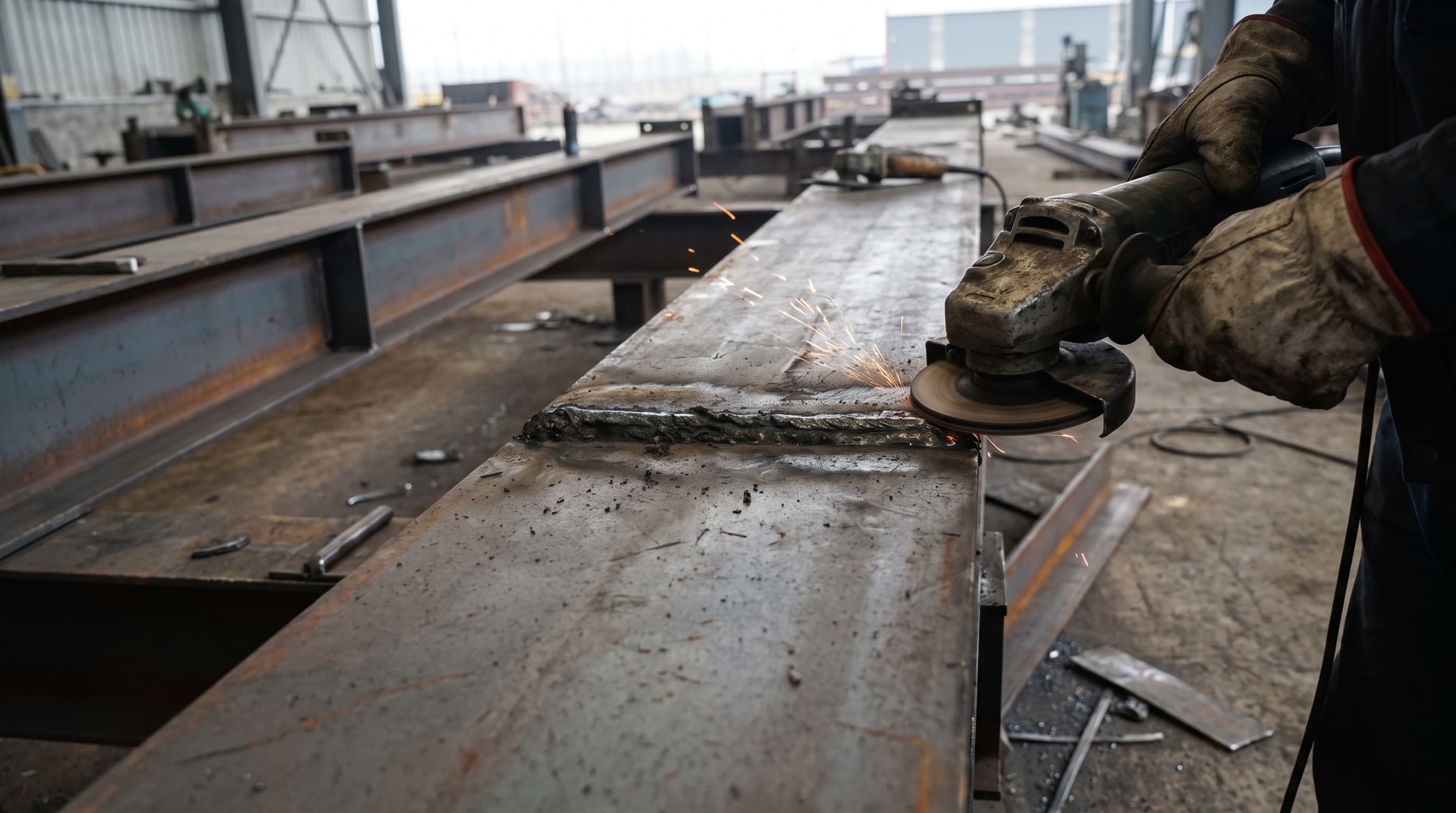
Because chemical pretreatment cannot address this problem, the slag must come off mechanically or thermally before the steel is sent to the galvanizer. The AGA recognizes several accepted methods: grinding, abrasive blast cleaning, wire brushing, flame cleaning, and chipping.
In practice, the choice of method often depends on the geometry of the fabrication, the volume of slag, and the surface quality required. Wire brushing by hand or with a power wire wheel is the most common approach for light to moderate slag on accessible welds. It is fast and does not require specialized equipment. For heavier slag accumulations or complex geometries where a wire wheel cannot reach effectively, chipping or grinding may be necessary first, followed by brushing to remove loose residue.
Abrasive blast cleaning is the most thorough method and produces a uniformly prepared surface, but it is not always practical as a routine step for every welded fabrication. When a project specification requires blast cleaning of all welded assemblies, it is often because the designer or owner wants consistency in surface preparation across the entire structure, not just at weld locations. This can be a sound approach for large, complex structures where distinguishing slag-prone from slag-free welds in the field is impractical.
Flame cleaning uses an oxy-fuel torch to heat and thermally shock slag, causing it to crack and spall from the surface. This method can be effective but requires care to avoid distortion of thinner material and should be followed by brushing to remove any remaining particles.
Regardless of method, the cleaning must be thorough. Partial removal of slag is not sufficient. Even a small residual patch of slag over a weld bead will produce a visible bare spot in the finished galvanized coating, and depending on the service environment, that bare spot may require field touch-up after galvanizing is complete.
How Incomplete Slag Removal Affects Coating Appearance
The appearance implications of inadequate weld preparation are significant, particularly for projects where the galvanized finish will be visible. Bare spots on or near welds are among the most common causes of coating rejections and field disputes in hot-dip galvanizing work.
When zinc cannot wet the steel surface at a weld location, it either runs off entirely, leaving a gray, uncoated area, or it forms a rough, poorly adhered coating with voids and thin spots at the slag boundary. Even when most of the slag has been removed, a film of slag residue too thin to see clearly can prevent proper zinc adhesion over a larger area than the visible residue would suggest.
From an aesthetic standpoint, weld areas already attract attention in a galvanized coating. The higher heat input and different steel chemistry at the weld and heat-affected zone can produce variations in zinc grain structure, surface texture, and reflectivity compared to the base metal. These variations are normal and expected. What is not acceptable is a bare spot or a zone of non-adherent zinc that exposes raw steel. On architectural or structural elements where appearance matters, the standard for weld preparation should be treated as non-negotiable.
At V&S Galvanizing, our team inspects incoming fabrications for surface condition before processing. When we identify slag on weld areas, we communicate that directly to the customer. In most cases, the fabrication is returned for cleaning rather than processed with inadequate surface preparation, because attempting to galvanize over slag does not improve the coating quality. It just moves the problem downstream.
The Clarification Fabricators Most Often Ask For: MIG and TIG Welding
The question that prompted the original AGA article is one we hear regularly from fabricators and engineers: if a structure is welded using MIG or TIG, does blast cleaning still apply?
The short answer is no, not for the purpose of slag removal. MIG and TIG welding processes use bare wire and gas shielding, not flux. No flux melts into the weld zone, so no slag forms. The weld surfaces from these processes are suitable for chemical pretreatment in the galvanizing line without any prior abrasive work, specifically because there is no slag to remove.
This matters practically because abrasive blast cleaning is a cost, a logistical step, and in some cases a dimensional consideration for tight-tolerance fabrications. Requiring blast cleaning where it is not technically necessary adds expense and time without improving coating quality. Conversely, assuming MIG welds never require any preparation at all can lead to overlooking other legitimate surface issues, such as grease, paint, or weld spatter, that do need to be addressed before galvanizing. The absence of slag does not mean the weld area is automatically ready for processing.
When a specification requires blast cleaning of all welded structures regardless of weld process, that requirement likely exists for a broader reason: achieving a consistent surface profile across the entire part, removing surface contamination beyond just slag, or meeting a project specification that was written conservatively. In those cases, the blast cleaning requirement should be followed. But fabricators and specifiers should understand the underlying technical reason so that the requirement is applied with appropriate context.
Fabricator Responsibilities and the Galvanizer's Role
Hot-dip galvanizing is a downstream process. By the time fabricated steel arrives at the galvanizing facility, most of the decisions that determine coating quality have already been made: the steel specification, the welding process, the joint design, the drainage provisions, and the surface preparation. The galvanizer can optimize the process parameters and the chemistry of the pretreatment line, but cannot compensate for slag that was never removed.
This places the responsibility for weld slag removal squarely on the fabricator. It is a step that belongs in the fabrication quality plan, not an afterthought when the coating is found to have bare spots after galvanizing. On complex structures, particularly those with multiple weld types and extensive welding, documenting which areas used flux-coated electrodes and confirming that slag was removed before shipment is a sound practice that avoids costly rework.
Communication between the fabricator and galvanizer is also valuable. If there is any uncertainty about whether a surface is adequately prepared, or if a fabricator is transitioning from one welding process to another partway through a project, discussing that with the galvanizing team in advance avoids surprises. We prefer to address preparation questions before a part is dipped rather than after the coating is inspected.
Surface Preparation Beyond Slag: What Else Affects Weld Area Coating Quality
While slag is the primary mechanical surface contaminant unique to flux-based welding, it is worth acknowledging that weld areas present other surface preparation considerations for hot-dip galvanizing.
Weld spatter, the small droplets of molten metal that land on the base metal surface adjacent to the weld, can create localized surface irregularities. While spatter does not chemically inhibit zinc adhesion the way slag does, it produces rough, pebbly surface texture in the galvanized finish. For appearance-sensitive applications, removing spatter by grinding or brushing before galvanizing produces a cleaner result.
The heat-affected zone (HAZ) around a weld may have altered surface oxide chemistry due to the elevated temperatures involved. The pickling process in pretreatment generally handles this, but heavily oxidized or scaled weld areas may require more aggressive acid exposure. This is usually managed by the galvanizer through pickling time adjustments rather than requiring additional work from the fabricator.
Porosity, undercut, and other weld discontinuities are not cleaning issues per se, but they do affect the appearance of the galvanized coating in those areas. Zinc will fill small surface voids, sometimes highlighting them rather than concealing them. For structures where weld quality and finish appearance are both important, the weld quality standard and the galvanizing specification should be coordinated early in the design phase.
Work With a Team That Understands What Happens Before the Zinc
The quality of a hot-dip galvanized coating is determined at least as much by what happens before the steel enters the zinc kettle as by what happens during immersion. Weld slag removal is one of the clearest examples of that principle. The process cannot fix what was not addressed in fabrication, and bare spots caused by residual slag represent a preventable failure with straightforward solutions available well before galvanizing begins. When fabricators understand the mechanism behind the requirement, the distinction between flux-based and bare-wire processes, and the methods for reliable slag removal, the path to a complete, high-quality galvanized coating becomes significantly more predictable.
If you have questions about how your fabrication's welding processes affect galvanizing preparation requirements, or if you want to review a specific project before submitting for processing, reach out through our contact page. Our technical team is available to help you avoid preparation-related coating problems before they become rework problems.
Frequently Asked Questions About Weld Slag and Hot-Dip Galvanizing
Does the galvanizing pretreatment acid bath remove weld slag?
No. The hydrochloric acid solutions used in galvanizing pretreatment do not dissolve weld slag. Slag is a glassy, chemically inert residue composed largely of silicates and metal oxides that resist acid attack at normal pickling concentrations. Mechanical removal by grinding, wire brushing, abrasive blasting, chipping, or flame cleaning is required before the steel is sent to the galvanizer.
Do MIG or TIG welds require blast cleaning before hot-dip galvanizing?
Not for the purpose of slag removal. GMAW (MIG) and GTAW (TIG) processes use bare wire electrodes and gas shielding rather than flux. Because no flux is introduced into the weld zone, no slag is produced. Abrasive blast cleaning is not required at these weld locations specifically to address slag. However, if a project specification requires blast cleaning of all welded surfaces for other reasons, that requirement should still be followed.
Which welding processes require slag removal before galvanizing?
Any process that uses flux to shield the weld pool produces slag that must be removed. This includes Shielded Metal Arc Welding (SMAW/stick), Flux Cored Arc Welding (FCAW), and Submerged Arc Welding (SAW). Processes that use gas shielding and bare wire, including GMAW (MIG), GTAW (TIG), and Plasma Arc Welding (PAW), do not produce slag and do not have this cleaning requirement.
What happens to the galvanized coating if weld slag is not removed?
Weld slag physically blocks molten zinc from contacting the steel surface. The zinc cannot wet or bond to slag-covered areas, resulting in bare spots in the finished coating. These areas are unprotected from corrosion and are typically visible as gray, uncoated patches on or adjacent to the weld bead. Depending on service environment and specification, bare spots may require field touch-up with zinc-rich paint or zinc spray after galvanizing.
Is wire brushing sufficient to remove weld slag, or is abrasive blast cleaning always required?
Wire brushing, including power wire wheel cleaning, is acceptable for removing weld slag and is commonly used on standard fabrications. Abrasive blast cleaning provides the most thorough and uniform surface preparation but is not always required specifically for slag removal. The appropriate method depends on the extent of the slag, the accessibility of the weld area, and any project specification requirements. What matters is that all slag is fully removed before the part is submitted for galvanizing.
Can weld spatter cause problems with the galvanized coating in addition to slag?
Weld spatter does not block zinc adhesion the way slag does, but it does affect the surface texture of the galvanized finish. Spatter creates small, irregular protrusions on the base metal that remain visible in the coating. For structural applications where appearance is not critical, spatter is generally acceptable. For projects with appearance requirements, removing spatter by grinding or brushing before galvanizing produces a cleaner, more uniform finish.
Who is responsible for removing weld slag before galvanizing?
Weld slag removal is the responsibility of the fabricator, not the galvanizer. The galvanizing facility cannot remove slag through its chemical pretreatment process, and attempting to process slag-contaminated parts does not improve the outcome. Slag removal should be incorporated into the fabrication quality plan as a defined step before parts are shipped to the galvanizing facility.
If a structure uses both flux-coated and bare-wire welding processes, does the whole structure need blast cleaning?
Not necessarily. The slag removal requirement applies specifically to welds made with flux-coated electrodes or under a flux blanket. Welds made with MIG or TIG processes on the same structure do not generate slag and do not require mechanical cleaning for that purpose. However, if a project specification mandates blast cleaning of all welded surfaces regardless of process, that requirement applies to the full structure. When using mixed weld processes, clear documentation of which areas require mechanical cleaning helps ensure nothing is missed before submission for galvanizing.
