

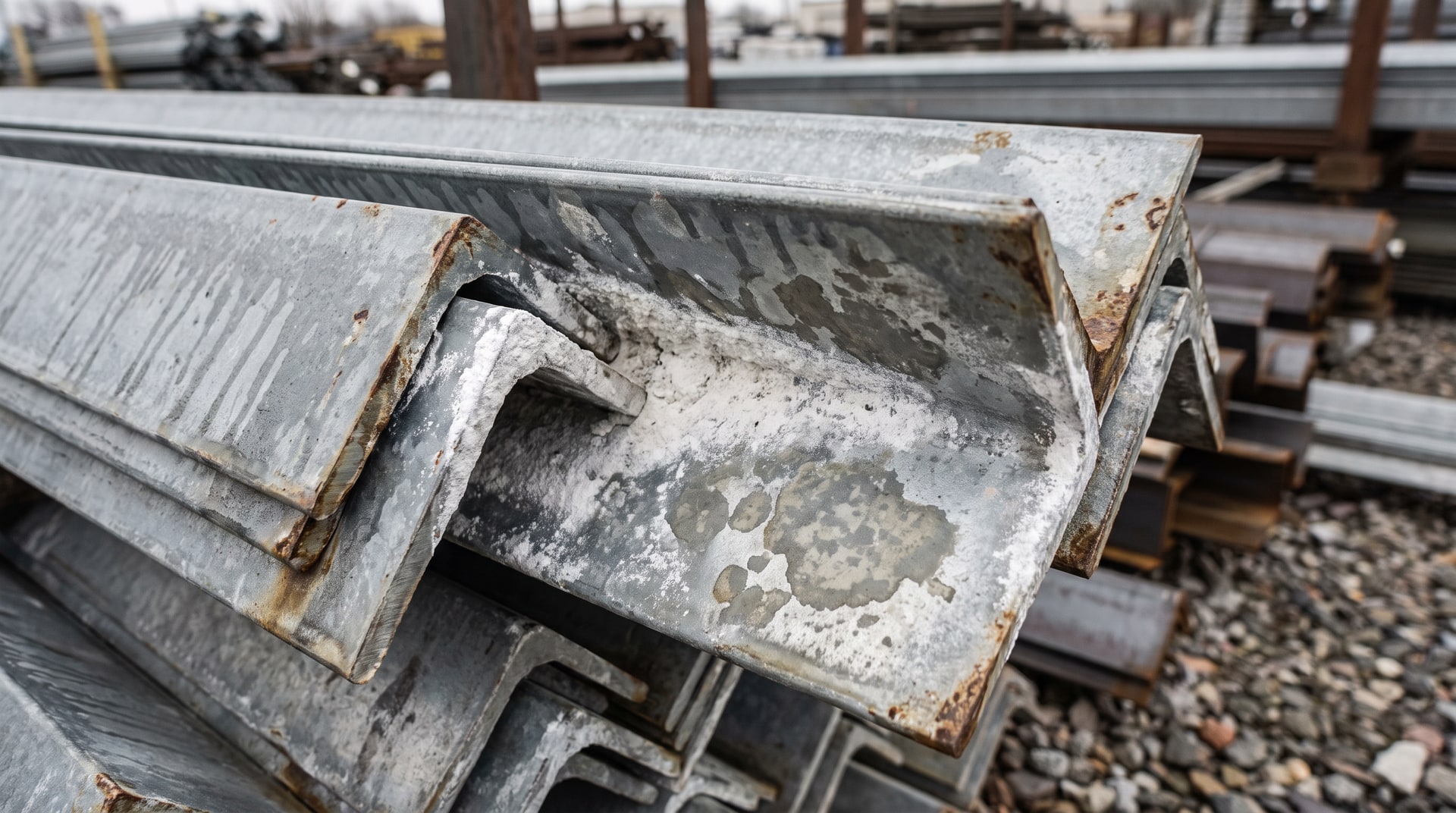
Anyone who has received a delivery of freshly galvanized steel only to find white, chalky deposits on the surface understands the immediate concern. The coating looks compromised. Customers ask questions. Project managers want answers. In most cases, what you are looking at is wet storage stain, a form of zinc corrosion that occurs when moisture becomes trapped between tightly stacked or bundled galvanized components before the zinc surface has had a chance to stabilize. It is one of the most commonly misunderstood appearance issues in the galvanizing industry, and how you respond to it matters far more than most people realize.
The American Galvanizers Association addresses this directly in their article on how to clean wet storage stain. At V&S Galvanizing, we expand on that foundation to explain what is actually happening at the material level, how severity influences the treatment path, and why this condition is often misdiagnosed or mishandled in the field.
What Is Actually Happening When Wet Storage Stain Forms
Freshly galvanized steel is not immediately passive. The outer zinc surface needs exposure to open air and specifically to carbon dioxide to develop the zinc carbonate layer that gives galvanized steel its long-term durability. That layer, commonly called the zinc patina, is what makes hot-dip galvanizing so effective over decades of service. It is tight, adherent, and chemically stable.
When galvanized parts are stacked directly against one another and moisture is present, that stabilization process gets interrupted. Water trapped between contacting surfaces cannot evaporate freely, and airflow carrying carbon dioxide cannot reach the zinc. Instead, zinc reacts with the water and oxygen in that confined space to form zinc oxide and zinc hydroxide compounds. These are the white or off-white deposits visible on the surface. The corrosion mechanism responsible for this buildup will keep running as long as moisture persists and airflow remains restricted. Drying the surface is not just a cosmetic step before cleaning. It is the first necessary intervention to stop the active corrosion process itself.
Identifying Severity Before You Do Anything Else
Not all wet storage stain requires the same response. The treatment path diverges significantly based on how far the stain has progressed, which is why accurate severity assessment matters before any cleaning or remediation begins.
Light wet storage stain typically presents as a thin, powdery white haze on the surface. The underlying zinc is intact, and the deposit is superficial. Medium wet storage stain is more pronounced, with thicker accumulation and a texture that resists casual wiping. Heavy wet storage stain covers larger areas with dense, crusty buildup. When medium or heavy stain progresses to the point where the affected surface turns black, this is a critical threshold: a significant portion of the zinc coating has been consumed. At that stage, the galvanized coating is no longer adequate and the steel must be stripped and regalvanized to comply with ASTM specifications.
This severity gradient is not arbitrary. It reflects the cumulative zinc loss that occurs as the corrosion reaction continues over time. The longer moisture sits on a restricted surface, the more zinc is converted from protective metallic coating into non-protective corrosion byproduct. Catching wet storage stain early, before it reaches the medium or heavy stage, preserves options and avoids more costly remediation.
Why Drying Comes First, Not Cleaning
It is tempting to go straight for the brush or cleaning solution when stain is discovered. But cleaning a wet surface does not resolve the underlying condition. It only redistributes the problem. The corrosion mechanism that produces wet storage stain is driven by the presence of liquid water and restricted airflow. Until the surface is genuinely dry, that mechanism remains active. Any cleaning attempted on a wet surface is working against an ongoing reaction, not resolving it.
Practical drying means separating stacked components so air can circulate between them, moving material to a covered but well-ventilated area, and allowing adequate time for moisture to fully dissipate. In high-humidity environments or after prolonged rain exposure, this may take longer than expected. The goal is not surface-level dryness but the elimination of the moisture reservoir trapped between contact points. Once the zinc surface is genuinely dry and the active corrosion has stopped, assessment and treatment can proceed rationally.
Light Stain: When Weathering Is the Right Answer
For light wet storage stain, the appropriate response is often no cleaning at all, provided the right conditions will be present going forward. After the surface has dried, light stain can be left to weather naturally if the steel will have adequate airflow in its installed or storage location. The zinc oxide and hydroxide compounds that make up the stain are not chemically inert. Given exposure to atmospheric carbon dioxide, they will gradually convert into zinc carbonate, which is precisely the zinc patina that normally develops on galvanized steel anyway. In other words, the stain becomes the patina.
This outcome depends on the future environment. If the steel will be installed in an open outdoor location with good air movement, leaving light stain to weather is both acceptable and practical. If, however, the steel will be placed in a confined space, stored under cover with limited ventilation, or is likely to accumulate standing water again, then the stain must be removed. Leaving it in those conditions risks continued zinc consumption rather than natural patina conversion.
Cleaning Medium and Heavy Wet Storage Stain
Medium and heavy wet storage stain cannot simply be left to weather. The accumulated corrosion product is thick enough that it will not convert uniformly to zinc carbonate on its own, and its presence physically prevents the zinc surface beneath from forming a proper patina. This creates a scenario where the coating's long-term service life is directly compromised, not just its appearance.
Mechanical removal is the starting point. A stiff-bristled nylon brush is the recommended tool for this work. The choice of nylon matters: metal wire brushes can abrade the zinc surface and introduce iron contamination, creating new problems while trying to solve the existing one. Nylon bristles provide enough mechanical action to dislodge the corrosion deposits without damaging the zinc beneath. The brushing should be combined with an appropriate cleaning solution to break down and lift the deposits effectively.
After cleaning, the work is not finished. When medium or heavy stain is involved, the coating thickness must be measured to verify that adequate zinc remains on the base steel. The corrosion process that produced the stain consumed real zinc, and the question is how much. Coating thickness measurement using calibrated magnetic gauges tells you whether the remaining zinc meets the minimum requirements. If it does, the cleaned surface can proceed to service. If the coating is deficient, repair or regalvanizing must be addressed before the steel is put into use.
The Black Stain Threshold and What It Requires
The color change from white to black in wet storage stain is not a cosmetic variation. It signals a fundamentally different condition. When medium or heavy wet storage stain turns black, the zinc that was present in those areas has been substantially consumed. What remains is not a protective coating in any meaningful sense. The corrosion product has progressed through the zinc and the surface no longer provides the barrier protection that hot-dip galvanizing is designed to deliver.
At this stage, neither brushing nor cleaning will restore the coating. The steel must be stripped of its existing galvanized coating and regalvanized. This is not a judgment call or a cost-saving opportunity to be negotiated away. ASTM specifications define minimum coating thicknesses for a reason, and a zinc surface that has been consumed to the point of blackening cannot meet those minimums. Proceeding to service with inadequate zinc coverage accelerates corrosion of the underlying steel and defeats the entire purpose of the galvanizing process. If regalvanizing is indicated, it should be treated as a non-negotiable remediation step.
Coating Thickness Measurement After Remediation
Measuring zinc coating thickness after cleaning medium or heavy wet storage stain is a step that should not be skipped, even when the visible result of cleaning looks acceptable. Visual assessment alone cannot tell you how much zinc was lost to the corrosion process. The surface may appear clean and continuous after brushing, but the coating could be thinner than ASTM minimums require in areas where stain was heaviest.
Magnetic coating thickness gauges are the standard instrument for this measurement on steel substrates. They are nondestructive, portable, and straightforward to use. Multiple readings should be taken across affected areas, not just spot checks, because wet storage stain rarely occurs uniformly. Areas between former contact points, where moisture pooled most persistently, will show the greatest zinc loss and require the most careful attention. The data from these measurements, not visual inspection alone, should drive the decision about whether the cleaned part is acceptable for service or needs further action. Our team routinely supports customers in understanding what these measurements mean and what the applicable ASTM thresholds require for their specific steel geometry and application.
Prevention Is Simpler Than Remediation
Understanding what causes wet storage stain makes prevention straightforward in principle, even if it requires discipline in practice. The three conditions necessary for wet storage stain to develop are moisture, restricted airflow, and contact between galvanized surfaces. Eliminating any one of these breaks the corrosion cycle.
Proper storage practices make the largest difference. Galvanized steel should be stored in a covered, well-ventilated location. Parts should be separated or racked so that air can circulate between them rather than being laid flat face-to-face. When outdoor storage is unavoidable, covering the material while allowing airflow underneath prevents moisture accumulation. During transit, blocking and separation between components prevents the tight surface contact that traps condensation. New galvanized steel delivered directly to a job site and left in a bundle or stack without separation is exactly the scenario most likely to produce wet storage stain within days, particularly in humid or variable weather conditions.
These are not complicated measures. They require attention to how material is handled between the galvanizing plant and its final installation. Incorporating them into standard material handling procedures, procurement specifications, or delivery requirements is the most cost-effective approach to wet storage stain by a wide margin.
Work With a Team That Understands the Coating From the Inside Out
Wet storage stain is one of those conditions that looks alarming but is often manageable when handled correctly and promptly. The key is accurate severity assessment, stopping active moisture exposure before doing anything else, and following the appropriate treatment path based on what the actual condition of the zinc coating is. Light stain treated as heavy stain wastes effort. Heavy stain treated as light stain risks putting structurally compromised steel into service. Neither outcome serves the project or the structure.
At V&S Galvanizing, we have worked through these situations with fabricators, contractors, and engineers across a wide range of projects and environments. We understand the galvanized coating at the metallurgical level, and we can help you determine whether a stained surface needs cleaning, regalvanizing, or simply better storage conditions going forward. If you are dealing with wet storage stain and want guidance on the right course of action for your specific situation, reach out through our contact page and our team will help you work through it.
Frequently Asked Questions About Wet Storage Stain on Galvanized Steel
Is wet storage stain the same as white rust, and does the distinction matter for remediation?
Wet storage stain and white rust are terms often used interchangeably, and they describe the same general phenomenon: zinc corrosion products forming when moisture is trapped on a galvanized surface with restricted airflow. The distinction matters mainly in context. For remediation purposes, what drives the treatment path is severity, not terminology. Light deposits that can convert to zinc patina through weathering require a different response than heavy buildup that has consumed significant zinc coating, regardless of what you call them.
Can a nylon brush actually remove medium or heavy wet storage stain, or is more aggressive treatment needed?
A stiff-bristled nylon brush combined with an appropriate cleaning solution is the recommended approach for mechanical removal of medium and heavy wet storage stain. The nylon bristles provide sufficient mechanical action to dislodge the corrosion deposits without abrading or contaminating the zinc surface beneath. Metal wire brushes are not recommended because they can damage the zinc and introduce iron particles that accelerate further corrosion. For very heavy accumulation, multiple passes with cleaning solution may be needed, but the tool remains a nylon brush, not a wire one.
After cleaning medium or heavy stain, how do I know if enough zinc coating remains?
Coating thickness must be measured with a calibrated magnetic gauge after cleaning medium or heavy wet storage stain. Visual inspection is not sufficient because zinc loss is not always visible. Multiple readings across affected areas, particularly where stain was heaviest, will reveal whether the remaining coating meets ASTM minimum thickness requirements for the relevant steel geometry. If measurements fall short of those minimums, the steel must be regalvanized rather than placed into service.
What does it mean when wet storage stain turns black, and is there any way to treat it short of regalvanizing?
Black discoloration in medium or heavy wet storage stain indicates that a significant portion of the zinc coating has been consumed in those areas. This is not a surface deposit that can be cleaned away to reveal intact zinc beneath. The zinc itself is gone. At that point, neither brushing nor cleaning restores the coating, and the steel must be stripped and regalvanized to meet ASTM specifications. There is no field repair method that adequately compensates for this level of zinc loss.
Why does light wet storage stain convert to zinc patina in some conditions but not others?
Light wet storage stain consists of zinc oxide and zinc hydroxide compounds. In the presence of atmospheric carbon dioxide and adequate airflow, these compounds react to form zinc carbonate, which is the stable, protective zinc patina. When airflow is restricted or moisture continues to accumulate on the surface, that conversion cannot occur, and the corrosion mechanism continues instead. The transition from stain to patina requires both dry conditions and carbon dioxide exposure. Without those two conditions together, weathering in place is not a safe remediation strategy even for light stain.
How quickly can wet storage stain develop on freshly galvanized steel?
Wet storage stain can develop within hours to days under the right conditions. Freshly galvanized steel is particularly susceptible because the zinc surface has not yet formed its protective carbonate patina. If parts are stacked or bundled immediately after galvanizing and exposed to rain, condensation, or high humidity without adequate separation, the corrosion process can begin quickly. This is why storage and handling practices in the period immediately following galvanizing are especially important.
Does wet storage stain affect the long-term service life of the galvanized coating if it is cleaned properly?
Light wet storage stain that either weathers naturally or is cleaned with a nylon brush before significant zinc loss occurs generally does not meaningfully affect long-term service life. The galvanized coating that remains continues to provide cathodic and barrier protection as designed. Medium and heavy stain that is cleaned and verified by coating thickness measurement can also be acceptable for service if the remaining zinc meets ASTM minimums. The risk to service life arises when heavy or black stain is left untreated, ignored, or remediated without verifying that adequate zinc remains.
What storage practices most effectively prevent wet storage stain from forming?
The three conditions required for wet storage stain are moisture, restricted airflow, and surface-to-surface contact between galvanized parts. Preventing stain means disrupting at least one of these. Storing galvanized steel in a covered, well-ventilated location eliminates moisture accumulation. Racking or separating components so that air circulates between them eliminates both restricted airflow and direct contact. When outdoor storage is unavoidable, covering the material while allowing airflow underneath reduces condensation. These practices are most critical in the period immediately after galvanizing, before the zinc surface has stabilized into its protective carbonate patina.
