

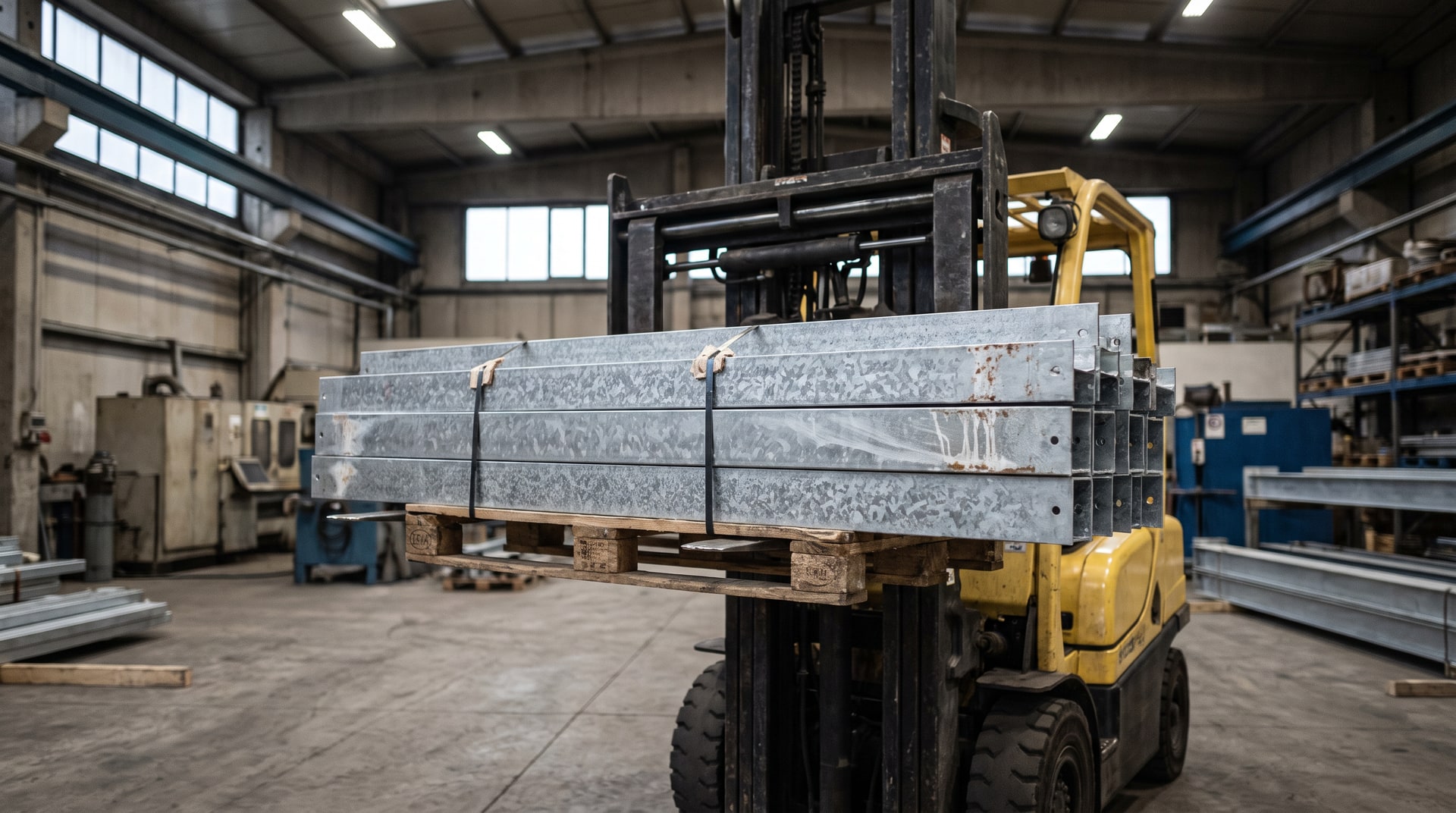
Hot-dip galvanized steel has a reputation for toughness, and that reputation is well earned. The metallurgical bond between zinc and steel produces a coating that resists abrasion, withstands rough jobsite conditions, and does not peel away under normal handling. Yet despite that durability, the coating is not invincible. The way galvanized steel is cooled, stacked, stored, and moved between the galvanizing plant and the final installation site has a direct influence on how that coating looks and performs when it arrives.
Coating damage during transit is one of the more frustrating outcomes in a galvanizing project, not because it is catastrophic, but because it is largely preventable. Flaking on thick-coated members, white corrosion products from improperly stored bundles, and scratches from careless unloading all fall into this category. Understanding why these things happen, and what conditions trigger them, gives fabricators, logistics teams, and site contractors a much clearer picture of where their attention is needed.
The American Galvanizers Association addresses this directly in their article on transportation, handling, and storage of hot-dip galvanized articles. At V&S Galvanizing, we expand on that foundation to explain what is actually happening at the material level, how coating thickness influences mechanical behavior, and why the rules around ownership and repair responsibility are often misunderstood in the field.
The Coating Itself: Why It Is Tougher Than Most People Expect
To understand when and why damage occurs, it helps to understand what the HDG coating actually is. Hot-dip galvanizing does not apply a surface film the way a painted system does. The coating forms through a metallurgical reaction between molten zinc and the iron in the steel, producing a series of intermetallic alloy layers bonded to the substrate at roughly 3,600 psi. These inner layers are extremely hard and abrasion-resistant. The outermost layer, known as the Eta layer, is composed of nearly pure zinc and is more ductile than the intermetallic layers beneath it, giving the coating some capacity to absorb impact without fracturing.
This layered structure means a standard HDG coating can survive conditions that would destroy a paint film. Chains used during transport, contact with steel rigging, and minor impacts during loading and unloading generally do not compromise the coating in any meaningful way. For most structural steel applications, no special wrapping, padding, or rigging is required. The coating can simply handle it.
That said, the behavior changes as coating thickness increases. When reactive steels or high-silicon steels are galvanized, the coating can grow substantially thicker than a typical article. Once the total coating thickness approaches and exceeds 8 to 10 mils, the proportion of brittle intermetallic layers relative to the ductile Eta layer shifts in a way that makes the overall coating more susceptible to impact damage. At that thickness, a strike that would leave no mark on a standard-thickness coating can cause localized flaking. This is not a defect in the galvanizing process itself, but it does require a different handling approach.
Cooling, Stacking, and What Happens Right After the Bath
Some of the most easily prevented coating problems occur in the minutes and hours immediately after steel exits the zinc bath. When freshly galvanized articles are stacked or allowed to contact each other while the zinc is still hot and not fully solidified, the surfaces can bond together at contact points. Separating them afterward damages the coating at those points. The fix is straightforward: avoid stacking or contact of hot articles during cooling. This is primarily a galvanizing plant responsibility, but customers who take delivery of steel directly from the floor rather than waiting for proper cooling and handling should be aware of the risk.
Any fabrication work done after galvanizing also introduces coating risks. Punching, drilling, or cutting galvanized steel removes zinc from the affected area and exposes bare steel. This is not always avoidable, but it should be minimized where possible. When post-galvanizing fabrication is necessary, the affected areas need to be repaired in accordance with ASTM A780, the standard that governs touch-up and repair of damaged or uncoated areas of hot-dip galvanized coatings.
Bending After Galvanizing: What the Coating Tolerates and What It Does Not
Occasionally, fabricators need to bend or form galvanized steel after it has been coated. The HDG coating can tolerate bending, but the speed of the bend matters. Slow bending gives the coating time to deform without fracturing. Fast bending, particularly with mechanical or hydraulic equipment operating at standard forming speeds, applies strain faster than the coating can accommodate. The result is cracking or flaking at the bend radius.
This is not a failure of the galvanizing. The zinc coating at a bend is still performing cathodic protection of the underlying steel, even if visual cracking is present. But for applications where coating continuity across a bend is critical, the guidance is clear: reduce the speed of the bending operation when working with galvanized steel. This simple adjustment significantly reduces the likelihood of visible coating disruption at bends.
Transport Conditions and What Actually Matters in Practice
Standard HDG steel does not need specialized transport conditions in most cases. However, a few practical factors make a meaningful difference in how the coating arrives at the job site.
Moisture is the primary concern. Transport under dry, well-ventilated conditions prevents the accumulation of moisture between stacked surfaces, which is the direct trigger for wet storage stain, a white zinc corrosion product discussed in more detail below. If articles are shipped wrapped or covered in a way that traps humidity rather than allowing air circulation, the risk increases substantially, particularly in humid or rainy conditions.
Physical arrangement on the truck also matters. Loads should be positioned so articles can be unloaded by forklift without awkward maneuvering, on properly rated pallets or in forklift-compatible containers, and secured with restraints of the appropriate load rating. This is largely standard freight practice, but it is worth confirming with logistics personnel who may not be familiar with the specific dimensions or weight distribution of structural steel loads.
For reinforcing bar, there are additional field handling recommendations specific to HDG rebar that should be followed separately, given the different form factor and jobsite handling conditions involved.
Wet Storage Stain: What It Is and Why It Happens
Wet storage stain is one of the most commonly misidentified issues in hot-dip galvanized steel. It appears as a white, powdery or bulky deposit on the zinc surface, and it understandably raises concerns about coating quality. In most cases, it is a surface phenomenon rather than a sign of deep coating damage, but it is worth understanding precisely what triggers it.
Zinc reacts readily with water and oxygen to form zinc hydroxide, a white corrosion product. Under normal atmospheric conditions, this process progresses slowly and produces a stable zinc carbonate patina that actually protects the coating. The problem arises when moisture is trapped between stacked or closely bundled galvanized surfaces without adequate airflow. In that environment, the moisture cannot evaporate, oxygen availability is limited, and the corrosion chemistry shifts toward zinc hydroxide accumulation rather than the protective carbonate layer. The result is visible white staining that can, in severe cases, consume meaningful coating thickness if left unchecked over time.
Prevention is straightforward: store galvanized steel in a way that allows air to circulate between surfaces, keep it dry where possible, and do not leave wet bundles bundled tightly for extended periods. The AGA has published detailed guidance on best practices for storage specifically addressing wet storage stain, and we recommend that document for any project involving extended storage between galvanizing and installation.
Handling Thick or Reactive Steel: A Different Set of Rules
When steel chemistry leads to an exceptionally thick coating, the handling requirements shift. The brittleness that develops in coatings above 8 to 10 mils means that routine impact forces that would be harmless on standard steel can cause localized flaking. Anyone involved in moving, rigging, or installing these articles needs to understand the difference.
Minimizing direct contact between the forklift tines and the coated surface, using lift rigging instead, reduces localized impact at contact points. Avoiding drops and hard strikes during loading and assembly is more important than it would be with standard-thickness coatings. Impact tools, particularly for bolt installation, can cause localized flaking at the point of contact and should be avoided where possible. For long or slender articles, using a sufficient number of lift points distributed along the length prevents bowing during suspension, which would impose bending stress on the coating along the length of the member.
None of these precautions require specialized equipment. They require awareness of why the coating behaves differently and a deliberate adjustment in how the pieces are handled on site.
Repair Responsibility: Who Owns the Damage Depends on When and Where It Occurred
One of the areas where expectations most often diverge between galvanizers, fabricators, and contractors is the question of who is responsible for repairing coating damage. The answer depends entirely on when and where the damage occurred, and it is worth being explicit about this before a project begins.
| Location Where Damage/Flaking Occurred | At Galvanizing Plant or Under Galvanizer Ownership | Trucking or Transportation by Customer | After Acceptance by Customer or Delivery to Jobsite |
|---|---|---|---|
| Responsible Party for Touch-up & Repair | Galvanizer | Customer | Customer |
| Reference to Maximum Allowable Repair Size | ASTM A123, 6.2.1-6.2.2; ASTM A153, 4.5; ASTM A767, 9.1 | None | None |
| Touch-up & Repair Requirements | ASTM A780 | ASTM A780 | ASTM A780 |
Damage that occurs at the galvanizing plant or while the steel is still under galvanizer ownership must be repaired or the article must be re-galvanized, based on the maximum allowable repair size criteria defined in ASTM A123, ASTM A153, or ASTM A767 depending on the product type. Once the customer accepts delivery or the steel is transported by the customer's logistics, the responsibility shifts. Damage from customer trucking, handling at the job site, or installation is not grounds for rejection of the galvanizing, and the galvanizer is not responsible for those repairs. Field repairs are made in accordance with ASTM A780, with no restriction on maximum allowable repair size for customer-caused damage.
This is not a loophole or an industry workaround. It reflects a practical reality: the galvanizer has no control over what happens to the steel once it leaves the plant. The repair standard, ASTM A780, applies regardless of who caused the damage. What changes is who bears the cost and who is obligated to act.
It is also worth noting that not every minor scratch requires repair. Small scratches less than 1/8 inch in mildly corrosive environments benefit from the cathodic protection that zinc provides. The surrounding zinc will sacrifice itself preferentially to protect the exposed steel, preventing rust from spreading at the scratch. In highly corrosive environments, or for large scratches in any environment, repair is appropriate and should not be deferred.
Setting Expectations Before the Project Begins
Many of the disputes and misunderstandings that arise around coating damage during transport and installation come down to terms and conditions that were never clearly defined. Before galvanizing begins, the purchase agreement should explicitly address when ownership transfers from galvanizer to customer. This matters because it determines who is responsible for any damage that occurs in that transition window, including during loading at the plant or during transit arranged by either party.
When the project involves reactive steels, particularly silicon-killed or high-silicon steels that do not fall within the recommended chemistry ranges in ASTM A385, it may be prudent to include language in the purchase order that limits the galvanizer's responsibility for coating appearance and thickness outcomes that fall outside normal parameters. Reactive steel galvanizing is not a process failure, but the resulting thick and sometimes rougher coating is different from what an engineer specifying standard steel might expect, and aligning those expectations in writing avoids downstream disagreements.
Work With a Team That Understands the Full Chain of Custody
Protecting a hot-dip galvanized coating is not just a plant-floor concern. It extends through logistics, jobsite storage, and installation. The coating's metallurgical durability gives it a wide margin for normal handling, but that margin narrows as coating thickness increases, and it can be eroded quickly by trapped moisture, hard impacts during assembly, or post-delivery fabrication that removes zinc from cut edges.
Understanding these mechanisms, rather than treating HDG as a monolithic coating that either passes or fails, gives every party in the supply chain the knowledge to make better decisions. Galvanizers, fabricators, logistics teams, and contractors each play a role in how the coating arrives and performs. When everyone understands that role, the outcome is predictable and the steel performs as intended for decades.
At V&S Galvanizing, our team works with customers throughout the project, not just at the point of galvanizing, to help anticipate and prevent the handling and storage issues that lead to coating problems in the field. If you have questions about a specific project, steel chemistry concern, or storage situation, reach out through our contact page and we will work through it with you.
Frequently Asked Questions About HDG Coating Handling, Storage, and Transport
Why does hot-dip galvanized steel sometimes flake during transport or installation, and is this a defect?
Flaking during transport or installation is most often associated with thick coatings that develop on reactive or high-silicon steels. When the total coating thickness exceeds approximately 8 to 10 mils, the coating becomes more brittle than thinner coatings and can fracture under impact. This is not necessarily a defect in the galvanizing process itself, but it does require adjusted handling: minimizing direct forklift contact, avoiding impact tools, and using distributed lift points for long members. If the flaking occurs at the galvanizing plant or while under galvanizer ownership, it must be addressed per ASTM A123 repair criteria. If it occurs after customer acceptance, it is repaired in the field per ASTM A780 without a size restriction.
What exactly causes wet storage stain, and how serious is it for coating performance?
Wet storage stain forms when moisture is trapped between stacked or bundled galvanized surfaces without adequate airflow. In that confined, wet environment, zinc reacts with water and oxygen to form zinc hydroxide, a white corrosion product, rather than the stable zinc carbonate patina that forms under normal atmospheric exposure. In mild cases it is a cosmetic issue. In severe or prolonged cases it can consume meaningful coating thickness. The fix is proper storage with airflow between surfaces and protection from sustained moisture contact.
Does a small scratch on a galvanized coating always need to be repaired?
Not necessarily. Scratches smaller than 1/8 inch in mildly corrosive environments benefit from the cathodic protection that zinc provides to surrounding steel. The zinc in the coating will sacrifice preferentially, preventing rust from spreading at the scratch site. In highly corrosive environments, all damage should be repaired to preserve service life. Large scratches should always be repaired regardless of environment. All touch-up and repair work, when it is performed, must follow ASTM A780.
Who is responsible for repairing coating damage that occurs during trucking by the customer?
Once the customer accepts delivery or arranges transport after accepting the steel, any coating damage that results from that trucking is the customer's responsibility to repair. The galvanizer is not responsible for repairs in that case, and there is no maximum repair size restriction applied under those circumstances. All repairs are still performed to ASTM A780 standards regardless of which party caused the damage.
Does bending galvanized steel after coating damage the zinc, and what can be done to prevent it?
Bending galvanized steel after coating can cause cracking or flaking at the bend radius if the bending is done at standard forming speeds. The coating can tolerate bending, but it needs time to deform without fracturing. Reducing the speed of the bending operation significantly reduces the risk of visible coating disruption. The zinc at the bend still provides corrosion protection even if minor surface cracking is present, but slow bending preserves coating appearance and continuity.
Are special rigging or tie-downs required when transporting standard hot-dip galvanized structural steel?
For standard-thickness HDG coatings, no special rigging or tie-downs are required. The metallurgical bond of the coating at approximately 3,600 psi means it can withstand chains used during transport without damage. Loads should be properly secured with restraints of the correct load rating and positioned for safe forklift unloading, but no special protective wrapping is required for typical structural applications. Special handling considerations apply when dealing with thick or reactive steel coatings that exceed 8 to 10 mils.
What ASTM standards govern repair of hot-dip galvanized coatings, and how do they apply differently depending on who caused the damage?
ASTM A780 is the governing standard for touch-up and repair of damaged or uncoated areas on HDG steel, and it applies in all scenarios regardless of who is responsible. The distinction is in the allowable repair size criteria. When damage occurs at the galvanizing plant or under galvanizer ownership, the maximum repair size is governed by ASTM A123, ASTM A153, or ASTM A767 depending on the product. When damage occurs after customer acceptance or due to customer-arranged transport, there is no maximum repair size restriction, and field repairs proceed under ASTM A780 without that constraint.
What should be addressed in purchase order terms before galvanizing reactive steel?
For reactive steels that fall outside the recommended chemistry in ASTM A385, purchase order terms should clearly define when ownership transfers from galvanizer to customer, and may include clauses limiting the galvanizer's responsibility for coating thickness or appearance outcomes associated with the steel chemistry itself. Reactive steel produces thicker, sometimes rougher coatings as a result of its silicon or phosphorus content, and aligning expectations about this in writing before the project begins prevents disputes over coating outcomes that are inherent to the material rather than the process.
