
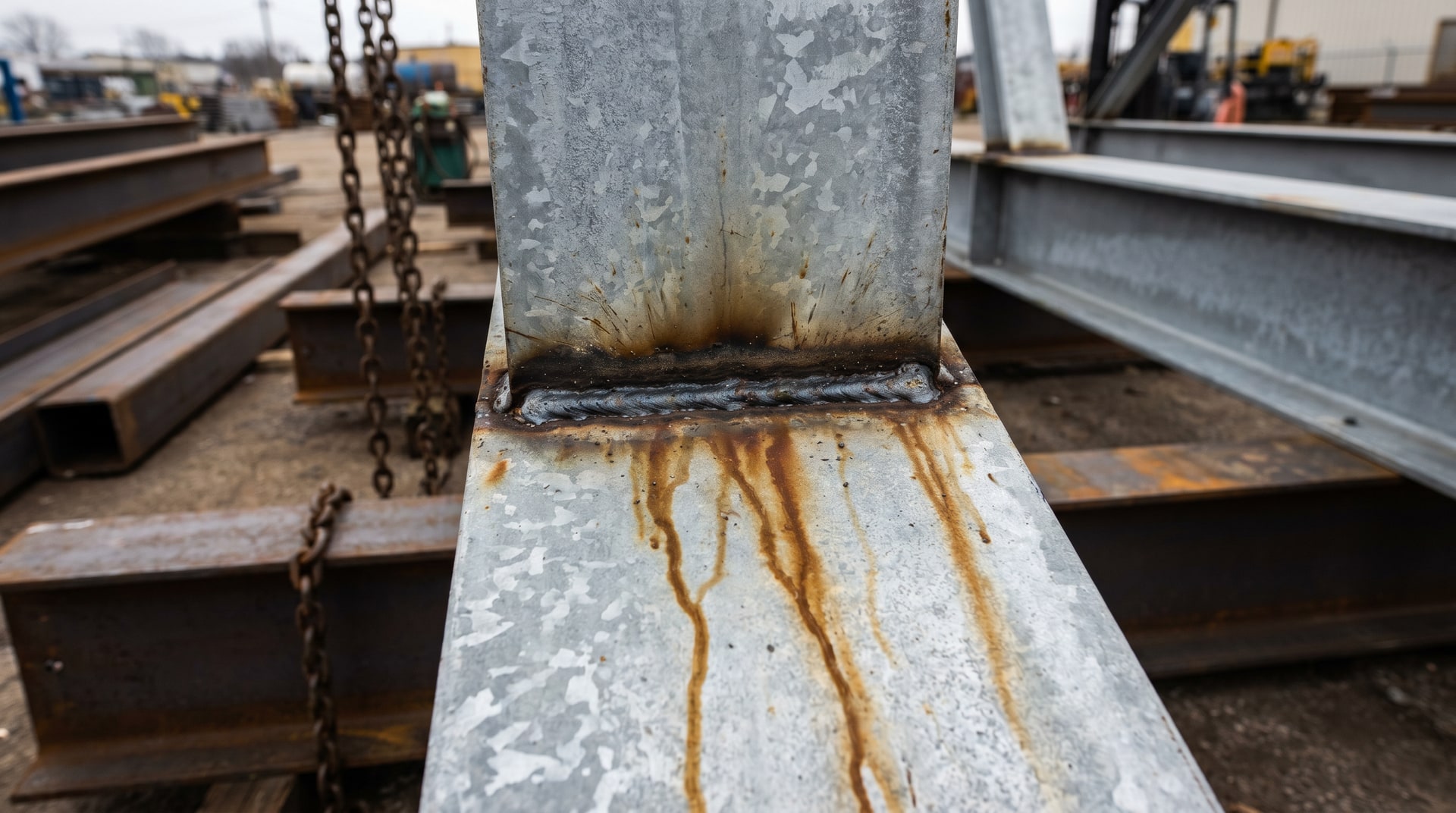
After a steel assembly comes out of the galvanizing kettle, inspectors and fabricators sometimes notice brown or rust-colored staining running down the zinc surface from a welded connection. The zinc coating itself looks intact everywhere else, but at the joint there is a visible streak, almost as if something is leaking outward from inside the weld. That is exactly what is happening. This condition is called a weeping weld, and it is one of the more common appearance-related surprises fabricators encounter when working with hot-dip galvanized assemblies for the first time.
Understanding why it happens, and more importantly how it can be prevented before the steel ever reaches the galvanizing line, is the difference between a clean, professional-looking product and one that generates unnecessary disputes about responsibility.
The American Galvanizers Association addresses this directly in their article on weeping welds. At V&S Galvanizing, we expand on that foundation to explain what is actually happening at the material level, how joint geometry influences the galvanizing process, and why this is often misunderstood in the field.
What a Weeping Weld Actually Looks Like
The visual signature of a weeping weld is fairly consistent. You will see a brownish or yellowish discoloration streaking downward from a weld joint, usually along a lap joint, a fillet-welded connection, or anywhere two overlapping steel surfaces are joined together. The staining can range from a faint tint to a heavier rust-like discoloration depending on how much trapped solution was present and how forcefully it expelled during the galvanizing process.
The zinc coating in the stained area is not necessarily thin or defective. The discoloration itself comes from the cleaning chemistry, not from a failure of the zinc to bond. This is an important distinction, because it means the structural and corrosion-protection performance of the coating is generally unaffected. The weeping weld is an appearance issue, not a coating failure.
That said, it is an appearance issue that is entirely preventable at the design and fabrication stage, which is why understanding the root cause matters.
The Mechanism Behind the Staining
Hot-dip galvanizing involves a sequence of chemical pretreatment steps before the steel ever touches molten zinc. Steel moves through degreasing, pickling in hydrochloric acid, and fluxing in a zinc ammonium chloride solution. These are not gentle surface treatments. They are aggressive chemical processes designed to remove mill scale, rust, oil, and oxides so that molten zinc at around 840 degrees Fahrenheit can form a true metallurgical bond with the steel surface.
When two pieces of steel are welded with a continuous bead that fully seals the joint, any gap between the overlapping surfaces becomes a closed cavity. That cavity traps cleaning solution during pretreatment. The solution cannot drain out, and because the weld bead seals the perimeter, it also cannot be rinsed out effectively between tanks. The trapped liquid remains inside the joint as the part enters the flux bath and, eventually, the galvanizing kettle.
When the assembly enters the molten zinc at approximately 840 degrees Fahrenheit, that trapped solution rapidly vaporizes and expands. The pressure forces the liquid outward through any micro-gaps or weld pores at the joint edge. As it bleeds out across the freshly galvanized surface, it leaves behind the characteristic brown staining. The staining is essentially the residue of the cleaning chemistry that was never able to escape cleanly.
Why Continuous Weld Beads Create the Problem
The geometry of a fully sealed, continuous weld bead is what creates the trap. When a fabricator runs an uninterrupted bead around the full perimeter of a lap joint or along both sides of a fillet connection with no designed drainage, they are enclosing whatever air and liquid happens to be between those two steel surfaces. The tighter the fit-up and the more complete the seal, the worse the entrapment problem becomes.
This is not a galvanizing problem in origin. It is a fabrication geometry problem that the galvanizing process reveals. The galvanizer has no way to fully evacuate a sealed cavity during pretreatment, and no practical method for preventing the bleed-out once the part is in the kettle. The cleaning chemistry has to go somewhere when it vaporizes, and it will find the path of least resistance.
It is also worth noting that some steel assemblies arrive with very tight lap joints where the surfaces are in near-contact. Even without a continuous weld bead, capillary action can draw cleaning solution deep into a very narrow gap. If that gap is small enough that zinc cannot penetrate it during galvanizing, the result is a space that holds liquid but cannot be filled with protective zinc coating. That combination is a setup for both weeping and for long-term corrosion at the faying surfaces.
The 3/32-Inch Gap Requirement and What It Accomplishes
The solution is straightforward once the mechanism is understood. The AGA specifies that a gap of 3/32 inch (2.4 mm) or larger should be maintained between the two steel pieces at welded connections. That dimension is not arbitrary. It is sized to allow molten zinc to physically flow into the joint during immersion.
Molten zinc has a relatively low surface tension compared to many metals, which means it can penetrate into reasonably small gaps if they are open and accessible. A 3/32-inch gap gives zinc enough clearance to enter the joint from the edges and fully coat the faying surfaces inside. When zinc is present throughout the joint, there is no sealed void for cleaning solution to become trapped in, and no uncoated steel surface left vulnerable to corrosion.
This design approach actually improves the corrosion resistance of the connection. A fully sealed continuous weld with trapped contamination and uncoated steel at the faying surfaces is structurally problematic over the long term. A properly spaced joint with zinc penetration protects those interior surfaces as effectively as the exterior faces of the steel.
Skip Welding: Stronger Than It Sounds
The companion to maintaining the gap is the welding technique used to close the joint. Instead of a continuous bead, the weld is made with intermittent passes, often called skip welding or stitch welding. The AGA is explicit on this point: the weld must be made with gaps rather than a continuous bead. These gaps are placed deliberately to allow zinc to penetrate the joint during galvanizing.
The phrase "actually making a stronger joint when the process is complete" from the AGA source reflects an important truth about how zinc interacts with a properly designed skip-welded connection. Because zinc infiltrates the joint and bonds metallurgically to both steel surfaces inside, the connection gains corrosion protection at the faying surfaces. A continuous sealed bead might feel like the more robust choice from a purely structural standpoint, but when galvanizing is part of the specification, the sealed weld introduces vulnerabilities that the skip weld avoids.
From a structural engineering perspective, skip welds are routinely specified in structural steel design precisely because they balance connection strength with practical fabrication requirements. When galvanizing is added to the equation, the skip weld is not a compromise. It is the correct specification for the application.
Responsibility: Who Owns This Defect
This is where the topic becomes commercially sensitive. When a weeping weld shows up on a finished galvanized assembly, the natural instinct for a fabricator or owner is to look at the galvanizer. The zinc is stained. The galvanizer applied the zinc. The connection between cause and party seems obvious.
But the AGA is unambiguous: weeping welds are not the responsibility of the galvanizer and are not cause for rejection. The reasoning follows directly from the mechanism. The galvanizer has no control over how the steel was designed or fabricated. If the joint geometry traps cleaning solution, that is a condition created at the design and fabrication stage, well before the steel arrives at the galvanizing plant. The galvanizer cannot predict which joints will weep, cannot physically evacuate sealed cavities during pretreatment, and cannot prevent the bleed-out once the assembly enters the kettle.
This does not mean the galvanizer has no role in quality outcomes. Our team at V&S Galvanizing routinely reviews fabrication drawings and communicates with fabricators before material is processed when we identify potential issues. If we see a lap joint specification that is likely to cause problems, we say so. But once the steel is fabricated with sealed continuous welds, there is no process adjustment on the galvanizing side that eliminates the risk of weeping. The solution has to come from upstream in the design and fabrication process.
For anyone writing galvanizing specifications, this is worth documenting clearly in the project requirements. Specifying hot-dip galvanizing per ASTM A123 should be accompanied by fabrication guidance that addresses joint design, including the 3/32-inch gap requirement and skip weld specifications at all lap and fillet-welded connections.
What Happens If a Weeping Weld Does Occur
If a weeping weld shows up on a delivered assembly, the first question to ask is whether the staining is purely cosmetic or whether there is a coating performance concern. In most cases, the zinc coating itself is intact and meets thickness requirements away from the stained zone. The brown discoloration is surface contamination from the expelled cleaning solution, not evidence of a coating defect.
That said, the area at the weld joint itself warrants a closer look. If cleaning solution was forced out under pressure, there may be a narrow zone at the very edge of the weld where zinc adhesion was compromised or where bare steel was exposed. Those areas can be addressed with zinc-rich paint or other approved touch-up methods consistent with ASTM A780 recommendations. The touch-up does not restore the metallurgical bond of hot-dip zinc, but it does provide corrosion protection at isolated points.
The more important question is whether the sealed joint now contains uncoated steel on the faying surfaces. If zinc could not penetrate the joint because the gap was insufficient, those interior surfaces are bare. In a corrosive environment, moisture can eventually infiltrate the joint and reach unprotected steel. Over time, corrosion at the faying surfaces can cause visible rust staining and potential pack-rust expansion. This is a long-term durability concern that goes beyond aesthetics and is the stronger argument for getting the joint design right from the beginning.
Design Guidance for Fabricators Working With Galvanizing Specifications
The simplest way to prevent weeping welds is to build the 3/32-inch gap requirement into fabrication drawings and welding procedure specifications from the start. This is a design-stage decision that costs nothing once it becomes standard practice for projects involving hot-dip galvanizing.
A few practical considerations are worth keeping in mind. The gap must be consistent along the joint, not just nominal. Fit-up variation during fabrication can close a designed gap to near-zero at certain points, reintroducing the capillary entrapment problem. Shop drawings and welding procedures should specify not just the gap dimension but the inspection criteria for verifying it before welding.
Skip weld patterns should be laid out so that the open intervals are positioned to allow both drainage during pretreatment and zinc penetration during galvanizing. The orientation of the part during galvanizing affects how zinc flows, and communication between the fabricator and the galvanizer about planned part orientation can help ensure that the weld gaps are located where they will be most effective. Our team is available to review drawings and provide input at the fabrication planning stage, which is where these decisions have the most impact.
Work With a Team That Catches These Issues Before They Become Problems
Weeping welds are a reliable indicator of a design or fabrication decision that did not account for the realities of the hot-dip galvanizing process. They are not failures of the zinc coating, and they are not the galvanizer's responsibility under any standard interpretation of the applicable specifications. But that does not make them acceptable to an end client who is receiving a stained assembly. The practical impact falls on everyone in the supply chain when the root cause is not addressed upstream.
At V&S Galvanizing, we treat pre-fabrication coordination as a core part of what we offer. Understanding how joint geometry, weld design, and galvanizing interact is exactly the kind of technical knowledge that prevents inspection disputes and rework. When the design is right, the galvanized product is right.
If you are working on a project that involves galvanized assemblies with welded connections and want to make sure your fabrication details align with galvanizing requirements, reach out to our team through our contact page. We are glad to review drawings and provide guidance before material reaches the shop floor.
Frequently Asked Questions About Weeping Welds in Hot-Dip Galvanizing
What is a weeping weld in hot-dip galvanizing?
A weeping weld is a condition where brown or rust-colored staining appears on the zinc surface at a welded joint after galvanizing. It is caused by cleaning solution that became trapped inside a sealed weld joint during the pretreatment process and was forced outward when the steel entered the molten zinc bath. The staining is a residue of that expelled chemistry, not a zinc coating defect.
What causes cleaning solution to become trapped in a weld joint?
When two steel pieces are joined with a continuous weld bead that fully seals the perimeter of a lap or fillet joint, any liquid present between the faying surfaces during pretreatment has no path to drain or rinse out. The sealed cavity retains acid pickle solution and flux, which then vaporize under the heat of the galvanizing kettle and are expelled through weld pores or micro-gaps at the joint edge.
How do you prevent a weeping weld?
The AGA recommends maintaining a minimum 3/32-inch (2.4 mm) gap between the two steel surfaces at welded connections, and using skip welding rather than a continuous bead. The gap allows molten zinc to penetrate the joint during galvanizing, eliminating the sealed void and providing corrosion protection to the faying surfaces.
Is the galvanizer responsible for weeping welds?
No. The American Galvanizers Association is explicit that weeping welds are not the responsibility of the galvanizer and are not cause for rejection. The condition originates from joint design and welding practice at the fabrication stage. Once steel arrives with sealed continuous welds at lap joints, the galvanizer has no practical method to prevent the bleed-out.
Does a weeping weld mean the zinc coating is defective?
Not necessarily. The brown staining is surface contamination from expelled cleaning solution, not evidence of poor zinc adhesion or inadequate coating thickness on the broader steel surface. However, the joint area itself should be inspected to confirm there are no zones of bare steel at the weld edge, and the interior faying surfaces may be uncoated if zinc could not penetrate the joint.
Why does the AGA say a skip-welded joint is actually stronger after galvanizing?
When a 3/32-inch gap is maintained and a skip weld pattern is used, molten zinc penetrates the joint and metallurgically bonds to both steel surfaces inside the connection. This gives the faying surfaces the same corrosion protection as the exterior faces. A sealed continuous weld, by contrast, may leave uncoated steel inside the joint that is vulnerable to corrosion over time, which can undermine long-term structural integrity at the connection.
Can weeping weld staining be removed or repaired?
The surface discoloration from a weeping weld can sometimes be reduced through light cleaning, but the more relevant repair question is whether any bare steel is present at the weld edge or on the faying surfaces. Those areas can be touched up with zinc-rich paint or other methods consistent with ASTM A780. The cosmetic staining on the surrounding zinc surface does not typically affect coating performance.
At what stage in a project should joint design for galvanizing be addressed?
The 3/32-inch gap requirement and skip weld specification should be incorporated into fabrication drawings and welding procedure specifications before fabrication begins. Addressing this at the design stage costs nothing and eliminates the problem entirely. Attempting to correct sealed joints after fabrication is either impractical or requires rework that could have been avoided entirely with upstream coordination.
