

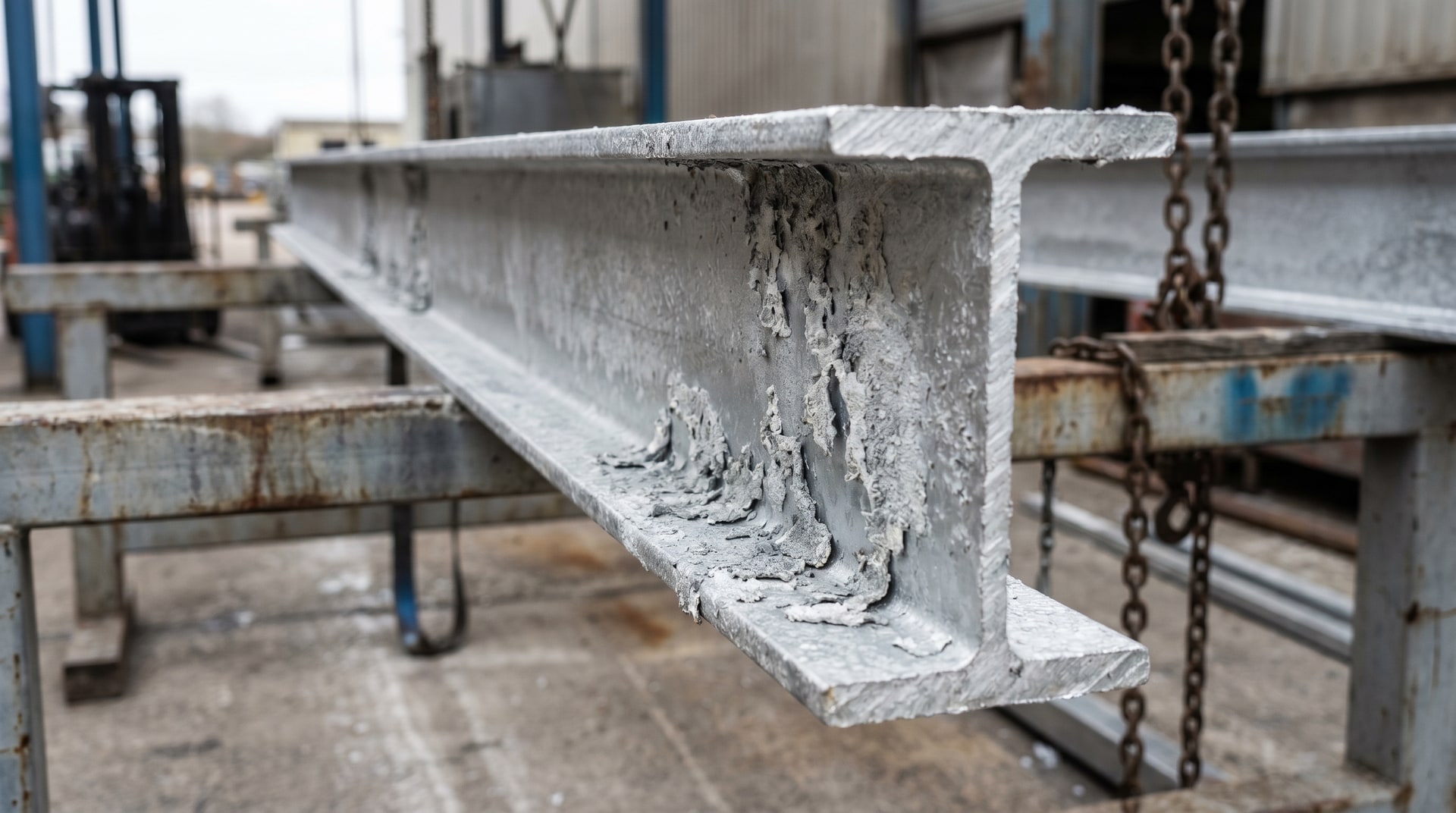
Anyone who has spent time on the floor of a galvanizing facility has seen it: a piece of steel pulled from the molten zinc bath with what looks like a rough, crusty patch clinging to its surface. It can look alarming at first glance, especially to an inspector or engineer unfamiliar with the process. The instinct is often to flag it, reject it, or demand an explanation. In most cases, however, that surface irregularity is simply a zinc skimming deposit, and it tells you far less about the quality of the underlying coating than its appearance might suggest.
The American Galvanizers Association addresses this directly in their article on zinc skimmings. At V&S Galvanizing, we expand on that foundation to explain what is actually happening at the material level, how the withdrawal process influences where skimmings land, and why this is often misunderstood in the field.
What Zinc Skimmings Actually Are
Zinc skimmings are a natural byproduct of the hot-dip galvanizing process. During galvanizing, the surface of the molten zinc bath is never perfectly clean. A combination of zinc oxides, zinc chloride residues, iron-zinc compounds, and flux byproducts accumulates continuously on the bath surface. This material is collectively referred to as dross and skimmings, though galvanizers typically distinguish between the two: dross settles to the bottom of the kettle as a heavy iron-zinc intermetallic compound, while skimmings float on the surface as a lighter, more heterogeneous mixture of oxides and flux remnants.
The skimmings layer is a persistent feature of any operating galvanizing kettle. It forms because zinc oxidizes readily when exposed to air, and the flux materials used earlier in the process leave behind residues that float at the zinc-air interface. Galvanizers manage this layer by periodically pushing it to the side or skimming it off the bath surface entirely. When the process runs smoothly, a clear path through the zinc surface is opened during steel withdrawal, allowing the part to exit the bath with a clean, continuous zinc coating.
How Skimmings End Up on the Steel Surface
The mechanism behind zinc skimming deposits is straightforward once you understand the geometry of the withdrawal step. When a fabricated steel part is lifted out of the molten zinc bath, it breaks the surface of the liquid zinc. At that moment, whatever is floating on the bath surface has the potential to be dragged along with the part as it rises through the interface.
Under ideal conditions, the galvanizer positions the part at an angle during withdrawal. This allows liquid zinc to drain efficiently and gives the operator access to push surface skimmings clear of the exit path before the steel fully clears the bath. However, not every part geometry allows for this. Complex assemblies, parts with internal cavities, very large structural members, or assemblies hung in a particular orientation may limit how much control the operator has during withdrawal. When there is no clear access to push skimmings aside, the steel passes through the floating layer and carries those deposits up with it.
Once the part exits the bath and the zinc solidifies, those skimming deposits are frozen in place on the coating surface. The result is a rougher, sometimes granular or flaky-looking patch that stands out visually against the surrounding galvanized surface.
Why This Is Not a Coating Defect
Here is where the misunderstanding most commonly occurs in the field: zinc skimming deposits look like damage, but they are not. The AGA is explicit on this point. Zinc skimming deposits are not grounds for rejection.
The reason comes down to what is underneath those deposits. The skimmings sit on top of the zinc coating, not in place of it. The metallurgical bond between the steel and the zinc alloy layers forms during immersion, not during withdrawal. By the time the steel exits the bath, the intermetallic zinc-iron layers have already formed at the steel surface. Those layers are the structural foundation of the galvanized coating, and they are unaffected by what accumulates on the outer surface during withdrawal.
When skimming deposits are removed, the zinc coating beneath them is intact. It has not been thinned, disrupted, or compromised by the presence of the skimmings. The coating meets the same performance and specification requirements as any other area of the galvanized surface.
The Metallurgical Reality Underneath
To appreciate why skimmings cause no harm to the coating, it helps to understand the layer structure that forms during hot-dip galvanizing. When steel is immersed in molten zinc at approximately 840 degrees Fahrenheit, a diffusion reaction begins almost immediately at the steel-zinc interface. Zinc atoms migrate into the steel surface, and iron atoms migrate outward into the zinc, forming a series of intermetallic phases.
These phases, progressing from the steel surface outward, include the gamma phase (the thinnest and most iron-rich), the delta phase, the zeta phase, and finally an outer layer of relatively pure zinc called the eta layer. Together, these layers make up the galvanized coating. The eta layer is the outermost zinc, and it is what you see and touch on the surface of a galvanized part.
Zinc skimmings that attach during withdrawal sit on top of this eta layer. They are a surface contaminant, not a structural component of the coating. Their presence does not alter the thickness or integrity of the layers below them. This is why their removal leaves the coating undamaged.
Removing Zinc Skimmings in Practice
Removing skimming deposits is a routine part of finishing galvanized work. The process is straightforward and does not require anything that would harm the underlying coating. Because the skimmings are not metallurgically bonded to the zinc surface in the same way the intermetallic layers are, they can typically be knocked or scraped away with relatively modest mechanical effort.
What the galvanizer or inspector finds after removal is a zinc surface that may be slightly different in appearance from the surrounding area but is nonetheless functional and conforming. The coating thickness in that area is not reduced to below specification by the skimming event itself, and the adhesion of the remaining zinc is not affected.
In our experience at V&S Galvanizing, skimming deposits are most commonly encountered on large structural assemblies where the sheer size of the part limits the operator's ability to maneuver skimmings out of the withdrawal path. This is not a process failure. It is a physical consequence of working with large parts in a constrained operating environment.
Common Misconceptions Among Inspectors and Engineers
One of the most persistent misconceptions we encounter is the assumption that any surface irregularity on a galvanized part is evidence of a defect in the coating. Zinc skimmings are often confused with bare spots, flux inclusions that indicate poor surface preparation, or cold shuts caused by premature solidification of zinc during withdrawal. These are distinct phenomena with different causes and different implications.
A bare spot is an area where no zinc coating was deposited, typically due to inadequate surface preparation or air pockets trapped during immersion. A zinc skimming deposit is the opposite situation: there is extra material on the surface, not a lack of it. Treating a skimming deposit as equivalent to a bare spot would lead to unnecessary rejection of conforming work.
Another misconception is that the rough texture left after skimming removal indicates that the underlying zinc was disrupted. In fact, that texture often simply reflects the natural surface character of the zinc in that area, which may have solidified slightly differently than the surrounding material due to the thermal conditions at the moment of withdrawal. Texture variation in galvanized coatings is normal and does not predict performance differences.
Engineers reviewing galvanized fabrications should also be aware that ASTM A123, the primary specification governing hot-dip galvanized coatings on structural steel, does not treat zinc skimming deposits as a basis for rejection. The specification focuses on coating thickness, adherence, and the absence of genuine defects such as bare spots. Skimmings fall outside the category of defects as defined by that standard.
Design and Fabrication Factors That Influence Skimming Occurrence
While zinc skimmings are not harmful to the coating, it is worth understanding what fabrication decisions can make them more or less likely. Part geometry is the primary driver. Assemblies with tight internal angles, closely spaced members, or geometries that force withdrawal in a single fixed orientation are more prone to skimming deposits because the operator has fewer options for clearing the bath surface ahead of the exiting steel.
Fabricators who design for galvanizing can reduce skimming occurrence by considering withdrawal geometry early in the design process. Parts that can be hung at an angle, that have sufficient vent holes for drainage, and that do not trap air or zinc internally tend to give the galvanizer more control at the withdrawal stage. This is one of the practical reasons why early coordination between the design team and the galvanizer matters, even for what might seem like purely cosmetic outcomes.
That said, it is important not to overstate the problem. Zinc skimmings are a recognized and accepted feature of hot-dip galvanizing on complex work. They do not indicate poor galvanizing quality. They are a natural consequence of working with a process that involves a floating surface layer on a liquid metal bath.
What Happens to Corrosion Resistance in Areas Where Skimmings Were Present
A reasonable engineering question is whether the removal of skimming deposits changes the corrosion performance of the galvanized coating in that area. The short answer is no, provided the underlying coating meets the required thickness and the zinc-iron intermetallic layers are intact.
Corrosion protection in hot-dip galvanized steel comes from two mechanisms working together. The first is the barrier effect: zinc physically separates the steel from the environment. The second is cathodic protection: because zinc is electrochemically active relative to iron, it sacrifices itself preferentially when both metals are exposed to a corrosive electrolyte, protecting the steel even at small gaps or scratches. Both mechanisms depend on the presence of the zinc coating itself, not on the surface texture or the presence of any superficial skimming material.
After skimming deposits are removed and the underlying coating is confirmed to be intact, the corrosion resistance of that area is equivalent to any other conforming area of the galvanized surface. There is no residual penalty from the skimming event.
Work With a Team That Understands What Matters in Galvanized Coatings
Zinc skimmings are one of the more frequently misunderstood surface conditions in hot-dip galvanized steel, not because they are technically complex, but because they look more serious than they are. Understanding that they sit on top of an intact coating, that their removal causes no harm, and that they are explicitly excluded from rejection criteria under applicable standards is the kind of working knowledge that prevents unnecessary disputes, rework, and project delays.
At V&S Galvanizing, our team brings this level of process knowledge to every project. We work with engineers, fabricators, and inspectors to identify what genuinely matters in a galvanized coating and to provide clear, technically grounded answers when questions arise on the floor or in the field. If you have questions about zinc skimmings, surface conditions, coating specifications, or anything else related to the galvanizing of your fabricated steel, we encourage you to reach out through our contact page.
Frequently Asked Questions About Zinc Skimmings
Are zinc skimmings a reason to reject galvanized steel?
No. Zinc skimming deposits are not grounds for rejection. The AGA explicitly states this, and the underlying zinc coating beneath the skimmings is not harmed during their removal. The coating meets applicable specifications once the skimmings are removed.
What causes zinc skimmings to form on galvanized steel?
Zinc skimmings form when surface material floating on the molten zinc bath (a mixture of zinc oxides, flux residues, and iron-zinc compounds) cannot be cleared away before the steel is withdrawn from the kettle. When the withdrawal path does not allow the operator to push skimmings aside, they are carried up with the steel and solidify on the coating surface.
Does removing zinc skimmings damage the coating underneath?
No. The zinc coating beneath skimming deposits is intact and unaffected by their presence or removal. The intermetallic zinc-iron layers that form during immersion are already established before withdrawal, and skimmings rest on top of those layers rather than replacing them.
How do zinc skimmings differ from bare spots on galvanized steel?
Bare spots are areas where no zinc coating was deposited, typically caused by surface preparation failures or trapped air during immersion. Zinc skimmings are the opposite: excess surface material carried onto an otherwise coated area. They are unrelated conditions with very different implications. Skimmings are not a defect; bare spots may be, depending on their size and location.
Does the presence of zinc skimmings affect corrosion resistance?
No. Once skimming deposits are removed and the underlying zinc coating is confirmed to be intact and of adequate thickness, the corrosion resistance in that area is equivalent to the rest of the galvanized surface. Both the barrier protection and cathodic protection mechanisms of the zinc coating remain fully functional.
What part geometries are most likely to result in zinc skimming deposits?
Complex assemblies with tight internal angles, large structural members that must be withdrawn in a fixed orientation, or parts that restrict the operator's ability to clear the bath surface during withdrawal are most prone to skimming deposits. Design choices that allow angled withdrawal, drainage, and clear access to the exit path reduce the likelihood of skimmings.
Does ASTM A123 address zinc skimmings as a defect?
ASTM A123, the primary specification for hot-dip galvanized coatings on structural steel, focuses on coating thickness, adherence, and the absence of genuine defects such as bare spots. Zinc skimming deposits are not classified as defects under this standard and are not a basis for rejection when the underlying coating meets the required criteria.
Can design changes reduce zinc skimming occurrence without compromising the galvanized coating quality?
Yes. Fabricators who coordinate with their galvanizer early in the design process can orient parts for angled withdrawal, include adequate vent and drain holes, and avoid geometries that trap the operator into a single fixed withdrawal path. These changes give the galvanizer more control at the bath surface and reduce the frequency of skimming deposits, though they will not always eliminate them entirely on complex work.
