

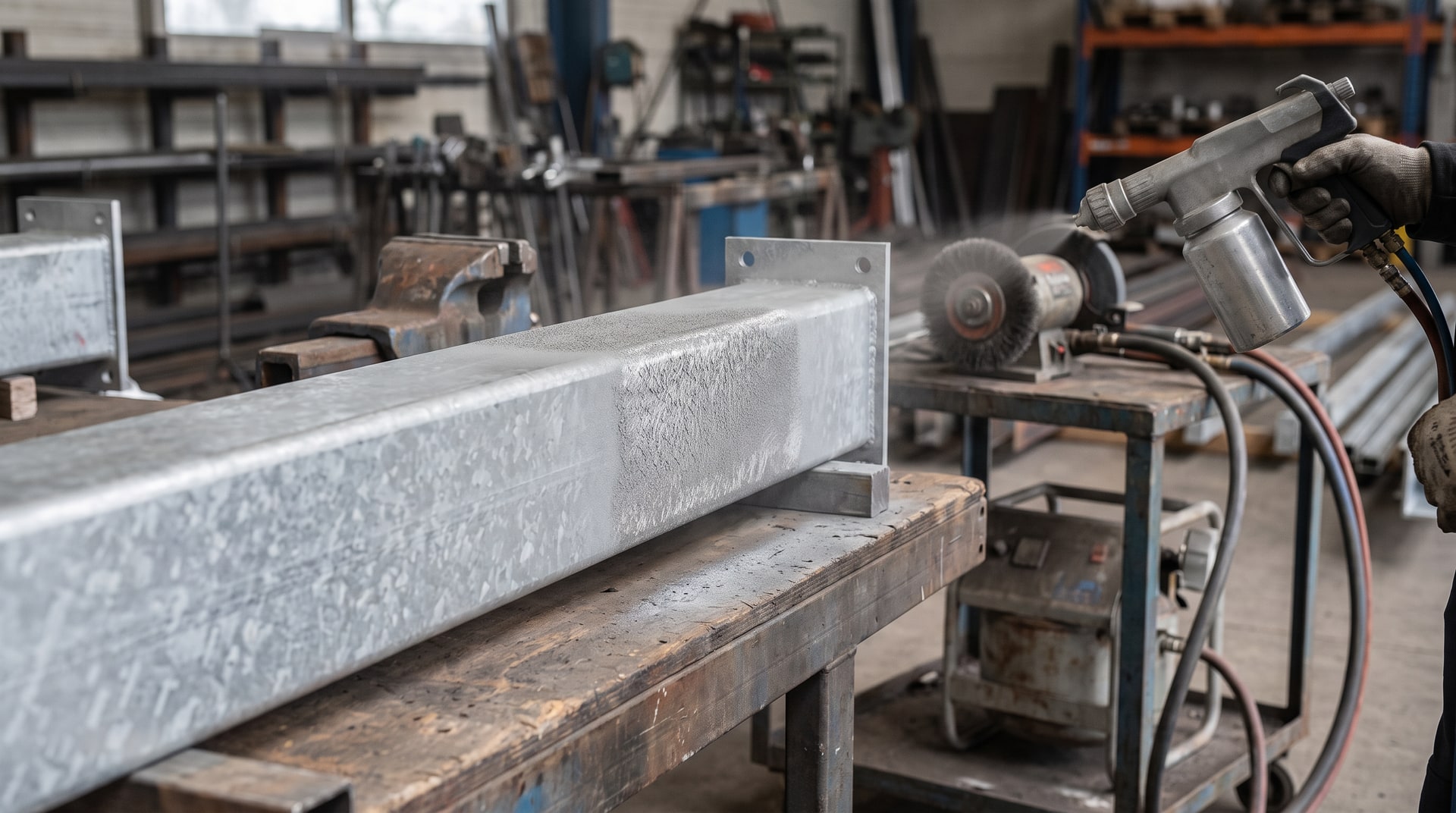
When a hot-dip galvanized steel component leaves the galvanizing plant, it is ready for decades of standalone corrosion protection. But when that same component is destined for a paint or powder coating topcoat, something changes. The surface that was perfectly acceptable under galvanizing standards may not yet be acceptable for coating adhesion. And here is where projects run into trouble: when no one has clearly established who is responsible for getting the surface ready for the painter or powder coater.
In practice, the galvanizer and the coating applicator are often two completely separate companies. The fabricator may have sent parts through a galvanizer without telling them the parts would be painted afterward. The painter may receive the galvanized components and assume they are ready to coat. Neither party filled in the gap, and the result is poor adhesion, a lumpy finish, or premature coating failure. This is not a hypothetical scenario. It happens regularly on real projects.
The American Galvanizers Association addresses this directly in their article on responsibilities for surface preparation prior to painting or powder coating HDG. At V&S Galvanizing, we expand on that foundation to explain what is actually happening at the material level, how surface condition influences coating performance, and why this division of responsibility is often misunderstood in the field.
Why Surface Condition Matters Differently in a Duplex System
Hot-dip galvanizing produces a zinc coating that bonds metallurgically to the steel substrate. That zinc layer provides excellent corrosion protection on its own, and ASTM A123/A123M defines what an acceptable galvanized coating looks like. Under that standard, surface features like minor roughness, small dross inclusions, and zinc runs are considered acceptable because they do not meaningfully affect the corrosion protection the zinc provides.
Paint and powder coating operate on a completely different adhesion mechanism. Instead of metallurgical bonding, they rely on mechanical and chemical adhesion to the surface they are applied to. That means a zinc surface that passes every ASTM A123 check can still be problematic as a substrate for paint or powder coating. Roughness that is inconsequential for bare galvanized performance can translate directly into a lumpy, uneven topcoat. Zinc runs that do not compromise corrosion protection can create adhesion weak points under a paint film.
This is the fundamental reason that ASTM D6386 (for painting over HDG) and ASTM D7803 (for powder coating over HDG) exist as separate standards from ASTM A123. They address the surface from the perspective of the coating applicator, not the galvanizer. Understanding that distinction is the first step to getting the duplex system right.
The 2015 Revision to ASTM A123 That Changed How Responsibility Is Defined
For a long time, the question of who handled surface preparation before painting or powder coating was left largely to informal agreement between parties. The 2015 revision to ASTM A123/A123M addressed this gap directly by updating Sections 6.2 and 6.4 with explicit language about responsibility. Both sections now include identical wording to make the division of labor clear.
The specification language reads: "Surface roughness of articles to be painted or powder coated and the smoothing of the galvanized coating before painting or powder coating shall be mutually determined by the galvanizer and the purchaser. Further preparation of galvanized coatings for painting or powder coating including cleaning, profiling and outgassing shall be in accordance with Practice D6386 for painting and Practice D7803 for powder coating and are the responsibility of the paint or powder coating applicator."
That language draws a clear line. Surface smoothing sits in a shared zone that requires communication between parties. Everything beyond smoothing, including cleaning, profiling, and outgassing, belongs to the paint or powder coating applicator. What this revision accomplished was to remove ambiguity from a process step that had caused adhesion failures and project disputes for years.
The First Step That Is Easy to Overlook: Post-Treatment Restrictions
Before any surface preparation discussion even begins, there is a step that must happen before the steel ever enters the galvanizing kettle, or at minimum before it exits the process. The galvanizer needs to know the steel is going to be painted or powder coated afterward.
Why does this matter so early? Because galvanizers routinely apply post-treatments after galvanizing as part of their standard process. Water quenching and chromate quenching are common examples. These treatments serve legitimate purposes for bare galvanized steel, including minimizing wet storage stain and controlling the appearance of the freshly galvanized surface. But they are problematic for duplex systems. Chromate conversion coatings in particular can interfere with paint and coating adhesion, creating a barrier between the zinc surface and the applied topcoat.
The responsibility here sits with the customer or the party coordinating paint application. They need to communicate the duplex system intent to the galvanizer ahead of time. Once informed, the galvanizer takes on responsibility for ensuring no post-treatments are applied that would compromise the subsequent coating step. This communication has to happen before galvanizing, not after the parts come out looking different than expected.
Surface Smoothing: The Step That Requires Genuine Coordination
Surface smoothing is the most genuinely collaborative step in the process, and it is the one most likely to fall through the cracks when communication is informal. ASTM A123 places this in a shared responsibility zone for a good reason: both parties have relevant information that the other does not.
The galvanizer understands what the surface looks like after processing and what smoothing operations are feasible given the geometry and alloy characteristics of the steel. The paint or powder coating applicator understands what surface profile and smoothness their process requires to achieve good adhesion and an acceptable finish. Neither party can make a fully informed decision without the other.
The surface smoothing requirements themselves are defined in ASTM D6386 Section 5.2 for painting and ASTM D7803 Section 5.1.1 for powder coating. Critically, ASTM A123 now specifies that responsibility for smoothing should be agreed upon before hot-dip galvanizing takes place, not after the fact when the parts are already coated and waiting for paint. That sequencing matters because some smoothing approaches are easier to perform before the steel goes through the galvanizing process, while others are appropriate afterward.
In our experience, the most common failure point here is not disagreement but silence. When the galvanizer and painter never discuss smoothing requirements, each assumes the other has it handled, and neither does. The result shows up in the finished coating.
Cleaning, Profiling, and Outgassing: The Applicator's Domain
Beyond surface smoothing, the remainder of the preparation work belongs firmly to the paint or powder coating applicator. This includes cleaning the surface to remove contaminants, profiling the surface to create the mechanical tooth that allows the topcoat to bond, and, for powder coating specifically, outgassing.
Cleaning matters because galvanized steel that has been handled, stored, or shipped can accumulate oils, handling residue, and environmental contaminants that will interfere with adhesion even on an otherwise well-prepared surface. The applicator is the party with direct control over the surface at the point of coating application, which is why this responsibility sits with them.
Profiling creates microscopic surface texture that gives paint or powder coating mechanical grip on the zinc surface. The appropriate profiling method and profile depth depend on the specific coating system being applied and the condition of the galvanized surface. ASTM D6386 and D7803 both address this based on surface condition categories: newly galvanized, partially weathered, and fully weathered surfaces each have different requirements because the zinc surface chemistry and texture change as the coating ages and weathers.
Outgassing is unique to powder coating and deserves specific attention. During the powder coating cure cycle, heat drives trapped gases out of the zinc coating. If the powder coat has already begun to cure and cross-link when those gases escape, the result is pinholes or blistering in the finished surface. The standard practice to prevent this is a pre-heat step that allows the substrate to outgas before powder is applied. Because this step is entirely within the powder coater's process, ASTM A123 correctly assigns it to them.
How Surface Condition Categories Affect What Preparation Is Required
Not every galvanized surface requires the same preparation steps, and both ASTM D6386 and ASTM D7803 recognize this by categorizing surfaces as newly galvanized, partially weathered, or fully weathered. Each condition presents a different surface chemistry and texture, and the preparation approach differs accordingly.
Newly galvanized steel has a bright, often smooth surface with a relatively alkaline pH and zinc oxide and zinc hydroxide compounds forming on the surface. This can make it challenging for paints to wet out properly. Profiling is often more critical at this stage to give the coating system something to mechanically grip.
Partially weathered zinc has begun to develop a zinc carbonate patina, commonly called the natural patina, which provides a slightly better surface for coating adhesion than bare new zinc. The surface is more chemically stable and typically easier to coat with proper cleaning and profiling.
Fully weathered zinc with an established carbonate patina generally provides the most favorable surface for coating, though cleaning to remove any biological growth, chalk, or accumulated contamination remains important.
The applicator's responsibility to follow ASTM D6386 or D7803 is not simply a formality. Those standards contain the practical guidance for identifying which category a surface falls into and what preparation is required for each. Skipping this assessment step is a common source of coating system failures in duplex applications.
What This Means for Project Coordination and Specification Writing
From a project management perspective, the implications of ASTM A123's updated language are straightforward but require proactive action. The conversation about surface preparation responsibilities cannot wait until the galvanized parts arrive at the painting facility. It needs to happen at the specification stage, before fabrication, and certainly before galvanizing.
For specifiers and engineers, this means writing procurement documents and scope-of-work agreements that explicitly address who handles each preparation step. The updated ASTM A123 language provides a solid framework for this, but it only works if the parties involved are aware of it and structure their agreements accordingly.
For contractors managing subcontractors, it means ensuring the galvanizer and coating applicator communicate directly about the specific components being processed. A general statement that parts will be painted is not sufficient. The coating applicator's requirements for surface smoothness and profile should be relayed to the galvanizer before processing.
At V&S Galvanizing, we encounter duplex system projects regularly, and the ones that go smoothly share one characteristic: someone took responsibility early in the process for making sure all parties understood their role. The ones that result in callbacks and rework almost always trace back to a gap in that early communication.
Common Misconceptions That Lead to Coating Failures
One of the most persistent misconceptions in duplex system work is that a galvanized surface that looks clean and smooth is ready to coat. Visual appearance is not a reliable indicator of surface chemistry or surface profile. A freshly galvanized part can look bright and smooth and still have chromate residue from a post-treatment quench that will prevent adhesion. A weathered part can look dull and textured and actually be in better condition for painting than it appears.
Another common misconception is that the galvanizer is responsible for the complete surface preparation package because they processed the steel most recently. The updated ASTM A123 language is explicit that cleaning, profiling, and outgassing fall to the applicator. The galvanizer's responsibility ends at ensuring no interfering post-treatments were applied and, in coordination with the purchaser, at surface smoothing. Expecting the galvanizer to hand off a coat-ready surface without this coordination specified and agreed to is a setup for missed steps.
Finally, some project teams assume that the duplex system adhesion is the galvanizer's problem if it fails. In reality, adhesion failures almost always trace back to preparation steps performed, or skipped, by the applicator. The zinc coating itself is not the failure mode; the interface between the zinc and the topcoat is. That interface is prepared and controlled by the applicator, which is precisely why the standards assign responsibility there.
Work With a Team That Understands the Full Duplex System Picture
Surface preparation for painting or powder coating over hot-dip galvanized steel is not a single task with a single owner. It is a shared process that spans the galvanizer's shop and the coating applicator's facility, governed by multiple ASTM standards that each address a different stage of that process. ASTM A123/A123M defines the galvanized coating itself and splits surface smoothing responsibility between parties. ASTM D6386 and D7803 govern the applicator's preparation steps for painting and powder coating respectively. The 2015 revision to ASTM A123 made this division explicit in ways that provide a clear framework for project coordination, but only if the parties involved know it exists and act on it early.
At V&S Galvanizing, we work with fabricators, engineers, and contractors on projects where the galvanized coating is the first layer in a duplex system. We know where the communication gaps typically occur, and we help our customers get ahead of them before they become finish quality problems. If you are specifying or coordinating a project that involves painting or powder coating over galvanized steel and want to make sure the surface preparation responsibilities are defined correctly from the start, reach out through our contact page and we can walk through the specifics with you.
Frequently Asked Questions About Surface Preparation for Painting and Powder Coating Over HDG
Who is responsible for cleaning and profiling a hot-dip galvanized surface before painting?
Under ASTM A123/A123M (updated in 2015), cleaning and profiling of hot-dip galvanized steel prior to painting are the responsibility of the paint applicator. These steps must be performed in accordance with ASTM D6386. The galvanizer is not responsible for these steps unless separately contracted to perform them.
Why does the galvanizer need to know a part will be painted before processing it?
The galvanizer needs advance notice because standard post-treatments such as water quenching or chromate quenching can interfere with paint adhesion. When informed ahead of time that a part will be painted or powder coated, the galvanizer is responsible for omitting these post-treatments so the zinc surface is compatible with subsequent coating steps.
What is the surface smoothing step and who handles it?
Surface smoothing addresses roughness, zinc runs, and similar surface irregularities on the galvanized coating that could affect the appearance or adhesion of a paint or powder coat topcoat. ASTM A123 places this in a shared responsibility zone: the galvanizer and the purchaser must mutually determine and agree on responsibility for smoothing before hot-dip galvanizing takes place. Requirements are defined in ASTM D6386 Section 5.2 (painting) and ASTM D7803 Section 5.1.1 (powder coating).
What is outgassing in powder coating over galvanized steel and why does it matter?
Outgassing refers to gases escaping from the zinc coating when it is heated during the powder coat cure cycle. If the powder has begun to cure when this happens, the escaping gases create pinholes or blistering in the finished surface. The standard mitigation is a pre-heat step before powder application, which allows outgassing to occur before the coating is applied. This step is the responsibility of the powder coat applicator.
Does a surface condition that passes ASTM A123 automatically pass requirements for painting or powder coating?
No. ASTM A123/A123M governs the galvanized coating itself and allows surface conditions such as minor roughness, dross inclusions, and zinc runs that do not affect corrosion protection. These same features can negatively affect adhesion of a topcoat. Painting and powder coating over HDG are governed separately by ASTM D6386 and ASTM D7803, which have different surface requirements focused on coating adhesion rather than corrosion protection alone.
How do surface preparation requirements differ for newly galvanized versus weathered galvanized steel?
Both ASTM D6386 and ASTM D7803 define three surface condition categories: newly galvanized, partially weathered, and fully weathered. Each category has different preparation requirements because the zinc surface chemistry and texture change as the coating ages. Newly galvanized surfaces typically require more attention to profiling for adhesion, while fully weathered surfaces with an established zinc carbonate patina are generally more receptive to topcoats but still require cleaning to remove contamination.
What ASTM standards govern surface preparation responsibilities for duplex systems?
Three standards govern this area together. ASTM A123/A123M covers the hot-dip galvanized coating and, since its 2015 revision, explicitly defines responsibility boundaries for surface preparation steps. ASTM D6386 covers preparation of zinc-coated steel surfaces for painting. ASTM D7803 covers preparation of zinc-coated steel surfaces for powder coating. Together, they define a complete framework for duplex system surface preparation from the galvanizer's process through the applicator's preparation steps.
If paint adhesion fails on a galvanized surface, is the galvanizer typically at fault?
Not usually. Adhesion failures in duplex systems most often trace back to preparation steps that are the applicator's responsibility, such as inadequate cleaning, insufficient profiling, or skipped outgassing for powder coating. The zinc coating itself is not the failure mode; the interface between the zinc and the topcoat is. That interface is prepared by the applicator, which is why ASTM A123 and the D6386/D7803 standards assign responsibility for cleaning, profiling, and outgassing to the applicator rather than the galvanizer.
