

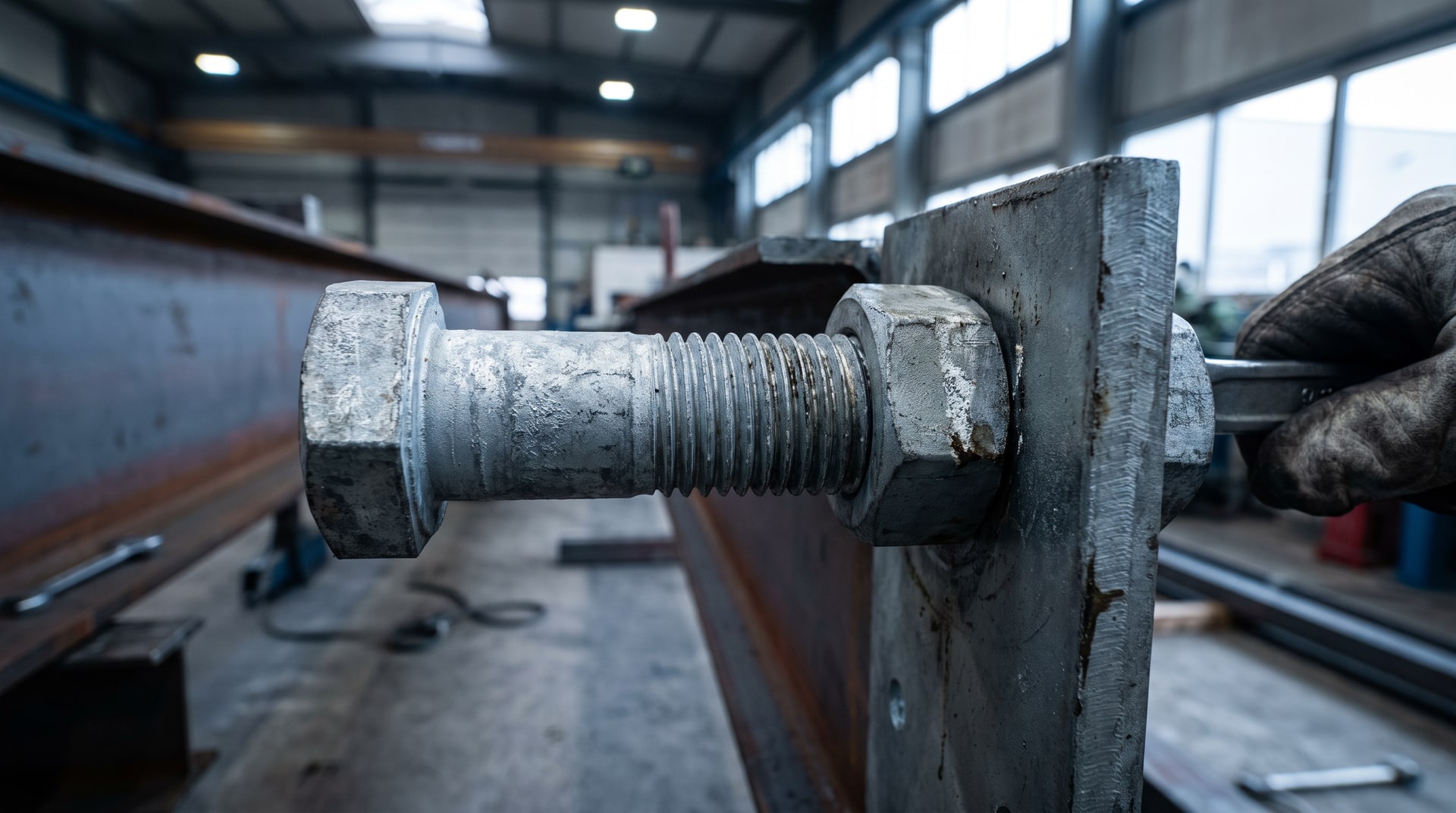
When a fabricator or engineer specifies hot-dip galvanized fasteners for a structural connection, the immediate concern is usually corrosion protection and load capacity. Thread fit rarely comes up until assembly day, when a galvanized bolt won't engage a standard nut or a field crew strips threads trying to force the connection. That problem is not a defect in the galvanizing. It is the predictable result of applying a zinc coating to a threaded surface without accounting for the dimensional change that coating creates.
Hot-dip galvanizing adds measurable thickness to every surface it touches, and threaded fasteners are no exception. The zinc metallurgically bonds to the steel, building up on the flanks, crests, and roots of the thread form. Because male and female threads are already manufactured to tight tolerances, even a modest coating thickness can prevent proper engagement. The solution is to overtap female threads, meaning they are tapped to a slightly larger pitch diameter than the standard dimension, creating the clearance the zinc coating requires.
The American Galvanizers Association addresses this directly in their article on overtapping allowances for hot-dip galvanized steel products. At V&S Galvanizing, we expand on that foundation to explain what is actually happening at the material level, how coating thickness influences thread fit and performance, and why this is often misunderstood in the field.
Why the Zinc Coating Changes Thread Geometry
Hot-dip galvanizing is not a paint or an applied film. It is an alloying reaction between molten zinc and the base steel, producing a series of zinc-iron alloy layers that are bonded to the substrate at the atomic level. The outermost layer is pure zinc, and the entire coating builds outward from the steel surface. On flat structural steel, this dimensional change is rarely a concern. On precision-threaded surfaces, it is critical.
Thread fit depends on the pitch diameter, which is the theoretical cylinder whose surface passes through the thread form at points where the widths of the thread and the groove are equal. Standard thread tolerances leave very little room between a bolt's pitch diameter and a nut's pitch diameter. When zinc coats the flanks of a male thread, it effectively increases the bolt's pitch diameter. If the nut's internal thread pitch diameter has not been increased to match, the assembly will bind or the threads will gall under torque.
The physics here are straightforward: zinc coatings on threaded fasteners are typically thicker than on flat surfaces because zinc pools slightly in recesses and because the surface area-to-volume ratio in a thread form concentrates the coating. Centrifuging after galvanizing removes excess zinc, but it does not reduce the bonded alloy layers that have already formed. What remains is a uniform, adherent coating that increases the effective pitch diameter of the male thread by a meaningful and predictable amount.
The ASTM Standard That Governs Overtapping
The allowances for overtapping are not arbitrary shop estimates. They are codified in ASTM A563, the Standard Specification for Carbon and Alloy Steel Nuts. Specifically, Table 5 of that specification defines the diametral allowances and the resulting minimum and maximum pitch diameter ranges for overtapped female threads intended for use with hot-dip galvanized male fasteners. These values were determined by ASTM through material testing and represent the dimensions necessary to achieve proper assembly without compromising the structural integrity of the threaded connection.
Separately, ASTM A153 governs the zinc coating itself on iron and steel hardware. The galvanizer is responsible for ensuring all threaded products meet A153 requirements and that threads are clean and usable after processing. These two specifications work together: A153 defines acceptable coating performance, and A563 defines the geometric accommodation that makes the coated fastener functional in assembly.
Understanding that these are ASTM-standardized values, not estimates, matters for engineering documentation. When a project specification calls for hot-dip galvanized fasteners, the overtapping requirement is an inherent part of compliance, not an optional field adjustment.
Reading the Overtapping Allowance Table
The data in ASTM A563 Table 5 is reproduced below as Table 1. Three columns define the dimensional requirements for each nominal female thread or nut size: the diametral allowance, the minimum pitch diameter increase, and the maximum pitch diameter increase.
The diametral allowance is the total amount by which the pitch diameter of the female thread must be increased relative to the standard uncoated dimension. For a 1/4-inch thread, that allowance is 0.016 inches. For a 1-inch thread, it increases to 0.024 inches. Threads at 1-3/4 inches and larger carry a 0.050-inch allowance, reflecting the greater coating thickness that larger fasteners typically accumulate during the galvanizing process.
The minimum and maximum pitch diameter columns define the acceptable range for the overtapped thread. For a 1/2-inch female thread, the pitch diameter must fall between 0.4680 and 0.4745 inches. For a 2-inch thread, the range is 1.9057 to 1.9181 inches. These ranges are tight by design. An overtapped thread that is too loose will reduce load-carrying capacity and bearing area; one that is too tight will not accept the galvanized male thread without damage.
| Nominal Female Thread or Nut Size (in.) | Diametral Allowance (in.) | Pitch Diameter: Minimum Increase (in.) | Pitch Diameter: Maximum Increase (in.) |
|---|---|---|---|
| 0.250 | 0.016 | 0.2335 | 0.2384 |
| 0.500 | 0.018 | 0.4680 | 0.4745 |
| 0.750 | 0.020 | 0.7050 | 0.7127 |
| 1.000 | 0.024 | 0.9428 | 0.9516 |
| 1.250 | 0.024 | 1.1812 | 1.1908 |
| 1.500 | 0.027 | 1.4187 | 1.4292 |
| 1.750 | 0.050 | 1.6701 | 1.6817 |
| 2.000 | 0.050 | 1.9057 | 1.9181 |
| 2.500 | 0.050 | 2.3876 | 2.4011 |
| 2.750 | 0.050 | 2.6376 | 2.6513 |
| 3.000 | 0.050 | 2.8876 | 2.9015 |
| 3.250 | 0.050 | 3.1376 | 3.1517 |
| 3.500 | 0.050 | 3.3876 | 3.4019 |
| 3.750 | 0.050 | 3.6376 | 3.6521 |
| 4.000 | 0.050 | 3.8876 | 3.9023 |
A pattern worth noting is the step change at the 1-3/4-inch nominal size, where the diametral allowance jumps from 0.027 inches to 0.050 inches. This reflects the practical reality that larger fasteners are more difficult to centrifuge effectively and tend to carry heavier zinc deposits. The allowance accounts for that variation in coating distribution.
How Structural Nuts Are Actually Processed
Most structural nuts are not threaded before galvanizing. They are galvanized as blanks, meaning the through-hole is either not yet threaded or is threaded and then retapped after the coating is applied. Retapping after galvanizing is the standard practice for ensuring the female thread fits a galvanized male fastener correctly.
When a nut is retapped after galvanizing, the threading operation removes the zinc coating from the internal thread surfaces. This is a deliberate and accepted result. The internal threads of the nut will have bare steel exposed at the thread flanks and crests. The question engineers sometimes raise is whether this compromises corrosion protection at the connection.
The answer, supported by the AGA's technical guidance, is that it does not present a significant durability problem. The male thread, which retains its full zinc coating, is in solid contact with the female thread throughout the engaged length. This creates cathodic protection at the interface: zinc, being anodic to steel, sacrifices preferentially, protecting the exposed steel in the female thread from corrosive attack. The physical geometry of the threaded engagement also limits electrolyte access to the interface, further reducing the corrosion exposure. The combination of cathodic protection and restricted electrolyte access creates durability that is adequate for structural service.
Managing Coating Thickness on Male Threads
The galvanizer's responsibility does not end at getting steel through the zinc bath. For threaded fasteners, the post-galvanizing process is equally important. Excess zinc on male threads must be removed to ensure the fastener will engage an overtapped nut correctly and that the assembled connection can be properly torqued.
The standard method for removing excess zinc from smaller fasteners is centrifuging. After withdrawal from the zinc bath, fasteners are spun in a centrifuge while the zinc is still molten. The centrifugal force flings excess liquid zinc from the threads before it solidifies, leaving a coating that is bonded and uniform but not excessively thick. This process is well-suited to bolts, nuts, and smaller threaded hardware.
Large fasteners with male threads present a different challenge. When a bolt or stud is too large or heavy for the centrifuge, the excess zinc must be managed another way. One approach is wire brushing the threads while the zinc is still hot after withdrawal from the bath. This physically removes pooled or bridged zinc from the thread form before it sets, reducing the coating to a manageable thickness. Studs that are welded to assemblies, and therefore cannot be centrifuged, are particularly dependent on this manual intervention. Any stud that will receive a mating nut in service needs clean, functional threads, and that requires deliberate attention from the galvanizing crew.
At V&S Galvanizing, ensuring thread usability on complex assemblies is part of our quality responsibility under hot-dip galvanizing. When a fabricator sends us an assembly with welded studs, we account for those features in our processing approach.
Practical Implications for Engineers and Fabricators
Knowing the overtapping allowance values exists is only useful if they are applied at the right stage of procurement and fabrication. The most common failure point is not ignorance of the standard; it is a timing problem. A fabricator orders standard nuts, the hardware arrives galvanized, and no one specified overtapping. The bolts do not fit, the schedule is disrupted, and the fix requires either sourcing new hardware or field rework.
Specifying overtapped nuts from the outset eliminates this problem. When purchasing galvanized structural nuts, the purchase order should explicitly reference ASTM A563 and specify that nuts are to be overtapped per Table 5 for use with hot-dip galvanized bolts. Suppliers familiar with galvanized hardware will understand this requirement; suppliers who are not should be directed to the specification.
For field situations where a standard nut must mate with a galvanized bolt, the field solution is controlled retapping of the nut to the appropriate pitch diameter using the values from the table. This requires the right tooling and a clear target dimension. Using the minimum pitch diameter increase as the target gives the tightest acceptable fit, while the maximum sets the outer limit of acceptable clearance. Anything beyond the maximum represents a thread that is too loose for reliable structural load transfer.
Engineers detailing connections should also be aware that overtapping applies to any female thread mating with a galvanized male thread, not just hex nuts. Threaded inserts, couplings, turnbuckle barrels, and anchor rod template holes are all subject to the same dimensional constraint. If a galvanized male thread is involved, the mating female thread needs clearance.
A Note on Coating Thickness Variability
The overtapping allowance values in ASTM A563 represent upper-bound accommodation. They are sized to accept the maximum expected zinc coating thickness on a properly processed galvanized fastener. In practice, coating thickness varies depending on the steel chemistry, the bath temperature, the immersion time, and whether centrifuging was performed. A bolt with a relatively thin coating may engage an overtapped nut with more play than expected; one with a thicker coating may be tighter.
This variability is why the table specifies both a minimum and maximum pitch diameter for the female thread rather than a single target. The range is the tolerance band within which properly galvanized male and properly overtapped female threads will assemble correctly regardless of where the actual coating thickness falls within the ASTM A153 allowable range. Specifying to the standard protects the connection across the realistic distribution of coating outcomes, not just the nominal case.
It also explains why manual cleaning methods for large fasteners require care. Wire brushing is less consistent than centrifuging. A stud that is brushed unevenly may have adequate thread clearance in some areas and excessive coating in others. Inspecting threads for cleanness and engaging a nut by hand before final installation is a reasonable verification step on large, manually processed fasteners.
Work With a Team That Understands Threaded Fastener Processing
Threaded fasteners look simple on paper, but they concentrate several of the most technically demanding aspects of hot-dip galvanizing: tight dimensional tolerances, post-processing requirements, and dual-specification compliance. Getting them right requires understanding both the metallurgy of the zinc coating and the thread geometry standards that govern assembly. The ASTM values for overtapping allowances exist because the industry has quantified what is needed, and working within those values consistently is what separates functional hardware from field problems.
Our team works with fabricators, structural engineers, and contractors who need galvanized fasteners and assemblies processed correctly the first time. If you have questions about thread usability, coating specifications for threaded hardware, or how to specify overtapping correctly for your project, reach out through our contact page and we will work through the details with you.
Frequently Asked Questions About Overtapping Allowances for Galvanized Fasteners
What is an overtapping allowance and why is it required for hot-dip galvanized bolts?
An overtapping allowance is the increase in pitch diameter applied to female threads or nuts so they can properly engage a hot-dip galvanized male thread. Because the zinc coating increases the effective pitch diameter of a galvanized bolt or stud, the mating nut must be tapped to a larger internal dimension than a standard uncoated thread. The required allowances are defined in ASTM A563 Table 5 and range from 0.016 inches for 1/4-inch threads to 0.050 inches for threads 1-3/4 inches and larger.
Does retapping the nut after galvanizing eliminate corrosion protection at the thread interface?
No. While retapping after galvanizing does remove the zinc from the internal thread surfaces of the nut, the galvanized male thread maintains its coating and provides cathodic protection to the exposed steel at the thread interface. The physical contact between male and female threads also restricts electrolyte access to the interface, which further limits corrosion risk. This approach is the recognized industry standard for structural nuts used with galvanized bolts.
At what nominal thread size does the ASTM A563 diametral allowance jump significantly?
The allowance increases notably at 1-3/4 inches nominal thread size, where it rises from 0.027 inches to 0.050 inches. This step change reflects the heavier zinc deposits that larger fasteners typically accumulate, particularly those that cannot be effectively centrifuged to remove excess molten zinc after galvanizing.
Can a standard nut be used with a hot-dip galvanized bolt if the nut is not overtapped?
In most cases, no. A standard nut tapped to uncoated tolerances will not properly engage a hot-dip galvanized bolt. The zinc coating increases the bolt's pitch diameter beyond what a standard nut's internal thread can accept. Attempting to force assembly risks stripping the threads, damaging the zinc coating, or creating an undertorqued connection. The correct solution is to specify overtapped nuts per ASTM A563 Table 5 at the time of procurement.
How is excess zinc removed from the threads of large galvanized bolts that cannot be centrifuged?
For large fasteners that are too heavy or large for the centrifuge, excess zinc is typically removed by wire brushing the threads while the zinc is still hot after withdrawal from the molten bath. This manually displaces pooled zinc from the thread form before it solidifies. The same approach is used for studs welded to assemblies, which cannot be centrifuged at all. The goal in both cases is to reduce coating thickness in the thread form to a level that will allow proper assembly with an overtapped nut.
Does the overtapping requirement apply to threaded holes in structural assemblies, not just nuts?
Yes. Any female thread that will mate with a hot-dip galvanized male thread must be overtapped to the appropriate pitch diameter. This includes threaded inserts, couplings, anchor rod templates, turnbuckle barrels, and threaded holes in structural components. The nominal size and corresponding allowance from ASTM A563 Table 5 apply regardless of the form of the female thread.
What specification governs the zinc coating on threaded hardware, and what specification governs the overtapping dimension?
ASTM A153 governs the zinc coating applied to iron and steel hardware by hot-dip galvanizing, including threaded fasteners. The galvanizer is responsible for meeting A153 requirements and ensuring threads are clean and usable. ASTM A563 governs the dimensional requirements for carbon and alloy steel nuts, and its Table 5 defines the pitch diameter allowances for overtapping when used with hot-dip galvanized bolts. Both specifications apply to a properly specified galvanized fastener connection.
Why do the minimum and maximum pitch diameter values define a range rather than a single target dimension?
The range accommodates natural variability in zinc coating thickness on galvanized male threads. Because coating thickness depends on steel chemistry, bath conditions, and processing method, the actual pitch diameter of a galvanized bolt will vary within the limits allowed by ASTM A153. The min-max range for the overtapped female thread is sized to produce a functional assembly across that full distribution of coating outcomes. An overtapped thread that falls within the specified range will properly engage any compliant galvanized male thread without being too tight to assemble or too loose to transfer load reliably.
