

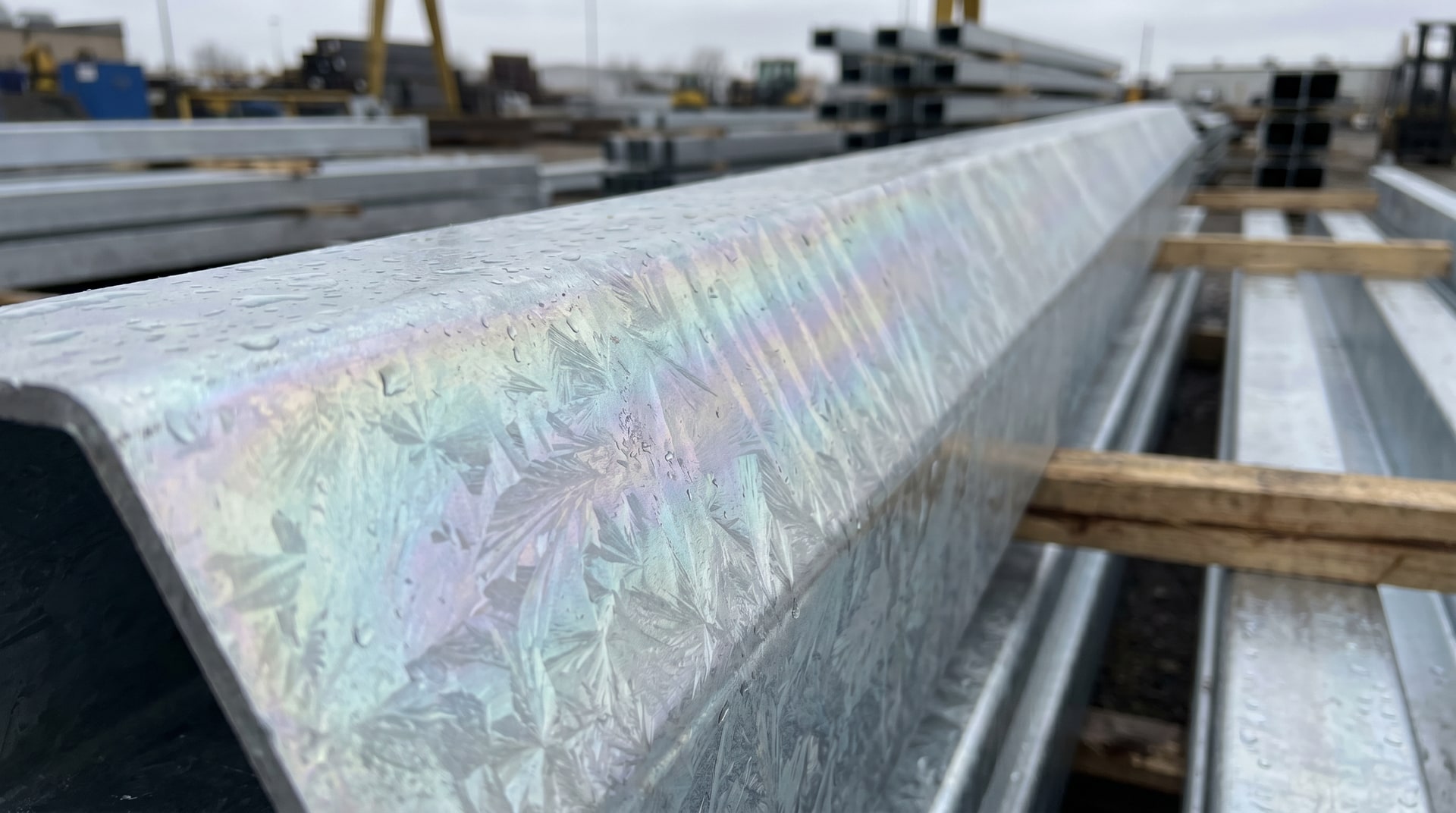
Freshly galvanized steel does not leave the kettle in a chemically stable state. The zinc surface is reactive, and in some cases, a temporary passivation layer is applied to control early exposure conditions. One of the most common questions that follows is how long any presence of Chromium VI remains on the surface and what happens to it over time.
The American Galvanizers Association addresses this directly in their article on chromium conversion. At V&S Galvanizing, we expand on that foundation to explain what is actually happening at the material level, how environmental exposure drives the conversion, and why this process is often misunderstood in the field.
What Chromium VI Is Doing on the Surface
Chromate treatments have historically been used as a short term stabilization method for newly galvanized steel. Their primary purpose is to reduce the risk of early-stage oxidation, especially in conditions where moisture exposure cannot be avoided during storage or transport.
Chromium VI is part of that initial surface chemistry. It is highly reactive and exists only as a transitional state. Once the steel is exposed to real environmental conditions, it begins changing almost immediately.
The important point is that Chromium VI is not intended to be permanent. It is part of a short-lived surface condition that evolves as the coating stabilizes.
The Conversion Process in Real Conditions
The transition from Chromium VI to Chromium III is a reduction reaction driven by exposure to air, moisture, and naturally occurring compounds in the environment.
As the galvanized surface interacts with its surroundings:
- Chromium VI is reduced chemically
- It converts into Chromium III, which is significantly more stable
- The surface begins shifting toward a natural equilibrium
This is not a controlled or staged process. It is a passive reaction that begins as soon as the material leaves the galvanizing environment and is exposed to ambient conditions.
What Controls the Speed of Conversion
The timeline for conversion is not fixed. It depends entirely on how the material is exposed after galvanizing.
In open, breathable environments where steel can cycle between wet and dry conditions, the reaction progresses efficiently. Airflow, oxygen availability, and carbon dioxide all contribute to the conversion and stabilization of the surface.
In contrast, enclosed or restricted environments can slow the process. If materials are tightly stacked, wrapped, or exposed to constant moisture without drying, the conversion still occurs but at a slower rate.
The key takeaway is that the process always moves forward. It may accelerate or decelerate depending on conditions, but it does not stop.
Why This Matters Beyond Chemistry
The distinction between Chromium VI and Chromium III is often discussed in terms of environmental and safety considerations, but from a galvanizing standpoint, it is equally important to understand what does not change.
The long-term performance of galvanized steel is not dependent on this surface chemistry. Corrosion protection comes from the zinc coating itself, which continues to function regardless of the temporary presence or conversion of chromium compounds.
This is where confusion often happens. Surface chemistry is transient. Coating performance is structural and long term.
How Modern Galvanizing Approaches This
Galvanizing practices have evolved significantly. Many operations have reduced or eliminated the use of Chromium VI-based passivation systems, moving toward alternatives that achieve similar short-term stabilization without relying on hexavalent chromium.
Where chromate systems are used, they are tightly controlled and understood as part of a broader process, not as a defining characteristic of the coating.
At V&S Galvanizing, process control is focused on delivering consistent coating thickness, adhesion, and coverage while aligning with modern environmental expectations.
What Should Actually Be Evaluated
From a project perspective, Chromium VI conversion is not something that typically requires inspection, measurement, or specification.
What matters is whether the galvanized coating:
- Meets thickness requirements
- Maintains full coverage
- Provides long-term corrosion protection
Those are the factors that determine performance in the field.
Work With a Team That Understands Coating Chemistry
Questions about galvanizing often come down to understanding how temporary surface conditions relate to long-term performance. Knowing what changes and what does not helps eliminate unnecessary concern and keeps projects focused on what actually matters.
At V&S Galvanizing, we work with engineers, contractors, and project teams to explain how galvanizing behaves in real-world conditions and how process variables translate into performance.
Chromium VI on galvanized steel is a temporary surface condition that begins converting to Chromium III as soon as the material is exposed to the environment. The rate of that conversion depends on airflow, moisture, and exposure conditions, but the process is continuous and inevitable. What remains constant is the role of the zinc coating itself, which provides the corrosion protection the system is designed for. If you need help understanding how coating chemistry applies to your project or want to review your material conditions, reach out to our team through our contact page.
Frequently Asked Questions About Chromium Conversion on Galvanized Steel
What is Chromium VI on galvanized steel?
It may be present in temporary chromate treatments used to stabilize freshly galvanized steel during early exposure.
Does Chromium VI remain on the surface permanently?
No. It converts naturally to Chromium III as the steel is exposed to air and moisture.
How quickly does the conversion happen?
It begins immediately after exposure and progresses based on environmental conditions such as airflow and humidity.
Does this affect corrosion protection?
No. Corrosion protection is provided by the zinc coating, not the temporary chromate layer.
Why is Chromium III important?
It is more stable and less reactive, which makes it the final state after environmental exposure.
Are chromate treatments still used?
Some processes still use them, but many have transitioned to alternative systems.
Should this be specified in project documents?
Typically no. It is a process-level consideration, not a design requirement.
What should be inspected instead?
Coating thickness, adhesion, and coverage are the key performance indicators.
