

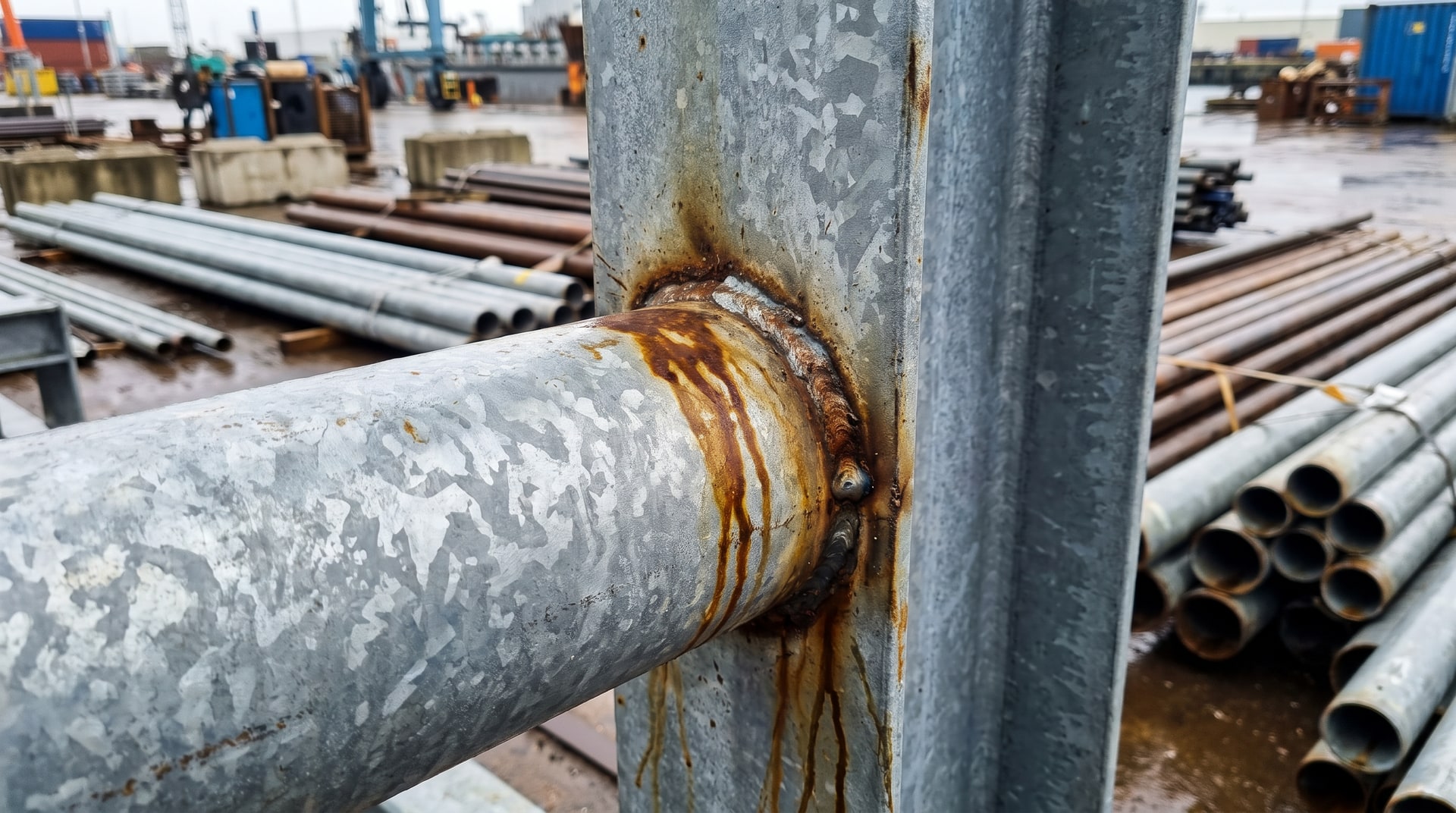
Few things create more confusion on a galvanizing project than iron oxide streaks appearing on freshly galvanized steel. A fabricator ships parts to a galvanizer, the work comes back with a clean zinc coating, and then, within days or even months, rust-colored trails start running down the sides of tubes or structural members. The assumption is almost always that something went wrong in the galvanizing shop. In reality, the cause is nearly always rooted in decisions made at the design table or the welding bench, often well before the steel ever arrives at our facility.
The American Galvanizers Association addresses this directly in their article on rust bleeding on welded parts. At V&S Galvanizing, we expand on that foundation to explain what is actually happening at the material level, how trapped moisture and cleaning chemistry interact with uncoated steel surfaces, and why this phenomenon is so consistently misattributed to the galvanizer in the field.
What Rust Bleeding Actually Is
Rust bleeding is not a galvanizing defect. The term describes iron oxide streaks that form on a zinc-coated surface and follow the path of gravity downward, leaving reddish-brown trails that look alarming against the silver-gray of a fresh galvanized finish. The zinc coating itself is intact. The rust originates from uncoated steel surfaces trapped inside a closed or semi-closed cavity formed during fabrication. Moisture finds its way into that cavity, contacts bare steel, and produces iron oxide. That oxide then migrates outward through whatever opening exists and stains the exterior zinc surface.
Understanding that distinction matters enormously when a contractor calls to report a problem. The galvanized coating is doing its job. The issue is that there is bare steel somewhere inside the assembly that the zinc never reached, and moisture has been given a path to reach it.
How Trapped Cavities Form During Fabrication
The geometry of welded steel assemblies creates enclosed or partially enclosed spaces more often than designers tend to anticipate. When a tube is welded to a structural member, the weld line forms a boundary. If that boundary does not completely seal the interior, a cavity exists behind it. If the boundary does completely seal it but the weld contains even a single pinhole, that cavity is effectively connected to the outside world through an opening too small to see but large enough for liquid to enter.
There are three distinct configurations that produce rust bleeding, and each behaves a little differently through the galvanizing process.
The first is a large enclosed area that requires a vent hole to comply with hot-dip galvanizing best practices under ASTM A385. Without venting, trapped air expands violently when the assembly enters the molten zinc bath, creating a dangerous pressure event. So the fabricator adds a vent hole, which solves the safety problem but introduces a new one: cleaning solutions now have an entry point into the cavity. Rinsing those solutions back out is difficult because the vent placement, the orientation of the part on the rack, and the narrow gap between steel faces all work against complete drainage.
The second configuration involves stitch welding, where the weld is applied in intermittent segments rather than a continuous bead. The gaps between weld segments allow air and cleaning solutions to migrate in and out of the area between the two steel faces. This functions similarly to a vent hole from a process standpoint. The same drainage problem applies, and the same residue is left behind.
The third configuration is the fully seal-welded small area. Here, the intent is to close off the cavity completely on all sides. If the welder achieves that, no cleaning solution enters and no rust bleeding occurs. But if even one pinhole exists in the weld seam, a small amount of solution enters and cannot escape. That pocket of chemistry sits inside the assembly through the entire galvanizing cycle.
What Happens to Cleaning Chemistry Inside a Trapped Cavity
To understand why rust bleeds, it helps to trace the cleaning chemistry through the galvanizing sequence. Before steel enters the zinc kettle, it passes through a series of surface preparation steps: degreasing, pickling in acid to remove mill scale and oxides, and fluxing to prepare the surface for zinc adhesion. Each of those steps uses liquid chemical solutions, and the goal is to arrive at the zinc bath with a chemically clean, reactive steel surface.
When cleaning solution enters a trapped cavity, it does not behave the same way it does on an open surface. On open steel, the solution is rinsed, the flux dries, and the surface enters the zinc bath ready to react. Inside a cavity, the rinse water cannot fully flush the acid or flux residue. Some amount of chemical solution remains pooled or absorbed against the steel walls of the cavity.
When the assembly enters the galvanizing kettle, temperatures approach 850 degrees Fahrenheit. The moisture in the trapped solution evaporates rapidly, but the dissolved compounds do not. They are left behind as dried salt crystals and cleaning compound residue coating the interior steel surfaces. Those surfaces are now bare steel with a mineral crust on them, but no zinc. The molten zinc never reached the interior because the vent or pinhole opening is far too small for metal of that viscosity to penetrate and fill.
After galvanizing, parts are typically either quenched in water or air cooled. Quenching immediately reintroduces moisture to the trapped cavity. Air cooling does the same thing over time as the part cycles through temperature changes and is exposed to humidity. Either way, moisture eventually enters, contacts the salt-crusted bare steel, and corrosion begins. The resulting iron oxide follows gravity and bleeds outward through whatever opening exists, staining the zinc surface below it.
Why Zinc Cannot Fill These Gaps
A reasonable question is: why does not the molten zinc simply flow into the cavity and coat the interior surfaces? The answer comes down to the physical properties of molten zinc at galvanizing temperatures. Zinc has a relatively low viscosity compared to many metals, but it is not water. Surface tension and the geometry of very narrow gaps prevent it from penetrating confined spaces.
The threshold matters here. Unless the gap between two steel faces is 3/32 of an inch or greater, molten zinc will not penetrate and fill the space between them. Most of the cavities formed by stitch welding or partial welds are far narrower than that. A weld pinhole is orders of magnitude smaller. So the zinc coats everything it can physically reach on the exterior surfaces, stops at the boundary of the opening, and leaves the interior uncoated.
This is not a limitation of the galvanizing process. It is a physical reality that should inform how welded assemblies are designed when they are intended for hot-dip galvanizing.
The Design and Fabrication Decisions That Prevent It
The most effective solution to rust bleeding is to eliminate the trapped cavity entirely or to ensure zinc can fill it. The source article from the AGA is direct on this point: planning for a gap of at least 3/32 of an inch between two pieces to be welded allows zinc to flow in during galvanizing, filling the space completely and actually producing a stronger joint than the weld alone.
That design decision has to happen before fabrication begins. Once a part is welded tight with gaps narrower than that threshold, there is no remediation path that fully restores the performance of a correctly designed assembly. The galvanizer cannot widen the gap after the fact. The fabricator needs to understand this requirement at the time of welding.
For assemblies where a seal weld is the intended approach, the welding procedure must produce a truly continuous, pinhole-free bead on every side of the enclosed area. A weld that looks visually complete can still contain gas pockets or microscopic voids that allow solution entry. Welding quality control is therefore a direct factor in whether rust bleeding occurs, not just aesthetics or structural integrity.
For large enclosed areas, ASTM A385 provides guidance on proper vent hole sizing and placement. Following that standard reduces the danger during galvanizing and gives the cleaning solutions a better chance of draining out during preparation. But vent holes alone do not guarantee that residue is fully cleared from a cavity with complex internal geometry or a tight gap between faces.
Who Is Responsible: A Practical Assessment
We have seen this conversation play out many times. The fabricator delivers parts. We galvanize them. Rust bleeding appears, sometimes while the parts are still at our facility, sometimes weeks or months into service. The immediate reaction is that the galvanizer caused it or failed to prevent it.
The technical reality is that rust bleeding originates in either the design of the assembly or the quality of the welding procedure. The galvanizer does not control either of those. We cannot see inside a sealed cavity to know whether cleaning solution has been trapped. We cannot weld better or design out the cavity after fabrication. The cause of the trapped area rusting is either a poor welding procedure that left a pinhole in what should have been a seal weld, or a design that included a large trapped area without adequate venting.
That said, when a customer raises a rust bleeding issue, the response should not simply be to assign blame and move on. The practical question is what can be done now, and what should be done differently on the next project.
Remediation in the Field: What Works and What Does Not
When rust bleeding is already visible, the approach is straightforward but limited in its long-term effectiveness. First, clean off the visible rust from the exterior zinc surface. The zinc coating itself is not compromised, so cleaning the stain does not damage the corrosion protection already in place. Then, attempt to plug the vent hole or weld pinhole through which the rust is escaping. Silicone sealant is the typical material used for this.
The honest assessment is that this is a temporary fix. Silicone sealants are not permanent in outdoor service conditions. UV exposure, thermal cycling, and mechanical contact all degrade the seal over time. Once the plug fails, moisture reenters the cavity, and the rust bleeding resumes. The silicone plug will need periodic inspection and maintenance to remain effective.
The reason the remediation is only partial is that the trapped area still contains bare steel. The root problem has not been solved, only the pathway for moisture has been blocked. Without the 3/32-inch gap that would have allowed zinc to fill the space during galvanizing, there is no retrofit option that puts a corrosion-resistant coating on those interior surfaces.
For critical structures where rust bleeding represents more than a cosmetic concern, the only sound path is to redesign and refabricate the affected components. That is an expensive lesson, but it underscores why understanding galvanizing requirements during the design phase is not optional.
Work With a Team That Catches These Issues Early
Rust bleeding is one of those problems that is almost entirely preventable with the right conversation before fabrication begins. The engineering and design requirements for assemblies intended for hot-dip galvanizing are well established. ASTM A385 covers venting and drainage provisions in detail. The 3/32-inch gap specification for zinc penetration is a straightforward dimensional requirement. The need for continuous, pinhole-free seal welds on closed cavities is a welding quality standard that any competent fabrication team can meet when they know it is required.
At V&S Galvanizing, we work with engineers, fabricators, and contractors at the front end of projects to identify design details that could produce rust bleeding or other galvanizing complications before steel is cut. That review is not a formality. It is a technically grounded assessment of how a specific assembly will behave through our process, based on decades of handling complex welded structures. Addressing a detail at the drawing stage costs almost nothing. Addressing it after fabrication, or after rust bleeding has appeared on a finished structure, costs considerably more.
If you are working on a project with welded assemblies destined for hot-dip galvanizing and want to review the design details before fabrication, reach out through our contact page. We are glad to work through the specifics with your team.
Frequently Asked Questions About Rust Bleeding on Galvanized Welded Parts
Why does rust appear on steel that has been hot-dip galvanized?
Rust bleeding on galvanized steel does not indicate a failure of the zinc coating. It originates from bare steel trapped inside a closed or partially closed cavity formed during welding. Cleaning chemicals enter the cavity during surface preparation, cannot be fully rinsed out, and leave residue on uncoated interior steel. Once moisture re-enters the cavity after galvanizing, corrosion begins on those bare interior surfaces and the resulting iron oxide bleeds outward, staining the exterior zinc surface.
What gap dimension is required for zinc to penetrate between two welded steel faces?
Molten zinc requires a gap of at least 3/32 of an inch between two steel faces to penetrate and fill the space during hot-dip galvanizing. Gaps narrower than this threshold will not allow zinc to flow in, leaving the interior surfaces uncoated regardless of how well the exterior is galvanized.
Is the galvanizer responsible for rust bleeding on welded assemblies?
No. The galvanizer does not control the design of the assembly or the quality of the welding procedure. Rust bleeding results from either a design that created a trapped cavity without adequate venting per ASTM A385, or a welding procedure that left pinholes in what should have been a fully sealed weld. Both of those are fabricator and designer responsibilities established before the steel arrives at the galvanizing facility.
What is the difference between a stitch weld and a seal weld in the context of galvanizing?
A stitch weld is applied in intermittent segments, intentionally leaving gaps along the weld line. Those gaps allow air and cleaning solutions to enter the space between two steel faces during galvanizing preparation, which serves a venting function but also introduces trapped chemistry. A seal weld is a continuous bead intended to close all sides of an area completely. If the seal weld is truly pinhole-free, no cleaning solution enters. If any pinhole exists, solution enters and cannot escape, creating the conditions for rust bleeding.
Can the rust bleeding problem be fixed after galvanizing?
The visible rust staining can be cleaned from the exterior zinc surface, and the opening through which rust is escaping can be plugged with silicone sealant to block further moisture entry. However, this is a temporary fix. The silicone will degrade over time and require maintenance. The underlying bare steel inside the cavity remains uncoated, so if moisture re-enters, corrosion resumes. The permanent solution is to redesign and refabricate the affected components with proper gap dimensions or continuous seal welds.
How does ASTM A385 relate to preventing rust bleeding?
ASTM A385 provides guidance on the proper sizing and placement of vent holes in large enclosed areas of steel assemblies intended for hot-dip galvanizing. Following this standard ensures that trapped air can escape safely during galvanizing and gives cleaning solutions a better opportunity to drain from the cavity. Proper venting does not guarantee that all chemistry is removed from narrow gaps, but it is a required baseline for assemblies with large enclosed volumes.
Why does rust bleeding sometimes appear months after galvanizing rather than immediately?
Whether rust bleeding appears at the galvanizing facility or months later depends on how quickly moisture accumulates in the trapped cavity. Parts that are quenched after galvanizing have moisture reintroduced immediately, so bleeding may appear before the part leaves the shop. Parts that are air cooled take longer, as moisture enters gradually through temperature cycling and ambient humidity. In seal-welded areas with pinhole leaks, the internal moisture buildup can be very slow, delaying visible rust bleeding for several months.
Does leaving a proper gap between steel pieces affect weld strength when galvanizing?
Designing for a 3/32-inch or greater gap between two steel faces before galvanizing actually results in a stronger joint overall, not a weaker one. When molten zinc fills the gap during galvanizing, it bonds metallurgically to both steel faces, adding a zinc-filled connection that complements the structural weld. The assembly benefits from both the mechanical integrity of the weld and the full zinc coverage of the interior interface.
