

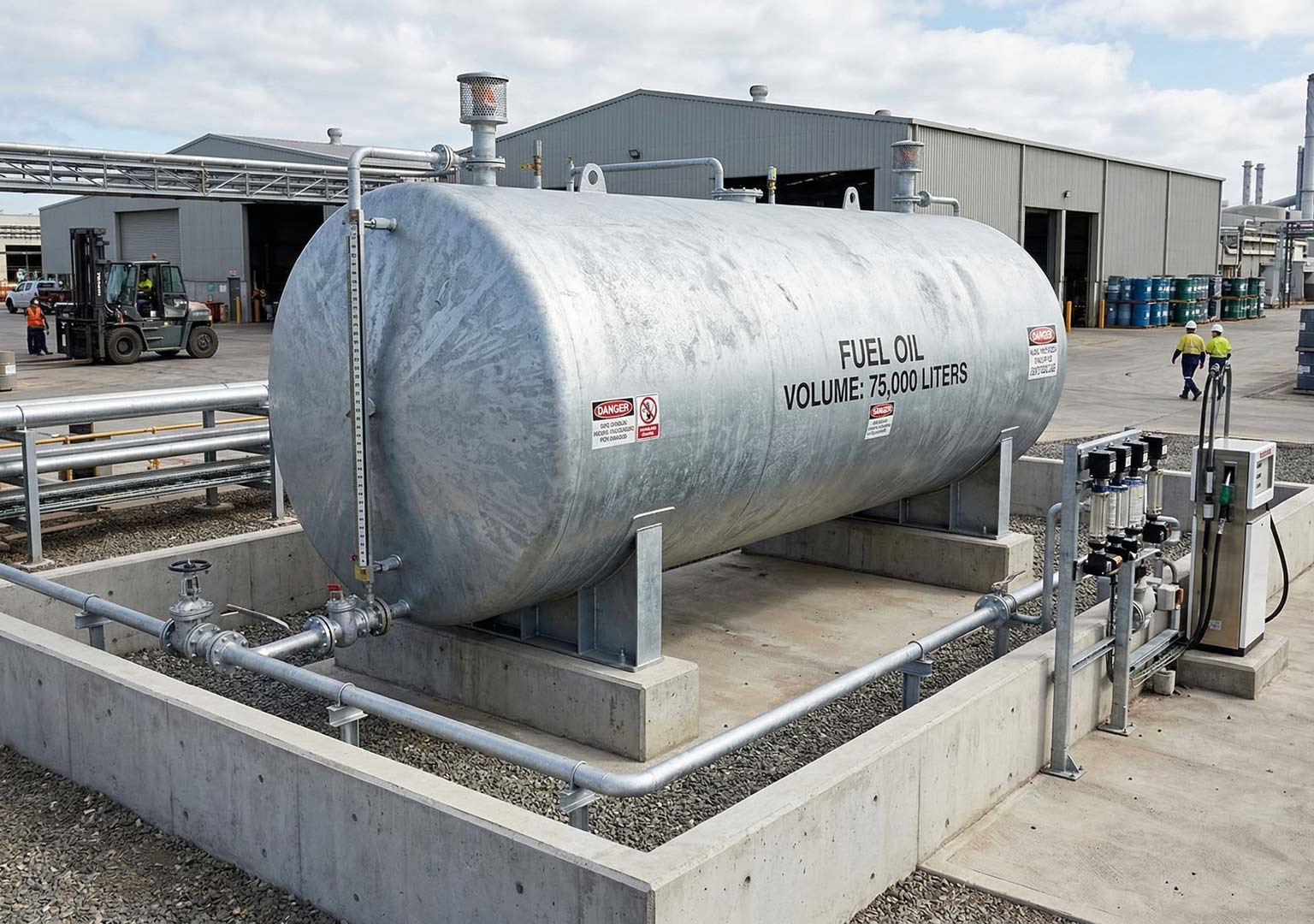
Fuel storage tanks represent a demanding corrosion environment. Whether used for diesel, gasoline, aviation fuel, biodiesel, or secondary containment applications, tanks are exposed to atmospheric moisture, condensation cycles, and potentially aggressive external conditions. The selection of corrosion protection systems must consider both interior and exterior exposure mechanisms.
The Galvanize It article discussing hot dip galvanizing and fuel storage tanks provides foundational technical insight. Expanding on that technical base, this article evaluates corrosion behavior in fuel storage applications, zinc compatibility with various fuel types, interior and exterior protection mechanisms, and key design considerations.
Corrosion Mechanisms in Fuel Storage Tanks
Fuel storage tanks experience corrosion from multiple sources:
- Exterior atmospheric exposure
- Interior condensation from temperature cycling
- Water accumulation at tank bottoms
- Soil exposure for buried tanks
- Microbiologically influenced corrosion in some environments
Even though hydrocarbons themselves are generally non corrosive to steel, water contamination and condensation can create corrosive conditions inside tanks.
Zinc coatings provide both barrier and sacrificial protection in many of these exposure scenarios.
Exterior Protection of Fuel Tanks
Exterior tank surfaces are often exposed to:
- Rain and humidity
- Industrial pollutants
- Chloride deposition in coastal environments
- Soil contact in partially buried systems
Hot dip galvanizing provides uniform coating coverage over complex geometries, including welds, stiffeners, and edges.
Because the coating is metallurgically bonded, it resists mechanical damage during transportation and installation.
Coating thickness in accordance with ASTM A123 provides predictable service life in atmospheric environments.
Interior Tank Exposure and Fuel Compatibility
Zinc exhibits good compatibility with many petroleum based fuels, including:
- Diesel fuel
- Gasoline
- Jet fuel
- Kerosene
However, certain factors must be considered:
- Water accumulation inside tanks
- Fuel additives
- Biofuel blends
- Long term immersion conditions
In most hydrocarbon storage applications, zinc corrosion rates are low when moisture is minimal.
Interior performance depends largely on whether water is present. Water accumulation at tank bottoms can create localized corrosion environments.
Proper drainage and tank maintenance are critical regardless of coating type.
Biodiesel and Ethanol Blends
Biofuels and ethanol blended fuels may introduce different chemical conditions compared to conventional petroleum fuels.
Higher water absorption potential and certain organic compounds may influence corrosion behavior.
In applications involving high biofuel concentrations, material compatibility evaluation is recommended.
Engineering assessment should consider:
- Blend concentration
- Operating temperature
- Storage duration
- Maintenance practices
Condensation and Temperature Cycling
Temperature variation causes moisture condensation on interior tank walls.
Zinc provides sacrificial protection in these intermittent wet conditions.
Because galvanizing coats all interior surfaces uniformly, it offers protection at weld seams and corners where coatings such as paint may be thinner or discontinuous.
Proper ventilation and moisture management reduce internal corrosion risk.
Design Considerations for Galvanized Tanks
When specifying galvanizing for fuel storage tanks, engineers should consider:
- Complete venting and drainage for immersion
- Weld quality and surface preparation
- Steel thickness relative to coating requirements
- Inspection access
Large tanks may require sectional fabrication depending on kettle size.
Drainage and venting are critical to ensure full internal coating coverage.
Maintenance and Inspection
Galvanized fuel tanks should be inspected periodically for:
- Exterior coating integrity
- Accumulated water inside tank bottoms
- Mechanical damage
- Soil condition for buried applications
Because zinc corrodes predictably, exterior service life can be estimated using environmental corrosion rate data.
Interior performance depends primarily on moisture management.
Comparison to Alternative Coating Systems
Hot dip galvanizing differs from paint based interior coatings in several ways:
- It provides metallurgical bonding rather than adhesion only
- It protects edges and welds uniformly
- It offers sacrificial protection at scratches
Organic coatings may require periodic recoating, whereas galvanized exteriors often provide long term maintenance free service in appropriate environments.
Selection should consider lifecycle cost, environment severity, and operational requirements.
Fuel storage tanks are exposed to multiple corrosion mechanisms, both external and internal. Hot dip galvanizing provides uniform, metallurgically bonded protection that performs predictably in atmospheric exposure and many hydrocarbon storage environments. Interior compatibility depends largely on moisture presence and fuel composition. Careful design, fabrication coordination, and maintenance planning are essential for optimal performance.
If you would like to discuss fuel storage tank applications or determine whether galvanizing is appropriate for your specific fuel type and exposure condition, please reach out via our contact page.
Frequently Asked Questions About Galvanizing and Fuel Storage Tanks
Is galvanized steel compatible with diesel and gasoline?
Yes. Zinc is generally compatible with diesel, gasoline, jet fuel, and similar petroleum based fuels. Corrosion risk increases primarily when water accumulates inside the tank.
Can galvanized tanks be used for biodiesel?
In many cases, yes. However, high biodiesel concentrations and increased water absorption potential require evaluation of long term compatibility and operating conditions.
Does fuel attack zinc coating?
Hydrocarbon fuels themselves are typically non corrosive to zinc. Moisture contamination, additives, or aggressive environments may influence corrosion behavior.
Is galvanizing suitable for underground fuel tanks?
Exterior galvanizing may be suitable depending on soil resistivity, moisture content, and environmental classification. Soil corrosion evaluation is recommended.
How does galvanizing protect weld seams inside tanks?
Hot dip galvanizing coats weld seams and internal corners uniformly during immersion, reducing risk of localized corrosion.
What maintenance is required for galvanized fuel tanks?
Maintenance includes periodic inspection for mechanical damage, checking for water accumulation, and monitoring environmental exposure conditions.
Can galvanized tanks last decades?
Yes. Exterior galvanized coatings can provide decades of service in moderate atmospheric environments. Interior performance depends on moisture control and fuel type.
