
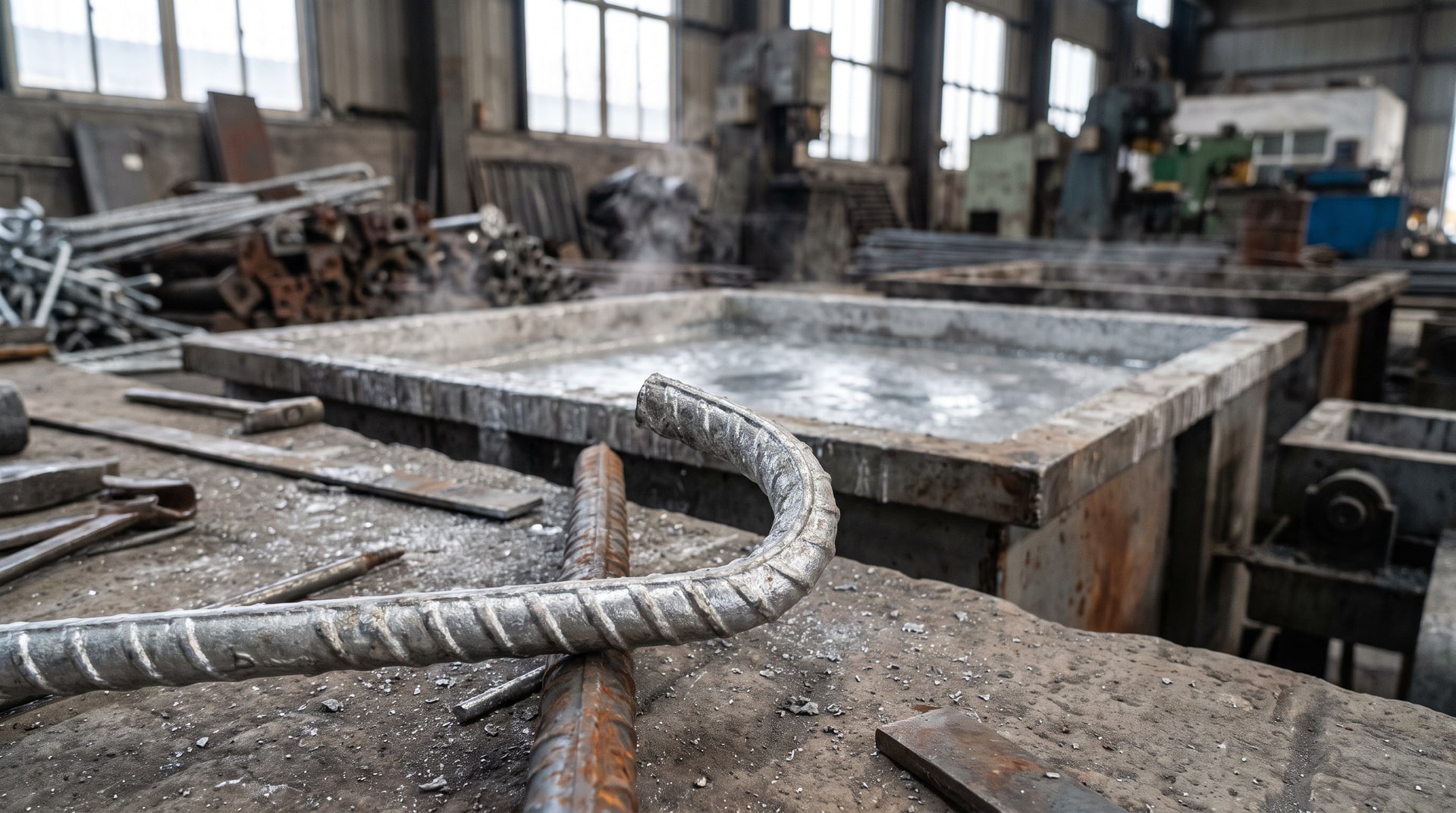
When steel components are bent before hot-dip galvanizing, the geometry of that bend matters far more than most fabricators initially expect. A bend that looks perfectly acceptable on the shop floor can become a liability once the steel enters a galvanizing kettle at temperatures above 800°F. The reason comes down to how cold working introduces stress into steel and how heat interacts with those stressed regions during the galvanizing process. Get the bend geometry wrong, and you risk a condition called strain-age embrittlement, a form of localized hardening and loss of ductility that can compromise structural integrity in ways that are not always visible to the eye.
This is not a marginal concern reserved for extreme cases. It affects routine fabrication decisions, including how tight a hook can be formed on a rebar cage, how a bracket plate gets bent, and whether a shop procedure needs a stress-relief step before parts go to the galvanizer. The good news is that established standards provide clear guidance, and understanding the underlying mechanism makes those guidelines far easier to apply correctly.
The American Galvanizers Association addresses this directly in their article on recommended bend diameters for galvanizing. At V&S Galvanizing, we expand on that foundation to explain what is actually happening at the material level, how steel chemistry influences cold-working behavior, and why the rules for reinforcing bar are genuinely different from those for structural shapes and plate, a distinction that is often misunderstood in the field.
What Happens Inside Steel When It Is Bent Cold
Cold bending, by definition, happens at temperatures well below what would be considered hot forming, typically a few hundred degrees Fahrenheit and below. At these temperatures, the steel cannot plastically deform without resistance. When it is bent, the material on the outer radius of the bend gets stretched in tension, while the inner radius is compressed. Both zones experience significant plastic deformation relative to the neutral axis running through the center of the cross-section.
This deformation is not simply a shape change. At the microstructural level, it moves dislocations within the crystal lattice of the steel and introduces residual stress throughout the affected zone. The tighter the bend, meaning the smaller the bend radius relative to the steel diameter, the more severe this deformation becomes and the higher the residual stress concentration that results.
Under normal service conditions at room temperature, these residual stresses can persist for extended periods without causing problems. Strain aging does occur slowly at ambient temperatures, but not fast enough to cause immediate concern in most structural applications. However, when the steel is exposed to the elevated temperatures of a galvanizing kettle, the kinetics of strain aging accelerate dramatically. What might have taken years to manifest at room temperature can occur within the minutes or hours the steel spends in the galvanizing bath.
Strain-Age Embrittlement: The Mechanism Behind the Risk
Strain-age embrittlement is the technical term for a specific degradation mode that can follow cold working. The AGA defines it as an increase in hardness and strength in the areas stressed by cold working, accompanied by a corresponding decrease in ductility in those same areas. That tradeoff matters enormously in structural applications where both strength and toughness are expected.
The underlying mechanism involves interstitial atoms, primarily nitrogen and carbon, that are dissolved in the steel's iron lattice. After cold working creates dislocation networks in the material, these interstitial atoms migrate to and pin those dislocations during aging. Once the dislocations are pinned, the steel in that zone resists further plastic deformation much more strongly. It becomes harder and stronger in a narrow sense, but it loses the ability to redistribute stress through localized yielding. That loss of ductility is what makes the condition dangerous: rather than deforming gradually under overload, the affected zone can fracture with little warning.
The galvanizing kettle accelerates this process because diffusion of those interstitial atoms increases rapidly with temperature. The combination of high residual stress from tight bends and thermally activated aging is what makes pre-galvanizing bend geometry such an important design and fabrication consideration.
The ASTM A143 Standard and What It Covers
For most structural steel, the governing standard is ASTM A143/A143M. This standard recommends a minimum bend diameter of at least three times the material thickness or diameter, commonly written as 3X the steel diameter, for intermediate and heavy shapes, plates, and general hardware destined for hot-dip galvanizing.
The 3X recommendation exists because it limits the outer-fiber strain during bending to a level that most carbon steel can accommodate without generating excessive residual stress. At that radius, the plastic deformation in the bend zone stays below the threshold where strain-age embrittlement becomes a significant risk for typical structural steel chemistries.
It is worth being precise about what ASTM A143 does and does not cover: it explicitly does not apply to reinforcing bar. That omission is intentional, and the reasons for it are rooted in the fundamentally different material characteristics of rebar compared to structural shapes.
Why Reinforcing Bar Requires Its Own Standard
The distinction between rebar and other structural steel is not arbitrary. Most black steel reinforcing bar is manufactured primarily from scrap iron, which introduces a high degree of variability in steel chemistry from heat to heat and even within a single heat. The composition of rebar can vary considerably in terms of carbon content, nitrogen levels, manganese ratios, and the presence of trace alloying elements. Each of those variables influences how the steel responds to cold working and how susceptible it is to strain-age embrittlement.
Because that variability is built into the material, a single bend radius recommendation suitable for homogeneous structural steel cannot adequately protect all rebar. A tighter radius that is fine for a low-nitrogen heat might be problematic for a high-nitrogen heat from a different scrap charge. The AGA notes that different bend recommendations are necessary precisely because of the varying properties that come with varying chemistries.
The governing standard for rebar intended for galvanizing is ASTM A767/A767M, which includes a table of recommended bend diameters organized by bar size. These recommendations account for the broader range of material properties found in rebar and are generally more conservative than the 3X rule used for structural steel.
| Bar Size | Minimum Bend Diameter |
|---|---|
| #3 through #8 | 6 times the nominal bar diameter |
| #9 through #11 | 8 times the nominal bar diameter |
| #14 and #18 | 10 times the nominal bar diameter |
When Tighter Bends Cannot Be Avoided
Design constraints do not always accommodate the recommended bend diameters. A rebar cage detail might require a tight hook that falls inside the ASTM A767 threshold, or a custom bracket might need a bend radius smaller than 3X. In those situations, the standards provide two legitimate paths forward, and understanding both is important for fabricators and engineers working with galvanized components.
The first option is to form the bend while the steel is hot. Hot forming is done at temperatures high enough that the steel deforms plastically without introducing the same level of residual stress that cold bending creates. Because the dislocations can recover during forming at elevated temperature, the resulting bend carries significantly less locked-in stress. A hot-formed bend that would otherwise be below the recommended radius can be galvanized without the same concern about strain-age embrittlement.
The second option, when cold bending is unavoidable and the geometry falls outside the recommended range, is stress relief through controlled heating before galvanizing. ASTM A143 specifies that the steel must be heated to a temperature between 900 and 1050°F (482 to 566°C) and held at that temperature for one hour per inch of steel diameter. This thermal treatment allows the dislocations introduced by cold working to recover and the residual stresses to redistribute, reducing the embrittlement risk before the steel sees the galvanizing kettle.
Annealing is another valid pre-treatment when tighter bends are necessary. A full anneal restores ductility more completely than a stress relief, though it also requires more time and controlled furnace conditions. Either approach, stress relief or annealing, must be completed before the steel is submitted for galvanizing.
Practical Implications for Fabrication Shops and Design Teams
Understanding these standards in isolation is one thing. Applying them consistently across a real fabrication workflow requires deliberate coordination between design, detailing, and production.
On the design side, engineers specifying galvanized rebar assemblies should be referencing the ASTM A767 bend diameter table when detailing hooks, stirrups, ties, and other bent elements. If a standard ACI hook geometry produces a bend radius that falls below the ASTM A767 threshold for that bar size, that is a flag to either adjust the geometry, specify hot bending, or call for pre-galvanizing stress relief on that element. Catching that in the design phase is far less disruptive than addressing it after fabrication.
For fabricators, the most common issue is receiving partially bent assemblies with no documentation of how the bends were made or whether stress relief was performed. When parts arrive at a galvanizing facility with no indication of whether tight bends were cold-formed, the galvanizer is in a difficult position. Clear job documentation that notes bend radii, forming temperatures, and any pre-treatment performed protects everyone in the supply chain.
Our team at V&S Galvanizing encounters these situations regularly. Parts that arrive with undocumented tight bends, or with bend geometries that are clearly tighter than the recommended minimums, require a conversation before they go into the kettle. In some cases, that means returning parts for stress relief. In others, it means documenting the risk and proceeding with the customer's informed awareness of the potential consequences.
The Role of Steel Chemistry in Susceptibility
One of the more nuanced points in the AGA guidance is the role that steel chemistry plays in determining how sensitive a given steel is to strain-age embrittlement. Not all steels are equally susceptible, and the difference comes down primarily to the levels of interstitial elements, particularly nitrogen and carbon, that are present in solution in the iron lattice.
Steels with higher free nitrogen content are generally more susceptible to strain-age embrittlement because nitrogen atoms are particularly mobile at galvanizing temperatures and are very effective at pinning dislocations. Steels that have been aluminum-killed, meaning aluminum was added during steelmaking to combine with free nitrogen and remove it from solution, tend to be considerably more resistant to strain aging. However, the degree to which rebar is aluminum-killed varies with the scrap source and steelmaking practice, which circles back to the fundamental variability issue that makes rebar a special case.
This is also why the 3X rule that works well for homogeneous structural steel produced to tighter chemical specifications is not automatically transferable to rebar. The chemical variability in rebar is not a defect; it is an inherent characteristic of the material class. The ASTM A767 bend recommendations exist precisely to accommodate that variability with an appropriate margin of safety.
Work With a Team That Understands the Material, Not Just the Process
Bend diameter recommendations before galvanizing are not bureaucratic minimums to work around. They exist because the interaction between cold-working stress and galvanizing temperatures is a real metallurgical phenomenon with real consequences for the structural performance of galvanized components. Whether you are working with structural shapes, hardware, or reinforcing bar, getting the bend geometry right is one of the most straightforward ways to prevent embrittlement-related issues that can be expensive to diagnose and nearly impossible to reverse after galvanizing.
The key takeaways are clear: ASTM A143/A143M governs structural steel and hardware, recommending a minimum bend diameter of 3X the steel diameter. ASTM A767/A767M provides separate, bar-size-specific bend diameter limits for rebar, reflecting the chemical variability inherent to that material class. When tighter bends are necessary, hot forming or pre-galvanizing stress relief at 900 to 1050°F for one hour per inch of diameter provides a legitimate path forward. These are not optional considerations for galvanized steel; they are baseline requirements for ensuring the final product performs as intended throughout its service life.
If you are working on a project involving galvanized rebar assemblies or fabricated structural components with bent elements and have questions about whether your bend geometry is within acceptable limits, our team is ready to help. Reach out through our contact page and we can review the details with you before fabrication progresses to a point where corrections become costly.
Frequently Asked Questions About Recommended Bend Diameters Before Galvanizing
What is the minimum recommended bend diameter for structural steel before hot-dip galvanizing?
ASTM A143/A143M recommends a minimum bend diameter of at least three times (3X) the steel diameter for intermediate and heavy shapes, plates, and hardware intended for hot-dip galvanizing. This recommendation does not apply to reinforcing bar, which is covered by a separate standard.
Why does reinforcing bar have different bend diameter requirements than structural steel?
Most black steel rebar is produced primarily from scrap iron, which introduces significant variability in steel chemistry from heat to heat. Because properties such as nitrogen content, carbon levels, and aging characteristics differ widely across rebar heats, a single radius rule is not adequate. ASTM A767/A767M provides bar-size-specific bend diameter recommendations that account for this chemical variability.
What is strain-age embrittlement and when does it occur in galvanized steel?
Strain-age embrittlement is an increase in hardness and strength in areas stressed by cold working, accompanied by a corresponding decrease in ductility in those zones. It occurs slowly at room temperature but accelerates rapidly when steel is exposed to galvanizing kettle temperatures. Tight cold bends that introduce high residual stress are the primary precursor condition.
What should be done if a design requires a bend tighter than the recommended diameter?
There are two acceptable approaches. The first is to form the bend while the steel is hot, which reduces the residual stress introduced during forming. The second is to stress-relieve the cold-bent steel by heating it to between 900 and 1050°F (482 to 566°C) and holding it at that temperature for one hour per inch of steel diameter before galvanizing. Annealing is also an option when more complete ductility restoration is needed.
Does stress-relief heating need to happen before or after galvanizing?
Stress relief must be completed before galvanizing. The purpose of the treatment is to reduce residual stress in the cold-bent zone before the steel is exposed to galvanizing temperatures. Performing it after galvanizing would damage the zinc coating and would not address the embrittlement risk during the galvanizing process itself.
Which steel chemistries are most susceptible to strain-age embrittlement during galvanizing?
Steels with higher levels of free nitrogen in solid solution are generally more susceptible because nitrogen atoms diffuse readily at galvanizing temperatures and effectively pin dislocations created by cold working. Aluminum-killed steels, where aluminum was added during steelmaking to tie up free nitrogen, tend to be significantly more resistant to strain-age embrittlement.
Does the 3X bend diameter rule apply to all plate thicknesses and bar sizes?
ASTM A143/A143M applies the 3X diameter recommendation to intermediate and heavy shapes, plates, and hardware in general. It does not apply to reinforcing bar, which uses size-specific recommendations from ASTM A767/A767M. Engineers and fabricators should confirm which standard governs their specific material type before specifying bend geometry for galvanized components.
What documentation should accompany fabricated steel with tight bends sent for galvanizing?
Fabricators should document whether bends were formed cold or hot, the bend radii used relative to the material diameter, and whether any stress-relief or annealing treatment was performed prior to submitting parts for galvanizing. This documentation allows the galvanizer to assess risk and process parts appropriately rather than proceeding without knowing the forming history of the material.
