

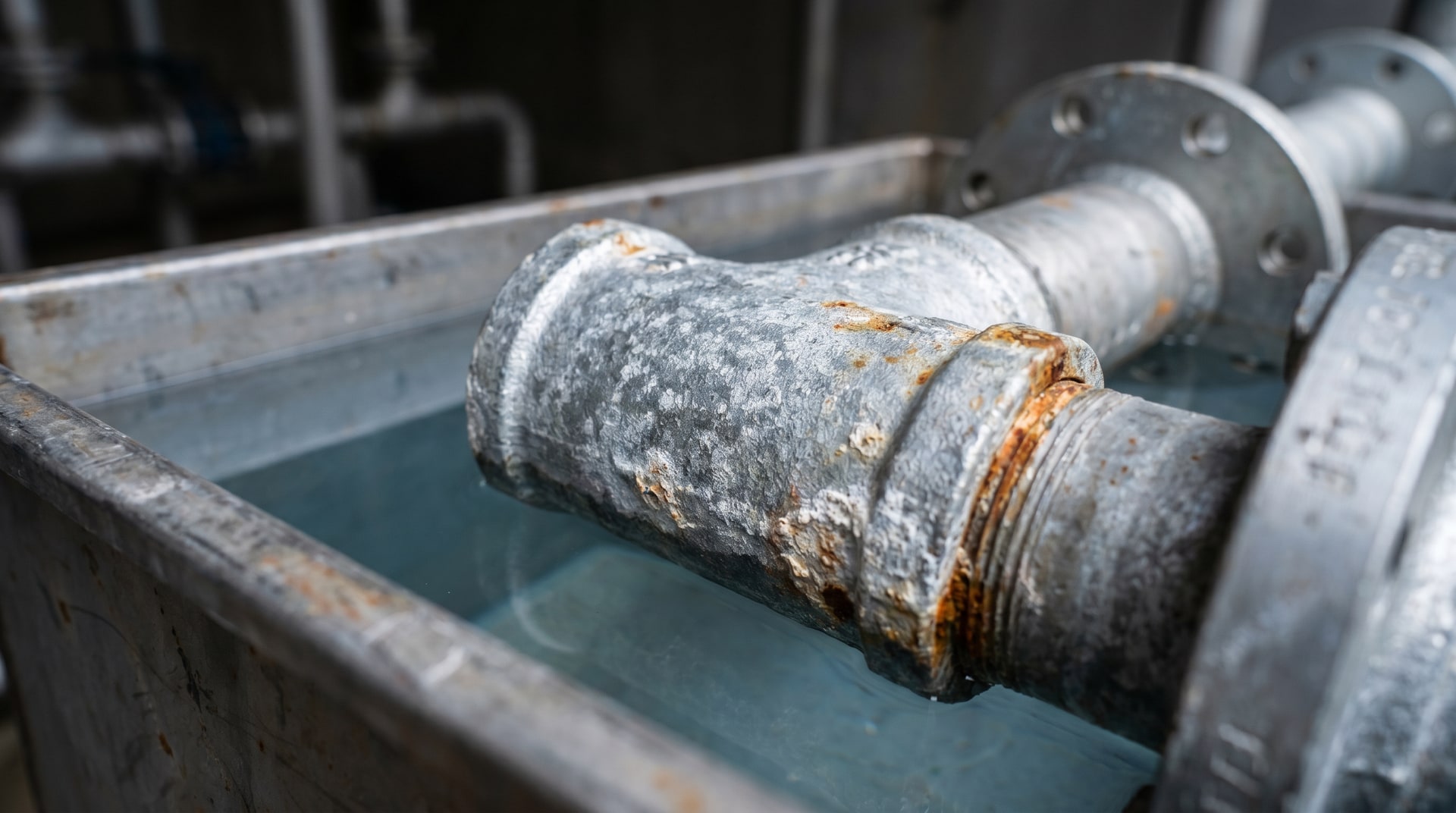
When engineers and fabricators spec out components for fluid handling systems, heat exchangers, HVAC loops, or food-adjacent processing equipment, the question of chemical compatibility with the zinc coating on galvanized steel comes up quickly. Propylene glycol is one of the more common fluids encountered in these applications. It shows up as an antifreeze agent in closed-loop heating and cooling systems, as a heat transfer fluid, and in a range of industrial and even food-grade processing contexts. The natural question is whether the zinc coating on hot-dip galvanized steel will hold up when it comes into sustained contact with this compound.
The American Galvanizers Association addresses this directly in their article on how corrosive propylene glycol is to hot-dip galvanized steel. At V&S Galvanizing, we expand on that foundation to explain what is actually happening at the material level, how the nature of the zinc-glycol interaction influences long-term performance, and why this question is often oversimplified or mishandled in the field.
The Core Data Point and What It Actually Tells Us
The authoritative figure here comes from Frank Porter's reference work, Corrosion Resistance of Zinc and Zinc Alloys. According to that source, propylene glycol corrodes zinc-coated steel at less than 0.5 mil per year. That number deserves some unpacking before anyone treats it as a blanket green light.
First, what does 0.5 mil per year actually mean in practical terms? One mil is one-thousandth of an inch, or roughly 25 microns. A typical hot-dip galvanized coating on structural steel will range from about 3.0 to 5.0 mils in total thickness, depending on the steel chemistry, section geometry, and the applicable ASTM standard. At a corrosion rate below 0.5 mil per year, a coating in the 3.5-mil range could theoretically last seven or more years of continuous exposure before the zinc layer is substantially compromised. That is a meaningful service life, even in a continuous-contact scenario.
Second, and critically, the source is explicit that temperature and concentration data are not provided alongside this corrosion rate. That is not a footnote to gloss over. It means the figure of less than 0.5 mil per year is a general reference value, not a worst-case or best-case boundary. The actual corrosion behavior you will see in a real system will depend heavily on operating conditions that this number does not capture.
Why Temperature and Concentration Are the Missing Variables
Corrosion rates for zinc in chemical environments are not fixed constants. They shift significantly with temperature, chemical concentration, and the presence of other dissolved species in solution. Propylene glycol is no exception to this pattern.
At low concentrations and near ambient temperatures, propylene glycol behaves as a relatively mild chemical toward zinc. The compound is a diol, meaning it carries two hydroxyl groups, and it does not generate the kind of aggressive acid or alkaline conditions that rapidly attack zinc. This is part of why it reads as relatively benign in general corrosion testing.
However, glycol solutions in real systems are rarely pure glycol and deionized water. They often contain pH buffers, corrosion inhibitor packages, biocides, or scale inhibitors. As temperatures rise, particularly in systems running above 60 degrees Celsius (140 degrees Fahrenheit), glycol compounds can begin to degrade. Glycol oxidation products include glycolic acid and other organic acids, which are considerably more aggressive toward zinc than fresh glycol solution. A system that starts out mild can become meaningfully more corrosive over its service life if the fluid is not properly maintained or if it runs at elevated temperatures over extended periods.
This degradation mechanism is worth flagging for any engineer designing a system where hot-dip galvanized components will see continuous glycol exposure at elevated temperatures. The 0.5 mil per year figure may remain valid in a well-maintained, ambient-temperature system. It may not be representative of a system where the glycol is degrading steadily into acidic byproducts.
Understanding the Zinc Coating as a Sacrificial Layer
One of the distinguishing characteristics of hot-dip galvanized steel is the metallurgical bond between the zinc coating and the base steel. The coating itself is not a simple surface layer. It is a series of intermetallic zinc-iron alloy phases that form during the galvanizing process, capped by an outer layer of relatively pure zinc. This structure gives galvanized coatings their exceptional adhesion and mechanical durability.
In a corrosive environment, zinc acts as a sacrificial anode. It preferentially corrodes rather than allowing the underlying steel to rust. In atmospheric exposures, zinc corrosion products (primarily zinc carbonate and zinc oxide) form a tightly adherent patina that actually slows further corrosion, extending service life considerably beyond what the initial corrosion rate would suggest.
In immersed or continuous-contact chemical environments like a glycol loop, the patina dynamic changes. The corrosion products may not build up the same protective layer, particularly in a flowing system where they are continuously washed away. The zinc continues to corrode at whatever rate the chemical environment drives, without the benefit of a self-limiting patina mechanism. This distinction matters when you are using that less-than-0.5-mil-per-year figure to estimate service life in an immersed application versus an atmospheric one.
Where Galvanized Steel Is and Is Not Typically Used in Glycol Systems
Hot-dip galvanized steel is widely used in structural components, secondary containment, exterior piping supports, and architectural applications where performance in the outdoor environment is the primary concern. For applications where components are continuously wetted or immersed in a chemical fluid, the selection logic shifts, and galvanized steel competes against stainless steel, coated carbon steel, and other alternatives.
In practice, galvanized steel does appear in certain glycol-adjacent applications. Structural framing and supports around fluid systems are common. Conduit, cable trays, and secondary structural elements in HVAC mechanical rooms are routinely galvanized, even in spaces where glycol piping runs nearby. The concern is not incidental contact or splash exposure, which the low corrosion rate handles with ease. The concern is sustained immersion or near-constant wetting at elevated temperatures.
For fluid-carrying components that will live inside a glycol loop, most engineers will lean toward materials with better defined chemical resistance across the expected operating envelope. But for the surrounding structure, supports, and hardware in those same spaces, galvanized steel remains an economical and durable choice, and understanding how the zinc responds to glycol exposure is a legitimate engineering input when specifying those components.
How Coating Thickness Factors Into the Calculation
If you accept the less-than-0.5-mil-per-year corrosion rate as a working figure, then coating thickness becomes the primary lever for adjusting service life. Thicker coatings simply take longer to consume at any given corrosion rate. This is a straightforward relationship, but the way it plays out in practice depends on how the galvanized article is specified and processed.
ASTM A123, the governing standard for hot-dip galvanizing of fabricated structural steel, specifies minimum coating thicknesses that vary with steel category (sheet, strip, wire, structural shapes, pipe, and so on) and steel thickness. For structural steel plate and shapes 0.25 inch and thicker, the minimum average coating thickness is 3.9 mils. For thinner material, minimums are lower. Real-world coatings on heavier structural steel often come in above the minimum, particularly on steel with reactive silicon content.
Our team at V&S Galvanizing routinely sees coating thicknesses that exceed ASTM minimums on well-prepared structural steel, which provides a meaningful additional buffer for corrosive service environments. If a project involves components that will see glycol exposure as part of their service life, specifying to the higher end of the coating thickness range is a straightforward way to extend that service life without changing the coating material or process.
The Role of pH in Glycol-Zinc Interactions
Zinc has a characteristic vulnerability to both strongly acidic and strongly alkaline environments. The metal corrodes relatively slowly in the pH range of roughly 6 to 12, and accelerates significantly outside that window in either direction. Fresh propylene glycol solutions are typically near neutral in pH, which keeps them within the stable range for zinc. This is a key reason why the reported corrosion rate is low.
However, glycol solutions that have degraded, become contaminated, or been treated with improper additive packages can drift outside this neutral zone. Acidic degradation products from oxidized glycol can push the pH well below 6, where zinc corrosion accelerates sharply. Conversely, some inhibitor formulations are highly alkaline, and while zinc tolerates moderate alkalinity reasonably well, very high pH can also attack the coating.
For any application where galvanized steel will see prolonged glycol contact, maintaining the fluid's pH within the neutral to mildly alkaline range is both good practice for the fluid system generally and directly protective of the zinc coating. This is standard operating procedure in well-maintained closed-loop systems, but it is worth making explicit as part of the engineering rationale when galvanized steel is in the picture.
Practical Guidance for Specifiers and Fabricators
When the question of propylene glycol compatibility comes up during a project, the honest answer is that galvanized steel performs well in fresh, near-neutral glycol solutions at or near ambient temperature. The corrosion rate of less than 0.5 mil per year is a low number, and a properly galvanized coating provides multiple years of protection even under continuous exposure at that rate.
The conditions that shift the calculation toward greater caution are elevated operating temperatures, degraded or contaminated glycol with low pH, high-velocity flow that prevents any buildup of protective corrosion products, and thin base coatings on light-gauge steel. None of these conditions necessarily disqualify galvanized steel, but they require the specifier to think carefully about whether the general corrosion rate still applies to their specific scenario.
When in doubt, the most defensible approach is to consult with a galvanizer who understands the relationship between coating characteristics and chemical exposure. Providing complete system information (operating temperature, glycol concentration, expected fluid pH, flow conditions, and whether the exposure is immersed or intermittent) allows for a much more grounded assessment than a simple lookup of a single corrosion rate number.
Work With a Team That Understands the Full Performance Picture
A corrosion rate of less than 0.5 mil per year for propylene glycol on zinc-coated steel is a genuinely favorable number. It reflects propylene glycol's relatively benign chemistry toward zinc under typical conditions, and it provides a reasonable basis for engineering judgment when galvanized steel is being considered for environments where glycol contact is possible. That said, it is a general figure without temperature or concentration boundaries attached, and applying it without understanding what drives corrosion behavior in practice can lead to poor decisions in edge-case applications.
At V&S Galvanizing, we work with engineers, fabricators, and project teams across a wide range of industries and service environments. Our team understands how coating thickness, steel chemistry, and operating conditions interact to determine real-world performance. If you are specifying galvanized steel for an application that involves propylene glycol or other chemical exposures, we welcome the conversation. Reach out through our contact page to discuss your project and get answers that go beyond the general reference data.
Frequently Asked Questions About Propylene Glycol and Hot-Dip Galvanized Steel
What is the corrosion rate of propylene glycol on hot-dip galvanized steel?
According to Frank Porter's Corrosion Resistance of Zinc and Zinc Alloys, propylene glycol corrodes zinc-coated steel at less than 0.5 mil per year. This figure is not tied to a specific temperature or glycol concentration, so it should be treated as a general reference rather than a precise engineering limit.
Does temperature affect how quickly propylene glycol corrodes galvanized steel?
Temperature is a significant variable that the published corrosion rate does not account for. At elevated temperatures, glycol solutions can oxidize and form acidic degradation products, which are more aggressive toward zinc than fresh glycol. Systems running above roughly 60 degrees Celsius warrant closer attention to fluid condition and coating performance.
Can propylene glycol degrade inside a closed-loop system and become more corrosive over time?
Yes. Glycol oxidation produces organic acids, including glycolic acid, which lower the pH of the solution. Since zinc corrodes rapidly in low-pH environments, a degraded glycol system can be significantly more aggressive than fresh glycol. Regular fluid testing and maintenance are important in any closed-loop system that contacts galvanized steel.
What pH range is safe for zinc coatings in glycol-containing systems?
Zinc is most stable in the pH range of approximately 6 to 12. Fresh propylene glycol solutions are typically near neutral and fall comfortably within this range. Maintaining the system fluid within that pH band will help protect the zinc coating and slow corrosion to rates consistent with the reference data.
How does coating thickness affect service life in propylene glycol exposure?
Service life scales directly with coating thickness at any given corrosion rate. A coating of 3.5 mils consumed at less than 0.5 mil per year provides a theoretical minimum of seven years of protection under continuous exposure. Thicker coatings, which are common on heavier structural steel galvanized to ASTM A123, extend that window further.
Is hot-dip galvanized steel appropriate for pipes or fittings that carry propylene glycol directly?
For structural supports and secondary components near glycol systems, galvanized steel is generally appropriate given the low reported corrosion rate. For fluid-carrying components in direct, continuous contact with glycol at elevated temperatures, most engineers specify materials with a more fully characterized chemical resistance profile. The specific application conditions should always guide the final material selection.
Does the zinc-iron alloy layer in a galvanized coating behave differently than pure zinc in glycol exposure?
The inner alloy layers of a hot-dip galvanized coating are harder and slightly less reactive than the outer pure zinc layer. In practice, corrosion typically proceeds from the outer surface inward, meaning the pure zinc layer is consumed first. The intermetallic phases provide additional service life before the base steel is exposed, though their specific behavior in glycol environments is not separately characterized in the available reference data.
Should I specify a minimum coating thickness if galvanized steel will be near a glycol system?
For incidental or splash exposure, ASTM A123 minimum thicknesses are generally adequate. For sustained or immersed glycol contact, specifying toward the higher end of achievable coating thickness provides additional margin. Discussing the application conditions with your galvanizer before fabrication allows the coating to be optimized for the service environment.
