

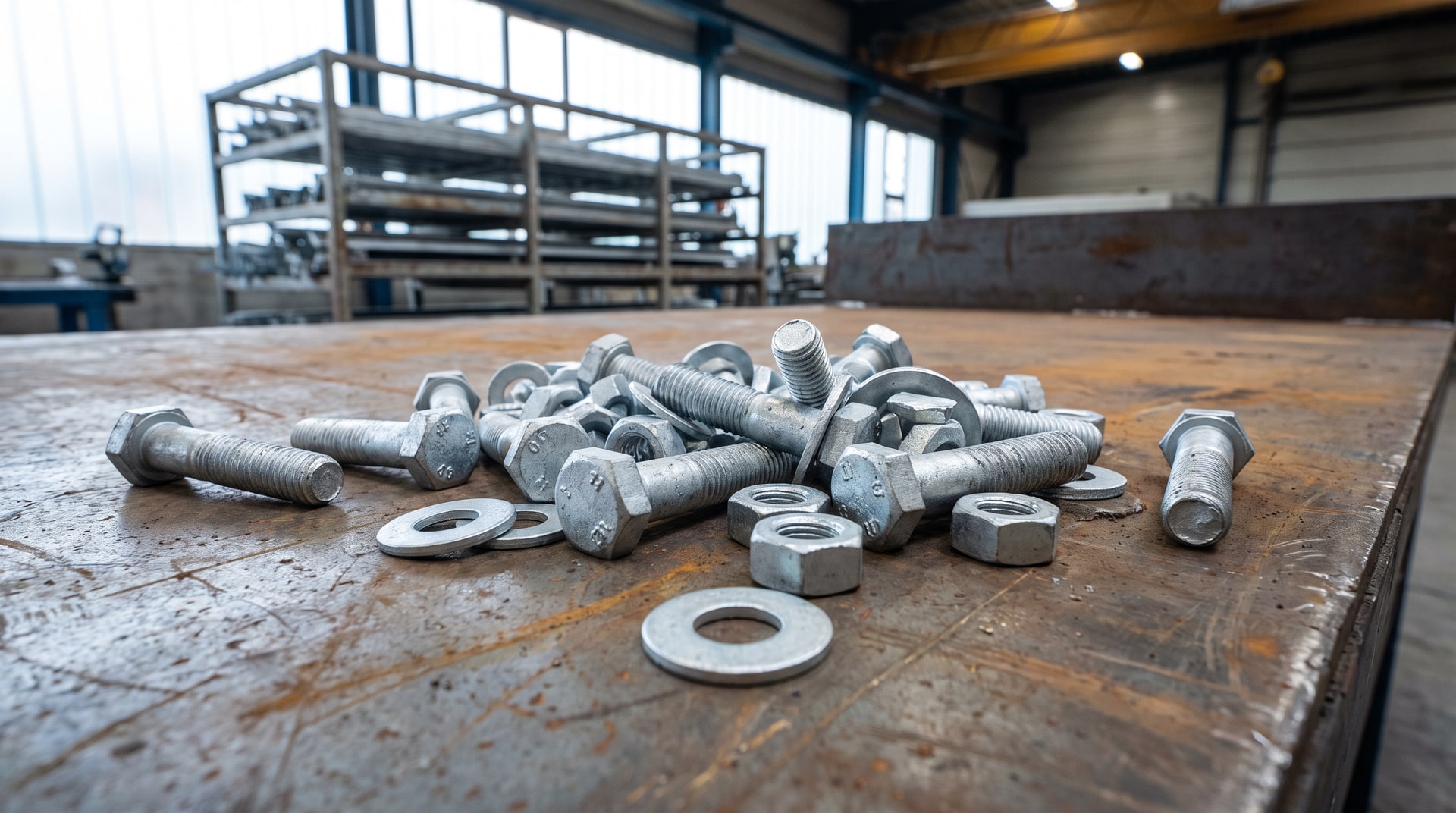
When a project specifies galvanized fasteners, the assumption is often that one galvanizing standard is much like another. In practice, the differences between ASTM A153 and ASTM F2329 can have real consequences for production scheduling, coating performance, documentation, and final inspection acceptance. Whether you are a structural engineer specifying hardware for a bridge project, a contractor coordinating with a fabricator, or a quality manager reviewing certifications before shipment, understanding how these two standards diverge is not a minor administrative detail. It directly affects what a galvanizing plant must do, what paperwork must accompany the material, and whether the finished product will pass inspection.
The American Galvanizers Association addresses this directly in their article on ASTM F2329 vs. ASTM A153. At V&S Galvanizing, we expand on that foundation to explain what is actually happening at the material level, how specification choice influences coating performance and process requirements, and why this distinction is often misunderstood in the field.
Two Standards With the Same Goal, Different Paths to Get There
Both ASTM A153 and ASTM F2329 govern hot-dip galvanizing of hardware that is centrifuged after being withdrawn from the zinc bath. Centrifuging is the step that removes excess molten zinc from the threads and recesses of small parts like bolts, nuts, and washers so they remain dimensionally usable after coating. Without it, fastener threads would fill with zinc and the parts would become impossible to assemble.
What sets the two standards apart is not the fundamental galvanizing process but the rigor of the quality framework surrounding it. ASTM A153 has been the workhorse specification for galvanized hardware for decades, and most galvanizing plants are intimately familiar with its requirements. ASTM F2329 was developed more recently and is tailored specifically to fasteners, drawing heavily on A153 in many of its sections while layering additional requirements on top. In fact, galvanizing fasteners in strict compliance with A153 will usually meet or exceed F2329 requirements in most areas precisely because F2329 defers to A153 in several key clauses. The word "usually" matters here, though. There are specific areas where F2329 is more demanding, and those differences are worth examining carefully before a specification is finalized.
It is also worth noting that F2329 does not cover nails or rivets. If your project involves those hardware types, A153 remains the applicable specification.
How Sampling Protocol Determines What Gets Tested and How Often
One of the most practically significant differences between the two standards is how they define and handle sampling. ASTM A153 uses a relatively straightforward sampling approach. ASTM F2329 introduces two distinct lot types, each with its own inspection framework, and the customer is responsible for specifying which applies.
A batch lot under F2329 is defined as a quantity of identical parts cleaned, pickled, fluxed, and galvanized together at one time in a galvanizing basket. This is conceptually similar to the lot structure in A153, but F2329 Table 1 adds explicit requirements for adhesion testing and visual appearance inspection that are not standard under A153. Notably, F2329 Table 1 actually requires fewer samples per batch lot size than A153 does, but those samples must be evaluated against three distinct criteria: coating thickness, adhesion, and appearance. The acceptance criterion in every case is zero defects.
| Batch Lot Size (Number of Articles) | Coating Thickness (No. of Test Articles) | Adhesion (No. of Test Articles) | Appearance (No. of Test Articles) |
|---|---|---|---|
| Source table image could not be reconstructed with full confidence | See source image | See source image | See source image - Acceptance criterion: zero defects in all cases |
Production lots are a different structure entirely. These are defined as batches of parts originating from the same manufacturing lot, processed continuously through cleaning, chemical cleaning, fluxing, zinc dipping, and centrifuging without significant changes in time, temperature, or process chemistry. F2329 further subdivides production lots into a Detection Process and a Prevention Process, each requiring different sample sizes drawn from ASTM F1470 Table 3. For example, a lot of 500 articles under the detection process requires testing of 11 samples for coating thickness, 11 for visual appearance, and 3 for adhesion.
| Inspection Criterion | Detection Process - Sample Size Column (F1470 Table 3) | Prevention Process - Sample Size Column (F1470 Table 3) |
|---|---|---|
| Coating Thickness | Per F1470 Table 3 Detection column (e.g., 11 samples for lot of 500) | Per F1470 Table 3 Prevention column |
| Visual Appearance | Per F1470 Table 3 Detection column (e.g., 11 samples for lot of 500) | Per F1470 Table 3 Prevention column |
| Adhesion | Per F1470 Table 3 Detection column (e.g., 3 samples for lot of 500) | Per F1470 Table 3 Prevention column |
| Acceptance Number (all criteria) | Zero defects | Zero defects |
Note A: Suppliers shall furnish certified test results from which the shipping lots originated. If certified test reports are not available, the supplier must default to Sample Size C and conduct the required tests.
The practical takeaway for engineers and procurement teams is straightforward: if F2329 is specified on the order, the lot type must be explicitly stated. Failing to specify which type of production lot process applies defaults the supplier to Sample Size C under F1470, which carries its own implications for testing scope and cost. Ambiguity here creates friction in production and can lead to certification gaps at delivery.
Coating Thickness: Where the Numbers Actually Diverge
On most hardware categories, A153 coating thickness requirements meet or exceed those of F2329. But there are three specific cases where F2329 demands more zinc than A153 would require, and these are worth knowing before a project is priced or specified.
For fasteners and nuts 3/8 inch and under in diameter, F2329 sets the average coating thickness on individual specimens at 1.5 mils. ASTM A153 requires only 1.4 mils for the same parts. The difference is small in absolute terms but can be meaningful when you are working with tightly threaded fasteners where any excess zinc affects fit-up with standard nuts.
Washers less than 3/16 inch in thickness follow the same pattern. F2329 requires 1.5 mils on individual specimens versus 1.4 mils under A153. Again, the gap is narrow, but the specification is clear.
The most significant divergence involves Grade A394 bolts. ASTM F2329 includes Supplementary Requirement 1 specifically addressing these bolts, requiring a minimum average coating thickness of 2.8 mils across all specimens and 2.5 mils for any individual specimen. Under A153, A394 bolts fall into Class C, which only requires 2.1 mils average and 1.7 mils per individual specimen. That is a substantial difference. Specifying F2329 with SR1 for A394 bolts puts significantly more zinc on the part, which has implications for thread clearance, nut compatibility, and the overall corrosion life of the fastener assembly.
For coating thickness measurement, both standards use ASTM E376 as the test method. F2329 adds one procedural note not found in A153: for long pieces such as anchor rods or any article exceeding five feet in length, thickness measurements must be taken at each end and in the middle of the article. This is analogous to multi-specimen measurement on structural shapes under ASTM A123, but it is not a requirement A153 imposes on hardware.
Adhesion Testing and the Stout Knife Test
Under ASTM A153, adhesion testing is not a routine requirement. It is only performed when there is already visible evidence of a potential adhesion problem. ASTM F2329 takes a different position: adhesion testing using the stout knife test is required for every batch lot, applied to the number of articles specified in Table 1.
The stout knife test involves driving a stout-bladed knife under the coating with significant force to assess whether the zinc bond has adequate strength. A properly galvanized coating bonds metallurgically to the base steel through a series of iron-zinc alloy layers. If those layers have formed correctly, the coating will resist the knife without flaking or peeling. If cleaning or fluxing was inadequate, or if silicon content in the base steel caused reactive galvanizing behavior, the coating may lift or delaminate under the knife.
Requiring this test for every batch lot rather than only on suspicion represents a genuine increase in quality assurance burden under F2329. Galvanizing plants that process large volumes of small hardware under A153 routinely may need to adjust workflow to accommodate the additional testing cadence when F2329 is specified.
Appearance Requirements and What They Actually Evaluate
The topic hint for this article rightly draws attention to appearance, because surface condition is one area where field personnel sometimes misinterpret what a specification actually requires. Both F2329 and A153 address appearance, and F2329 explicitly calls for visual inspection for appearance on every batch lot using the methods provided in A153.
What does that mean in practice? A galvanized coating on hardware is not expected to be perfectly uniform in color or texture. Variation in the iron-zinc alloy layer structure, the presence of spangled free zinc, minor surface roughness from centrifuging, and early-stage oxidation of the zinc surface are all normal features of a compliant coating. The appearance requirements in A153 focus on identifying genuine defects: bare spots, blisters, heavy dross inclusions, sharp protrusions that could affect assembly, or areas where the coating has clearly separated from the steel.
Lumpiness, dullness, matte gray areas, or minor color non-uniformity are not defects under either standard. This distinction matters when a contractor or inspector encounters galvanized fasteners on a job site and raises concerns based on cosmetic variation that falls well within specification. Educating field personnel on what constitutes an actual appearance defect versus normal variation in a hot-dip galvanized coating prevents unnecessary rejection of compliant material and avoids costly re-work or replacement.
Preventing Hydrogen Embrittlement: Shared Goals, Different Test Methods
Both ASTM A153 and ASTM F2329 recognize hydrogen embrittlement as a risk during the galvanizing of high-strength fasteners and address it with the same two preventive approaches. The first option is baking parts after chemical cleaning and before galvanizing to drive off absorbed hydrogen. The second is abrasive blasting followed by a brief flash chemical cleaning, which avoids the prolonged acid exposure that allows hydrogen to diffuse into the steel lattice in the first place.
Where the standards diverge is in how embrittlement testing is conducted if it is deemed necessary. Under A153, testing follows ASTM A143 Paragraph 9. Under F2329, it is conducted per ASTM F606, which involves a wedge positioned and tensioned under a bolt head. These are fundamentally different mechanical test configurations, and a galvanizing plant or testing lab equipped for one may not be set up for the other. Engineers specifying F2329 on high-strength fastener orders should confirm in advance that the testing infrastructure is in place.
It is also worth noting that individual bolt specifications may place additional requirements on embrittlement prevention or testing beyond what either standard requires. Those should be researched separately for each hardware grade being galvanized.
Bath Temperature, Mechanical Properties, and What the Galvanizer Must Communicate
The temperatures used in hot-dip galvanizing, typically in the range of 820 to 900 degrees Fahrenheit as noted in F2329, do not ordinarily alter the mechanical properties of common structural steels. However, two situations create legitimate concern: steel that has been severely work hardened, and fasteners with tempering or stress-relief temperatures that fall within or below the galvanizing bath temperature range.
For work-hardened fasteners, F2329 requires that stress relief occur prior to galvanizing. For situations where the bath temperature exceeds the fastener's stress-relieving or tempering temperature, Paragraph 7.2.1.2 of F2329 requires the purchaser to arrange for mechanical testing after galvanizing. This is a meaningful requirement: it places responsibility on the purchasing side to assess the thermal exposure risk and follow up with testing rather than assuming galvanizing at standard temperatures is harmless.
F2329 also requires the galvanizer to record and communicate the average bath temperature to the customer. Best practice under F2329 is to document this proactively. A153 does not carry this requirement, so galvanizing plants upgrading orders from A153 to F2329 need a reliable method for capturing and reporting bath temperatures as part of the certification package.
Quenching, Post-Treatment, and Lubrication: Options That Require Upfront Coordination
Several F2329 requirements that have no parallel in A153 relate to what happens after the parts come out of the zinc bath. F2329 Paragraph 5.3.1 specifies that all parts are to be quenched in water after galvanizing unless the customer specifies air cooling. Water quenching halts the alloy layer growth and helps prevent the formation of zinc oxide, which can interfere with appearance and paint adhesion in duplex systems. A153 does not require water quenching at all, so a plant accustomed to air cooling hardware under A153 may need to confirm quench tank availability before committing to an F2329 order.
F2329 also allows customers to request chemical post-treatments. Chromating reduces the risk of wet storage stain, a white powdery deposit that forms when zinc surfaces are exposed to trapped moisture during storage or transit. Phosphating is available as an option to improve adhesion if the fasteners will subsequently be painted. These are not mandatory under F2329, but if a customer elects to require them, the galvanizing plant must either have that capability or disclose that it does not.
Lubrication is a similar situation. A153 has no lubrication requirement. F2329 Paragraph 5.5.2 permits the customer to request lubrication of nuts, bolts, or screws to assist with assembly after galvanizing. If the plant cannot apply lubricant, a third party will need to perform that step at additional cost. None of these are insurmountable logistics challenges, but they all need to be resolved before production begins, not after the parts are already coated.
Documentation and Delivery Requirements
ASTM F2329 requires more detailed ordering information from the purchaser and more comprehensive documentation from the galvanizer at delivery than A153 does. The scope of additional paperwork depends on which optional requirements the customer elects, but the baseline expectation under F2329 is a more complete certification package that documents lot traceability, bath temperature, test results for thickness, adhesion, and appearance, and any supplementary requirements that were invoked.
One detail that sometimes catches fabricators off guard: if the purchaser requires dimensional inspection of parts upon delivery, F2329 stipulates that the purchaser must supply the galvanizer with the necessary inspection tools and gauges. The standard does not assume the galvanizing plant maintains a full complement of dimensional inspection equipment for every hardware type it processes.
Work With a Team That Knows the Standard Before the Order Is Placed
The differences between ASTM A153 and ASTM F2329 are not academic. They affect how a galvanizing plant plans production, what testing it performs, what documentation it generates, and whether the finished hardware will pass certification. Most compliance issues with F2329 arise not from a galvanizer's inability to meet the technical requirements but from insufficient communication at the start of an order. Lot type, quench method, post-treatment needs, lubrication, bath temperature documentation, and embrittlement testing method all need to be settled before parts go into the line.
Our team works through these specification questions with customers before production begins, not after. If you have an upcoming fastener order with F2329 requirements, or if you are trying to determine whether A153 or F2329 is the right specification for your project, we are glad to help you think through the details. Reach out through our contact page and one of our team members will be in touch.
Frequently Asked Questions About ASTM F2329 vs. ASTM A153
What is the key difference between ASTM A153 and ASTM F2329?
Both standards cover hot-dip galvanizing of centrifuged hardware, but ASTM F2329 adds more rigorous sampling requirements, mandatory adhesion testing for every batch lot, additional documentation at delivery, and specific requirements for quenching, bath temperature recording, and post-treatments that do not appear in ASTM A153. F2329 defers to A153 in many sections, so A153-compliant galvanizing usually meets F2329 requirements except in a few specific areas.
Does ASTM F2329 require thicker zinc coatings than A153?
In most cases the requirements are similar or A153 is more demanding, but F2329 requires a higher coating thickness for fasteners and nuts 3/8 inch and under in diameter (1.5 mils vs. 1.4 mils under A153), washers thinner than 3/16 inch (same difference), and Grade A394 bolts under Supplementary Requirement 1 (2.8 mils average vs. 2.1 mils under A153 Class C). The A394 bolt case is the most significant divergence.
What does the stout knife adhesion test involve and why does F2329 require it?
The stout knife test involves driving a stout-bladed knife under the galvanized coating with significant force to check whether the metallurgical bond between the zinc and the steel is intact. ASTM F2329 requires this test on a defined number of articles for every batch lot. ASTM A153 only requires adhesion testing when there is already visible evidence of a problem. The F2329 requirement reflects a more proactive quality assurance posture.
What is the difference between a batch lot and a production lot under ASTM F2329?
A batch lot is a quantity of identical parts cleaned, pickled, fluxed, and galvanized together in a single basket. A production lot is a continuous run of parts from the same manufacturing lot processed without significant changes to time, temperature, or process chemistry. Production lots under F2329 are further divided into Detection Process and Prevention Process types, each with different sample size requirements drawn from ASTM F1470 Table 3. The customer must specify which type applies.
How does ASTM F2329 handle hydrogen embrittlement testing differently from A153?
Both standards use the same two preventive methods: baking after chemical cleaning before galvanizing, or abrasive blasting with flash chemical cleaning. When embrittlement testing is required, A153 directs testing per ASTM A143 Paragraph 9, while F2329 requires testing per ASTM F606, which uses a wedge positioned and tensioned under the bolt head. These are different test configurations, so lab capability should be confirmed before specifying F2329 on high-strength fastener orders.
Does ASTM F2329 require water quenching after galvanizing?
Yes. F2329 Paragraph 5.3.1 requires water quenching of all parts after galvanizing unless the customer specifically requests air cooling to prevent zinc oxide formation. ASTM A153 does not require water quenching. Galvanizing plants that air cool hardware by default under A153 need to confirm they have quench tank capability before accepting F2329 orders where quenching is not waived.
What documentation does ASTM F2329 require that A153 does not?
F2329 requires more detailed ordering information from the purchaser and a more complete certification package at delivery. This includes lot traceability documentation, recorded average bath temperature, test results for coating thickness, adhesion, and visual appearance, and documentation of any supplementary requirements. If dimensional inspection is required at delivery, F2329 also requires the purchaser to supply the necessary inspection gauges to the galvanizer.
Can a galvanizing plant certified to ASTM A153 automatically certify to ASTM F2329?
Not automatically. Because F2329 defers to A153 in many areas, a plant meeting A153 requirements is already partway there. However, F2329 adds requirements for mandatory adhesion testing on every batch lot, bath temperature documentation, water quenching, optional post-treatments and lubrication capability, and a more structured certification package. A plant needs to assess whether it has the process infrastructure and documentation systems to meet these additional demands before committing to F2329 certification on a customer order.
