

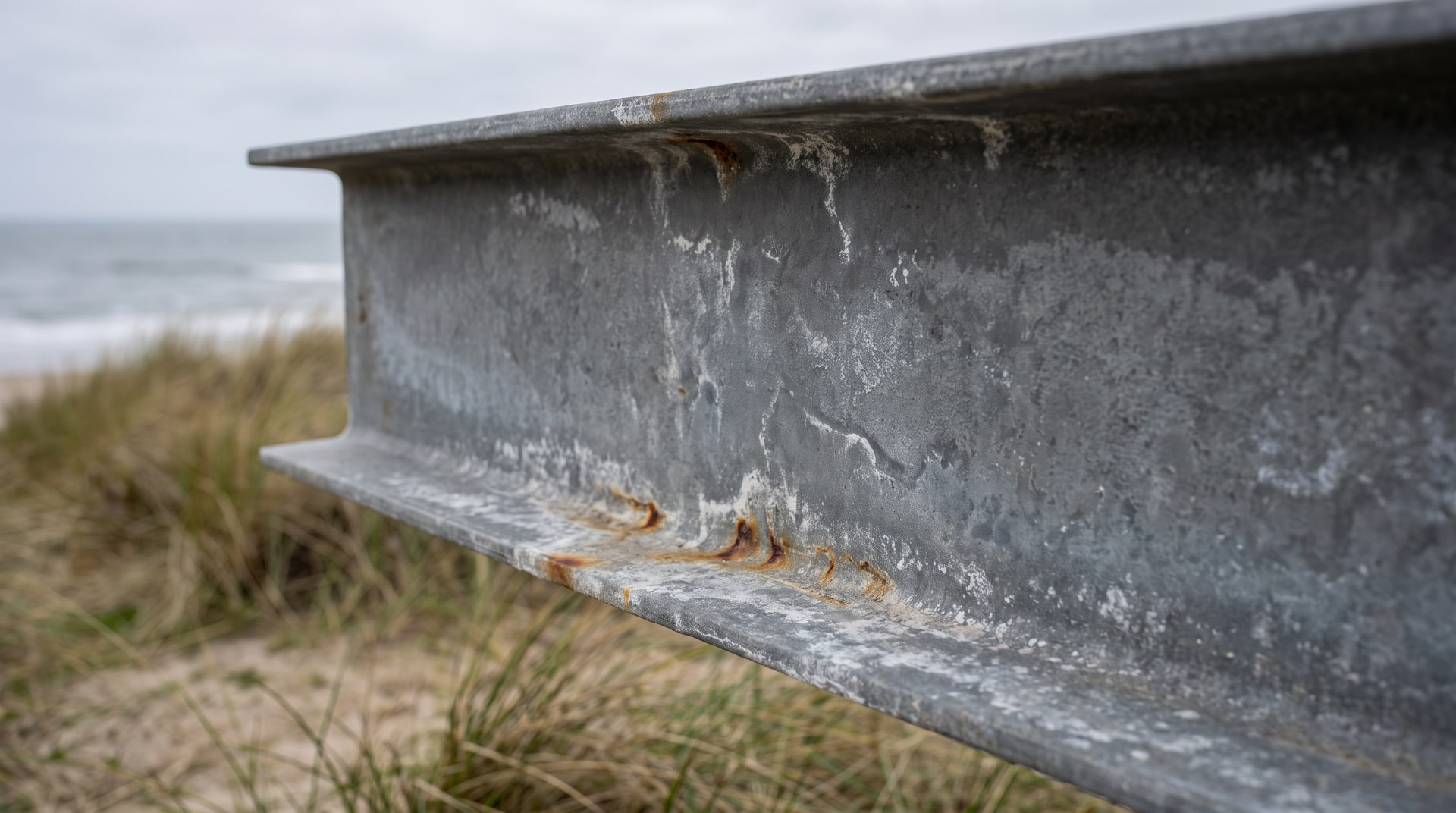
When a contractor or procurement engineer receives a test report showing that a galvanized steel component failed or underperformed in a salt spray chamber, the instinct is to question the coating. In many cases, the more appropriate response is to question the test. Salt spray testing has been a fixture of corrosion evaluation programs for decades, and its results carry real weight in specifications and purchase decisions. The problem is that for hot-dip galvanized steel specifically, the most commonly used version of that test accelerates the wrong corrosion mechanism entirely.
The American Galvanizers Association addresses this directly in their article on salt spray testing. At V&S Galvanizing, we expand on that foundation to explain what is actually happening at the material level, how zinc carbonate formation influences performance, and why this is often misunderstood in the field.
The Purpose Behind Accelerated Corrosion Testing
Accelerated corrosion tests exist because field exposure takes time. A structural steel component deployed in a marine environment might take five, ten, or twenty years to show meaningful corrosion progression. That timeline is obviously incompatible with product qualification cycles, specification development, or comparative coating studies. Accelerated testing compresses that timeline by intensifying one or more environmental variables, most commonly salt concentration, humidity, temperature, or some combination of those.
The underlying assumption of any accelerated test is that the mechanism being accelerated in the laboratory is the same mechanism that operates in the field. If that assumption holds, results can be extrapolated or at least compared meaningfully. If it does not hold, the test produces data that looks rigorous but describes something fundamentally different from real-world behavior. For galvanized steel tested under ASTM B117, that assumption fails in a very specific and consequential way.
What ASTM B117 Actually Does to Zinc
ASTM B117, the Standard Practice for Operating Salt Spray (Fog) Testing, is the most widely used accelerated corrosion test in North America. The test exposes a coated surface to a continuous fine mist of 5% sodium chloride solution at essentially room temperature. The exposure is uninterrupted: the surface stays wet with salt solution for the entire duration of the test.
For many coating systems, particularly organic paint systems applied over prepared steel, continuous salt fog is a reasonable stress condition. The test challenges adhesion, film integrity, and the ability of the coating to resist undercutting at defects. Those are real failure modes for those coating types.
For zinc, the continuous wet condition creates an entirely different problem. Zinc in service does not corrode in a uniform, steady-state way. Its corrosion resistance depends critically on the formation of a reaction product layer on its surface. Under natural exposure conditions, zinc reacts with moisture, carbon dioxide, and oxygen in the atmosphere to form zinc carbonate, a dense, adherent, low-solubility compound that physically blocks further corrosion. This carbonate layer is the core of zinc's long-term protection mechanism. It is not incidental to how zinc works. It is the reason zinc works.
In the ASTM B117 chamber, that layer never gets the chance to form. The continuous salt spray prevents the surface from ever drying out or contacting ambient atmospheric carbon dioxide in the way needed for carbonate chemistry to proceed. The zinc surface stays wet, stays reactive, and gets attacked directly by the sodium chloride solution without the benefit of its natural defense. The result is rapid surface deterioration that looks alarming in a test report but tells you almost nothing about how the same coating would perform on a bridge, a transmission tower, or a highway guardrail.
Why Zinc Carbonate Changes Everything
It is worth spending a moment on the chemistry because the zinc carbonate mechanism is genuinely counterintuitive if you approach it from a purely electrochemical framework.
When galvanized steel is first deployed, the outer surface is essentially pure zinc or zinc-rich alloy phases. This surface is reactive. In early exposure, particularly in humid environments, it will show white corrosion products, sometimes called white rust, which are zinc hydroxide and zinc oxide compounds. These are mildly protective but not particularly durable on their own.
Over time, as the surface cycles through wet and dry periods and interacts with atmospheric carbon dioxide, those initial corrosion products convert to zinc carbonate. Zinc carbonate is significantly less soluble than zinc hydroxide, so it accumulates on the surface rather than washing away. It forms a tight, adherent film that dramatically slows further zinc consumption. This is why galvanized steel in atmospheric exposure often shows high early corrosion rates followed by a much slower, stabilized rate once the carbonate layer matures.
That transition from reactive surface to carbonate-protected surface is exactly what ASTM B117 short-circuits. The test never allows the surface to dry, never allows carbonate chemistry to proceed, and therefore never tests the coating that actually exists in service. What it tests is bare, unprotected zinc under continuous salt attack, which is a condition that rarely if ever exists in real applications.
The Misleading Conclusions That Follow From B117 Data
When engineers or specifiers use ASTM B117 results to draw conclusions about galvanized steel service life, those conclusions tend to be significantly pessimistic relative to actual field performance. A galvanized coating that shows early red rust breakthrough in a salt spray chamber after a relatively short exposure period might perform excellently for decades in a marine or industrial atmospheric environment.
This disconnect has been documented in technical literature for many years. The criticism is not new or particularly controversial within the corrosion science community. The problem persists largely because ASTM B117 is entrenched in procurement specifications and quality programs that were written without careful attention to the mechanism-specificity of the test. Once a test requirement appears in a specification, it tends to reproduce itself through contract chains and supplier qualification programs, often long after its technical limitations are understood.
We see this in practice when customers bring us salt spray results and ask us to interpret what they mean for service performance. The honest answer is that B117 data for galvanized steel should be treated with significant skepticism. It can tell you something about gross coating defects or very thin coatings, but it is not a reliable predictor of field corrosion behavior for a properly applied hot-dip galvanized coating.
A More Realistic Alternative: ASTM G85 and Wet-Dry Cycling
The more meaningful test for galvanized steel is ASTM G85, the Standard Practice for Modified Salt Spray (Fog) Testing. Rather than continuous immersion in salt fog, ASTM G85 incorporates wet-dry cycling that more closely replicates what happens to a steel structure in service.
The specific cycle relevant to galvanized steel uses a mixed salt solution of ammonium sulfate and sodium chloride, which more closely approximates the chemistry of atmospheric deposition in industrial or marine environments. The test alternates between one hour of fog at room temperature and one hour of drying at an elevated temperature of approximately 95 degrees Fahrenheit. This cycling is run for a minimum of 16 hours.
The wet-dry alternation allows zinc carbonate to begin forming during the dry periods. The surface gets to cycle between the reactive wet state and the partially dried state in which carbonate chemistry can proceed. This means the test is accelerating something closer to the actual mechanism that operates in the field rather than a continuous-immersion condition that does not occur in atmospheric service.
The use of ammonium sulfate in the solution also matters. Real atmospheric deposition on steel structures contains sulfates, particularly in urban and industrial environments where sulfur dioxide emissions contribute to the corrosive load. A test solution that includes sulfate chemistry produces corrosion products that more closely resemble what you find on naturally weathered galvanized steel, which means the test results have a stronger basis for comparison with field observations.
What Neither Test Can Fully Capture
Even ASTM G85, with its improved methodology, is not a perfect analog for field exposure. This is an important limitation to understand. All accelerated corrosion tests involve compromises and approximations. The acceleration is achieved by intensifying certain variables, and that intensification inevitably distorts others.
Real atmospheric corrosion involves variable wind, rain washing (which removes some corrosion products and deposits others), biological activity, pollution cycles, seasonal temperature swings, and ultraviolet exposure. No laboratory chamber captures all of that simultaneously. What G85 does capture is the fundamental mechanism of zinc carbonate formation and the wet-dry cycling dynamic, which makes it a far more meaningful basis for comparison than B117.
The broader lesson here is that accelerated corrosion test results for zinc and galvanized steel must always be interpreted in light of the mechanism being tested. If the wrong mechanism is accelerated, the data cannot be extrapolated to field performance, regardless of how carefully the chamber was calibrated or how many hours the test was run. This is not a flaw in the testing equipment. It is a fundamental limitation of applying a test method to a material system it was not designed to characterize.
Practical Implications for Engineers and Specifiers
If you are writing or reviewing a specification that includes salt spray testing requirements for hot-dip galvanized components, there are a few things worth considering carefully.
First, question whether salt spray testing is actually needed for galvanized steel in your application, or whether it has simply been carried over from a paint or electroplated coating specification. Many galvanized steel specifications rely instead on coating thickness measurements per ASTM A123 or ASTM A153, which have direct correlations to service life based on decades of field data. Coating thickness is a far more reliable predictor of galvanized steel longevity than B117 salt spray hours.
Second, if accelerated corrosion testing is genuinely required for comparative or qualification purposes, specify ASTM G85 rather than ASTM B117. The wet-dry cycling protocol with a mixed sulfate-chloride solution will produce results that are at least interpretable in the context of real atmospheric exposure.
Third, when evaluating supplier test reports that include B117 data for galvanized steel, do not use those results to make direct comparisons with service life data from field studies or AGA exposure databases. The two datasets are describing different phenomena and cannot be meaningfully compared without a conversion factor that does not reliably exist for zinc.
At V&S Galvanizing, our hot-dip galvanizing process produces coatings qualified under ASTM A123, and we regularly work with engineers and fabricators to help them understand what different test results actually mean for their specific applications and environments. Coating quality and performance are interconnected, and the test method you choose shapes the conclusions you can legitimately draw.
Work With a Team That Understands What the Test Data Is Telling You
Salt spray testing is deeply embedded in corrosion evaluation practice, and it is unlikely to disappear from specifications any time soon. What matters is knowing what the data means and what it does not mean. For hot-dip galvanized steel, ASTM B117 results reflect the behavior of bare zinc under conditions that prevent its primary protection mechanism from operating. Those results do not describe field performance. ASTM G85 wet-dry cycling comes considerably closer, because it allows the zinc carbonate layer to develop and tests the coating under conditions that better approximate real atmospheric exposure dynamics.
Understanding these distinctions is part of what separates a well-written specification from one that inadvertently penalizes a superior coating system. If you are working through a project where corrosion testing requirements are being debated, or if you have received test data that does not seem to align with the long service history you expected from galvanized steel, we are glad to help you work through it. Reach out through our contact page and connect with our technical team.
Frequently Asked Questions About Salt Spray Testing and Galvanized Steel
Why does galvanized steel perform poorly in ASTM B117 salt spray testing even though it lasts decades in marine environments?
ASTM B117 keeps the zinc surface continuously wet with a 5% sodium chloride solution, which prevents the formation of zinc carbonate, the protective layer that gives galvanized steel its long-term corrosion resistance in atmospheric service. Without that carbonate film, bare zinc is attacked directly by the salt solution and corrodes rapidly. In actual marine or road salt environments, wet-dry cycling allows zinc carbonate to form and stabilize, which is why field performance bears little resemblance to B117 test results.
What is zinc carbonate and why is it so important to galvanized coating performance?
Zinc carbonate is a dense, low-solubility reaction product that forms on the surface of galvanized steel when zinc interacts with atmospheric moisture, oxygen, and carbon dioxide during natural wet-dry cycling. Once established, this carbonate layer significantly reduces the rate of further zinc consumption. It is the primary reason galvanized steel corrosion rates stabilize over time in atmospheric exposure. Any corrosion test that prevents carbonate formation is not testing the coating that actually exists in service.
Is ASTM G85 a reliable replacement for ASTM B117 when testing galvanized steel?
ASTM G85 is considerably more appropriate for galvanized steel than ASTM B117 because it incorporates wet-dry cycling and uses a mixed ammonium sulfate and sodium chloride solution. The cycling allows zinc carbonate to begin forming during dry periods, which better replicates the actual protection mechanism of galvanized steel in atmospheric service. While no accelerated test fully reproduces field exposure, G85 produces corrosion products and behavior that are more representative of natural zinc weathering.
How should I interpret a salt spray test report for a hot-dip galvanized component?
B117 salt spray data for hot-dip galvanized steel should not be used to predict service life or to compare directly with field performance data. It can reveal gross defects, very thin coatings, or major adhesion failures, but it is not a reliable predictor of atmospheric corrosion behavior. If your specification relies on B117 data to qualify galvanized components, consider whether coating thickness measurements per ASTM A123 or A153 would be a more technically defensible performance criterion.
Can ASTM B117 results be converted to years of field service life for galvanized steel?
No reliable or standardized conversion factor exists between ASTM B117 hours and years of atmospheric service life for hot-dip galvanized steel. Because the test accelerates the wrong corrosion mechanism, the data does not exist on the same continuum as field exposure data. Attempts to apply generic conversion ratios (such as hours of salt spray to years of outdoor exposure) are not valid for zinc coatings tested under B117 conditions.
What solution does ASTM G85 use and why does the chemistry matter?
ASTM G85 uses a mixed solution of ammonium sulfate and sodium chloride rather than the pure sodium chloride solution used in B117. This matters because real atmospheric deposition on steel structures contains sulfates, particularly in industrial and urban environments. Using a sulfate-containing test solution produces corrosion products that more closely resemble those formed during natural weathering of zinc, which gives the test results a stronger basis for comparison with observed field behavior.
Should galvanized steel specifications include salt spray testing requirements?
In most cases, coating thickness testing per ASTM A123 (for structural steel) or ASTM A153 (for fasteners and hardware) is a more reliable and technically defensible specification requirement for hot-dip galvanized steel than salt spray testing. Coating thickness has direct, well-documented correlations to service life across a range of environments. If accelerated corrosion testing is genuinely required, ASTM G85 with wet-dry cycling is the more appropriate method. Specifying ASTM B117 for galvanized steel often creates confusion and may unfairly disadvantage a coating system with an excellent long-term track record.
At what point in a project should corrosion test method selection be discussed?
Ideally, test method selection should be addressed during the specification development or pre-bid phase, before coating suppliers are engaged. Once a test method is embedded in a contract or purchase order, changing it requires formal modification. If you are working on a project specification that currently calls out B117 for galvanized components, raising the mechanism-accuracy issue early gives the project team time to substitute G85 or redirect to thickness-based qualification criteria without impacting schedule.
