
When a galvanized coating fails visually, the instinct is often to call it peeling and move on. But not all coating separations are the same, and treating them as interchangeable leads to misdiagnosis, incorrect repairs, and recurring problems on future jobs. The way a coating separates, how much material remains on the steel, and what caused the separation in the first place all point to fundamentally different mechanisms. Getting the distinction right matters for inspection decisions, quality control, and long-term corrosion protection.
The American Galvanizers Association addresses this directly in their article on peeling vs. flaking of hot-dip galvanized coatings. At V&S Galvanizing, we expand on that foundation to explain what is actually happening at the material level, how coating thickness and temperature influence performance, and why these two defect types are often misunderstood or conflated in the field.
The Four-Layer Structure That Makes This Distinction Possible
To understand why peeling and flaking behave so differently, you need a clear picture of what a properly galvanized coating actually consists of. Hot-dip galvanizing does not simply apply a layer of zinc to the surface of steel. It creates a series of zinc-iron intermetallic alloy layers through a metallurgical bonding reaction that occurs while the steel is immersed in the molten zinc bath.
From the steel outward, those layers are the gamma layer (closest to the steel substrate), the delta layer, the zeta layer, and finally the eta layer, which is essentially pure zinc and sits at the outermost surface. The intermetallic layers are harder and more brittle than pure zinc, while the eta layer is soft and ductile. The entire coating system is metallurgically bonded to the steel, not mechanically adhered like paint. This distinction is important: under normal conditions, a hot-dip galvanized coating does not simply peel away the way a paint film might.
When coating defects do appear, their character is defined by which of these layers separates and from what. That is precisely where the peeling and flaking distinction comes in.
What Peeling Actually Looks Like and Why It Happens
Peeling occurs when the outer eta layer, the free zinc, separates from the intermetallic layers beneath it. If you measure coating thickness in an area that has peeled, you will still find coating present, typically in the range of 2 to 6 mils. The intermetallic layers remain bonded to the steel. Only the outermost zinc has lifted away.
The primary mechanism behind peeling is a phenomenon known as the Kirkendall Effect. This occurs when a newly galvanized part cools extremely slowly or when the steel is exposed to elevated temperatures exceeding 400 degrees Fahrenheit for prolonged periods. At temperatures above 600 degrees Fahrenheit, the galvanizing reaction does not simply stop when the part exits the zinc bath. If the steel remains hot enough, the reaction continues, and it draws from the eta layer as its source of zinc.
As that outer zinc layer is consumed to feed the continuing intermetallic reaction, voids begin to form at the interface between the eta layer and the intermetallic layers below it. These voids are small but structurally significant. Once enough of them accumulate, the bond across that interface weakens, and the remaining eta layer separates. The result looks like a peeled coating, but the steel is not bare. The intermetallic layers are still there, still bonded, still providing a degree of corrosion protection.
This means peeling, while a cosmetic and quality concern, is not the same severity of defect as flaking. Coating thickness measurements in the peeled area will confirm how much protection remains. Depending on the application and specification requirements, repair may or may not be mandatory.
What Flaking Actually Looks Like and Why It Is More Serious
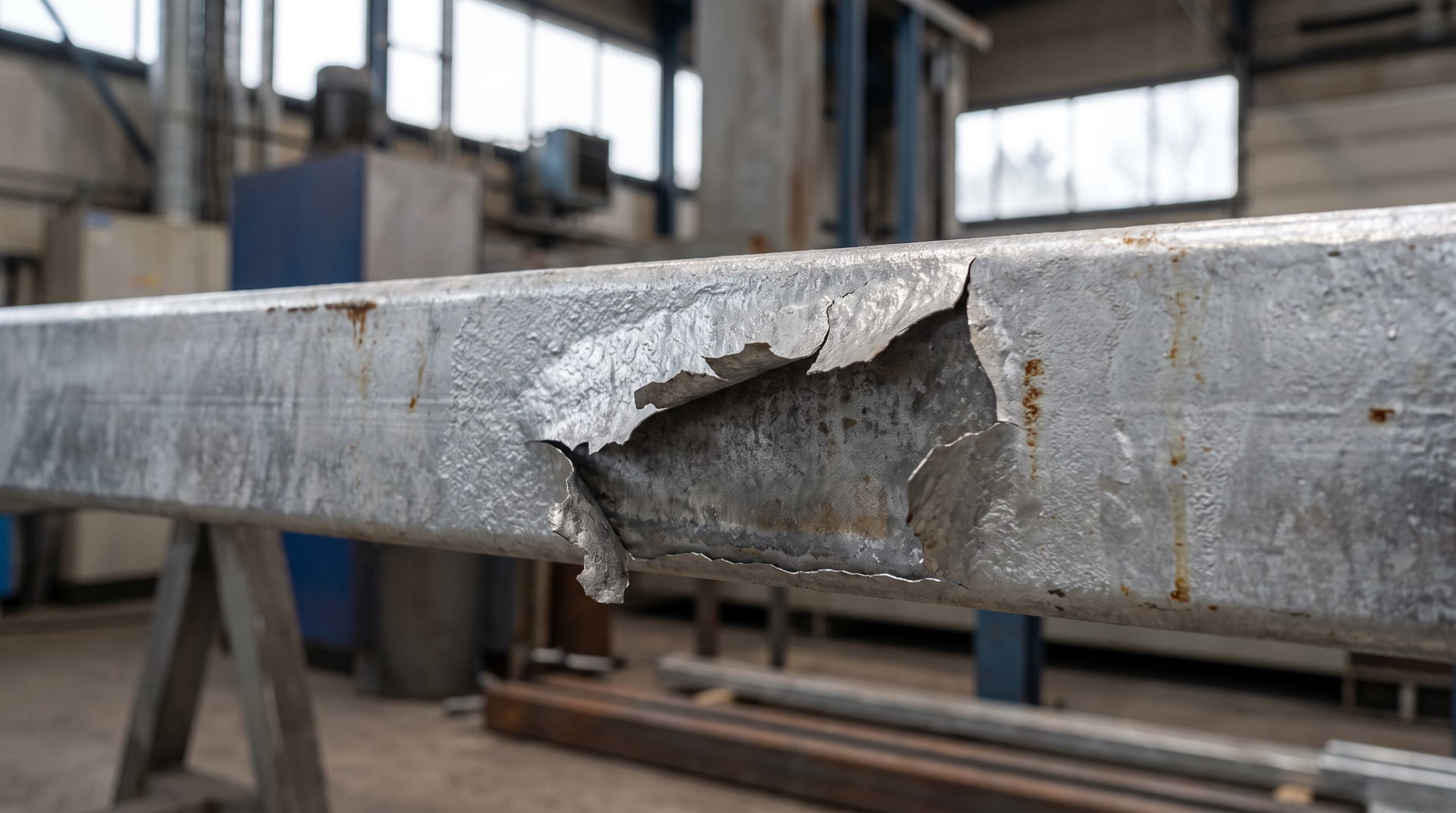
Flaking is a different animal entirely. When a coating flakes, three of the four galvanized layers detach simultaneously. A thickness measurement taken in a flaked area will read near zero, or in some cases, exactly zero. Only the gamma layer, the innermost intermetallic zone adjacent to the steel surface, is left behind. The steel is, for all practical purposes, exposed.
Flaking is driven by excessive coating thickness. As a galvanized coating grows beyond approximately 10 mils, its mechanical character changes. The intermetallic layers, which are already harder and more brittle than the pure zinc eta layer, become progressively more dominant as the coating thickens. A coating that is thicker than normal is also a coating that is more brittle than normal.
That brittleness creates vulnerability to impact. When a thickly galvanized part is struck, during transport, lifting, or assembly in the field, the energy of the impact cannot be absorbed by a ductile coating. Instead, the brittle layers fracture and separate. The pieces that come off tend to have long, clean, well-defined edges, which is one of the visual signatures that distinguishes flaking from peeling. The detached coating segments often look almost like ceramic shards.
Because flaking leaves large areas of steel with essentially no protection, it is generally treated as a cause for rejection. The affected areas must be repaired or the part must be regalvanized.
Why Coating Thickness Grows Beyond Normal Ranges
Understanding why coatings become excessively thick in the first place is critical to preventing flaking from recurring. The answer almost always comes back to steel chemistry.
Certain steel compositions react more vigorously with the molten zinc bath than others. Steels with elevated silicon or phosphorus content, sometimes called reactive steels, undergo an accelerated galvanizing reaction that produces thicker, faster-growing intermetallic layers. This is not a process error. It is a predictable consequence of steel chemistry interacting with the thermodynamics of the galvanizing reaction.
ASTM A385 provides guidance on the steel chemistry recommended for hot-dip galvanizing, specifically to avoid the kind of reactivity that leads to overly thick coatings. When fabricators specify steel that falls within those chemistry parameters, they significantly reduce the probability of producing a coating that becomes brittle enough to flake. When that guidance is not followed, the galvanizer is working with a material that is predisposed to producing a thick, brittle coating regardless of how carefully the process is controlled.
This is not a hypothetical risk. Our team at V&S Galvanizing regularly encounters reactive steel, and it is one of the reasons we strongly encourage fabricators to provide material certifications and to reference ASTM A385 in their procurement specifications. The earlier in the supply chain this chemistry concern is addressed, the better the outcome for everyone involved.
Process Adjustments That Reduce Thickness During Regalvanizing
When a part has already been galvanized and the coating is too thick, or when regalvanizing is required after flaking has occurred, there are specific process levers that can reduce the thickness of the new coating. None of them are magic solutions, but each addresses part of the physics of coating growth.
Reducing the time the steel spends immersed in the zinc kettle limits how long the galvanizing reaction has to build thickness. Lowering the kettle temperature slows the reaction rate and can produce a thinner, more controlled coating. Blast cleaning the steel prior to galvanizing is another effective approach. The blast profile creates a different surface texture that influences how the intermetallic layers form and can constrain total coating thickness even on reactive steel.
When our team knows in advance that we are working with reactive steel, blasting prior to galvanizing is standard practice. It is a proactive step that protects the quality of the finished product. It is also worth noting that galvanizers working with steel they know to be reactive should have clear contractual language in their purchase orders that acknowledges the limitations of galvanizing non-conforming steel and defines responsibility accordingly.
How to Tell Peeling and Flaking Apart During Inspection
For inspectors and quality personnel in the field, distinguishing between these two defect types requires more than a visual assessment. A magnetic coating thickness gauge is the most reliable tool for making the call.
In a peeled area, the gauge will read somewhere between 2 and 6 mils. The intermetallic layers are intact. The coating has not failed down to bare steel. In a flaked area, the gauge will read near zero. The steel surface is essentially unprotected. The physical appearance of the detached material also provides clues. Peeled sections tend to be irregular and thin. Flaked pieces tend to be larger and more geometric, with sharp, defined edges that reflect the brittle fracture mode of the intermetallic layers.
This distinction directly informs what happens next. Peeling may be addressable with touch-up using an approved zinc-rich compound, depending on the specification requirements and the extent of the affected area. Flaking, because it leaves large bare zones, typically requires more substantial intervention. In many cases, regalvanizing is the appropriate resolution.
The Broader Implications for Corrosion Protection
Both defect types matter not just as cosmetic concerns but as functional ones. The entire value proposition of hot-dip galvanizing is long-term corrosion protection without ongoing maintenance. A coating that has peeled still provides some cathodic protection through the remaining intermetallic layers, though less than a fully intact coating. A coating that has flaked provides essentially none in the affected areas, because the gamma layer alone is too thin to offer meaningful protection and the zinc that would have sacrificed itself cathodically is no longer present.
For structural steel in corrosive environments, coastal locations, high-humidity industrial settings, or applications where the steel will be buried or submerged, even a moderate loss of coating coverage can shorten service life significantly. This is why coating quality at the point of galvanizing is not an aesthetic concern but a structural and durability one. The coating has to be right before the steel leaves the plant.
At V&S Galvanizing, our quality control process includes visual inspection and coating thickness verification on every job. We catch thickness anomalies before they become field problems, and we work with our customers to resolve specification or chemistry issues before they affect a shipment. For detailed information on how our hot-dip galvanizing process is structured to support consistent, specification-compliant coating thickness, visit our hot-dip galvanizing services page.
Work With a Team That Understands the Difference Before It Becomes a Problem
Peeling and flaking are not interchangeable terms for coating failure. They represent distinct physical mechanisms with different causes, different levels of severity, and different remediation paths. Peeling reflects what happens when cooling conditions allow the galvanizing reaction to continue beyond the immersion stage and consume the eta layer from within. Flaking reflects what happens when coating thickness exceeds the ductility limits of the intermetallic system and impact energy causes brittle fracture. One leaves coating behind. The other removes it almost entirely.
At V&S Galvanizing, we bring this level of material understanding to every project we process. We communicate proactively with fabricators about steel chemistry, we apply blast cleaning when reactive steel is involved, and we measure and document coating thickness as part of our standard quality workflow. When you understand the difference between these defect types and the conditions that drive them, you can make better decisions at the design stage, the procurement stage, and the specification stage, before any steel enters our facility.
If you have questions about galvanizing quality, coating thickness expectations, or how your steel chemistry might affect your finished coating, reach out through our contact page. Our team is glad to work through the technical details with you.
Frequently Asked Questions About Peeling and Flaking in Hot-Dip Galvanized Coatings
What is the Kirkendall Effect in hot-dip galvanizing?
The Kirkendall Effect occurs when a freshly galvanized part cools very slowly or is exposed to temperatures above 400 degrees Fahrenheit for extended periods. Under these conditions, the galvanizing reaction continues after the part leaves the zinc bath, drawing zinc from the outer eta layer to feed further intermetallic growth. This creates voids at the interface between the eta layer and the intermetallic layers beneath it, ultimately causing the outer zinc to separate. The result is what is classified as peeling of the galvanized coating.
How do I use a coating thickness gauge to tell peeling from flaking?
A magnetic coating thickness gauge is the most reliable field tool for making this distinction. In an area that has peeled, the gauge will return a reading between approximately 2 and 6 mils, because the intermetallic layers are still present and bonded to the steel. In an area that has flaked, the reading will be near zero or exactly zero, indicating that three of the four coating layers have detached and only the thin gamma layer remains adjacent to the steel surface.
At what coating thickness does flaking become a risk?
Flaking becomes a concern as the total coating thickness approaches and exceeds 10 mils. At that thickness, the intermetallic layers that dominate the coating structure become brittle enough that impact, such as that experienced during transport, handling, or field assembly, can cause large sections to fracture and separate. Thinner coatings within normal specification ranges retain enough ductility to survive handling without fracturing.
What steel chemistry standard governs galvanizing-compatible steel?
ASTM A385 provides the recommended chemistry parameters for steel intended for hot-dip galvanizing. It addresses elements such as silicon and phosphorus, which are the primary drivers of accelerated galvanizing reactions and excessive coating thickness. Fabricators who specify steel conforming to ASTM A385 significantly reduce the likelihood of producing coatings that are thick enough to become brittle and prone to flaking.
Can flaking be repaired, or does the steel need to be regalvanized?
Because flaking removes three of the four galvanized layers and leaves large areas of steel with essentially no corrosion protection, it is generally cause for rejection of the affected part. Repair with zinc-rich compounds may be acceptable for small areas under some specifications, but the size and distribution of flaked zones typically make regalvanizing the appropriate resolution. During regalvanizing, process adjustments including reduced immersion time, lower kettle temperature, and blast cleaning prior to immersion can help control coating thickness on a second run.
Is peeling a cause for automatic rejection of galvanized steel?
Not necessarily. Unlike flaking, peeling leaves the intermetallic layers intact, so a measurable coating, typically 2 to 6 mils, remains on the steel. Whether a peeled area triggers rejection depends on the applicable specification, the intended service environment, and the extent of the affected region. In some cases, touch-up repair with a zinc-rich coating material may be sufficient. The decision should be guided by a thickness measurement to confirm how much coating remains and by reference to the governing specification for the project.
Why do flaked pieces of galvanized coating have such distinct, sharp edges?
The sharp, well-defined edges on flaked coating pieces are a visual signature of brittle fracture. The intermetallic layers in an excessively thick coating behave like a ceramic material under impact: rather than deforming, they crack cleanly. The fracture propagates along crystallographic boundaries in the intermetallic structure, producing the long, geometric edges that distinguish flaked sections from the more irregular appearance of peeled or damaged coatings caused by other mechanisms.
Does blast cleaning before galvanizing actually reduce coating thickness on reactive steel?
Yes. Blast cleaning changes the surface texture of the steel, which influences how the galvanizing reaction initiates and how quickly the intermetallic layers develop. On reactive steel, where the galvanizing reaction is inherently faster due to elevated silicon or phosphorus content, blast cleaning prior to immersion is one of the most effective ways to moderate the total coating thickness that develops. It does not eliminate the reactivity of the steel, but it creates surface conditions that constrain how thick the coating grows during the galvanizing reaction.
