
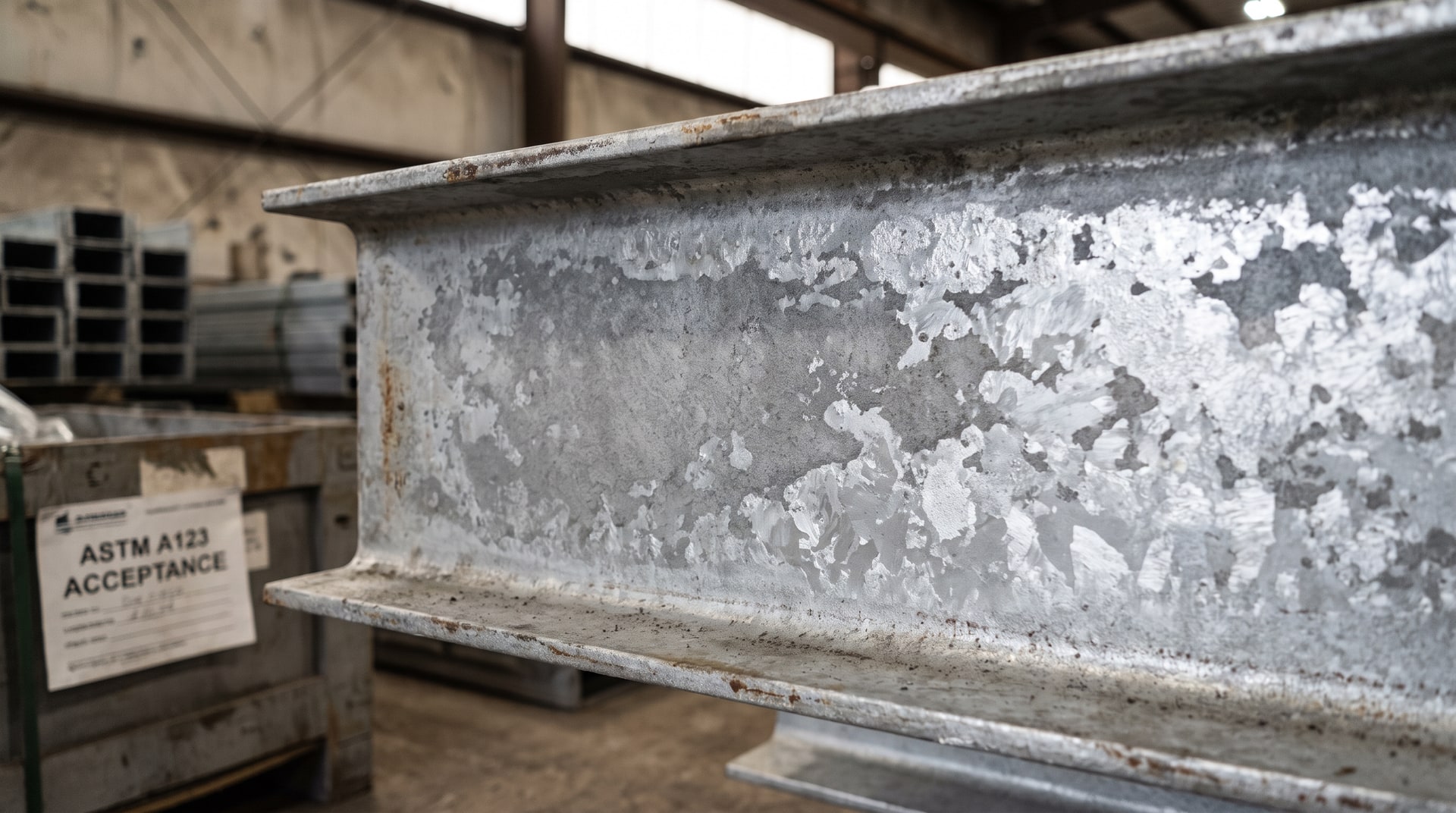
When galvanized steel comes out of the kettle, it does not always look the way people expect. Engineers familiar with paint or powder coating are accustomed to finishes that are smooth, consistent in color, and uniform across an entire fabrication. Hot-dip galvanizing does not work that way. Because it is a metallurgical reaction between liquid zinc and steel rather than a surface-applied coating, the result is influenced by steel chemistry, part geometry, cooling behavior, and process variables that no galvanizer can fully control. The result is a coating with real variation in surface texture, sheen, and color, and that variation is normal.
What matters practically is knowing which surface conditions affect corrosion protection, which ones are purely cosmetic, and which ones require repair or rejection before a part leaves the shop. The distinction is not always obvious on a job site, and confusion between rejectable defects and acceptable variation causes unnecessary disputes, delayed schedules, and sometimes incorrect repair decisions.
The American Galvanizers Association addresses this directly in their article on the most common appearance concerns on hot-dip galvanized steel. At V&S Galvanizing, we expand on that foundation to explain what is actually happening at the material level, how steel chemistry and thermal behavior influence the final surface, and why so many appearance issues are routinely misread as defects in the field.
Why Galvanized Coatings Look Different from Other Protective Finishes
Hot-dip galvanizing produces a coating with a layered internal structure: a series of zinc-iron intermetallic alloy layers bonded to the base steel, topped by a layer of free zinc (called the eta layer). This structure forms through a diffusion reaction that begins the moment steel enters the molten zinc bath at approximately 840 degrees Fahrenheit and continues, to varying degrees, until the steel cools below 550 degrees Fahrenheit.
Paint sits on top of steel. Galvanizing becomes part of the steel surface. That distinction explains a great deal about why the appearance of a galvanized coating is more variable than paint. The zinc-iron intermetallic layers are harder and more matte in appearance than the free zinc eta layer, which is softer and brighter. Depending on how much eta layer survives the cooling process, and how rapidly the intermetallic layers grew during galvanizing, the same fabrication can show areas that look quite different from one another.
ASTM A385, Section 3.6 is explicit on this point: galvanized coatings are specified for corrosion resistance, not appearance. For all practical purposes, normal and abnormal-looking coatings provide equal corrosion protection. This does not mean appearance is irrelevant, but it does mean that visual variation alone is not a reliable indicator of coating quality.
Mottling: What Uneven Cooling Does to the Surface
Mottling appears as irregular patches of varying color and sheen across the galvanized surface, and it is one of the most frequently misunderstood surface conditions in the field. It is also, in almost all cases, completely acceptable.
The mechanism is straightforward. After parts are withdrawn from the galvanizing kettle, they cool from approximately 840 degrees Fahrenheit down to ambient temperature. Thinner steel sections cool quickly. Thicker sections hold heat longer. Even within a single piece, different areas can cool at different rates. The outer edges of a flat plate, for example, will lose heat faster than the interior.
This matters because the zinc-iron intermetallic reaction continues as long as the steel remains above approximately 550 degrees Fahrenheit. In areas that stay hot longer, the reaction keeps consuming the free zinc eta layer. In areas that cool quickly, the eta layer remains intact. The result is a surface where some zones retain the brighter, shinier eta layer and others show the darker, matte intermetallic alloy. That contrast is mottling.
Quenching the steel after galvanizing stops this process rapidly and tends to produce a more uniform appearance, but not all galvanizers operate quench baths, and quenching is not always appropriate. On certain part geometries and steel thicknesses, rapid cooling carries a real risk of warpage. So mottling is often the expected outcome of responsible cooling practice. It has no meaningful effect on corrosion performance and is accepted under ASTM specifications.
Dull and Shiny Areas on the Same Fabrication
Perhaps the most common appearance question we hear from fabricators and contractors involves parts that come off the line with dramatically different-looking sections. One structural member looks bright and metallic. The piece welded to it looks flat gray. Both came out of the same kettle. This is not a process failure; it is the visible result of steel chemistry differences.
Two elements in steel have the strongest influence on how the galvanized coating looks and grows: silicon and phosphorus. Both act as catalysts for the zinc-iron intermetallic reaction. When a steel with elevated silicon or phosphorus content is galvanized, the intermetallic layers grow rapidly and thick. That accelerated growth consumes most or all of the free zinc eta layer, leaving behind a coating that is predominantly intermetallic alloy. That coating appears gray and matte rather than bright and shiny.
The important point is that this thicker, matte coating still meets specification requirements and provides corrosion protection equivalent to a brighter coating. Appearance here is a proxy for steel reactivity, not for coating performance. When different steel grades or thicknesses are welded together in a single fabrication, the finished assembly will often show zones of markedly different appearance. The same effect appears at weld seams, because the silicon content of the weld rod itself can influence intermetallic growth at those locations.
Galvanizers who know the steel chemistry in advance can use some process controls to moderate these effects, but they cannot eliminate them entirely when highly reactive steel is involved. This is one reason steel selection matters when appearance uniformity is a project requirement.
Bare Spots: The One Appearance Issue That Is Always Rejectable
Unlike mottling or dull-versus-shiny variation, bare spots on a galvanized surface are not acceptable under ASTM A123. A bare spot is an area of the steel surface where no zinc coating formed. It is exposed steel, not a variation in coating appearance.
Bare spots develop because of inadequate surface preparation or physical obstruction during the galvanizing process. Common causes include welding slag that was not fully removed before pretreatment, sand embedded in cast surfaces, excess aluminum in the galvanizing kettle (which suppresses zinc-iron bonding), and lifting devices or fixtures that physically block contact between the molten zinc and the steel surface.
The galvanizing pretreatment sequence, which includes degreasing, pickling in acid, and flux application, is designed to ensure the steel surface is chemically clean and reactive when it enters the zinc bath. Any contamination or residue that survives pretreatment can prevent the coating from forming. Because bare steel will begin to corrode immediately, bare spots must be identified and addressed before parts leave the facility. Small bare spots can be repaired at the shop using approved touch-up materials. If the cumulative area of bare spots exceeds the limits allowed by specification, the part must be stripped, re-galvanized, and re-inspected.
Inclusions: Dross, Flux, and Skimmings Behave Differently
Three types of inclusions can appear on a galvanized surface, and they are not treated the same way under the specifications. Understanding what each one is and where it comes from is essential for making correct accept-or-repair decisions.
Dross inclusions are particles of zinc-iron intermetallic alloy that form at the bottom of the galvanizing kettle and can become trapped in the coating during withdrawal. If a dross particle is small and completely covered by zinc, it does not compromise corrosion protection and is acceptable. The problem arises when a gross dross particle is large enough to prevent a full coating from forming in that area. In that case, the particle must be removed and the area repaired. It is worth noting that removing a large dross inclusion will expose a bare spot underneath, so repair is required regardless.
Flux inclusions are a different matter. They occur when the flux used in the pretreatment process fails to release from the steel surface as it enters the molten zinc, physically blocking the coating from forming. Because there is no zinc under a flux inclusion, the underlying steel is uncoated, and the area must be repaired before the part is accepted. Small flux inclusions can be cleaned and touched up. Larger areas require rejection and re-galvanizing. Flux deposits that form inside hollow sections, such as pipes or tubes, cannot be reached for repair and are cause for outright rejection. Those parts must be stripped and re-galvanized.
Zinc skimmings are the oxidized material that accumulates on the surface of the molten zinc bath. They can be deposited on the coating if there is no clear path to remove them during withdrawal. Unlike flux inclusions, zinc skimmings sitting on top of an otherwise intact coating are not grounds for rejection, provided the coating beneath is undamaged after removal and still meets the specification thickness requirements.
Peeling and Delamination: When the Zinc Separates from Itself
Delamination is a condition where a layer of zinc separates and lifts away from the coating. It typically occurs on large, heavy parts that retain heat for an extended period after leaving the kettle. As those parts cool slowly in air, the zinc-iron intermetallic reaction continues forming new layers. This post-withdrawal growth can create voids between the uppermost alloy layers. If enough voids accumulate, the top layer loses adhesion to the layers below and peels away.
The key specification question is what remains after delamination. If the coating that stays on the steel still meets the minimum thickness requirements of ASTM A123, the part is acceptable. If the remaining coating falls below specification minimums, the part must be rejected and re-galvanized. This distinction matters because delamination does not always expose bare steel; it often leaves a functional intermetallic coating underneath.
One important liability consideration: if delamination occurs as a result of work performed after galvanizing, such as abrasive blasting prior to painting in a duplex system, the galvanizer is not responsible for that outcome. The mechanical energy of the blast can disrupt a coating that had been intact, and accountability for the result rests with whoever performed the subsequent operation.
Flaking: A Consequence of Excessively Thick Coatings
Flaking is related to delamination but has a different root cause. It occurs when coatings grow to extreme thicknesses, typically 8 to 10 mils or greater, during the galvanizing process. Coatings that thick generate high internal stresses at the steel-to-zinc interface. Those stresses cause the coating to become brittle and separate in flakes rather than remain adhered to the surface.
The conditions that produce excessively thick coatings are primarily long immersion times and highly reactive steel. Galvanizers can minimize flaking risk by reducing immersion time, cooling parts as quickly as practical, and when possible selecting a steel grade less prone to accelerated intermetallic growth. When flaking occurs, the evaluation follows the same logic as delamination: small areas can be repaired and accepted; areas that exceed specification allowances require rejection and re-galvanizing.
It is worth being clear that flaking and peeling are distinct from the normal surface roughness that heavy-section galvanized steel often exhibits. A rough, crystalline surface texture is not flaking. Flaking involves actual separation of material from the coating surface.
Work With a Team That Understands What the Coating Is Telling You
Surface appearance on hot-dip galvanized steel communicates a great deal about what happened during the galvanizing process, the cooling environment, and the chemistry of the base steel. Reading that surface correctly determines whether a part should be accepted, repaired, or re-galvanized. Getting that determination wrong costs time, money, and sometimes results in correctly coated steel being unnecessarily rejected or, in the opposite error, genuinely defective parts being put into service.
At V&S Galvanizing, our team works with engineers, fabricators, and contractors to identify what they are seeing on a finished part and explain the mechanism behind it. Mottling is not a defect. Dull and shiny variation on the same piece is not a defect. Bare spots always require attention. Inclusions require evaluation based on type and size. The specifications are clear, and understanding them removes a significant source of confusion from the inspection and acceptance process.
If you have questions about a specific surface condition on galvanized steel, need guidance on ASTM A123 acceptance criteria, or want to discuss how steel selection and fabrication design affect galvanizing outcomes, reach out through our contact page. We are glad to work through the details with you.
Frequently Asked Questions About Hot-Dip Galvanized Steel Appearance
Is mottling on a galvanized surface a sign that the coating has failed?
No. Mottling is an acceptable surface condition under ASTM specifications and does not indicate coating failure. It results from uneven cooling rates across the steel surface after galvanizing, which causes the zinc-iron intermetallic reaction to continue at different rates in different areas. The corrosion protection of a mottled coating is equal to that of a uniform-looking coating.
Why does one piece of a welded assembly look dull gray while another looks bright and shiny after galvanizing?
This is caused by differences in steel chemistry, specifically the silicon and phosphorus content of each piece. Both elements accelerate the growth of zinc-iron intermetallic layers. Steel with higher reactivity develops a thicker, matte gray coating. Steel with lower reactivity retains more of the bright free zinc (eta) layer. The appearance differs, but the corrosion protection and specification compliance of both are equivalent.
What is the difference between a dross inclusion and a flux inclusion, and does each one require repair?
Dross inclusions are particles of zinc-iron alloy trapped in the coating. Small ones that are fully covered by zinc do not require repair. Flux inclusions occur when pretreatment flux fails to release during galvanizing, leaving an uncoated area beneath. Because there is no zinc under a flux inclusion, repair is always required. The two types look similar from the outside but have fundamentally different implications for coating integrity.
At what point does a bare spot require the entire part to be rejected and re-galvanized?
Small bare spots can be repaired in the galvanizing shop using approved touch-up methods. Rejection and re-galvanizing are required when the size of a single bare spot or the total number and cumulative area of bare spots exceed the limits defined in ASTM A123. The specific thresholds are set out in the standard and should be referenced directly for acceptance decisions.
Can peeling or delamination of galvanized coating occur after a part has been accepted and shipped?
Yes. Delamination can be triggered by work performed after galvanizing, such as abrasive blasting before painting in a duplex coating system. If delamination results from post-galvanizing fabrication or surface treatment, the galvanizer is not responsible. It is also possible for delamination to develop gradually on large heavy parts that retained heat and continued forming intermetallic layers after withdrawal from the kettle.
What causes flaking on galvanized steel, and how is it different from normal surface roughness?
Flaking occurs when the galvanized coating grows to extreme thickness, typically 8 to 10 mils or more. At that thickness, high internal stresses at the steel-to-zinc interface cause the coating to separate in flakes. Normal surface roughness on heavy-section galvanized steel, by contrast, is a textural variation in the coating surface without material separating from it. The two conditions look different and are evaluated differently under the specifications.
Does steel chemistry affect the thickness of the galvanized coating, not just its appearance?
Yes. Silicon and phosphorus in steel act as catalysts for zinc-iron intermetallic growth. Highly reactive steels, those with elevated silicon or phosphorus, tend to develop significantly thicker coatings than lower-reactivity steels galvanized under the same conditions. This is why steel selection and mill certification review matter when coating thickness consistency is important to a project, beyond just visual uniformity.
Are zinc skimmings on the surface of a galvanized part grounds for rejection?
Not automatically. Zinc skimmings trapped on the surface during withdrawal from the kettle are not grounds for rejection provided the coating underneath is undamaged after the skimmings are removed and the remaining coating meets the specification thickness requirements. Unlike flux inclusions, skimmings sit on top of an intact coating rather than replacing it.
