

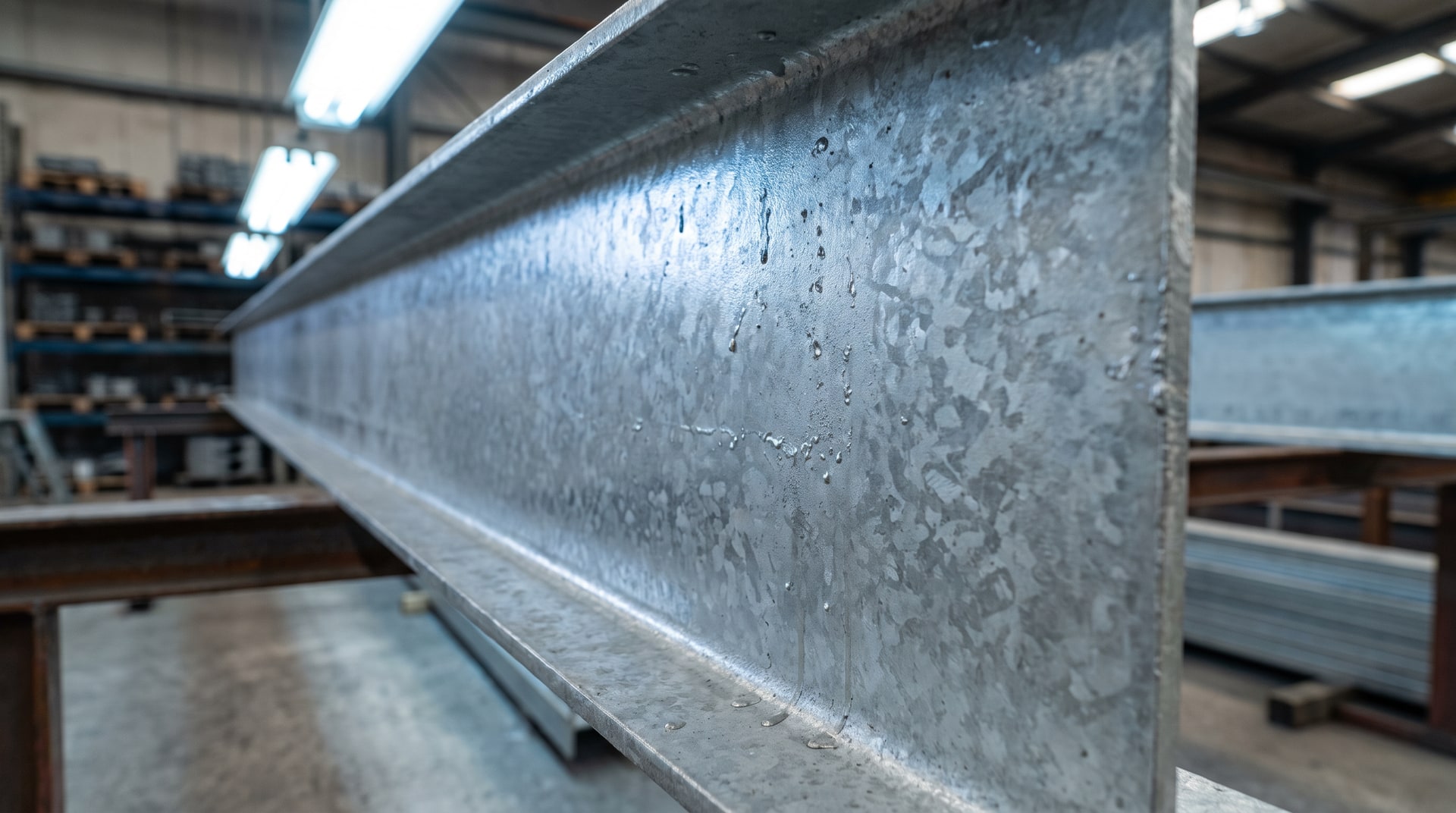
When galvanized steel comes out of the zinc bath, it does not always look the same from piece to piece or even from one end to the other. Some surfaces emerge bright and spangled. Others develop a matte gray tone almost immediately. Occasional surface variations, minor roughness, or subtle discoloration cause inspectors and fabricators to question whether the coating meets specification, even when it performs exactly as intended. The challenge is knowing which surface conditions are genuinely non-conformant and which are simply cosmetic realities of the metallurgical process.
The American Galvanizers Association addresses this directly in their article on ASTM A123/A123M, the governing specification for zinc hot-dip galvanized coatings on iron and steel products. At V&S Galvanizing, we expand on that foundation to explain what is actually happening at the material level, how coating appearance influences performance, and why the distinction between cosmetic variation and true defects is often misunderstood in the field.
What ASTM A123/A123M Actually Covers
ASTM A123/A123M is the primary specification governing after-fabrication hot-dip galvanizing of iron and steel products. It applies to individual steel pieces and to assemblies made up of multiple material categories. The six material categories recognized by the specification are structural shapes, strip and bar, plate, pipe and tubing, wire, and reinforcing bar. A single fabricated assembly, such as a welded frame, may incorporate several of these categories simultaneously, and all are evaluated under one specification umbrella.
The specification establishes four enforceable requirements: coating thickness, finish, appearance, and adherence. Each carries distinct criteria, and each addresses a different aspect of coating quality. Understanding how these four requirements relate to each other is the starting point for any informed inspection or design conversation.
It is also worth clarifying responsibility. The designer and fabricator are accountable for ensuring the product is properly designed and built before it ever arrives at the galvanizing plant. The galvanizer is then responsible for achieving specification compliance, but only when the product has been fabricated in accordance with supporting design standards. If a galvanizer needs to perform preparatory work, such as drilling drainage or vent holes, that work requires prior customer approval. Once galvanized, the product can be fully inspected at the plant before shipment.
Coating Thickness: Minimums, Categories, and Why There Is No Maximum
Coating thickness is the single most performance-critical requirement in ASTM A123/A123M. In atmospheric service, the time to first maintenance for a hot-dip galvanized coating is directly proportional to coating thickness. Thicker zinc means longer life, and the relationship is essentially linear when other variables are held constant.
All coating thickness values in the specification are minimums. There is no maximum thickness requirement. This is intentional. The specification is designed to ensure a baseline level of corrosion protection across all compliant coatings, not to penalize thicker coatings that simply result from the metallurgical interaction between the steel and the molten zinc.
The required minimum thickness depends on two variables: the material category and the measured steel thickness. Structural shapes on steel greater than 5/8 inch (16.0 mm) require a minimum average grade of 100 micrometers. The same thickness of pipe and tubing requires only 75 micrometers. Wire, at the thinnest end of the range, starts at a minimum of 35 micrometers. These differences reflect the practical realities of how zinc layers develop on different product geometries and steel compositions.
| Material Category | <1/16 in [<1.6 mm] | >1/16 to <1/8 in [1.6–3.2 mm] | >1/8 to 3/16 in [3.2–4.8 mm] | >3/16 to <1/4 in [4.8–6.4 mm] | >1/4 to <5/8 in [6.4–16.0 mm] | >5/8 in [>16.0 mm] |
|---|---|---|---|---|---|---|
| Structural Shapes | 45 | 65 | 75 | 75 | 100 | 100 |
| Strip and Bar | 45 | 65 | 75 | 75 | 75 | 100 |
| Plate | 45 | 65 | 75 | 75 | 75 | 100 |
| Pipe and Tubing | 45 | 45 | 75 | 75 | 75 | 75 |
| Wire | 35 | 50 | 60 | 65 | 80 | 80 |
| Reinforcing Bar | -- | -- | -- | -- | 100 | 100 |
| Forgings and Castings | -- | -- | -- | 100 | 100 | 100 |
Coating grade is expressed in micrometers, and Table 2 of the specification provides the corresponding values in mils, ounces per square foot, and grams per square meter for practical field use. A Grade 75 coating, for instance, equals 3.0 mils, 1.7 oz/ft², and 530 g/m². These conversion values are derived from the formulas embedded in the specification and allow engineers to work in whichever unit system their project requires.
| Coating Grade (µm) | mils | oz/ft² | µm | g/m² |
|---|---|---|---|---|
| 35 | 1.4 | 0.8 | 35 | 245 |
| 45 | 1.8 | 1.0 | 45 | 320 |
| 50 | 2.0 | 1.2 | 50 | 355 |
| 55 | 2.2 | 1.3 | 55 | 390 |
| 60 | 2.4 | 1.4 | 60 | 425 |
| 65 | 2.6 | 1.5 | 65 | 460 |
| 75 | 3.0 | 1.7 | 75 | 530 |
| 80 | 3.1 | 1.9 | 80 | 565 |
| 85 | 3.3 | 2.0 | 85 | 600 |
| 100 | 3.9 | 2.3 | 100 | 705 |
The Finish Requirement: What Continuous, Smooth, and Uniform Mean in Practice
The finish requirement under ASTM A123/A123M calls for a coating that is continuous, smooth, and uniform. This language sounds straightforward, but each word carries specific practical meaning when applied to a metallic coating formed through a reactive metallurgical process.
Continuous means there are no breaks in the coating, no bare spots where the steel substrate is exposed. Even a small area of uncoated steel represents a failure of continuity, regardless of how thick the surrounding zinc is. Smooth means the surface texture is not rough enough to suggest gross dross inclusions, excessive zinc runs, or adherence problems. It does not require a mirror finish, and it does not prohibit the naturally coarser texture that high-silicon or high-reactive steels sometimes produce. Uniform means the coating is consistent in coverage, without localized thin spots or significant buildup that affects intended use.
Taken together, these three criteria describe a coating that is sound and complete across the entire product surface. They do not describe a purely aesthetic standard. A coating can appear visually inconsistent, with variation in gloss and color, and still fully satisfy the finish requirement if it is continuous, adequately smooth, and structurally uniform.
Appearance Requirements: What Qualifies as a Defect
The appearance requirement is where the most field confusion tends to arise. ASTM A123/A123M specifies that the coating must be free from uncoated areas, blisters, flux deposits, and gross dross inclusions. It also must not have heavy zinc deposits that would interfere with the intended use of the product.
Uncoated areas are the most straightforward disqualifier. Any location where bare steel is visible represents a true defect. These areas are typically caused by surface contamination that was not fully removed during pre-treatment, or by flux inclusions that prevented zinc adhesion during immersion.
Blisters indicate entrapped gas or flux beneath the zinc layer. They suggest incomplete pre-treatment or moisture contamination and represent a location where the coating is not truly bonded to the steel. Even if the blister itself is covered in zinc, the area underneath is unprotected.
Flux deposits are residues from the fluxing stage of the galvanizing process that were not displaced during immersion. They appear as white or gray powdery patches on the surface and indicate areas where full metallurgical bonding did not occur.
Gross dross inclusions refer to particles of iron-zinc compounds that form in the zinc bath and become trapped in the coating. Minor dross inclusion is essentially unavoidable in industrial galvanizing, but gross inclusions that create significant surface roughness or coating discontinuity are a compliance issue.
Heavy zinc deposits are thick runs, drips, or blobs of zinc that solidified before they could drain properly. These are only a defect under the specification when they interfere with the product's intended use, for example, when they prevent a bolt from seating correctly or block a drainage path in a structural connection.
Surface Appearance Variation That Is Not a Defect
Perhaps the most important concept for engineers, inspectors, and fabricators to internalize is that visual variation in a hot-dip galvanized coating does not automatically indicate a problem. The zinc-iron alloy layers that form during immersion are determined by steel chemistry, immersion time, bath temperature, and the thermal history of the steel. None of these factors produce perfectly uniform results across all products.
Spangle pattern, surface brightness, matte versus shiny areas, and even color tone variations from silver-gray to darker gray are all natural outcomes of the galvanizing process. Darker, matte coatings are often thicker and can actually outperform bright, spangled coatings in long-term corrosion resistance. Brightness and spangle are not performance indicators.
Wet storage stain, sometimes called white rust, is another commonly misread surface condition. It is a white or gray powdery zinc oxide/hydroxide deposit that forms when galvanized surfaces are stored in humid conditions without adequate air circulation. Wet storage stain is a cosmetic issue that does not necessarily compromise the underlying zinc coating. It is not listed as a defect under ASTM A123/A123M because it does not indicate a coating failure in the same way that flux deposits or bare spots do. However, it can be worth evaluating if it is severe enough to call the coating thickness into question at affected locations.
Adherence: More Than a Surface Bond
Adherence is the fourth requirement in ASTM A123/A123M, and it is often the least discussed. The specification requires that the entire coating maintain strong adherence throughout the service life of the galvanized steel, not just at the time of initial inspection.
This is a significant requirement because it shifts the standard from a point-in-time snapshot to a durability expectation. A coating that peels or delaminates in service, even years after installation, raises questions about whether it was compliant to begin with. Proper steel preparation and consistent bath chemistry are the primary controls for achieving lasting adherence.
Mechanical adherence testing is sometimes used during inspection to verify bond quality. The common field approach is a knife test or a firm blow with a mallet. Peeling or flaking under these conditions indicates a non-compliant coating. Brittle fracture under extreme impact, on the other hand, may be a steel or design issue rather than a galvanizing failure, particularly with high-reactive steels that develop thicker, more brittle alloy layers.
Rejection, Repair, and the Re-Galvanizing Option
When a galvanized product does not meet the requirements of ASTM A123/A123M, the specification provides a clear path forward. Any material rejected for reasons other than hydrogen embrittlement may be stripped of its coating, re-galvanized, and resubmitted for inspection. This is a meaningful provision because it means a first-pass non-conformance is not necessarily a project-ending event.
Embrittlement is explicitly excluded from the re-galvanizing option because the embrittlement is a property of the steel, not the coating. Stripping and re-galvanizing would not resolve the underlying issue and could worsen it. Relevant guidance on designing to avoid embrittlement risk is found in ASTM A143/A143M, ASTM A384/A384M, and ASTM A385, all of which are referenced in the A123 specification as supporting documents for proper fabrication preparation.
The ability to inspect fully at the galvanizing plant before shipment is worth emphasizing. This is the most efficient point to catch and resolve any non-conformances. Waiting until a product is on-site to conduct a formal coating inspection adds cost and schedule risk that early plant inspection avoids entirely.
Designing for Compliance Before the Steel Hits the Kettle
ASTM A123/A123M places a deliberate upstream responsibility on designers and fabricators. The galvanizer can only meet the specification if the product arrives ready to be galvanized. Weld quality, surface condition, the presence of drainage and vent holes in closed sections, and steel chemistry selection all influence how the zinc reacts and where it flows.
The specification also flags that the hot-dip galvanized coating is intended for products already fabricated into their final shape. Post-galvanizing fabrication is strongly discouraged. Cutting, welding, or grinding after galvanizing compromises the coating in those areas and requires repair, which typically involves zinc-rich paint or metalizing. These repair methods, while functional, do not replicate the full barrier and cathodic protection performance of the original continuous coating.
For complex assemblies containing multiple material categories, designers should identify the controlling category and thickness range early. An assembly that combines thin plate with heavy structural shapes will have different minimum thickness requirements for each component, and understanding that nuance before fabrication avoids disputes at inspection.
Work With a Team That Understands Specification Compliance From the Start
ASTM A123/A123M sets a rigorous but achievable standard. The specification's appearance and finish requirements are not arbitrary aesthetics; they are engineering criteria tied directly to the coating's ability to protect steel over a service life that is measured in decades. Knowing which surface conditions constitute true non-conformances, and which are inherent to the metallurgical process, is the difference between effective quality management and unnecessary project delays.
At V&S Galvanizing, our team works through specification questions before material ships, not after it comes out of the kettle. If your project involves complex assemblies, mixed material categories, or tight inspection requirements, reach out through our contact page and we will help you think through what compliance looks like from design through final inspection.
Frequently Asked Questions About ASTM A123/A123M Appearance and Finish Requirements
Does a matte gray surface on hot-dip galvanized steel indicate a thinner or weaker coating?
No. A matte gray finish is typically the result of a thicker iron-zinc alloy layer that forms on certain steel chemistries, particularly those with higher silicon or phosphorus content. These coatings can actually exceed the minimum thickness requirements by a significant margin. Surface brightness is not a reliable indicator of coating thickness or performance. Magnetic gauge measurement is the correct method for evaluating compliance.
What is the difference between the finish requirement and the appearance requirement in ASTM A123/A123M?
The finish requirement addresses the overall character of the coating surface: it must be continuous, smooth, and uniform. The appearance requirement addresses specific defect types that are not permitted: uncoated areas, blisters, flux deposits, gross dross inclusions, and heavy zinc deposits that interfere with intended use. Both must be satisfied, but they evaluate different aspects of coating quality.
If a hot-dip galvanized product fails inspection, can it be re-galvanized?
Yes, with one important exception. Under ASTM A123/A123M, any rejected product can be stripped, re-galvanized, and resubmitted for inspection, unless the rejection is due to embrittlement. Embrittlement is a steel property issue, not a coating issue, and re-galvanizing would not correct it and could make it worse.
Why does ASTM A123/A123M set minimum coating thicknesses but no maximum?
The specification is designed to guarantee a baseline level of corrosion protection. Since coating life in atmospheric service is directly proportional to coating thickness, a thicker-than-minimum coating is simply better protection. Imposing a maximum would penalize metallurgical outcomes that naturally improve performance. The only practical concern with excessive thickness is dimensional tolerance on machined or close-fit parts, which is addressed at the design stage rather than by the specification.
What happens when an assembly includes multiple material categories with different minimum thickness requirements?
Each component within the assembly is evaluated against the minimum thickness grade for its own material category and steel thickness. A structural shape in the same frame as a thin plate will have different minimums. Inspectors measure each portion accordingly, and compliance is assessed per category. Designers should identify these requirements early and communicate them clearly on the purchase order.
Is wet storage stain a defect under ASTM A123/A123M?
Wet storage stain, the white or gray powdery deposit that forms when galvanized steel is stored in humid conditions without adequate ventilation, is not listed as a prohibited condition under the specification's appearance requirements. It is a cosmetic surface condition. However, if staining is severe, it may warrant a thickness check at affected areas to confirm the underlying coating remains adequate, as heavy corrosion of the zinc can reduce effective thickness.
What does ASTM A123/A123M require regarding post-galvanizing fabrication?
The specification states that the coating is intended for products already fabricated into their final shape. Further fabrication after galvanizing is described as something that rarely occurs and may have negative effects on corrosion protection. Areas affected by cutting, welding, or grinding after galvanizing will require repair, typically with zinc-rich paint or thermal spray zinc. This repair will not replicate the cathodic protection performance of the original continuous hot-dip coating.
How do the supporting ASTM standards referenced in A123 relate to galvanizing compliance?
ASTM A143/A143M, A384/A384M, and A385 provide guidance on preparing fabricated products for hot-dip galvanizing, specifically addressing embrittlement risk, distortion avoidance, and design for proper zinc flow and drainage. These standards do not set coating requirements directly but define the fabrication conditions under which a galvanizer can be expected to achieve A123 compliance. When a product is not designed or fabricated in accordance with these guidelines, the galvanizer's ability to meet the coating specification is compromised.
