

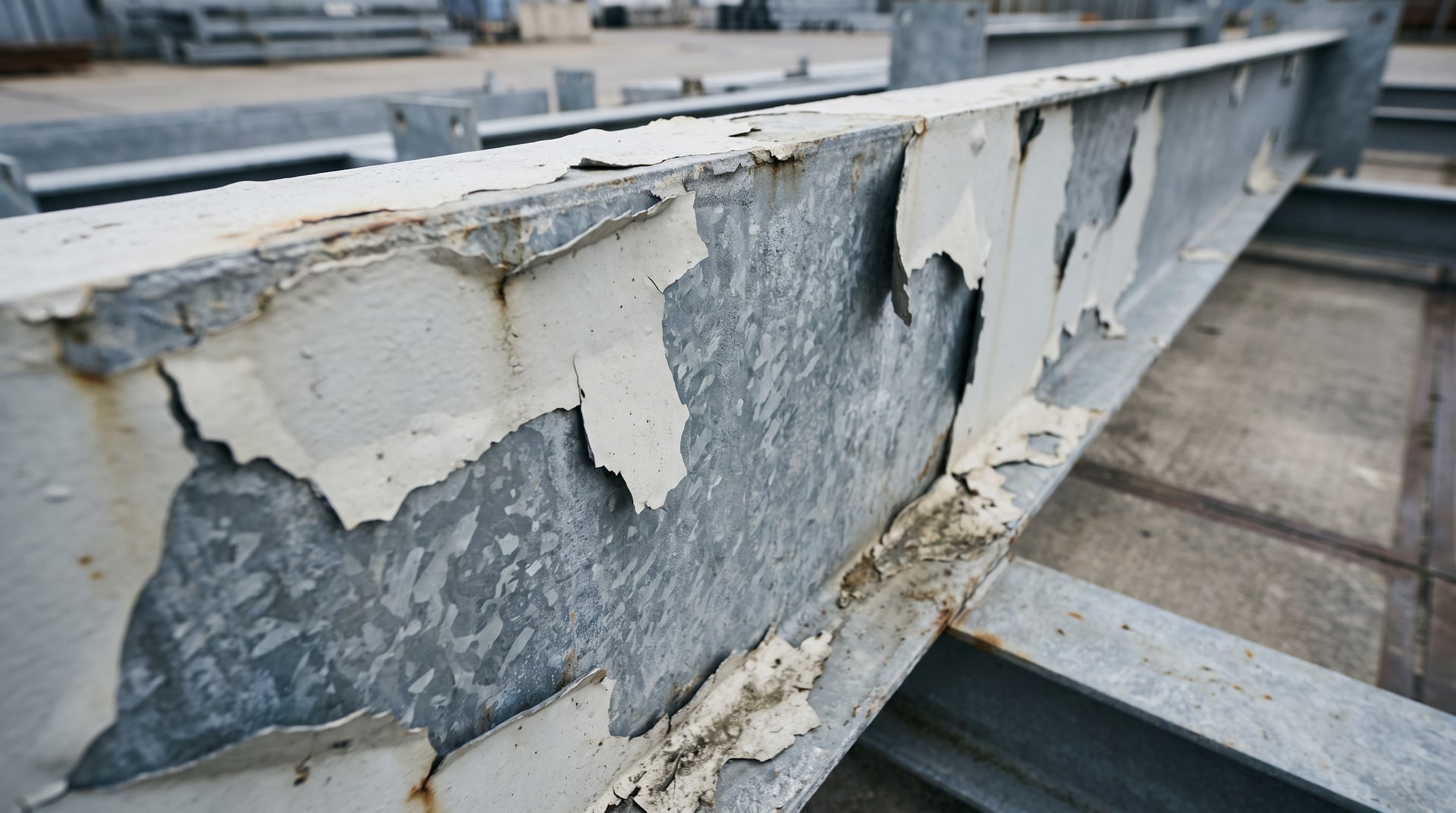
Paint failure over hot-dip galvanized steel is one of the more frustrating problems a fabricator or contractor can encounter, particularly because it often appears long after the project is complete. You see peeling at the edges of a beam, blisters forming under a powder coat on a railing, or flaking that exposes bare zinc on a structure that was supposed to carry both corrosion and aesthetic protection for decades. The coating looked fine at installation. So what went wrong?
The answer almost always traces back to one of two root causes: the surface was not properly prepared before coating, or the selected paint system was not formulated for zinc. Neither issue is rare. Both are preventable. But preventing them requires understanding what is actually happening at the surface level, not just following a general painting checklist.
The American Galvanizers Association addresses this directly in their article on why paint over galvanizing may fail. At V&S Galvanizing, we expand on that foundation to explain what is actually happening at the material level, how surface condition influences adhesion and long-term coating performance, and why this is often misunderstood in the field.
The Duplex System Premise — And Where It Breaks Down
A duplex system combines hot-dip galvanizing with an organic topcoat, either paint or powder coating, applied over the zinc surface. The concept is straightforward: zinc provides sacrificial electrochemical protection, and the organic layer provides a barrier that slows the zinc's consumption rate. In well-executed duplex systems, the service life of the combined system significantly exceeds what either coating would achieve on its own.
What makes duplex systems fail is the assumption that applying paint over galvanizing is essentially the same as painting over any primed steel surface. It is not. Zinc is a reactive metal. Its surface chemistry changes continuously after it leaves the galvanizing bath, and those changes affect how well an organic coating can bond to it. The galvanized surface is not passive the way a zinc-rich primer might be. It is a living surface in a chemical sense, and what it looks like the day you coat it determines a great deal about what happens years later.
Why New Galvanizing Is Not Ready to Paint Without Preparation
Freshly galvanized steel presents a particular challenge that surprises many applicators. The surface looks clean, bright, and uniform. It seems ready. But the metallurgical reality is that newly galvanized zinc is exceptionally smooth at a microscopic level, with very low surface energy, and that combination actively resists mechanical bonding with paint films.
Adhesion between a paint or powder coat and its substrate depends on a combination of mechanical interlocking (the coating penetrating microscopic surface irregularities) and chemical bonding. New zinc offers neither in adequate measure. The surface is too smooth for meaningful mechanical adhesion, and its high reactivity means some coating systems will interact with it in ways that undermine rather than promote bonding.
The practical response to new galvanizing is to create surface profile through an active preparation step. Sweep blasting with fine, soft abrasives at controlled low pressure is the most common method. A wash primer or acrylic pretreatment can achieve a similar result chemically. The goal is not to remove zinc but to roughen the surface enough to give the coating something to grip, while also removing any surface contaminants that arrived during handling, storage, or transit.
The Partially Weathered Stage: The Most Problematic Window
If new galvanizing presents one challenge, partially weathered galvanizing presents a different and arguably more complicated one. In the period roughly spanning two days to twelve months after galvanizing, depending on ambient moisture and atmospheric conditions, the zinc surface begins forming corrosion products: primarily zinc oxide and zinc hydroxide. These compounds are white, loosely adherent, and often mixed with organic contamination from the environment such as dirt, oils, and airborne grease.
This stage is problematic because the surface appears weathered and textured enough to paint, but the corrosion products and contamination sitting on top of the zinc are not stable bonding surfaces. Paint applied over zinc oxide or zinc hydroxide does not bond to the underlying metal. It bonds to the corrosion product, which is weakly attached to the substrate. The result is adhesive failure at the weakest interface, which is the layer just beneath the paint film.
Cleaning the surface of all contamination is necessary, but cleaning alone is not enough during this window. The profile needs to be re-established through sweep blasting, wash primer, or acrylic pretreatment. Only once contaminants are removed and the profile is corrected is the surface genuinely ready for coating.
Fully Weathered Zinc: The Easiest Starting Point
Galvanized steel that has been exposed long enough to develop a stable zinc carbonate film is actually the most straightforward surface to prepare for painting. The zinc carbonate layer is tightly bound to the galvanized surface, relatively rough in profile compared to new zinc, and chemically stable. In most cases, thorough cleaning to remove surface dirt and organic contamination is all that is needed before paint or powder application.
The matte gray appearance of fully weathered galvanizing is the visible indicator that this stable carbonate layer has formed. Contractors sometimes treat this appearance as a sign of coating degradation, but it is actually a sign of chemical maturity. The surface has reached a stable state that accepts paint more readily than either new or partially weathered zinc. That said, cleanliness still matters. Even a fully weathered surface with surface contamination will produce poor adhesion, so the cleaning step cannot be skipped regardless of how mature the zinc looks.
Moisture and Outgassing: A Specific Risk for Powder Coatings
One failure mechanism that is specific to powder coatings deserves particular attention because it can occur even when the surface appears clean and properly profiled. If the galvanized surface retains any moisture at the time of powder application, a sequence of events is set in motion that will ultimately produce blisters in the cured coating.
Moisture on the zinc surface reacts with the zinc itself to form zinc oxide. When the powder coat is applied over this moisture-contaminated surface and then sent through the curing oven, the heat causes the trapped moisture within the zinc oxide to expand and attempt to escape. This process is called outgassing. The expanding vapor has nowhere to go except through the uncured or newly cured powder film, and the result is a pitted or blistered surface that cannot be repaired without removing the coating entirely.
This is not a rare failure mode. It happens whenever the galvanized surface has not been thoroughly dried before powder application, which can occur even in a controlled shop environment if the parts were washed or rinsed as part of surface preparation and not fully dried before entering the coating line. The fix is simple but non-negotiable: the surface must be completely dry. In practice, this means allowing adequate drying time after any wet cleaning step and, ideally, verifying with a moisture check before coating.
Paint Chemistry and Zinc Compatibility
Surface preparation solves the physical adhesion side of the problem, but it does not address the chemical compatibility side. Some paint systems, when applied over zinc, undergo a saponification reaction. Saponification is essentially a soap-forming reaction between the alkaline zinc surface and certain resin systems, particularly oil-based or alkyd-based paints. The products of this reaction form a layer that inhibits adhesion, and the coating detaches from below even when the surface appeared correctly prepared.
This is not a speculative concern. It is a documented failure mechanism, and it is why most reputable paint manufacturers now offer product lines specifically formulated for application over zinc. These formulations are designed to resist the saponification reaction and are tested for compatibility with galvanized substrates. Using a general-purpose paint system over galvanizing without verifying its zinc compatibility is a predictable path to adhesion failure.
For architects and specifiers, this has a practical implication at the design documentation stage. Specifying a duplex system on galvanized steel requires not just calling out a paint product but confirming that product is explicitly rated for use over zinc. Many project specs still get this wrong, particularly when the galvanizing and painting scopes are handled by different subcontractors without direct coordination.
Removing Failed Coatings Without Damaging the Zinc
When paint or powder coat does fail over galvanizing, the next challenge is removing the failed coating without destroying the zinc layer underneath. This is a legitimate concern because some common coating removal methods are too aggressive for zinc, which is softer than steel and can be thinned or damaged by high-pressure abrasive blasting or very high-pressure water jetting.
Several methods have been shown to work effectively without compromising the galvanized coating. Chemical paint strippers can dissolve the failed organic layer without attacking the zinc. Blast cleaning is acceptable when done with fine, soft abrasives at low pressures, which removes the paint mechanically while staying within parameters that preserve coating thickness. Pressure washing is another option, but it must be performed at pressures below 1,400 psi. Above that threshold, there is meaningful risk of eroding the zinc surface or forcing water into the zinc-steel interface.
Once the failed coating is removed, the surface preparation process starts over. The zinc surface condition after removal determines which preparation steps are appropriate before recoating. If the removal process has roughened and cleaned the surface adequately, less additional preparation may be needed. If the zinc surface has developed new contamination or corrosion products during the stripping process, those need to be addressed before any new coating is applied.
Work With a Team That Understands the Surface, Not Just the Specification
Most paint failures over hot-dip galvanized steel are not material failures. They are process failures, communication failures, or specification failures. The zinc performs exactly as it should. The paint film does what it was designed to do. But when they are put together without accounting for surface chemistry, moisture, profile, and product compatibility, the system fails at the interface between them.
At V&S Galvanizing, we work with fabricators, engineers, and contractors throughout the preparation and galvanizing process to help avoid these outcomes from the start. Understanding which surface condition your galvanized steel will be in when it reaches the paint line, what preparation steps are appropriate for that condition, and whether your selected topcoat is formulated for zinc is not a detail to sort out after the coating has been applied. It is a conversation worth having before the order is placed.
If you are planning a project that involves painting or powder coating over hot-dip galvanized steel, or if you are troubleshooting an existing adhesion problem, reach out through our contact page and we will connect you with the right information and resources for your specific situation.
Frequently Asked Questions About Paint Adhesion Over Hot-Dip Galvanized Steel
Why does paint peel off galvanized steel even when the surface looks clean?
A clean-looking galvanized surface is not necessarily a paint-ready surface. Newly galvanized zinc is very smooth at a microscopic level, which limits mechanical adhesion. Partially weathered zinc may carry zinc oxide or zinc hydroxide deposits that look like part of the zinc surface but actually provide a weak, loosely bound layer that paint cannot bond to reliably. Cleaning removes contamination, but it does not create the surface profile that paint adhesion requires. Profile must be established separately through sweep blasting, wash primer, or acrylic pretreatment.
What is the difference between painting over new versus fully weathered galvanizing?
New galvanizing is smooth and chemically reactive, requiring active profiling before paint application. Fully weathered galvanizing has developed a stable zinc carbonate film that is naturally rougher and more chemically stable. In most cases, fully weathered zinc only needs thorough cleaning before coating, while new zinc requires additional steps to create adequate surface profile.
What causes blisters in powder coatings applied over galvanized steel?
Blisters in powder coatings over galvanized steel are typically caused by outgassing. If moisture is present on the zinc surface at the time of powder application, it reacts with the zinc to form zinc oxide. During the oven curing cycle, the trapped moisture expands and tries to escape through the powder film, producing pimples or blisters. Preventing this requires ensuring the galvanized surface is completely dry before any powder is applied.
Can any paint be used over hot-dip galvanized steel?
No. Some paint systems, particularly alkyd and oil-based formulations, can undergo a saponification reaction when applied over zinc. This produces soap-like corrosion products at the interface that inhibit adhesion. Paints used over galvanized steel should be explicitly formulated and tested for zinc compatibility. Most reputable manufacturers offer product lines designed for this application.
What is the safest way to remove failed paint from a galvanized surface without damaging the zinc?
Three methods are considered safe for galvanized steel: chemical paint strippers, blast cleaning with fine soft abrasives at low pressures, and pressure washing at or below 1,400 psi. Higher-pressure washing or aggressive abrasive blasting risks eroding the zinc coating. After removal, the surface condition should be assessed to determine what preparation steps are needed before recoating.
How long does galvanizing need to weather before it is ready to paint without special treatment?
Galvanizing must be fully weathered to reach the stage where cleaning alone is typically sufficient before painting. This means the surface has developed a stable zinc carbonate film, visible as a matte gray color. The time required depends on atmospheric exposure conditions and can vary considerably. Before that stage, whether the steel is freshly galvanized or partially weathered, additional surface profiling steps are required.
What role does surface profile play in duplex coating performance?
Surface profile refers to the microscopic roughness of the substrate that allows a paint or powder coating to mechanically interlock with the surface. Galvanized zinc, particularly when new, is too smooth for reliable mechanical adhesion without surface treatment. Creating adequate profile through sweep blasting or chemical pretreatment gives the coating film the physical grip it needs. Without it, even a chemically compatible and correctly applied coating is at elevated risk of adhesive failure.
Why do duplex system failures often show up long after installation rather than immediately?
Adhesion failures caused by inadequate surface preparation or incompatible paint chemistry often do not manifest immediately because the coating may initially appear to be adhering while remaining weakly bonded at the substrate interface. Thermal cycling, UV exposure, moisture infiltration at edges or damaged areas, and normal mechanical stress gradually exploit the weak interface over time, causing the failure to become visible as peeling, flaking, or blistering months or years after application.
