

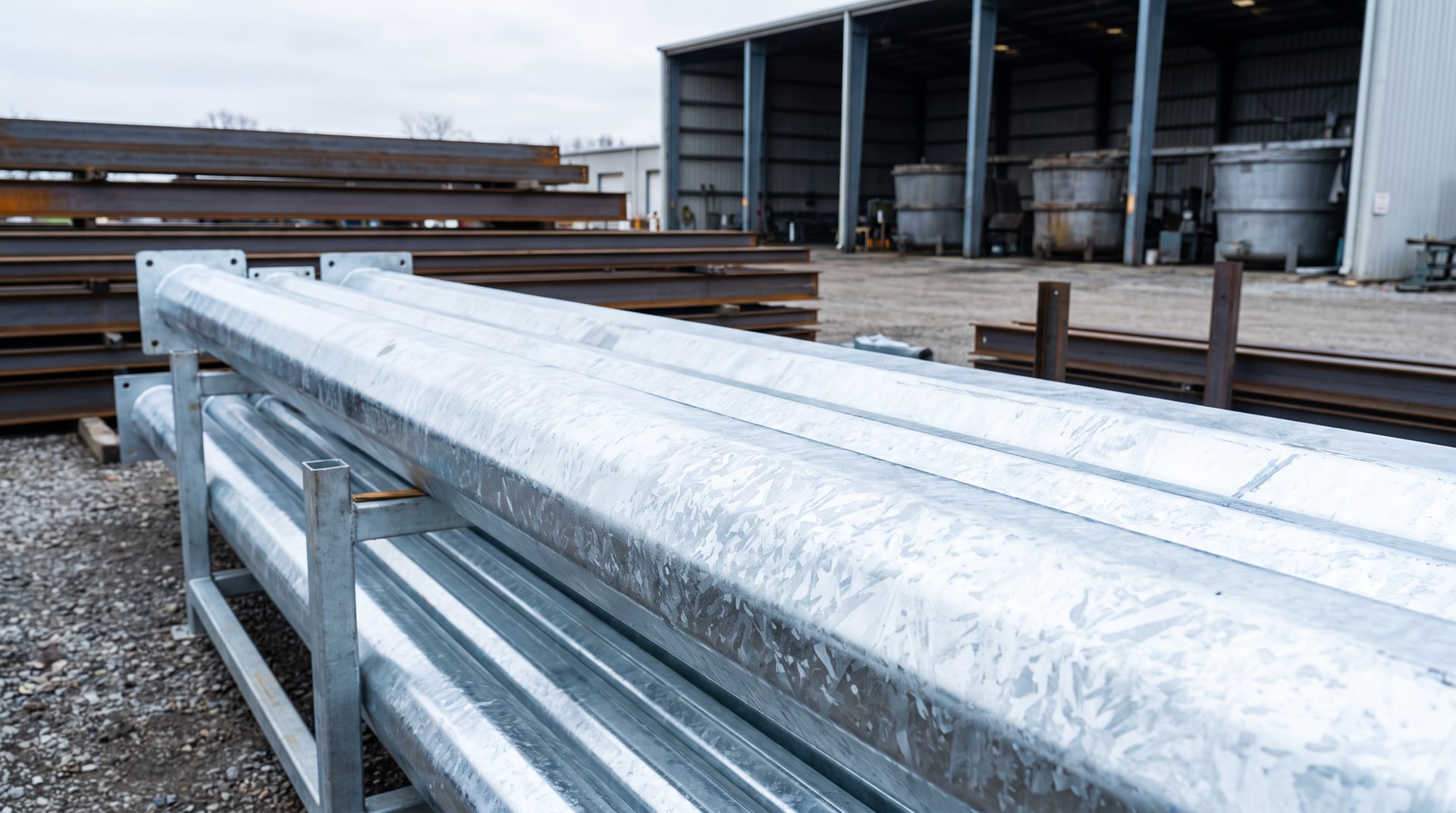
Not every project calls for a bright, mirror-like zinc surface. Landscape architects designing trail infrastructure, utility companies installing poles near roadways, and project teams working in visually sensitive environments sometimes require galvanized steel that blends into its surroundings rather than catching every ray of sunlight. The high reflectivity of newly galvanized steel, which can exceed 70%, has drawn real complaints: disrupted wildlife habitat, driver distraction near roadways, and visual intrusion in natural settings. These are legitimate concerns, and they have documented engineering solutions.
The American Galvanizers Association addresses this directly in their article on methods to dull hot-dip galvanized steel. At V&S Galvanizing, we expand on that foundation to explain what is actually happening at the material level, how coating microstructure and surface chemistry influence final appearance, and why some of the simplest approaches are also the most overlooked in the field.
Why Newly Galvanized Steel Is So Reflective
When steel exits the galvanizing kettle and is quenched in water or chromate solution, the outer surface of the coating solidifies rapidly. This fast solidification tends to produce a relatively smooth, continuous zinc layer with a bright, crystalline surface. The reflectivity of this surface can measure above 70%, which is genuinely high by any practical standard.
What drives that reflectivity is surface smoothness and the unweathered state of the zinc. Pure zinc in its freshly solidified form has not yet reacted with atmospheric oxygen, carbon dioxide, or moisture. Once those reactions begin, the surface chemistry changes. Zinc carbonate and zinc hydroxide compounds form progressively on the outer layer, producing what galvanizers call the zinc patina. This patina is microscopically rougher and less specularly reflective than the original surface, which is exactly why time and weathering are often the most straightforward path to a dull finish.
Understanding this distinction matters for project planning. The "problem" of reflectivity is, in most cases, a temporary condition driven by coating freshness rather than a permanent material characteristic.
Natural Weathering: The Simplest Approach for Most Applications
For the majority of projects where dulling is requested, the most practical answer is also the least interventional: wait. After six months of outdoor exposure, freshly galvanized steel will have developed enough zinc patina to meaningfully reduce reflectivity. Quantitative data from field observations makes this progression concrete.
A newly galvanized pole with reflectivity above 70% dropped to 55% after just 72 hours of outdoor exposure. A separate pole measured 28% reflectivity after two years. A third, observed at four years of outdoor exposure, registered 23% reflectivity. That trajectory is consistent with what we understand about zinc patina formation: the initial drop is fairly rapid as zinc reacts with atmospheric moisture and carbon dioxide, then the rate of change slows as the stable carbonate layer establishes itself.
One practical recommendation that supports faster natural dulling is omitting the quench step from the galvanizing process. Quenching in water or chromate solution slows atmospheric reactivity early on by creating a more stable initial surface. Skipping the quench leaves the surface chemistry more open to early atmospheric reaction, which accelerates patina formation. This is a low-cost adjustment with meaningful impact on how quickly the coating transitions from shiny to matte.
Dust and particulate accumulation in real-world environments also contribute to the appearance change. In practice, the combination of zinc patina development and surface soiling means that reflectivity in most outdoor settings decreases faster than clean-environment test data alone would suggest.
Chemical Post-Treatments: Zinc Phosphate Solutions
When a project timeline does not allow for six months of natural weathering, chemical post-treatment is the next most commonly used method. Several proprietary products are commercially available, and most are based on acidic zinc phosphate chemistry. When applied to a freshly galvanized surface, these solutions deposit fine-grain zinc phosphate crystals across the surface. The resulting texture is visually matte and structurally compatible with the underlying zinc coating.
Application methods vary by job size. Spray application works well for poles and structural shapes that can be handled individually. Immersion in treatment tanks is more practical for large production runs. The process sequence typically involves cleaning, phosphating, and an acid rinse sealing step, with rinsing between each stage. The fine-grain zinc phosphate crystals deposited during this process are also recognized as a suitable surface preparation for paint adhesion, which makes this treatment useful in duplex coating systems as well.
Colorado's Public Service Company developed a field-applicable version of this approach using a copper sulfate solution. Their formulation uses three pounds of copper sulfate crystals per gallon of water. If the crystals dissolve poorly at room temperature, crushing them before addition or using warm water can help. Once dissolved and cooled, one-half pint of concentrated-grade hydrochloric acid is added with thorough stirring. This acidified copper sulfate solution is applied via low-pressure spray equipment. The dulling effect is visible immediately on contact with the zinc surface. The material is then rinsed with water promptly to stop the acid reaction and prevent over-etching.
Galvanizers can also achieve a similar surface effect using their own acid or flux tanks. However, this approach requires careful attention to immersion time. Excessive time in an acid or flux bath can reduce coating thickness in ways that impair long-term corrosion protection. The results from this immersion method are also variable: blotchy, uneven areas with inconsistent dullness across a single part are common. For this reason, acid or flux tank treatment is only appropriate for very small jobs where a perfectly uniform appearance is not critical.
Process Variables During Galvanizing
A galvanizer can influence the final appearance of the coating by adjusting process parameters during the galvanizing run itself, without any post-treatment step. These adjustments work by promoting the formation of intermetallic compounds in the coating structure. The iron-zinc intermetallics, which form at the steel-zinc interface and grow outward during immersion, are harder and visually darker than the outer free zinc layer. Increasing their proportion in the coating profile produces a surface that is inherently less shiny.
For thick steel sections, specifically material greater than 0.5 inches, not quenching the part after withdrawal from the kettle allows it to cool slowly while remaining near reaction temperature. This extended thermal exposure gives the intermetallic layers more time to grow. The result is a coating with a higher proportion of iron-zinc phases and a correspondingly darker, more matte appearance.
Bath chemistry also plays a role. Allowing the aluminum concentration in the galvanizing bath to fall below 0.005% has a dulling effect on the finished surface. Aluminum is added to the bath to suppress dross formation and to promote a smoother, brighter outer zinc layer. At very low aluminum concentrations, this smoothing effect is reduced and the surface tends to be less reflective. This is a deliberate process adjustment, not a quality deficiency, but it does require the galvanizer to monitor bath chemistry closely and communicate clearly with the customer about the intended outcome.
The Magnesium Addition Experiment
In 1973, the American Smelting and Refining Company conducted a study exploring whether adding magnesium to the galvanizing bath could produce a consistently duller coating. Steel panels were processed under standard conditions using spelter with up to 1.0% magnesium content. The findings were instructive, though ultimately discouraging for practical production use.
Panels galvanized in spelter containing more than 0.4% magnesium showed a noticeable dulling effect. However, at concentrations above 0.2%, the researchers observed problems: coating adhesion became deleterious, and coating thickness increased beyond acceptable levels. Two additional practical obstacles emerged. First, magnesium oxidizes preferentially in the bath environment, meaning it would burn off over time and require constant replenishment, making sustained production runs difficult to manage. Second, the cost of magnesium addition compared unfavorably with post-treatment alternatives that achieve a similar visual result more reliably.
The magnesium study remains a useful reference point because it illustrates the limits of bath chemistry modification as a dulling strategy. The range between a useful dulling effect (above 0.4% Mg) and unacceptable coating degradation (above 0.2% Mg) is narrow and contradictory in those findings, which means there is no reliable operating window. For production galvanizers, the more predictable post-treatment methods are substantially more practical.
Matching the Method to the Project
The right dulling method depends on three variables: how quickly the dull finish is needed, how uniform the appearance needs to be, and how large the job is.
For most structural applications where a natural dull finish is acceptable after installation, doing nothing is genuinely the best answer. The zinc patina will form on its own, reflectivity will drop substantially within months, and the coating's long-term corrosion performance is completely unaffected. This approach also avoids adding any chemical processing steps that could introduce variability.
When the project requires a dull appearance at the time of delivery rather than after field exposure, zinc phosphate post-treatment is the most reliable option. For small volumes, an acid or flux tank immersion can work, with the understanding that appearance uniformity will vary. For larger production runs, investment in a dedicated post-treatment system using a proprietary phosphating product is the more consistent and scalable choice.
Process variable adjustments, such as skipping the quench or allowing aluminum concentration to drop, are best implemented in coordination with the galvanizing team from the start of the project. These are not field modifications. They require communication during the specification and scheduling phase so the galvanizer can plan accordingly and confirm that the adjustments are appropriate for the specific steel chemistry and geometry involved.
Appearance Versus Corrosion Performance
One concern that surfaces regularly when dulling methods are discussed is whether these treatments affect the long-term corrosion protection of the coating. The short answer is that properly applied dulling methods do not meaningfully reduce coating performance, but the details matter.
Natural weathering is completely benign from a performance standpoint. The zinc patina that forms is itself a corrosion-resistant layer. Chemical post-treatments using zinc phosphate also leave the coating intact and do not remove zinc. The acid rinse steps involved in phosphating are designed to clean and activate the surface rather than etch into the coating mass.
The risk area is immersion in acid or flux tanks. If immersion times are not carefully controlled, acid exposure can reduce coating thickness. Coating thickness directly correlates with expected service life, so any process that reduces it needs to be monitored. This is precisely why the flux or acid tank method is limited to small jobs where close monitoring is practical and where minor thickness variation is acceptable. For any project with a defined minimum coating thickness requirement per ASTM A123 or related specifications, this method requires verification that post-treatment thickness still meets the specified minimums.
Process variable adjustments that promote intermetallic formation can actually increase total coating thickness on thick steel sections, since the intermetallic layers are thicker than a standard free-zinc outer layer. This is generally not a problem, but it is worth noting if dimensional tolerances are tight.
Work With a Team That Understands Finish Requirements Before the Steel Goes in the Kettle
Dulling is one of those finishing requirements that works best when it is part of the conversation from the beginning of a project rather than an afterthought once the steel is already galvanized. The method that fits your timeline, appearance standard, and project scale depends on decisions made at the specification stage, not after delivery. Whether the right answer is a process adjustment, a post-treatment, or simply letting the zinc patina develop naturally over time, the outcome is more predictable when the galvanizer knows the expectation upfront.
If you are working on a project where galvanized finish appearance is a design constraint, our team is available to walk through the options with you. Reach out through our contact page and let us know what you are working with.
Frequently Asked Questions About Dulling Hot-Dip Galvanized Steel
How long does it take for hot-dip galvanized steel to naturally become dull?
Most galvanized steel develops a noticeably less reflective surface within six months of outdoor exposure as the zinc patina forms. Reflectivity data shows a drop from over 70% on freshly galvanized steel to 55% after 72 hours, 28% after two years, and 23% after four years of outdoor exposure.
Does omitting the quench step actually help speed up dulling?
Yes. Quenching stabilizes the surface chemistry and can slow early atmospheric reactivity. Skipping the quench leaves the zinc surface more reactive to moisture and carbon dioxide, which accelerates zinc patina formation and the associated reduction in reflectivity.
What is zinc phosphate post-treatment and how is it applied to galvanized steel?
Zinc phosphate post-treatment uses acidic solutions to deposit fine-grain zinc phosphate crystals on the galvanized surface. The process involves a cleaning step, phosphating, and an acid rinse sealing step with rinsing in between. It can be applied by spray or immersion, and the resulting surface is matte and also suitable as a paint base for duplex coating systems.
Can a galvanizer use their existing acid or flux tanks to dull a coating?
Yes, but with limitations. Immersion in an acid or flux tank can produce a dulled surface on small jobs, but results tend to be uneven, with blotchy areas of differing reflectivity. More importantly, immersion times must be carefully controlled to avoid reducing coating thickness below specification minimums. This method is not recommended for large jobs or projects with strict uniform appearance requirements.
Do chemical dulling treatments reduce the corrosion protection of the galvanized coating?
Properly applied zinc phosphate post-treatments do not reduce coating performance. They clean and activate the surface without removing zinc mass. The risk is with acid or flux tank immersion, where excessive exposure time can reduce coating thickness. Any dulling method applied to steel with an ASTM A123 or similar thickness specification should include post-treatment thickness verification.
Why was magnesium bath addition not adopted as a standard dulling method?
The 1973 American Smelting and Refining Company study found that magnesium concentrations above 0.4% produced dulling, but concentrations above 0.2% caused problems with coating adhesion and excessive thickness. The narrow, conflicting window between useful and problematic, combined with magnesium's preferential oxidation from the bath and higher cost compared to post-treatment alternatives, made it impractical for production use.
What process adjustments can a galvanizer make to produce a duller coating without post-treatment?
Two main adjustments are available. First, for thick steel (greater than 0.5 inches), skipping the quench and allowing the part to cool slowly promotes additional intermetallic layer growth, which produces a darker, less shiny surface. Second, allowing bath aluminum concentration to drop below 0.005% reduces the smoothing effect aluminum provides, resulting in a less reflective outer surface. Both require advance coordination with the galvanizing team.
Is the copper sulfate and hydrochloric acid spray solution safe for field application?
The solution, which combines three pounds of copper sulfate crystals per gallon of water with one-half pint of concentrated hydrochloric acid, involves concentrated acid and requires appropriate personal protective equipment and low-pressure spray equipment. The zinc surface must be rinsed promptly after application to stop the acid reaction. It is not a casual field touch-up procedure and should be treated with the same precautions as any industrial acid-based surface treatment.
