

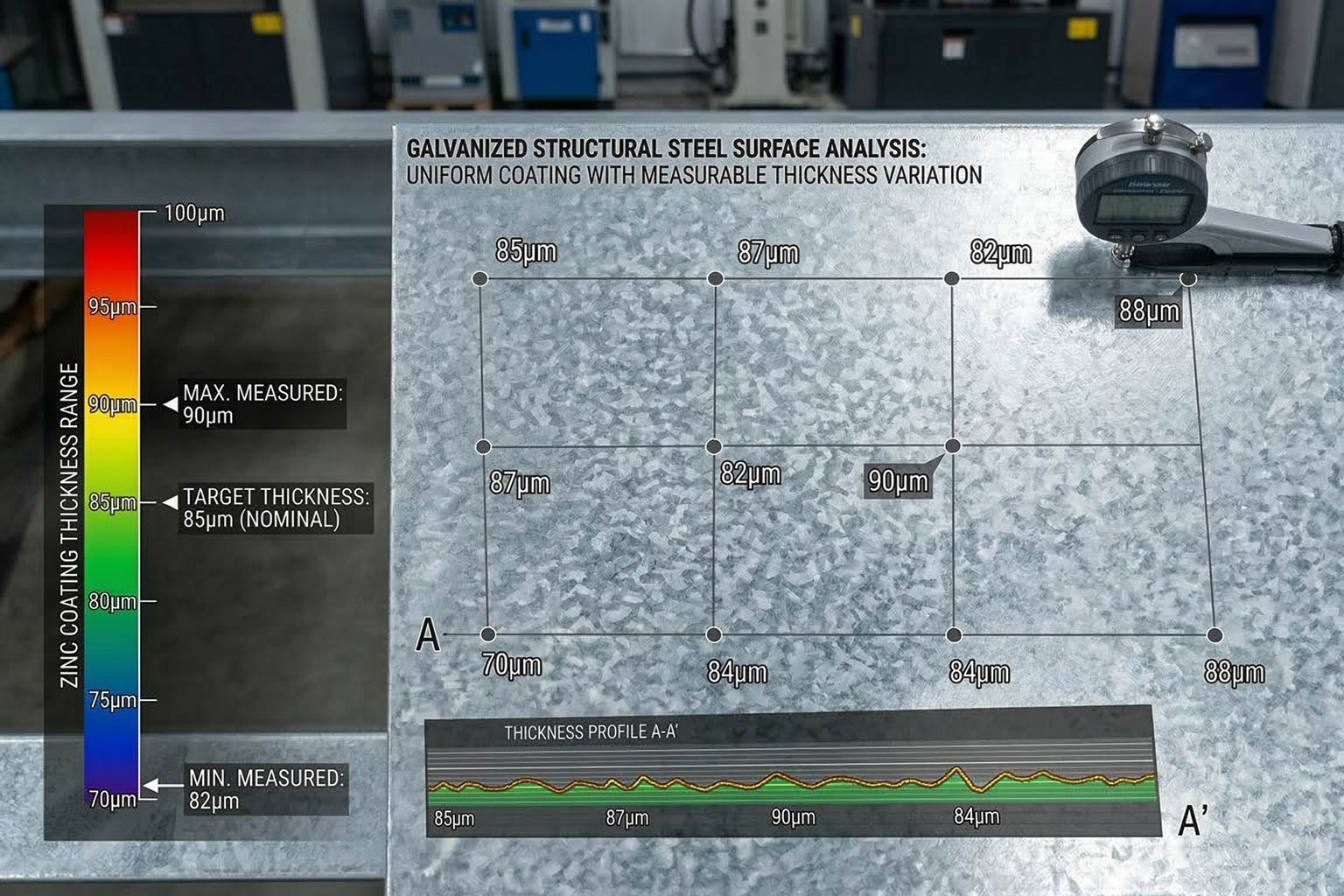
Steel chemistry directly influences how zinc reacts during hot dip galvanizing. While much attention is often given to reactive silicon content and the potential for heavy coatings, the opposite condition can also occur. Certain steels, particularly aluminum killed steels, may develop thinner than expected galvanized coatings due to their deoxidation chemistry and reduced surface reactivity.
The Galvanize It article discussing aluminum killed steel and thinner HDG coatings provides useful background. This expanded technical discussion examines how aluminum deoxidation affects galvanizing reactions, why coating growth may be inhibited, and how engineers should interpret thickness results during inspection.
What Is Aluminum Killed Steel?
Aluminum killed steel is produced by adding aluminum during the steelmaking process to remove dissolved oxygen. Aluminum acts as a strong deoxidizer, forming aluminum oxide inclusions and stabilizing the molten steel before casting.
This deoxidation process:
- Reduces oxygen content
- Improves uniformity
- Enhances mechanical properties
- Controls grain structure
Aluminum killed steel is widely used in structural and plate applications due to its improved consistency.
However, deoxidation chemistry also affects galvanizing behavior.
How Aluminum Influences Galvanizing Reactions
Hot dip galvanizing relies on diffusion between iron and molten zinc to form a series of zinc iron alloy layers.
Steel chemistry plays a significant role in reaction kinetics. Elements such as silicon and phosphorus typically accelerate coating growth. Aluminum, in contrast, can influence the surface condition and reduce reactivity under certain conditions.
In aluminum killed steels:
- Lower reactive silicon levels may be present
- Surface chemistry may slow alloy layer formation
- Coating growth rates may be reduced
The result can be thinner coatings compared to similar thickness steels with more reactive chemistry.
Coating Growth Mechanism
The galvanized coating develops through formation of intermetallic layers followed by an outer zinc layer.
When reactivity is reduced:
- Alloy layer growth may be slower
- Overall coating thickness may be closer to minimum specification limits
- Surface appearance may remain bright and uniform
This thinner coating does not necessarily indicate a defect. It reflects metallurgical interaction between steel composition and molten zinc.
Relationship to ASTM Thickness Requirements
ASTM A123 specifies minimum coating thickness requirements based on steel thickness categories. Aluminum killed steels may produce coatings near the lower end of the acceptable range.
As long as measured thickness meets or exceeds minimum requirements, the coating is compliant.
Engineers should base acceptance on measured thickness values rather than comparison to coatings observed on different steel chemistries.
Silicon Equivalent and Reactivity Balance
Steel reactivity is often evaluated using silicon equivalent values that consider both silicon and phosphorus content.
Steels with very low silicon content may produce thinner coatings.
Steels in reactive silicon ranges may produce heavier coatings.
Aluminum killed steel may fall into a lower reactivity range depending on composition.
Understanding this balance helps explain observed thickness variations between different heats of steel.
Inspection Considerations
When thinner coatings are observed on aluminum killed steel, inspectors should verify:
- Minimum thickness compliance
- Uniformity across surfaces
- Absence of bare areas
Appearance alone is not a reliable indicator of coating adequacy.
Magnetic thickness measurements provide objective evaluation.
If design life requirements demand heavier coatings due to environmental exposure, specification adjustments should be made during material selection rather than relying on process modifications alone.
Performance Implications
Service life of galvanized steel in atmospheric environments is approximately proportional to coating thickness.
If aluminum killed steel produces a coating closer to minimum thickness, expected service life remains predictable based on corrosion rate modeling.
There is no inherent reduction in coating adhesion or bonding quality. The metallurgical layers remain fully bonded to the substrate.
Engineers should evaluate:
- Environmental classification
- Required time to first maintenance
- Lifecycle performance goals
Where higher thickness is desired for aggressive environments, steel chemistry selection may be considered during procurement.
Managing Expectations in Projects
It is important to recognize that galvanizing is a chemical reaction influenced by steel composition. Differences between heats of steel can result in measurable variation in coating thickness even under identical processing conditions.
Proper specification coordination includes:
- Confirming applicable ASTM standards
- Understanding steel chemistry implications
- Evaluating environmental exposure requirements
If you would like technical guidance regarding aluminum killed steel behavior or coating thickness expectations for your project, please reach out through our contact page.
Early coordination helps align material selection with corrosion performance goals.
Aluminum killed steel is widely used for structural consistency and improved mechanical properties. Its deoxidation chemistry can reduce galvanizing reactivity, sometimes producing thinner but fully compliant coatings. These coatings remain metallurgically bonded and protective when minimum ASTM thickness requirements are met. Understanding steel chemistry effects allows engineers to properly interpret thickness measurements and plan for environmental exposure requirements.
Frequently Asked Questions About Aluminum Killed Steel and HDG Coatings
Why does aluminum killed steel sometimes produce thinner coatings?
Aluminum used in deoxidation can reduce steel surface reactivity during galvanizing. Lower reactive silicon content and altered surface chemistry may slow alloy layer growth, resulting in thinner coatings.
Does a thinner coating mean poor quality?
No. As long as the coating meets ASTM minimum thickness requirements and exhibits uniform coverage, it is compliant and protective. Thickness alone must be evaluated against specification criteria.
Can galvanizers increase thickness on aluminum killed steel by extending immersion time?
Immersion time has limited influence compared to steel chemistry. Coating growth is diffusion controlled, and chemistry remains the dominant factor.
Is aluminum killed steel unsuitable for galvanizing?
No. It galvanizes successfully and produces uniform coatings. However, thickness outcomes may differ from more reactive steels.
Should engineers consider steel chemistry during specification?
Yes. For projects requiring extended service life in aggressive environments, understanding steel chemistry can help predict coating thickness and performance outcomes.
Does thinner coating reduce corrosion resistance significantly?
Corrosion protection is proportional to thickness. A thinner but compliant coating provides predictable service life based on environmental corrosion rates. Designers should model exposure conditions accordingly.
How is coating thickness verified?
Coating thickness is measured using calibrated magnetic gauges in accordance with ASTM inspection procedures.
Can aluminum killed steel still achieve thicker coatings if necessary?
In some cases, selection of steel chemistry with appropriate silicon content may influence coating growth. Coordination during material procurement is more effective than attempting to modify processing parameters alone.
