
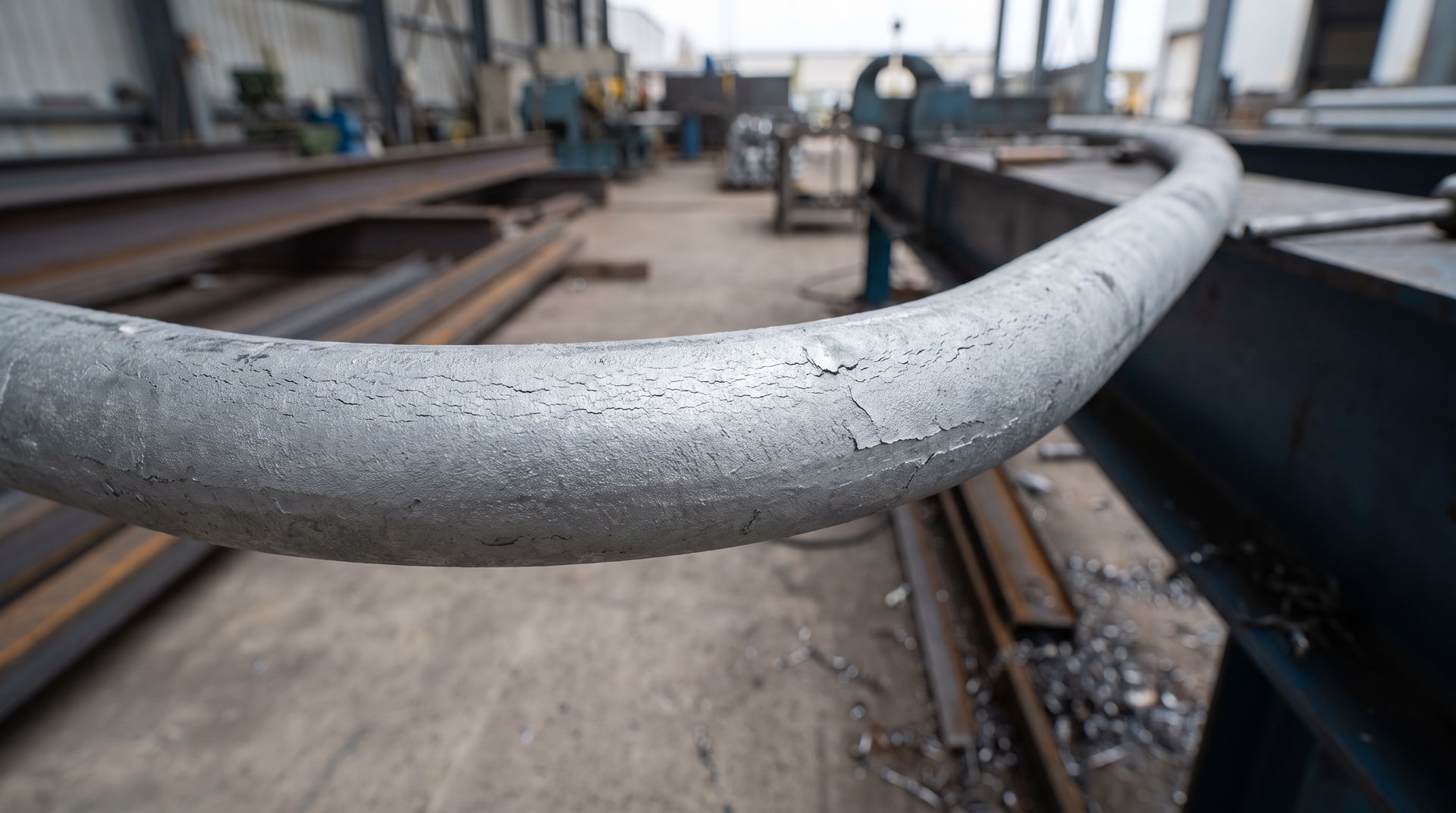
A fabricator calls with a complaint: steel that was bent before galvanizing has cracked, fractured during handling, or lost its ductility in a way it never did before the zinc bath. The immediate assumption is that galvanizing damaged the steel. It is a reasonable instinct, but it is the wrong diagnosis in most cases. The real culprit is a metallurgical phenomenon that begins long before the steel ever reaches the kettle, and galvanizing simply accelerates a process already set in motion at the bending table.
The American Galvanizers Association addresses this directly in their article on embrittlement of bent galvanized steel. At V&S Galvanizing, we expand on that foundation to explain what is actually happening at the material level, how cold working influences performance, and why this is often misunderstood in the field.
The Name "Galvanizing Embrittlement" Creates a False Impression
When engineers and contractors hear the term "galvanizing embrittlement," the natural reading is that the galvanizing process itself introduces brittleness into otherwise sound steel. That framing is misleading, and it leads to misplaced blame and missed prevention opportunities.
What is actually occurring is strain-age embrittlement, a well-documented phenomenon in materials science. Strain-age embrittlement describes a change in the mechanical properties of cold-worked steel over time. At room temperature, this change happens slowly. At elevated temperatures, it accelerates dramatically. Because the galvanizing bath operates at approximately 840 degrees Fahrenheit, steel that has been cold-worked during fabrication undergoes rapid aging during immersion. The result is a measurable loss of ductility that can produce brittle fracture under loads that would not have posed any risk before fabrication.
The galvanizing process is not introducing a new defect. It is revealing and accelerating a vulnerability that was created when the steel was bent, punched, or otherwise cold-worked. That distinction matters enormously when it comes to engineering decisions about design, steel selection, and fabrication sequence.
What Cold Working Actually Does to the Steel's Internal Structure
To understand why bends are the most common source of this problem, it helps to picture what happens at the material level when steel is bent cold. The metal around the circumference of the bend is compressed and distorted. The outer radius is placed in tension while the inner radius is compressed, and the fibers of steel in between are subjected to complex shear stresses. This process distorts the crystalline grain structure of the steel and can initiate microscopic tears or cracks along the bend zone.
The same thing happens around punched holes. The punching operation shears through the material, leaving a zone of highly stressed, deformed metal around the perimeter of the hole. These distorted zones are not always visible to the naked eye, but they represent areas where the steel's normal ductility has been compromised.
When that steel enters the galvanizing kettle, the heat activates atomic-level diffusion processes. Interstitial atoms, particularly nitrogen and carbon, migrate through the iron lattice and anchor dislocations that were introduced by cold working. This pinning effect is what reduces ductility and raises the ductile-to-brittle transition temperature. The zinc itself can also penetrate into pre-existing surface cracks and tears at the bend, particularly along the longitudinal axis of the bend, which compounds the structural disruption in that localized area.
Why Section Thickness Amplifies the Risk
Thicker steel sections are significantly more susceptible to this failure mode, and understanding why helps fabricators make better decisions about bend radius specifications.
When a given bending radius is applied to thicker material, the ratio of the bend radius to the section thickness decreases. A tighter ratio means a greater degree of strain is imposed on the outer fibers of the material during bending. More strain equals more dislocation generation within the grain structure, and more dislocations means there is more opportunity for the pinning mechanism that produces embrittlement during subsequent heating.
This is why a bend radius that works perfectly for light gauge steel may be completely inappropriate for heavy structural plate. The geometry looks the same on a drawing, but the actual cold-working strain imposed on the material is substantially higher. Fabricators working with heavier sections need to treat bend radius requirements as load-bearing design decisions, not merely aesthetic or spatial ones.
Minimum Bend Radius Guidelines and When They Apply
For steel with a carbon content between 0.20 and 0.25 percent, which represents a large portion of structural and fabricated steelwork, a bending radius of at least three times the section thickness is generally sufficient to produce a satisfactory galvanized product. This ratio limits the amount of cold-working strain imposed on the outer fiber to a level the material can tolerate through the galvanizing cycle without losing unacceptable amounts of ductility.
When design constraints require bends tighter than this threshold, alternative approaches are available. Bends with a radius less than four times the section thickness should be hot-formed rather than cold-bent. Hot forming allows the steel to deform without introducing the lattice damage that cold working creates, because the material is ductile enough at elevated temperatures to accommodate the shape change without strain hardening. For situations where radii less than three times the section thickness are unavoidable and hot forming is not practical, annealing at 1,200 to 1,500 degrees Fahrenheit prior to galvanizing can relieve the accumulated internal stress and restore much of the steel's ductility before it sees the zinc bath.
Punched holes present a related concern. Reaming punched holes to remove the cold-worked metal at the perimeter reduces the zone of damaged material before galvanizing occurs, which is particularly important for age-sensitive steel grades.
Steel Grade Selection When Design Cannot Accommodate Large Radii
Not every project allows the fabricator the freedom to adjust bend radii or change to hot forming. Architectural and structural designs sometimes call for sharp bends in heavy material, and the geometry is fixed by the time galvanizing becomes part of the conversation. In those cases, the answer lies in steel selection rather than geometry modification.
Aluminum-killed steels and other non-aging steel grades are substantially less susceptible to strain-age embrittlement. The aluminum in killed steel ties up the free nitrogen in the melt, leaving far fewer interstitial atoms available to pin dislocations during the galvanizing cycle. Without that pinning mechanism, the elevated temperature of the galvanizing bath has much less impact on ductility, even in cold-worked zones. Specifying aluminum-killed or non-aging steels is the most reliable protective measure when bend geometry cannot be adjusted to meet safe cold-working thresholds.
This is a specification decision that should ideally be made at the design stage. Retrofitting a project that used standard carbon steel with insufficient bend radii is far more difficult and expensive than writing the correct steel chemistry into the original specification.
Reinforcing Bars: A Specific Application With Its Own Standard
Reinforcing bars represent the most commonly bent steel that passes through galvanizing operations. The relevant standard is ASTM A767, the Standard Specification for Zinc-Coated Steel Bars for Concrete Reinforcement, which defines minimum bend diameters for galvanized rebar as a function of bar size and grade.
| Bar No. | Grade 40 | Grade 50 | Grade 60 | Grade 70 |
|---|---|---|---|---|
| 3, 4, 5 | 6d | 6d | 6d | -- |
| 6 | 6d | 6d | 6d | 6d |
| 7, 8 | 6d | 6d | 6d | 6d |
| 9, 10 | 8d | 8d | 8d | 8d |
| 11 | 8d | 8d | 8d | 8d |
| 14, 18 | -- | -- | 10d | 10d |
The values in that table represent the minimum bend diameters that must be maintained when bars are bent prior to galvanizing. If a project requires a tighter bend than the standard allows, the bars must be stress relieved at 900 to 1,050 degrees Fahrenheit for one hour per inch of bar diameter before galvanizing proceeds. This stress relief step accomplishes the same thing as annealing in structural steel contexts: it removes the internal stress and restores ductility before the material is exposed to the galvanizing bath temperature.
It is worth noting that the sequence matters. When galvanizing is performed before bending rather than after, some cracking and flaking of the zinc coating in the bend area is a recognized and acceptable outcome. ASTM A767 accounts for this, and the standard is clear that this type of coating damage is not cause for rejection. Any damaged areas in the bend zone should be repaired in accordance with ASTM A780 using an approved touch-up method.
How Galvanizing Sequence Affects the Problem
The order of operations, whether bending happens before or after galvanizing, fundamentally changes the nature of the risk.
Bending before galvanizing concentrates all the cold-working strain into the bend zone before the steel sees heat. The galvanizing bath then accelerates strain aging in that zone, which is where the embrittlement risk is highest. Getting the bend radius right, choosing appropriate steel, or applying heat treatment before galvanizing are all strategies aimed at mitigating this sequence.
Galvanizing before bending shifts the risk profile. The steel arrives at the bending operation with an intact zinc coating. The bending then places mechanical stress on the coating itself, which was not designed to be deformed and can crack or flake along the outer radius. The zinc coating does not contribute to embrittlement in this sequence, but coating integrity becomes the concern instead. Repair of the damaged coating area is straightforward and well-defined by ASTM A780, so galvanizing-then-bending is sometimes a practical alternative when the geometry or project sequence allows it.
Neither sequence is universally superior. The right choice depends on the bend geometry, the steel grade, the project specifications, and practical constraints on the fabrication floor. What matters is understanding the tradeoffs clearly before the sequence is locked in.
Practical Guidance for Fabricators and Engineers
The most reliable way to prevent embrittlement failures in bent galvanized steel is to treat it as a design-stage problem rather than a galvanizing-stage problem. By the time the steel arrives at our facility, the bend has already been made, the steel grade has already been specified, and most of the variables that determine embrittlement risk have already been fixed.
Fabricators can protect themselves by using the largest bend radius the design will tolerate, with three times the section thickness as a practical working minimum for standard carbon steel. Hot bending should be the default approach whenever radii fall below four times the section thickness, because it avoids the cold-working damage entirely rather than trying to remediate it afterward. When tight bends on heavy sections are unavoidable and cold forming is the only practical option, annealing before galvanizing is the appropriate corrective step. Selecting aluminum-killed or non-aging steel from the beginning provides the most comprehensive protection for applications where sharp bends in heavier material are part of the design intent.
Engineers specifying hot-dip galvanizing should review bend radii relative to section thickness during the design review rather than leaving that coordination to the fabricator or galvanizer. Notes on the drawings that specify minimum bend radii for galvanized applications, or that require aluminum-killed steel for sharply bent components, create a clear chain of responsibility and prevent field failures that are expensive and difficult to attribute accurately.
Work With a Team That Understands the Full Fabrication Context
Embrittlement of bent galvanized steel is one of those failure modes that looks like a coating problem on the surface but is actually a materials and fabrication problem at its core. Our team reviews incoming fabrications for conditions that increase embrittlement risk, including tight bend radii on heavy sections, evidence of cold working around punched holes, and steel grades known to be age-sensitive. When we identify concerns, we communicate them early so the fabricator or engineer has the opportunity to make corrections before a failure occurs in the field.
If you are working on a project that involves bent steel, reinforcing bars, or any application where cold working precedes galvanizing, we are glad to discuss the specifics before fabrication begins. Reach out through our contact page and we will help you identify the right approach for your materials, geometry, and performance requirements.
Frequently Asked Questions About Embrittlement of Bent Galvanized Steel
Is galvanizing itself what causes steel to become brittle after bending?
No. The brittleness that appears after galvanizing bent steel is caused by strain-age embrittlement, which originates during the cold-working process (bending, punching). Galvanizing accelerates the aging because the bath temperature is elevated, but the underlying damage is created at the fabrication stage. Calling it "galvanizing embrittlement" is a misnomer that misidentifies where the problem actually starts.
What is the minimum safe bend radius for steel that will be galvanized?
For steel with a carbon content between 0.20 and 0.25 percent, a bend radius of at least three times the section thickness is generally sufficient to prevent embrittlement issues through the galvanizing process. Tighter radii require either hot forming (for radii under four times thickness) or annealing at 1,200 to 1,500 degrees Fahrenheit before galvanizing (for radii under three times thickness).
Why does section thickness matter so much for embrittlement risk?
Because cold-working strain increases as the ratio of bend radius to section thickness decreases. The same bend radius that produces acceptable strain in light gauge material imposes much higher strain on a thicker section. More strain means more crystalline lattice damage, which gives the strain-aging mechanism more opportunity to reduce ductility during galvanizing.
What steel types are less susceptible to strain-age embrittlement after galvanizing?
Aluminum-killed steels and other non-aging grades are significantly more resistant. Aluminum in killed steel ties up free nitrogen in the melt, which limits the interstitial atom migration that pins dislocations during heating. This reduces the ductility loss that occurs when cold-worked steel is exposed to the galvanizing bath temperature.
What does ASTM A767 require for reinforcing bars bent before galvanizing?
ASTM A767 specifies minimum bend diameters for galvanized rebar based on bar size and grade, ranging from 6d for smaller and lower-grade bars up to 10d for large bars in Grade 60 and 70. If bars must be bent tighter than these minimums, they must be stress relieved at 900 to 1,050 degrees Fahrenheit for one hour per inch of bar diameter before galvanizing.
Is coating cracking at a bend zone a reason to reject galvanized rebar?
Not when galvanizing is performed before bending. ASTM A767 recognizes that some cracking and flaking of the zinc coating in the bend area is expected when pre-galvanized bars are subsequently bent, and this is not cause for rejection. Damaged areas should be repaired in accordance with ASTM A780 using an approved repair method.
Does zinc penetrate into the steel at bend zones, and does that cause embrittlement?
Yes, zinc can penetrate into the steel along cracks and tears that form during cold working, particularly along the longitudinal axis of a bend. This penetration is one contributing factor in embrittlement at bend zones, in addition to the strain-aging mechanism driven by elevated bath temperature. Using adequate bend radii reduces the number and severity of these surface cracks before the steel enters the zinc bath.
Should bent components be galvanized before or after bending to minimize risk?
It depends on the geometry and specifications. Galvanizing after bending preserves coating continuity but requires proper bend radii and steel selection to avoid embrittlement. Galvanizing before bending eliminates embrittlement risk but introduces the possibility of coating cracking at the bend, which must be repaired per ASTM A780. Neither sequence is universally better; the right choice depends on the specific project constraints, bend tightness, and coating continuity requirements.
