

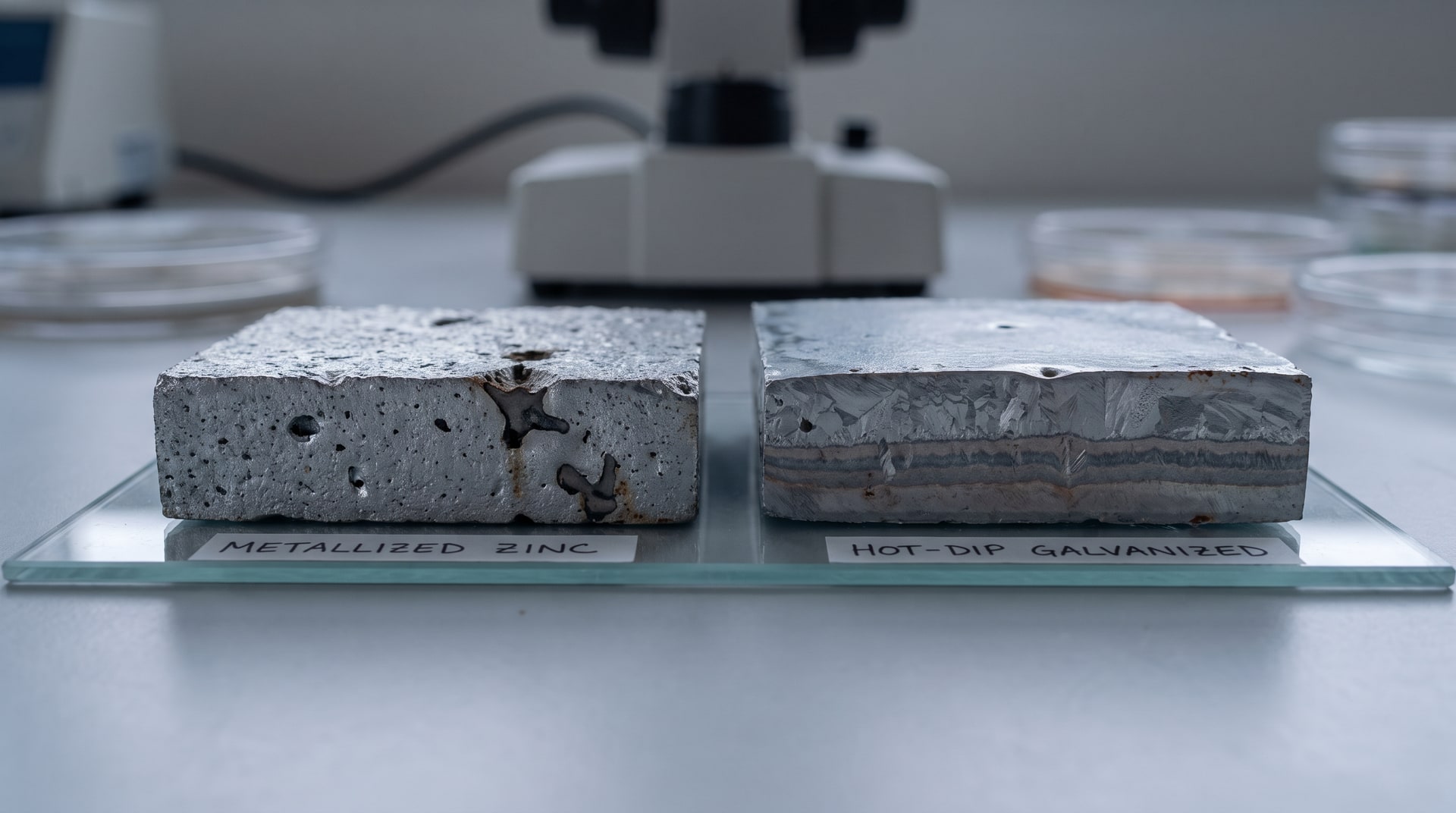
When a project calls for zinc-based corrosion protection, the conversation often moves quickly to hot-dip galvanizing. But there is a second zinc coating method that comes up on certain jobs, particularly when field application is needed or when large fabricated assemblies cannot physically fit inside a galvanizing kettle. That method is metallizing, also known as thermal spray, flame spray, or zinc spray metallizing. On the surface, the two seem interchangeable: both deposit zinc on steel, both provide barrier and cathodic protection, and both have a place in long-term corrosion control. The differences, though, are significant enough to change the outcome of a project if the wrong method is selected.
The American Galvanizers Association addresses this directly in their article comparing metallizing and hot-dip galvanizing. At V&S Galvanizing, we expand on that foundation to explain what is actually happening at the material level, how coating density and microstructure influence long-term performance, and why the cost comparison between these two methods is often misread by engineers and owners in the field.
How Each Coating Is Actually Applied
The application method is where these two processes diverge most fundamentally, and understanding that divergence explains nearly every downstream difference in performance.
Hot-dip galvanizing is a wet chemistry process followed by complete immersion. Steel is cleaned through a series of chemical baths, including caustic soda to remove oils and organics, an acid pickle to remove mill scale and rust, and a flux bath to prepare the surface for zinc adhesion. The cleaned steel is then lowered into a molten zinc kettle. At that temperature, zinc and iron atoms diffuse into each other at the interface, forming a series of intermetallic alloy layers before a free zinc outer layer solidifies on top. Every surface the kettle zinc can reach, including interior corners, threads, hollow sections, and the undersides of flanges, receives a fully metallurgically bonded coating. The process happens in a controlled shop environment and is not affected by weather.
Metallizing works differently from the ground up. The steel surface must first be abrasive blasted to a near-white metal finish, equivalent to NACE No. 2 or SSPC-SP 10. Within four hours of that cleaning step, zinc wire or powder is fed through a heated application gun where it melts and is propelled onto the steel surface using combustion gases or compressed air. The zinc particles strike the surface and solidify almost immediately. There is no metallurgical diffusion reaction between the zinc and steel. What forms is essentially a mechanically interlocked stack of solidified zinc particles, not a fused alloy system. The steel itself never approaches the elevated temperatures of a galvanizing kettle, which matters for distortion-sensitive assemblies, but it also means the coating bond is fundamentally different in character.
The applicable specifications reflect this distinction. Hot-dip galvanizing is governed by ASTM A123/A123M for structural products and ASTM A153/A153M for hardware. Metallizing is applied in accordance with AWS C2.2, Recommended Practices for Metallizing with Aluminum and Zinc for Protection of Iron and Steel.
What the Microstructure Actually Looks Like
Looking at a cross-section micrograph of each coating side by side clarifies a great deal. A hot-dip galvanized coating shows a layered, graduated structure: the intermetallic alloy phases closest to the steel substrate transition outward to a final free zinc layer. These layers are dense and continuous. A metallized coating, by contrast, looks more like a compressed stack of flattened zinc particles, with visible dark voids where air is trapped between particles during deposition. That porosity is not a defect in the traditional sense; it is an inherent characteristic of the thermal spray process.
The porosity matters for two reasons. First, it affects coating density. Metallized coatings have a specific gravity of approximately 6.4, compared to 7.1 for hot-dip galvanized coatings. That means for a given coating thickness, a metallized layer contains less actual zinc mass. Since the corrosion protection provided by a zinc coating is directly related to how much zinc is present rather than simply how thick the coating measures, a denser galvanized coating can outperform a thicker metallized coating in the same environment. Second, the voids can serve as initiation points for moisture ingress under certain conditions, which is part of why sealers are sometimes applied over metallized coatings in aggressive environments.
Metallized coatings can be applied across a thickness range of 3.3 to 8.3 mils. Hot-dip galvanized coatings must meet ASTM minimums that range from 1.4 to 3.9 mils depending on the steel thickness, though in practice galvanized coatings are often thicker than the specified minimum. The overlap in thickness ranges is real, but thickness alone does not capture the full picture when density differs between the two systems.
| Property | Metallizing (Zinc Spray) | Hot-Dip Galvanizing |
|---|---|---|
| Governing Specification | AWS C2.2 | ASTM A123/A123M; ASTM A153/A153M |
| Coating Structure | Free zinc layer only (no intermetallic alloy layers) | Intermetallic alloy layers + free zinc outer layer |
| Bond Strength | ~1,500 psi | ~3,600 psi |
| Coating Hardness (DPN) | ~70 DPN (free zinc) | 179-250 DPN (intermetallic layers); base steel ~159 DPN |
| Specific Gravity | 6.4 | 7.1 |
| Coating Thickness Range | 3.3-8.3 mils | 1.4-3.9 mils (ASTM minimums; often thicker) |
| Surface Prep Required | Abrasive blast to NACE No. 2 / SP 10 (near-white metal) | Chemical cleaning: caustic, acid pickle, flux bath |
| Weather Dependency | Yes - surface must be dry; temp must be 10 degrees F above dew point | None - shop process, weather independent |
| Coverage at Corners/Threads | Difficult to impossible; applicator skill dependent | Complete coverage by immersion |
| Estimated Time to First Maintenance | 17-22 years (environment dependent) | 50-75 years in many atmospheric environments |
| Relative Initial Cost | Approximately 2x the cost of HDG | Lower initial cost |
| Life-Cycle Cost Estimate | Can be 4-5x higher than HDG over structure life | Lower life-cycle cost in most applications |
Bond Strength and Hardness: Where the Numbers Tell the Story
The bond strength of a hot-dip galvanized coating to its steel substrate is approximately 3,600 psi. For metallized coatings, that figure is around 1,500 psi. Those numbers reflect fundamentally different adhesion mechanisms. A galvanized coating is not simply stuck to the steel surface; it is chemically continuous with it through the intermetallic alloy layers. A metallized coating relies on mechanical interlocking with the abrasive-blasted surface profile. That is still a meaningful bond, but it is more susceptible to delamination under mechanical stress or abrasion.
Hardness compounds this difference. Using the diamond pyramid number (DPN) scale, mild steel sits at approximately 159 DPN. The intermetallic alloy layers within a hot-dip galvanized coating range from 179 to 250 DPN. Those layers are actually harder than the base steel, which gives galvanized coatings a notable resistance to abrasion that is often overlooked in specs focused only on corrosion. Metallized coatings consist primarily of free zinc, which registers around 70 DPN. Zinc is inherently a soft metal, and that softness means a metallized coating can be scratched or damaged during handling, assembly, and even normal use in ways that a galvanized coating would resist.
For structural steel components that go through multiple handling steps, shipping, field assembly, and bolted connections, the practical consequence of that hardness difference is real. Galvanized coatings generally survive the fabrication-to-installation sequence with minimal damage. Metallized coatings require more careful handling and are more likely to need touch-up after assembly.
Coverage at Corners, Edges, and Complex Geometry
Hot-dip galvanizing covers steel by full immersion, which means the molten zinc reaches every surface the bath can access. Interior angles, thread roots, hollow sections, and tight re-entrant geometry are all coated without special attention from the applicator. That uniformity is one of the process's most undervalued advantages.
Metallizing is a line-of-sight process. The application gun must be directed at each surface to be coated, which means complex geometry requires a skilled applicator working methodically to ensure full coverage. Corners, threads, edges, and hollow sections are described in the AGA source as tough or impossible to coat using metallizing, depending on the geometry. Even when coverage is achievable, the uniformity at edges and re-entrant angles depends heavily on applicator technique and experience. This is not a criticism of metallizing as a process; it is a constraint that design teams need to account for when specifying it.
Beyond geometry, applicator skill introduces variability that the hot-dip process largely eliminates. A galvanizing kettle either covers the steel or it does not. A thermal spray operator's consistency, spray angle, distance from the substrate, and travel speed all affect coating thickness and uniformity. That variability is why quality control and inspection become more demanding on metallized projects.
Environmental and Weather Constraints
Hot-dip galvanizing is a shop process. Weather plays no role in the quality of the coating once the steel is in the plant. Humidity, temperature, and dew point do not affect the chemistry of the galvanizing kettle.
Metallizing is the opposite. The process can be performed in the field, which is a genuine advantage for certain projects, but it comes with weather-related constraints that must be actively managed. The steel surface must be dry at the time of application, and the surface temperature must be at least 10 degrees Fahrenheit above the dew point. If those conditions are not met, moisture on the surface will interfere with adhesion and contaminate the coating interface. On large field jobs, coordinating abrasive blasting and thermal spray application within the required four-hour window, under acceptable environmental conditions, adds scheduling complexity that does not exist with shop galvanizing.
For projects where field application is unavoidable, such as structures too large to transport to a galvanizing plant or assemblies that cannot be disassembled for galvanizing, metallizing is a legitimate solution. The weather constraints are manageable with proper planning. But they should not be treated as a minor footnote; they affect project scheduling, quality control procedures, and the cost of the work.
Service Life and Long-Term Cost Reality
Hot-dip galvanized steel has a well-documented service life of 50 to 75 years in a wide range of atmospheric environments, including industrial, urban, marine, and rural settings, before requiring any maintenance. That track record comes from decades of documented performance across infrastructure, utilities, transportation, and building construction.
The estimated time to first maintenance for metallized coatings ranges from 17 to 22 years, depending on the environment. That is a meaningful service life, and it is longer than many paint systems, but it is substantially shorter than galvanizing in nearly every environment type.
The initial cost comparison is also significant. Hot-dip galvanizing is generally about half as expensive as metallizing per square foot of coated steel. That difference alone would make galvanizing the default choice when both methods are viable. Over the life of a structure, the cost gap widens further. When the 17-to-22-year maintenance cycle of a metallized system is factored in alongside the 50-to-75-year maintenance-free window of galvanizing, life-cycle cost estimates suggest metallizing can end up costing four to five times as much as galvanizing over the long run.
These numbers do not mean metallizing is the wrong choice. They mean the choice should be made with full awareness of the trade-off. When metallizing is used because it is the only practical option for a given project, that cost premium is a reality the owner and design team should plan for explicitly.
When Metallizing Is the Right Answer
Despite every area where hot-dip galvanizing outperforms metallizing, there are genuine situations where metallizing is the better fit or the only viable option.
The most common case is size. Galvanizing kettles are large, but not unlimited in capacity. Very large structural assemblies, bridge girders, or fabrications that exceed kettle dimensions cannot be hot-dip galvanized as complete units without sectioning, which may not be architecturally or structurally acceptable. Metallizing applied in the field solves that problem.
A second situation involves distortion risk. When steel is immersed in a molten zinc bath, residual stresses from forming and fabrication can be relieved by the heat. For most structural steel, this is not an issue. For thin-section assemblies, precise fabrications, or components with uneven cross-sections, that stress relief can manifest as warping or distortion. Metallizing avoids this entirely because the steel temperature does not rise significantly during application.
On-site repair and touch-up of existing galvanized coatings in locations where removing and re-galvanizing is not feasible is another legitimate use. Metallizing can restore zinc coverage to areas where galvanized coatings have been damaged or where field modifications were made after galvanizing.
When one of these conditions applies, metallizing is not a compromise; it is the right engineering answer for that constraint. What matters is that the selection is intentional and informed, not a default or an assumption that both methods are equivalent in performance.
Work With a Team That Knows Both Sides of This Decision
Choosing between metallizing and hot-dip galvanizing is not just a coating specification decision. It involves the geometry and size of the fabrication, the project environment, the expected service life, the handling and assembly sequence, and the owner's long-term maintenance budget. Getting that decision right at the design and fabrication stage avoids costly corrections later.
At V&S Galvanizing, our team works with engineers, fabricators, and contractors to evaluate which zinc coating approach is appropriate for a given application. We understand the process requirements, the performance trade-offs, and the practical constraints that drive real project decisions. If you are working through a specification where this question matters, we are glad to talk through the details with your team.
Reach out through our contact page to connect with our technical staff.
Frequently Asked Questions About Metallizing vs. Hot-Dip Galvanizing
What is the main structural difference between a metallized coating and a hot-dip galvanized coating?
A hot-dip galvanized coating forms a series of intermetallic alloy layers where zinc and iron diffuse into each other at elevated temperature, topped by a free zinc outer layer. A metallized coating consists almost entirely of free zinc particles that solidify and mechanically interlock with the blasted steel surface. There is no intermetallic diffusion in metallizing, which is why the bond strength and hardness of the two coatings differ substantially.
Why does coating density matter more than thickness when comparing these two zinc coatings?
The corrosion protection zinc provides is directly related to how much zinc is present on the steel, not simply how thick the coating measures. Metallized coatings have a specific gravity of approximately 6.4, while hot-dip galvanized coatings measure around 7.1. That means a metallized coating of a given thickness contains less zinc mass than a galvanized coating of the same thickness, which affects how long each will protect the steel before zinc depletion occurs.
Can metallized coatings reliably cover threaded connections and interior corners?
Not consistently. Because metallizing is a line-of-sight application process, threads, tight interior angles, and hollow sections are difficult or in some cases impossible to coat. Coverage at these features depends heavily on applicator skill and access geometry. Hot-dip galvanizing covers these features automatically through full immersion in the zinc bath.
What environmental conditions are required before applying a metallized coating?
The steel surface must be completely dry and the surface temperature must be at least 10 degrees Fahrenheit above the dew point at the time of application. The abrasive blasting that prepares the surface must also be completed within four hours of the zinc spray application. These constraints are manageable but require active monitoring on field projects, particularly in humid or variable weather conditions.
How does the hardness of each coating affect performance during installation and service?
The intermetallic alloy layers in a hot-dip galvanized coating range from 179 to 250 DPN on the diamond pyramid number scale, which is harder than the base steel at approximately 159 DPN. This gives galvanized coatings strong abrasion resistance during handling, shipping, and assembly. Metallized coatings consist of free zinc at approximately 70 DPN, making them significantly softer and more prone to mechanical damage during the same stages of a project.
When is metallizing the appropriate choice over hot-dip galvanizing?
Metallizing is appropriate when fabricated assemblies are too large to fit in a galvanizing kettle, when on-site application is required for field construction or repair, or when distortion risk from the heat of a galvanizing bath is a design concern for thin or precision-fabricated sections. In those specific situations, metallizing provides viable zinc corrosion protection even though its overall performance characteristics are lower than hot-dip galvanizing.
How do the long-term costs of metallizing compare to hot-dip galvanizing?
Initial application costs for metallizing are roughly twice those of hot-dip galvanizing on a per-area basis. Over the life of a structure, the gap increases substantially. Hot-dip galvanized steel can go 50 to 75 years without maintenance in many environments, while metallized coatings typically require first maintenance at 17 to 22 years. When maintenance cycles are factored into the analysis, metallizing can cost four to five times as much as galvanizing over the full service life of the steel.
What specifications govern metallizing versus hot-dip galvanizing?
Hot-dip galvanizing for structural steel products is governed by ASTM A123/A123M, and for hardware by ASTM A153/A153M. Metallizing is applied in accordance with AWS C2.2, Recommended Practices for Metallizing with Aluminum and Zinc for Protection of Iron and Steel. The surface preparation for metallizing must meet NACE No. 2 or SSPC-SP 10, a near-white metal blast finish, before zinc application begins.
