

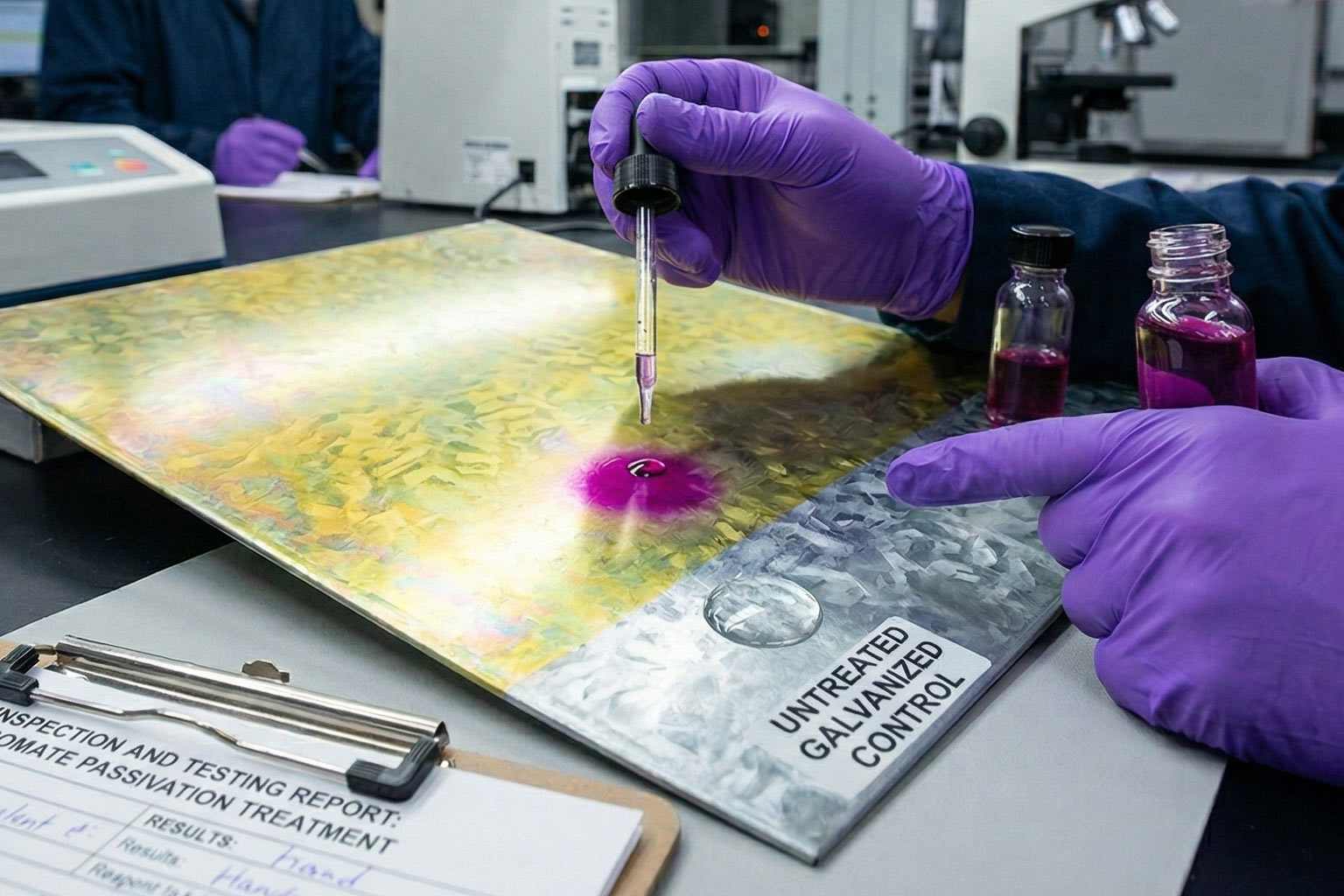
Galvanized steel coatings sometimes receive additional surface treatments after galvanizing to influence appearance or short term storage behavior. One of the most commonly discussed treatments is chromate passivation, which may be applied to zinc surfaces in certain manufacturing environments to reduce the formation of wet storage stain or to stabilize freshly coated surfaces during handling and transport.
In many projects, engineers, inspectors, or regulatory professionals may need to determine whether a galvanized component has received a chromate treatment. The American Galvanizers Association provides background on this topic here. This article expands on that discussion by explaining how chromate passivation works, how chromate testing is performed, and when testing may be required for galvanized steel components.
What Is Chromate Passivation
Chromate passivation is a surface treatment sometimes applied to zinc coatings to reduce early oxidation or discoloration. The treatment creates a thin conversion layer on the surface of the zinc coating.
Historically, chromate treatments have been used in some zinc coating processes to:
- Reduce the formation of white corrosion products during storage
- Improve cosmetic appearance immediately after coating
- Stabilize freshly applied zinc coatings during shipping
The treatment does not replace the corrosion protection provided by the zinc coating itself. Instead, it temporarily influences the surface chemistry of the coating.
Why Chromate Testing May Be Required
Chromate testing may be requested for several reasons.
Common situations include:
- Environmental compliance verification
- Project material certification
- Regulatory requirements regarding hexavalent chromium
- Quality assurance during manufacturing
Because certain chromate compounds contain hexavalent chromium, which is regulated in many industries, some projects require verification that chromate treatments are not present.
Testing helps confirm whether chromate passivation has been applied to a zinc surface.
Types of Chromate Compounds
Chromate treatments historically included compounds containing hexavalent chromium. Due to environmental and safety regulations, many industries have reduced or eliminated the use of hexavalent chromium treatments.
Chromate treatments may involve:
- Hexavalent chromium compounds
- Trivalent chromium compounds
- Alternative passivation technologies
Testing procedures may be used to detect the presence of these compounds on the zinc surface.
Chromate Detection Methods
Several analytical methods may be used to determine whether chromate compounds are present on a galvanized surface.
Testing approaches may include:
Chemical Spot Testing
Spot testing uses chemical reagents that react with chromium compounds to produce a visible color change.
These tests are commonly used for:
- Field inspection
- Preliminary verification
- Rapid screening of components
While convenient, spot testing typically provides qualitative results rather than precise concentration measurements.
Laboratory Analysis
More detailed laboratory testing may involve analytical methods such as:
- Spectroscopic analysis
- X-ray fluorescence testing
- Chemical extraction and laboratory evaluation
These methods provide more accurate identification and measurement of chromium compounds on the surface.
Chromate Treatments and Galvanized Steel
Chromate passivation is more commonly associated with electroplated zinc coatings or certain finishing processes. In batch hot dip galvanizing, chromate treatments are not typically required because the zinc coating itself provides durable corrosion protection.
Galvanized coatings produced through hot dip galvanizing rely on:
- Metallurgical bonding between zinc and steel
- Zinc sacrificial corrosion protection
- Formation of natural zinc patina over time
These mechanisms provide long term durability without requiring chromate surface treatments.
Environmental and Regulatory Considerations
Because hexavalent chromium compounds are regulated in many industries, chromate testing may be required in sectors such as:
- Transportation
- Consumer products
- Electronics manufacturing
- Government procurement
Compliance requirements may reference environmental regulations that restrict the presence of certain chromium compounds in finished materials.
Testing provides documentation that materials meet these requirements.
Inspection and Documentation
When chromate testing is required, documentation may include:
- Test results from laboratory analysis
- Certification from coating providers
- Material compliance reports
These records help verify that materials meet project specifications and regulatory requirements.
Inspectors and quality assurance teams may use testing as part of broader material verification procedures.
Technical Guidance for Galvanized Steel Applications
Understanding the role of surface treatments such as chromate passivation helps engineers and project teams evaluate compliance requirements and coating performance.
Hot dip galvanized coatings provide long term corrosion protection without relying on chromate treatments. When testing or certification is required for project documentation, technical coordination helps ensure appropriate evaluation methods are used.
If you have questions regarding galvanized coating specifications, inspection procedures, or environmental compliance considerations, our team can assist with technical review.
For project consultation or coating evaluation, please reach out through our contact page.
Early coordination helps ensure project specifications align with galvanizing processes and regulatory requirements.
Chromate testing is used to determine whether chromate passivation treatments are present on zinc coated surfaces. While chromate treatments were historically used in some finishing processes, hot dip galvanized coatings typically rely on the natural corrosion protection of zinc rather than additional passivation layers. Testing methods such as chemical spot testing or laboratory analysis help verify compliance with environmental and project requirements.
Frequently Asked Questions About Chromate Testing on Galvanized Steel
What is chromate passivation on zinc coatings?
Chromate passivation is a surface treatment that forms a thin conversion layer on zinc coatings to reduce early oxidation or discoloration during storage.
Why would galvanized steel be tested for chromate?
Testing may be required to verify compliance with environmental regulations or project specifications that restrict the presence of certain chromium compounds.
Does hot dip galvanizing normally include chromate treatments?
Hot dip galvanizing typically does not require chromate passivation because the zinc coating itself provides long term corrosion protection.
What testing methods detect chromate on zinc surfaces?
Common methods include chemical spot testing, laboratory spectroscopy, and analytical chemical testing.
Are chromate compounds regulated?
Yes. Certain chromate compounds, particularly those containing hexavalent chromium, are regulated in many industries due to environmental and health considerations.
Can chromate testing be performed in the field?
Yes. Chemical spot tests can be used for rapid field screening, although laboratory analysis may be required for precise verification.
Does chromate testing affect the galvanized coating?
Most testing methods are designed to evaluate the surface chemistry without significantly affecting the underlying zinc coating.
Why is chromate testing important for compliance?
Testing helps verify that materials meet environmental standards and project specifications related to chromium compounds.
