

When a fabricated steel component comes out of a galvanizing kettle, it rarely looks the way it will look a year or two later in service. New galvanized coatings can be shiny, spangled, dull gray, streaky, or uneven depending on steel chemistry, bath conditions, drainage patterns, and how the part was processed. Some of those initial appearances raise questions from architects, contractors, and project owners who expect a uniform finish. The honest answer is that most of those variations are cosmetic, temporary, and self-correcting given enough time outdoors.
The mechanism behind that change is the formation of the zinc patina, a tightly adhered layer of zinc carbonate and zinc hydroxide that develops on the coating surface as it reacts with moisture, oxygen, and carbon dioxide in the atmosphere. This patina is not just cosmetic. It is the primary reason galvanized steel performs so well over decades: the patina is chemically stable, poorly soluble in water, and acts as a barrier that sharply reduces the ongoing corrosion rate of the underlying zinc. As it forms, it also homogenizes the surface appearance, pulling visually disparate areas toward a common matte gray tone.
The American Galvanizers Association addresses this directly in their article on examples of natural weathering on HDG appearance. At V&S Galvanizing, we expand on that foundation to explain what is actually happening at the material level, how the weathering environment influences patina development, and why the initial appearance of a galvanized coating is so often misunderstood in the field.
Why Initial HDG Appearance Varies in the First Place
Hot-dip galvanizing produces a coating that is metallurgically bonded to the steel substrate. The outermost layer is relatively pure zinc, and its initial appearance depends heavily on how quickly that zinc solidifies after the part is withdrawn from the molten bath. Fast cooling, often promoted by quenching, tends to produce a shinier, more reflective surface. Slower cooling allows zinc crystals to grow larger, creating the visible spangle pattern that some galvanized surfaces show. Neither of those outcomes affects the thickness, adhesion, or protective quality of the coating.
Steel chemistry plays an equally significant role. High silicon or phosphorus content in the base steel accelerates the growth of iron-zinc alloy layers during galvanizing, which can produce a matte gray or dark gray appearance right out of the kettle. That coloration is not a defect. It reflects a thicker, denser alloy layer that in many environments actually provides superior corrosion resistance. The challenge is that it looks nothing like the bright coating on an adjacent piece of low-silicon steel, and without context, that visual difference gets flagged unnecessarily.
Processing variables like progressive dipping (used when a part is too long to fit in the kettle in a single immersion) introduce additional visible features. The overlap zone where the two dips meet receives a double coating of zinc and develops a darker, slightly raised line along its length. That line is structurally and chemically sound, but it stands out visually for months or years before weathering softens it.
The Jesup Bridge: A Decade of Progressive Dip Line Evolution
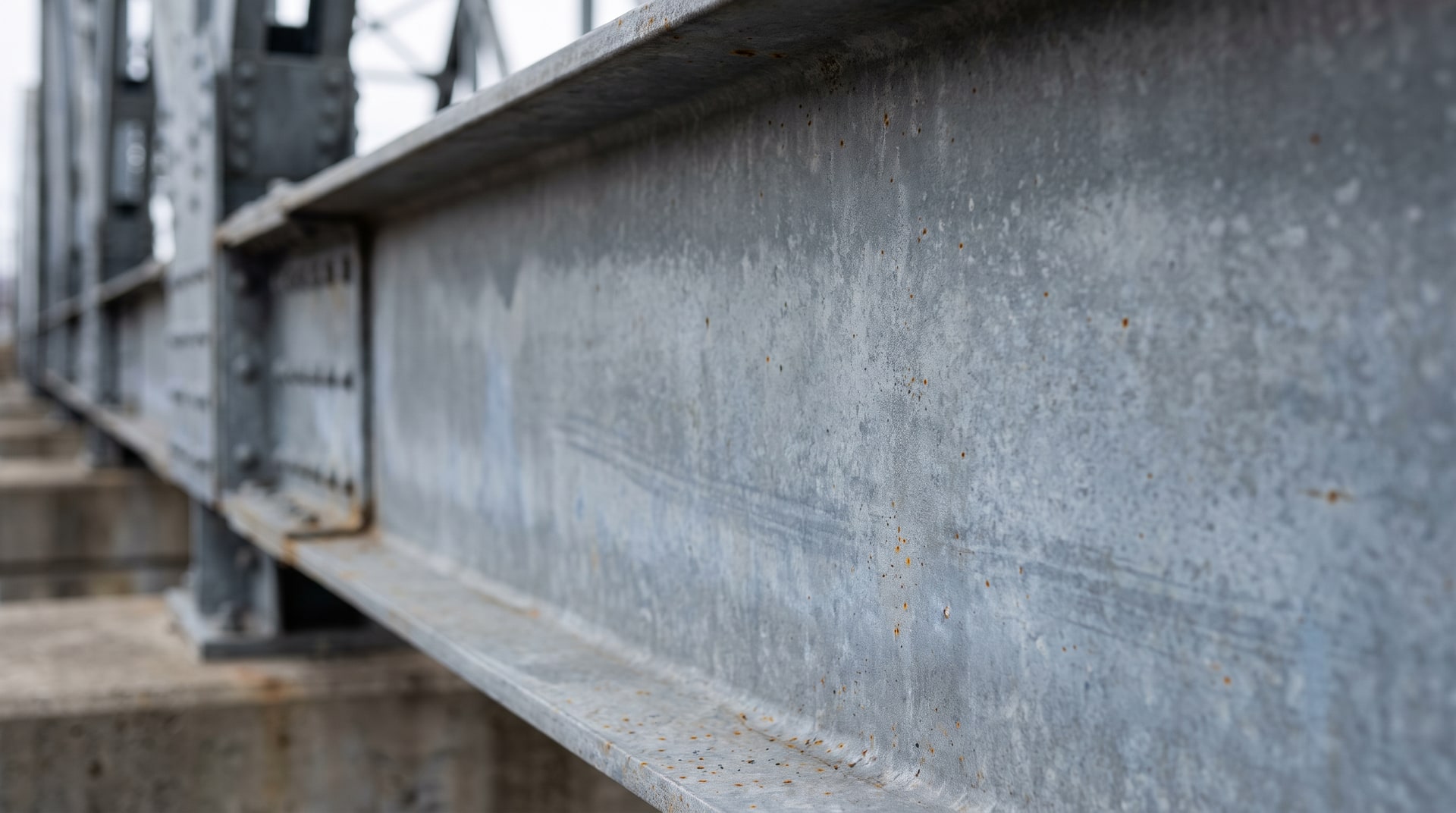
One of the most instructive long-term weathering records comes from the Jesup Bridge in Iowa, galvanized in 2014. The large beams required progressive dipping, and the resulting overlap lines were pronounced at installation: dark in color, slightly raised, and clearly distinct from the surrounding coating. Photographs taken at installation in autumn and winter 2013 show those lines in sharp relief against the brighter zinc surface around them.
Ten years later, in spring 2024, an AGA member returned to photograph the same beams. The progressive dip lines are still visible on close inspection, but the visual contrast between the overlap zone and the adjacent coating has been dramatically reduced. The entire beam surface has converged on a uniform matte gray, with the patina softening both the texture and the color differential that were so prominent at installation. The coating thickness in the overlap zone remains higher than the rest of the beam, which is a benefit rather than a liability, but the visual evidence of that extra zinc is now subtle.
This ten-year record is valuable because it puts a realistic timeline on the question engineers and project owners sometimes ask: how long does it take for appearance to normalize? In an open rural environment like a bridge crossing, a decade of natural weathering produces near-complete visual uniformity. In more urban or industrial environments where atmospheric carbon dioxide concentrations are higher, patina development can actually be faster.
Side-by-Side Weathering on Transmission Towers in Canada
A more controlled natural experiment was documented in Coteau-du-lac, Canada, where a newly galvanized transmission tower was installed directly adjacent to an existing tower that had been galvanized years earlier and had fully developed its zinc patina. The contrast photographed in December 2019 was stark: one tower bright and metallic, the other a uniform matte gray. The visual gap between the two was substantial enough that without knowing the context, an observer might have assumed they were different materials or coating types.
By March 2024, approximately four and a half years later, the same pair of towers was photographed again. The newly installed tower had weathered to a matte gray surface nearly indistinguishable from its older neighbor. The comparison illustrates two things clearly. First, the zinc patina that develops on hot-dip galvanized steel is consistent and predictable given comparable exposure conditions. Second, the initial appearance difference between a new and a weathered galvanized structure is entirely a function of time, not a reflection of any coating quality difference.
For project teams coordinating phased construction where new galvanized elements are added to an existing galvanized structure, this kind of before-and-after documentation is useful context to share with owners and architects who may notice the mismatch during the transition period.
Wet Storage Stain and Its Disappearance After Exposure
Wet storage stain is a common appearance issue that generates a disproportionate amount of concern relative to its actual impact on corrosion performance. It forms when galvanized steel is stored in conditions where moisture is present but air circulation is restricted, a common scenario in tightly bundled or stacked material stored under cover or wrapped in plastic. The moisture reacts with the zinc surface to produce zinc hydroxide, a bulky white-to-gray powder that is visually prominent and texturally rough.
The important technical distinction is that wet storage stain is a surface reaction that affects the outermost zinc layer rather than penetrating through the coating system. As long as the coating beneath the stain retains adequate thickness, the corrosion protection of the part is not meaningfully compromised.
The AGA documented a compelling example using two guardrail sections galvanized in the same batch on the same day. One section was stored with free-flowing air and remained bright and clean. The other was exposed to moisture without adequate airflow and developed wet storage stain, leaving it visually matte and powdery before installation. After both sections were installed and exposed to natural weathering, the appearance difference had largely resolved within about three months. More importantly, the corrosion protection of both sections was confirmed to be identical. That three-month convergence timeline is faster than most people expect and reflects the mechanism at work: once the wet storage stain is exposed to the open atmosphere, the stable zinc carbonate patina begins forming over it, and the powdery hydroxide gradually converts or is washed away.
Mixed Coating Appearances on Architectural Structures
The canopied walkway at Mark Twain Elementary School in Riverside, California, presents a different category of initial appearance variation: matte and shiny zones on the same structural beam following galvanizing. This kind of within-piece variation typically reflects local differences in steel surface condition, section thickness, or drainage geometry during the galvanizing process. It is cosmetically inconsistent but does not indicate any problem with coating integrity.
The school canopy was photographed at installation showing that mixed surface texture, with some beam faces clearly shinier than adjacent areas. After a few years of outdoor weathering in the California climate, the structure was revisited and the surface had normalized to a uniform matte gray across all elements. The patina development effectively averaged out the initial inconsistencies because the fundamental chemistry driving zinc oxidation and carbonate formation operates at a rate that is only weakly sensitive to whether the starting surface was shiny or matte.
For architects specifying galvanized steel in visible applications like canopies, handrails, or exposed structural elements, this kind of documented outcome is directly relevant. If the aesthetic target is a matte, low-reflectance finish, natural weathering will deliver that result without any additional treatment required. The timeline depends on the local climate and exposure, but convergence to a uniform gray is a predictable outcome, not a hopeful approximation.
When Repairs and Touch-Ups Weather Differently Than the Base Coating
Touch-up and repair of hot-dip galvanized steel introduces a nuance that the weathering examples above do not fully address. When a coating is damaged or when small areas require field repair after fabrication, the repair material is typically zinc-rich paint, zinc solder, or metallizing (thermal spray zinc). Each of those options behaves differently during weathering, and the long-term appearance outcome depends heavily on which one is used.
The pedestrian hand railing on the George Washington Bridge in Fort Lee, New Jersey, was repaired using a shiny zinc-rich paint matched to the appearance of the newly galvanized surrounding coating. That match looked reasonable at installation. But as the galvanized steel aged and its surface developed the stable matte gray zinc patina, the repaired areas did not follow the same path. Shiny zinc-rich paints generally do not weather or change appearance over time the way bare zinc does, because the zinc particles are encapsulated in an organic binder that prevents the direct atmospheric reactions that drive patina formation. The result, visible in photographs of the bridge railing, is a scatter of still-bright patches standing out against an otherwise uniform matte gray surface.
Matte gray zinc-rich paints perform better in this regard, as they tend to blend more naturally with a weathered galvanized surface over time. Repair methods that use actual zinc metal, specifically metallizing or zinc solder, will weather fully and develop a true zinc patina comparable to the surrounding hot-dip galvanized coating. For any application where long-term visual consistency matters, the choice of repair method is not just a performance question but an aesthetic one with consequences that play out over years.
This has practical implications for projects where hot-dip galvanized components may need field touch-up after handling or connection work. Specifying a matte zinc-rich paint at minimum, or preferring metallizing for larger repairs, will help the finished structure maintain a consistent appearance as the patina matures.
What Environments Accelerate or Slow Patina Development
The rate at which a zinc patina forms is not constant across all environments. The key drivers are moisture exposure, carbon dioxide availability, and the presence of airborne pollutants or salts. In urban and industrial environments, elevated CO2 and sulfur dioxide concentrations tend to accelerate zinc carbonate and zinc sulfate formation, which can actually speed up the transition from a bright or uneven initial appearance to a stable matte gray. In very clean, dry, rural environments, the process is slower simply because the chemical reactants are less concentrated.
Marine environments introduce chloride ions that can shift the patina chemistry toward zinc chloride compounds, which are somewhat less stable and more soluble than zinc carbonate. In those settings, the patina still forms and still provides meaningful protection, but the surface chemistry differs and the appearance can be slightly different in tone compared to inland exposures.
What does not meaningfully vary is the end state: given time and open atmospheric exposure, the zinc surface will reach a stable patina. The question is only how long that takes, which ranges from a few months in reactive urban conditions to a few years in clean, dry climates. Understanding this helps set realistic expectations for project stakeholders who notice variation in a newly installed structure and want to know when it will look the way they expect.
It is also worth noting that for any application governed by appearance standards, aesthetics alone are not sufficient grounds for rejecting a hot-dip galvanized coating. Performance criteria, specifically coating thickness and adhesion, are the governing acceptance parameters. The appearance will resolve with weathering; the protection is present from day one.
Work With a Team That Understands What You Are Looking At
Appearance variation on new hot-dip galvanized steel is not a signal that something went wrong. It is a normal consequence of the chemistry and physics involved in metallurgical bonding of zinc to steel, and the real-world documentation gathered over years by the AGA and its members confirms that natural weathering resolves the vast majority of those initial discrepancies. The zinc patina that develops is not incidental to the coating system, it is the mechanism that makes the system durable.
Understanding that process matters for everyone involved in specifying, procuring, installing, and inspecting galvanized steel. It informs decisions about storage, repair material selection, communication with project owners, and reasonable timelines for aesthetic normalization. When you see a progressive dip line, a patch of wet storage stain, or a mixed matte-and-shiny beam, the question to ask is not whether something failed, but what the coating looks like after a season of outdoor exposure.
Our team has direct experience working through appearance questions with engineers, architects, and contractors across a wide range of project types. If you have questions about a specific coating appearance or want guidance before or after galvanizing, reach out through our contact page and we will work through it with you.
