

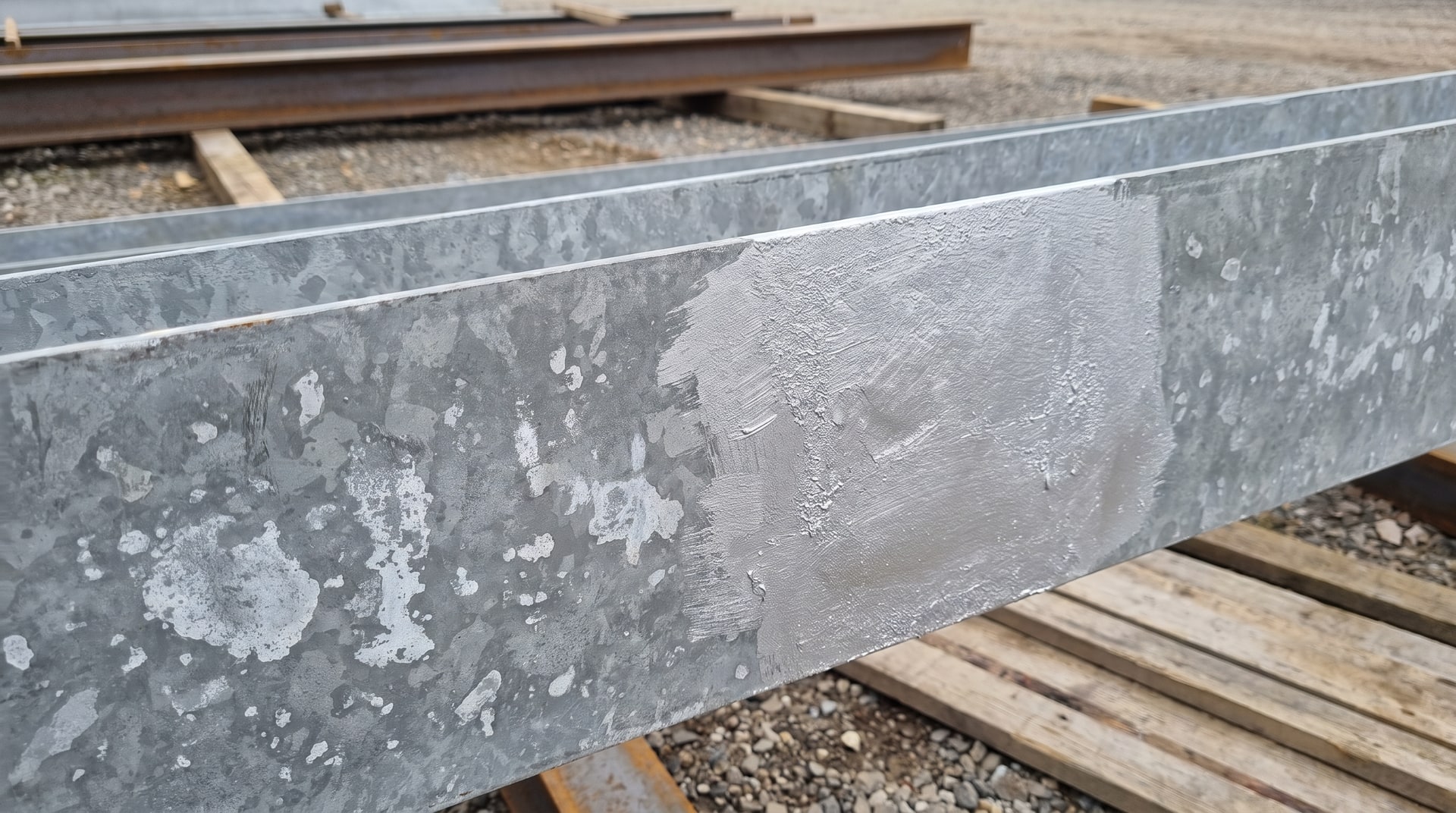
There is a moment that catches a lot of project teams off guard. The steel arrives on site looking bright, spangled, and silvery. Then, a few months into service, that same steel has shifted to a flat, uniform gray. And if a repair was made somewhere along the way using the wrong material, that repair now stands out like a patch on a faded jacket. The aesthetic mismatch was avoidable. Understanding how zinc weathers, and choosing repair materials with that weathering behavior in mind, is the difference between a finished project that looks intentional and one that looks inconsistent.
The American Galvanizers Association addresses this directly in their article on natural weathering and zinc repairs. At V&S Galvanizing, we expand on that foundation to explain what is actually happening at the material level, how repair material selection influences long-term appearance, and why the relationship between weathering rate and repair color is so frequently misunderstood in the field.
What Is Actually Happening When Galvanized Steel Weathers
Fresh hot-dip galvanized steel has a metallic, reflective appearance that many people associate with the process itself. That bright surface is the outer zinc layer, and it is chemically reactive the moment it is exposed to the atmosphere. What follows is a progressive, well-understood sequence of surface chemistry.
In the first days and weeks of outdoor exposure, zinc reacts with atmospheric oxygen and moisture to form zinc oxide and zinc hydroxide. These compounds are white or pale gray and give early-stage weathered galvanizing a dull, slightly chalky character. Over the following months, carbon dioxide in the atmosphere converts those compounds into zinc carbonate, which is the stable, adherent, dark gray patina that most people recognize on aged galvanized steel.
That zinc carbonate layer is not a sign of deterioration. It is actually a protective barrier. It is chemically stable, tightly bonded to the underlying zinc, and significantly less soluble in rainfall than the earlier zinc oxide phase. The formation of this carbonate patina is precisely why galvanized steel in outdoor environments performs so well over long service lives. The surface is not just sitting there passively. It is building its own additional defense over time.
The AGA source notes that this full weathering transition typically takes between 6 months and 2 years depending on environment. Industrial or coastal atmospheres with more reactive chemistry tend to accelerate the process. Sheltered or rural environments, where rainfall runoff and humidity cycles are less frequent, may extend the timeline toward the longer end of that range.
Why Appearance Changes Matter More Than People Expect
For purely structural applications, the weathering sequence described above is mostly invisible. The steel performs, the zinc protects, and no one spends much time scrutinizing the surface color. But for architectural and infrastructure projects where aesthetics are part of the specification, the weathering timeline becomes a design consideration.
Architects and specifiers increasingly use exposed galvanized steel as a finished surface material. In those contexts, the expectation is often that the steel will eventually arrive at a consistent, matte gray appearance. The problem arises when repair materials are introduced partway through that process, and those materials do not weather on the same timeline or toward the same color endpoint as the base galvanizing.
This is not a minor cosmetic issue on high-visibility projects. A repaired area that permanently remains a different shade from the surrounding surface creates a visible artifact that reads as a flaw, even if the underlying corrosion protection is perfectly sound. The structural engineer may be satisfied. The architect may not be.
When Repairs Are Necessary and What ASTM A780 Governs
Hot-dip galvanized coatings are highly abrasion resistant, but they are not immune to damage. Coating damage most commonly occurs after the steel leaves the galvanizing facility, typically from rough handling during transport, aggressive installation techniques, field welding performed after galvanizing, or in-service impacts. Any of these can expose bare steel, and bare steel in a corrosive environment will begin to rust.
ASTM A780, Practice for Repair of Damaged and Uncoated Areas of Hot-Dip Galvanized Coatings, is the governing standard for this work. It recognizes three distinct repair material categories: zinc-rich paint, zinc-based solder, and zinc-spray metallizing. Each has different application requirements, cost profiles, and appearance characteristics. The standard acknowledges that touch-up materials will not be an exact color match to the base galvanizing, and explicitly states that appearance differences resulting from repair work are acceptable and not grounds for rejection.
That last point is important. The standard is not demanding visual perfection. What it is requiring is that the repair material provides zinc-based protection to the exposed steel. Appearance is a secondary consideration from a specification standpoint, but that does not mean it is irrelevant on projects where it matters.
Zinc-Based Solder and Zinc-Spray Metallizing: The Closer Visual Match
Of the three repair methods recognized by ASTM A780, zinc-based solder and zinc-spray metallizing most closely replicate the appearance of the base hot-dip galvanized coating at the time of repair. Both materials are predominantly zinc, applied at metallic zinc densities that produce a surface reflectance and texture reasonably similar to the freshly galvanized surrounding steel.
More importantly, both materials weather in a manner similar to the base galvanizing. Because they are essentially applying metallic zinc to the surface, the same atmospheric chemistry that converts the surrounding coating to zinc carbonate will act on the repair area in parallel. The result, over the 6-to-24-month weathering window, is a fairly cohesive transition to matte gray across the entire surface.
The tradeoff is practical. Zinc-based solder requires a heat source and direct contact application, which limits its use to relatively small damaged areas and to situations where heat application is safe. Zinc-spray metallizing requires specialized equipment and trained applicators, which affects both cost and field accessibility. These constraints have to be weighed against the aesthetic benefit, particularly for large-scale repairs or projects in remote locations.
Zinc-Rich Paint: Choosing the Right Color for Long-Term Uniformity
Zinc-rich paint is the most commonly used repair material because it is easy to apply, widely available, and cost-effective for field use. It comes in aerosol, brush-applied, and spray-applied formats, making it practical across a wide range of repair scenarios. The challenge is that zinc-rich paint does not weather the same way metallic zinc does, and its initial appearance depends heavily on the formulation chosen.
There are two broad appearance categories in zinc-rich repair paints: bright or shiny formulations, and matte gray or weathered-color formulations. The distinction is consequential.
If a matte gray zinc-rich paint is used for repairs, the initial result will look like a patch of gray paint against a shinier surrounding coating. That can look mismatched at first. But the base galvanizing is still in the process of weathering toward matte gray. Within the 6-to-24-month window, the surrounding zinc surface catches up in appearance, and the overall result becomes visually cohesive. The repair does not disappear, but it blends into a uniform matte surface. This is the approach the AGA recommends when aesthetics are a primary concern and zinc-rich paint is the chosen repair method.
Bright or shiny zinc-rich paints are a different story. A shiny repair paint may look like a reasonable match to freshly galvanized steel immediately after application. But it will not weather in color the way the surrounding zinc does. As the base galvanizing darkens and flattens over time, the shiny repair area remains light and reflective. The contrast actually increases rather than decreases. The AGA source is direct about this: bright zinc-rich paint will result in a permanent mixed appearance once the surrounding coating weathers.
There is one scenario where a different approach applies. If the goal is to color-match the repair to freshly galvanized, bright steel rather than to the eventual weathered gray surface, the AGA notes that top-coating the repaired area with aluminum or bright spray-applied paint can achieve a visual match to new galvanizing. This is a niche application but worth knowing about for specific aesthetic requirements.
How Environment Affects the Weathering Timeline
The 6-to-24-month range for full patina development is not a fixed schedule. Local environmental conditions drive the pace considerably. In coastal environments, the combination of salt-laden air and frequent moisture cycling accelerates the zinc carbonate formation process. Industrial atmospheres with elevated sulfur dioxide concentrations similarly push the weathering forward faster than cleaner air environments.
By contrast, galvanized steel installed in sheltered or semi-enclosed conditions, such as covered bridges, parking structures, or interior-use steel with limited outdoor exposure, may take longer to develop the full matte gray patina. Rainfall is actually a significant factor: zinc requires periodic wetting and drying cycles to progress through the oxide and hydroxide phases into stable carbonate. Steel that stays dry for extended periods will weather more slowly.
This variability matters for repair planning. If a project is in an aggressive coastal environment, a matte gray paint repair made during installation may be indistinguishable from the surrounding surface within 6 months. The same repair on a sheltered rural structure might remain visually distinct for closer to 2 years. Understanding the likely exposure class for a given project helps set realistic expectations about how long any appearance mismatch will persist.
Matching Repair Strategy to Project Requirements
Not every project needs the same approach to repair. A structural support member buried in a utility corridor has different requirements than an exposed architectural feature on a pedestrian bridge. Our team at V&S Galvanizing regularly works with engineers, fabricators, and architects to think through these distinctions before damage occurs, not after.
For projects where corrosion protection is the sole criterion, zinc-rich paint in any color provides the required zinc barrier to protect exposed steel, and the appearance question is secondary. For projects with visibility requirements or architectural finish specifications, the repair material decision deserves the same deliberate attention as the original coating specification.
If welding after galvanizing is planned as part of the fabrication or erection sequence, that should be identified in advance so the repair strategy can be incorporated into the project workflow. Field welding is one of the most common sources of coating damage, and planning for it means having the right repair materials on site, applied by personnel who understand the weathering implications of their choices.
The AGA maintains an updated list of HDG repair material suppliers that includes both shiny and matte/weathered-color zinc-rich paint options. Reviewing that list before purchasing repair materials is worth the time, particularly for projects where appearance matters.
Work With a Team That Understands the Full Lifecycle of the Coating
The galvanized coating does not stop evolving the day the steel leaves the kettle. It continues to develop, stabilize, and ultimately form a durable zinc carbonate patina that will serve the steel for decades. Repair decisions made at installation have consequences that play out over that entire weathering period, and the wrong choice at that stage can create an appearance problem that cannot be corrected without recoating the entire surface.
At V&S Galvanizing, we work with project teams throughout the specification and post-galvanizing phases to help them understand what to expect from the coating over time and how to manage repairs in a way that supports both corrosion performance and long-term aesthetics. If your project involves hot-dip galvanizing and you have questions about repair strategies, weathering expectations, or material selection, we are glad to work through those details with you. Reach out through our contact page and our technical team will follow up promptly.
Frequently Asked Questions About HDG Weathering and Zinc Repairs
How long does it take for hot-dip galvanized steel to weather to a matte gray color?
The full transition from a bright, spangled surface to a stable matte gray zinc carbonate patina typically takes 6 months to 2 years, depending on the environment. Coastal and industrial atmospheres with higher moisture and reactive chemistry accelerate the process, while sheltered or rural environments with less frequent wetting cycles extend it toward the longer end of that range.
What repair materials are recognized by ASTM A780 for hot-dip galvanized coatings?
ASTM A780 recognizes three repair material types: zinc-rich paint, zinc-based solder, and zinc-spray metallizing. Each has different application methods, costs, and appearance characteristics. All three provide zinc-based protection to exposed steel areas, but they differ significantly in how closely they match the base galvanizing visually and how they weather over time.
Will a zinc-rich paint repair ever match the surrounding galvanized coating in appearance?
It depends on which type of zinc-rich paint is used. A matte gray or weathered-color zinc-rich paint will initially look different from the surrounding bright galvanizing, but as the base coating weathers to matte gray over 6 to 24 months, the two surfaces converge in appearance. A bright or shiny zinc-rich paint, however, will not weather the same way and will produce a permanent appearance mismatch as the surrounding zinc darkens and flattens.
Why does bright zinc-rich paint create a permanent mismatch while matte gray paint does not?
Bright zinc-rich paint retains its light, reflective appearance over time because the paint binder and pigment system does not undergo the same atmospheric chemistry as metallic zinc. The surrounding hot-dip galvanized surface progressively converts to dark zinc carbonate, increasing the contrast with the still-bright repair. Matte gray paint is already at approximately the same color endpoint the base galvanizing is heading toward, so the gap narrows as weathering progresses.
When is zinc-spray metallizing preferred over zinc-rich paint for HDG repairs?
Zinc-spray metallizing is preferred when the closest visual and weathering match to the base hot-dip galvanized coating is required, and when the application conditions and budget allow for it. Because the deposited material is metallic zinc, it weathers on essentially the same timeline as the surrounding coating. The limitation is that it requires specialized equipment and trained applicators, which makes it less practical for most field repair situations compared to zinc-rich paint.
Is an appearance difference between a repair area and the base galvanizing a cause for rejection?
No. ASTM A780 explicitly states that differences in appearance resulting from the use of touch-up materials are acceptable and do not constitute grounds for rejection. The standard focuses on the corrosion protection function of the repair, not on achieving a perfect visual match. That said, for projects where aesthetics are specified as a requirement, repair material selection should be addressed deliberately in the project planning stage.
What causes hot-dip galvanized coatings to need repair in the first place?
The most common causes of coating damage after galvanizing are rough handling during transport or storage, aggressive installation techniques, and welding performed on the steel after galvanizing. In-service impacts or abrasion can also create bare spots. Any of these exposures can remove zinc from localized areas, leaving bare steel that requires repair to restore corrosion protection and maintain coating continuity.
Can aluminum or other spray paints be used to match the appearance of newly galvanized steel at a repair location?
Yes. The AGA notes that top-coating a repaired area with aluminum or bright spray-applied paint products can be used to visually match freshly galvanized steel when that specific aesthetic is required. This approach is appropriate for situations where the goal is to blend the repair into new, bright galvanizing rather than into the eventual weathered matte gray surface the coating will develop over time.
