

When hot-dip galvanized steel leaves the kettle, the zinc surface is chemically active. That reactivity is by design in the sense that the metallurgical bond has just formed and the outer zinc layer is still relatively pure. But that same reactivity creates a practical problem: freshly galvanized zinc will react with atmospheric moisture very quickly, sometimes forming a white powdery corrosion product called wet storage stain before the steel ever reaches its intended application. To slow that initial reactivity and extend shelf life, galvanizers apply a passivation treatment, most commonly a chromate conversion coating, to the zinc surface before the material ships.
What is less understood in the field is how you actually verify that the passivation treatment is present, and more importantly, what it means when it is not. The American Galvanizers Association addresses this directly in their article on passivation testing. At V&S Galvanizing, we expand on that foundation to explain what is actually happening at the material level, how chromate chemistry influences performance, and why this is often misunderstood in the field.
Why Zinc Needs Passivation in the First Place
Zinc is a highly reactive metal when compared to the iron it protects, and that electrochemical activity is precisely what makes it effective as a sacrificial coating. In long-term atmospheric exposure, the zinc surface stabilizes by developing a tightly adherent zinc carbonate patina, commonly referred to as the zinc patina. That patina dramatically reduces the corrosion rate and is responsible for the decades-long service life we associate with hot-dip galvanized steel.
The challenge arises in the period between galvanizing and full atmospheric exposure. If freshly galvanized steel is stored in humid or wet conditions before that patina can form, the zinc reacts with moisture and carbon dioxide in a way that produces loose, chalky zinc hydroxide rather than the durable carbonate layer. This is wet storage stain, and while it does not typically compromise long-term corrosion protection in a structural sense, it can cause surface appearance issues and is sometimes misread by inspectors as a defect.
Passivation by chromate conversion coating changes the surface chemistry of the zinc temporarily. The chromate reacts with the outer zinc layer to form a thin conversion coating that slows the oxidation rate and suppresses the conditions that lead to wet storage stain. It is a bridge treatment, not a permanent protective layer, but it serves a real and measurable purpose during transit and storage.
The Chemistry Behind the Lead Acetate Test
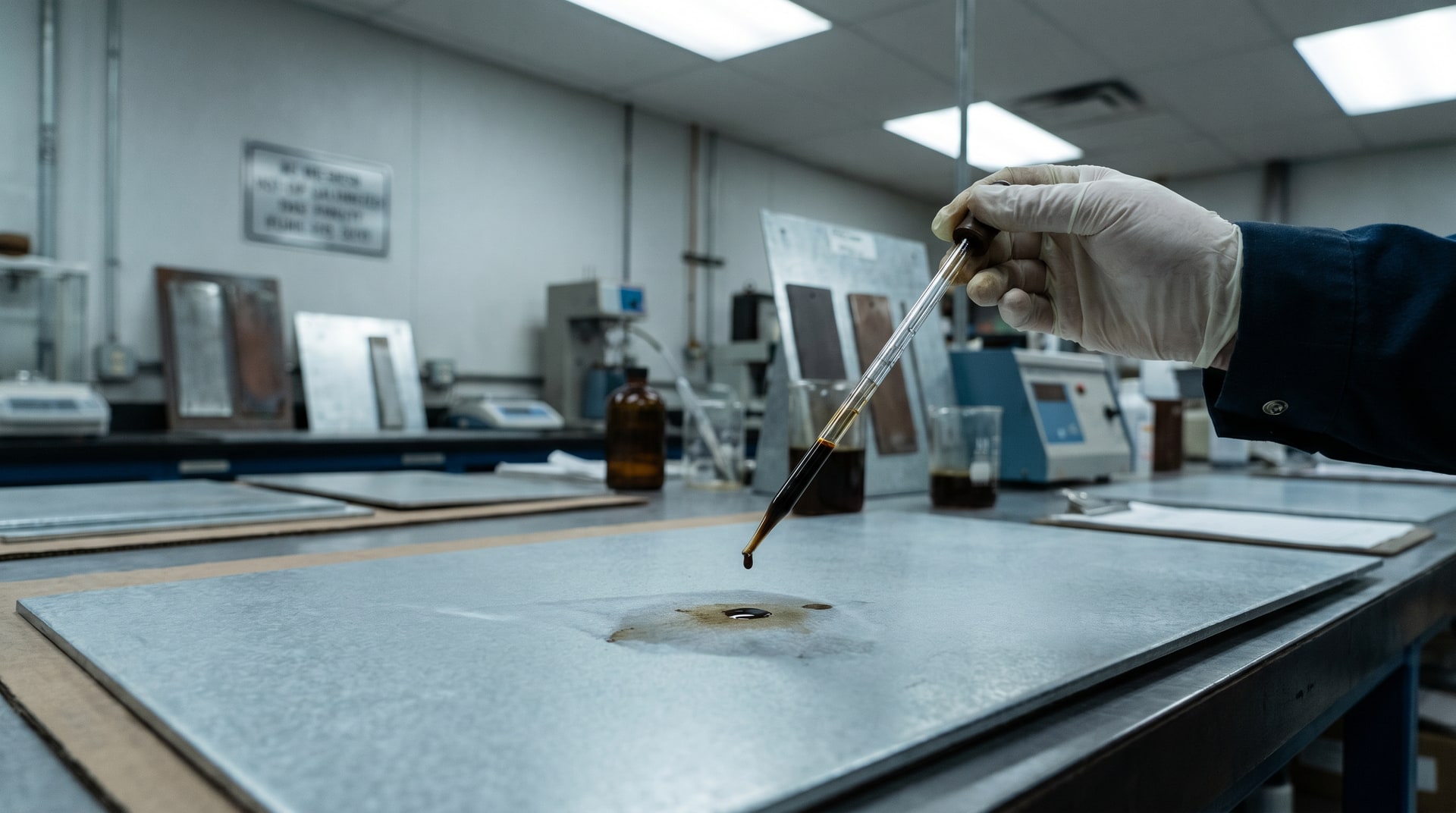
ASTM B201 is the governing specification for determining whether a chromate passivation coating is present on a zinc surface. The test itself is remarkably direct: a small drop of lead acetate solution is placed on the zinc surface, allowed to sit undisturbed for five seconds, and then gently blotted away.
The interpretation is equally clear. If the area beneath the drop shows a dark deposit or black stain after blotting, the test result is positive for unpassivated zinc. If the surface remains clear with no discoloration, chromate passivation is confirmed to be present.
The mechanism behind this test hinges on the chemistry of zinc in its unpassivated state. Bare, active zinc reacts with lead acetate in aqueous solution through a displacement reaction. Zinc, being more electrochemically active than lead, displaces the lead ions from solution, depositing metallic lead on the surface. That metallic lead deposit is what appears as the dark or black stain. It is not contamination from the reagent alone but a visible indicator of electrochemical activity at the zinc surface.
When chromate passivation is present, the conversion coating creates a physical and chemical barrier that suppresses this displacement reaction. The lead acetate solution cannot readily access the zinc surface, the displacement does not occur to any visible degree, and the result is a clear surface after blotting.
Reading the Test Result Correctly
One of the more common errors we see in practice involves misinterpreting what a positive result actually means. A dark stain from the lead acetate test tells you that unpassivated zinc is present at that location. It does not tell you that the galvanized coating itself is defective or that corrosion protection is compromised. The underlying zinc is doing exactly what it is supposed to do chemically. The absence of passivation simply means the protective conversion coating either was not applied, was applied inconsistently, or has worn off at that spot.
Equally important is understanding what a clear result confirms. A clean result indicates the presence of a chromate passivation coating at the test location. It is a surface-specific result, not a blanket certification of the entire part. For quality control purposes, it is standard practice to test multiple locations across a piece, particularly in areas most likely to see moisture accumulation during storage such as recesses, lap joints, and areas shielded from air circulation.
The test is also a point-in-time measurement. Chromate passivation is not permanent. Over time, particularly with UV exposure, abrasion, or repeated wetting and drying, the chromate layer degrades. A galvanized piece that passed ASTM B201 testing immediately after production may not pass the same test months later after outdoor exposure. That is expected behavior and not a cause for concern regarding the galvanized coating's long-term performance.
Where This Test Fits in the Broader Inspection Process
Passivation testing with ASTM B201 is one part of a broader quality control framework for hot-dip galvanized steel. It is not a substitute for coating thickness measurement under ASTM A123, adhesion assessment, or visual inspection for bare spots, flux inclusions, or drainage issues. Each of these tests addresses a different characteristic of the galvanized coating, and passivation testing specifically addresses only the surface treatment layer applied after galvanizing is complete.
In a production environment, passivation testing is typically used at two points. The first is during post-production quality control, where it confirms that chromate treatment was applied uniformly before the product ships. The second is upon receipt of material, where contractors or fabricators can verify the passivation status of material that has been in transit or storage for an extended period.
It is also worth noting that ASTM B201 applies to zinc surfaces broadly, not exclusively to hot-dip galvanized coatings. The same test methodology applies to electroplated zinc, mechanically applied zinc coatings, and zinc die castings. The underlying chemistry is consistent across zinc surfaces regardless of how the zinc was applied.
Practical Considerations for Contractors and Fabricators
From a handling standpoint, passivation testing is valuable in any scenario where galvanized steel has been stored under conditions that could lead to wet storage stain. If a delivery arrives and there is visible white powdery residue on the zinc surface, ASTM B201 testing can help determine whether the passivation coating was absent at the time of storage or has simply degraded during the storage period.
For structural steel that will be painted over the galvanized coating as part of a duplex system, passivation status becomes particularly relevant. Chromate passivation coatings, while thin, can interfere with the adhesion of certain paint systems. In those applications, the specification may actually call for the absence of passivation, or for a specific surface preparation step prior to painting. Knowing the passivation status of the substrate allows the applicator to make an informed decision about surface preparation requirements.
Similarly, if galvanized steel will be welded after delivery, any chromate passivation in the weld zone should be considered. The quantities involved are typically small, but specifying passivation status as part of the procurement process is a reasonable step in projects with tight environmental or safety controls for fume management.
Misconceptions About Chromate and Long-Term Corrosion Resistance
A persistent misconception in the field is that chromate passivation adds meaningfully to the long-term corrosion protection of galvanized steel. It does not. The zinc coating itself, metallurgically bonded to the steel substrate and measured in accordance with ASTM A123, is what provides decades of corrosion protection. The chromate layer is a temporary bridge treatment designed solely to manage surface reactivity during storage and transit.
Once galvanized steel is installed and exposed to the atmosphere, the zinc patina begins to form naturally. That patina ultimately provides far more durable surface stability than any passivation treatment. The chromate layer will degrade over a relatively short period of outdoor exposure without any negative consequence to the coating's long-term performance.
This distinction matters because it prevents over-reliance on passivation status as a performance indicator. A piece of galvanized steel with no detectable chromate passivation is not a defective piece. It is simply a piece that requires careful storage conditions to prevent wet storage stain until installation, or one where passivation has naturally degraded after installation without any structural consequence.
Applying the Test in the Field Without Laboratory Equipment
One of the practical advantages of ASTM B201 is that it does not require laboratory infrastructure. Lead acetate solution is the only reagent needed, and the test can be conducted in a shop, at a job site, or at a receiving dock. The simplicity of the test, drop, wait five seconds, blot, read, means that trained inspectors or quality control personnel can execute it consistently without specialized equipment beyond a timer and blotting material.
That said, the handling and disposal of lead acetate solution requires appropriate precautions. Lead is a regulated substance, and even dilute solutions must be managed in accordance with applicable environmental regulations. Personnel performing the test should use appropriate gloves and eye protection, and disposal should follow site-specific or facility-specific protocols for lead-containing waste.
Consistency in test execution also matters. The five-second dwell time specified in ASTM B201 is not arbitrary. Too short a dwell time may fail to detect marginal passivation, while a significantly extended dwell time could produce a false positive result even on a well-passivated surface. Using a standardized procedure and consistent technique across multiple test locations gives the most reliable and repeatable results.
Work With a Team That Understands the Full Galvanizing Picture
Passivation testing is a deceptively simple procedure that answers a very specific question: is chromate present on this zinc surface at this location? When interpreted correctly in context with the rest of the inspection process, it is a useful quality control tool that protects both the galvanizer and the customer. Where it becomes problematic is when it is treated as a stand-alone metric for coating quality or long-term corrosion performance, which it is not designed to assess.
Understanding what each test measures, what it does not measure, and how to integrate results across the full inspection framework is the kind of technical knowledge that prevents misunderstandings in the field and supports better project outcomes. At V&S Galvanizing, our team applies that same approach to every aspect of the work we do, from kettle chemistry to post-production treatment to documentation.
If you have questions about passivation testing, inspection requirements for your project, or anything related to hot-dip galvanized coatings, reach out through our contact page and we will be glad to help.
Frequently Asked Questions About Passivation Testing
What specification governs passivation testing on zinc surfaces?
ASTM B201 is the specification that governs the testing method used to determine whether a chromate passivation coating is present on zinc surfaces. The test uses a lead acetate solution applied directly to the zinc surface.
How exactly is the ASTM B201 test performed?
Drops of lead acetate solution are placed on the zinc surface and allowed to sit for five seconds. The solution is then gently blotted away. A dark or black deposit indicates unpassivated zinc is present. A clear result confirms the presence of a chromate passivation coating.
What causes the black stain in a positive test result?
The black stain is metallic lead deposited on the zinc surface through an electrochemical displacement reaction. Zinc, being more active than lead, displaces lead ions from the acetate solution. When chromate passivation is present, this reaction is suppressed and no deposit forms.
Does a failed passivation test mean the galvanized coating is defective?
No. A positive result for unpassivated zinc means the chromate surface treatment is absent at that location, not that the galvanized coating itself is defective. The zinc coating's structural and corrosion-protective properties are not assessed by ASTM B201.
Is chromate passivation permanent on galvanized steel?
No. Chromate passivation is a temporary surface treatment designed to manage reactivity during transit and storage. It degrades with UV exposure, abrasion, and weathering. Once galvanized steel is installed and the zinc patina develops naturally, the passivation layer is no longer relevant to corrosion performance.
Does passivation status matter when painting over galvanized steel?
It can. Certain paint systems may have adhesion issues over chromate-passivated surfaces. In duplex coating applications, the specification may require confirmation of passivation status or a surface preparation step to address it before topcoating. Knowing the passivation status of the substrate lets the applicator plan accordingly.
Can ASTM B201 be performed in the field without a laboratory?
Yes. The test only requires lead acetate solution, a timer, and blotting material. It can be performed at a job site, in a shop, or at a receiving dock. Personnel should use appropriate protective equipment and follow applicable regulations for handling and disposing of lead-containing solutions.
Does ASTM B201 apply only to hot-dip galvanized coatings?
No. ASTM B201 applies to zinc surfaces generally, including electroplated zinc, mechanically applied zinc, and zinc die castings. The lead acetate displacement reaction occurs on any unpassivated zinc surface regardless of how the zinc coating was applied.
