
Not all zinc coatings perform the same, and choosing the wrong system can lead to premature corrosion, unnecessary maintenance, or over-engineering a project. The challenge is that many coating types appear similar on the surface but behave very differently once exposed to real-world conditions.
The American Galvanizers Association addresses this directly in their zinc coatings and applications chart article. At V&S Galvanizing, we expand on that foundation to explain how each coating system actually performs, how thickness and application method influence durability, and how to match the coating to the environment rather than defaulting to a one-size-fits-all solution.
Why All Zinc Coatings Are Not Equivalent
Zinc is used in multiple coating systems because of its ability to protect steel through sacrificial corrosion. However, the way zinc is applied fundamentally changes how it performs.
Some coatings are applied as thin, uniform layers through electrochemical processes. Others, like hot dip galvanizing, create a metallurgically bonded coating that is significantly thicker and more durable.
The difference is not just in application. It is in how long the coating can survive in a given environment before the zinc is consumed.
This is why comparing coatings based on material alone is misleading. The method of application determines the outcome.
Thickness Is the Primary Driver of Service Life
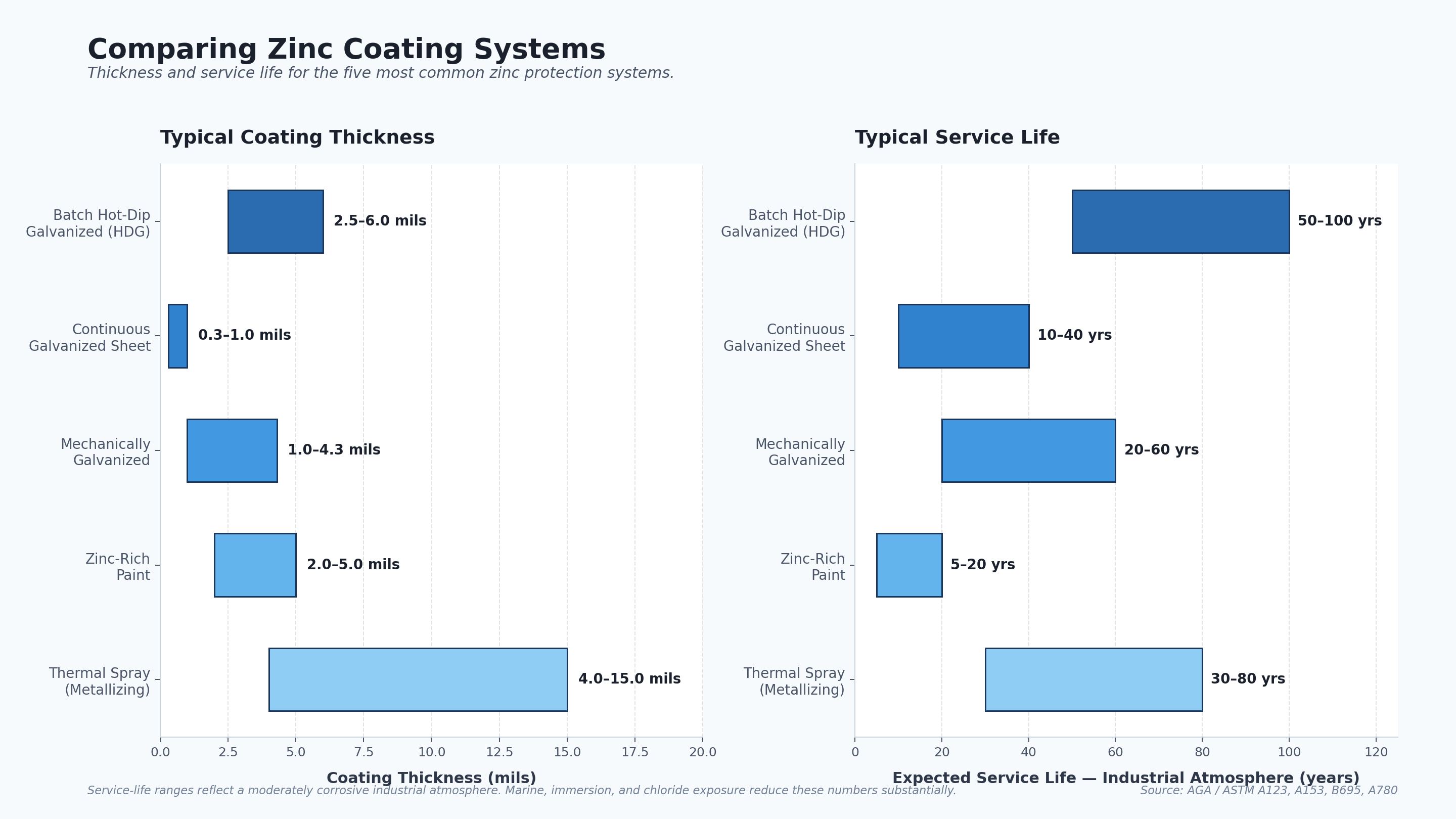
When evaluating zinc coatings, thickness is the most important variable. Corrosion protection is directly tied to how much zinc is available to be consumed over time.
Thinner coatings, such as zinc plating, are often measured in microns and are designed for controlled indoor environments. They provide a clean, uniform finish but have limited lifespan in aggressive conditions.
Thicker systems, such as hot dip galvanizing or thermal spray metallizing, provide significantly more zinc. This allows them to withstand outdoor exposure, moisture, and contaminants for much longer periods.
The key insight is simple but often overlooked. Coating life is proportional to coating thickness, assuming similar environmental exposure.
How Application Method Changes Performance
Beyond thickness, the method of application determines how well the coating adheres and how it behaves when damaged.
Electroplated coatings rely primarily on adhesion to the surface. If the coating is scratched, corrosion can begin at the exposed area and may spread.
Hot dip galvanizing forms a bonded alloy layer that becomes part of the steel itself. When damaged, the surrounding zinc continues to protect the exposed area through galvanic action.
Thermal spray coatings fall somewhere in between, offering thicker protection but without the same metallurgical bond.
This difference becomes critical in applications where abrasion, impact, or long-term exposure is expected.
Matching Coating Type to Environment
The most effective way to choose a zinc coating is to start with the environment, not the material preference.
Indoor, dry environments place minimal demand on coatings. In these cases, thinner systems may perform adequately and offer cost advantages.
Outdoor environments introduce moisture and atmospheric contaminants, which require more robust protection.
Marine, industrial, or deicing environments significantly increase corrosion rates. In these conditions, thicker coatings or duplex systems become necessary to achieve acceptable service life.
The mistake is not choosing a weaker coating. It is choosing a coating that does not match the exposure conditions.
Where Hot Dip Galvanizing Fits in the Spectrum
Hot dip galvanizing occupies a unique position among zinc coatings because it combines thickness, full coverage, and galvanic protection.
It is particularly well suited for:
- Structural components
- Infrastructure
- Outdoor and exposed applications
- Complex geometries requiring full coverage
Because the coating is applied by immersion, it protects internal surfaces, edges, and hard-to-reach areas that other systems may miss.
This makes it one of the most reliable options for long-term corrosion protection where maintenance is difficult or costly.
When Other Zinc Coatings Make More Sense
There are applications where galvanizing may not be the optimal solution.
Precision components with tight tolerances may require thinner coatings. Aesthetic requirements may favor smoother, more uniform finishes. Certain assemblies may not be compatible with immersion processes.
In these cases, electroplating or mechanical coatings may be more appropriate, even if they offer shorter service life.
The goal is not to default to galvanizing. It is to select the coating that aligns with the performance requirements of the application.
Why This Decision Impacts Long-Term Cost
Coating selection is not just a technical decision. It is a lifecycle decision.
A thinner coating may reduce upfront cost but require earlier replacement or maintenance. A thicker coating may increase initial cost but eliminate maintenance for decades.
When evaluated over the life of the asset, the difference in total cost can be significant.
This is why the best coating choice is not the cheapest or the most robust. It is the one that aligns with the expected service life and exposure conditions.
Work With a Team That Matches Coating to Performance
Choosing a zinc coating is not about picking from a chart. It is about understanding how each option behaves once it is installed and exposed to real conditions.
Zinc coatings all rely on the same fundamental principle of sacrificial protection, but their performance varies significantly based on thickness and application method. Selecting the right coating requires understanding how the environment will influence corrosion rates and how long the protection needs to last. By aligning coating type with real-world exposure, projects can avoid premature failure and unnecessary maintenance.
At V&S Galvanizing, we help customers evaluate coating options based on environment, performance requirements, and lifecycle expectations so the system performs as intended from day one. If you are evaluating zinc coating options and want to ensure your selection matches your application and service life expectations, reach out to our team through our contact page.
Frequently Asked Questions About Zinc Coating Selection
What is the most important factor when choosing a zinc coating?
Coating thickness, because it directly determines how long the zinc will last in a given environment.
Is galvanizing always the best option?
No. It depends on the application, environment, and performance requirements.
How does galvanizing compare to zinc plating?
Galvanizing is thicker and more durable, while zinc plating is thinner and better suited for controlled environments.
What is a duplex system?
A combination of galvanizing and an additional coating, such as paint, to extend service life.
Can thinner coatings be used outdoors?
They can, but they typically have a shorter lifespan and may require maintenance.
Why does coating thickness matter so much?
Because corrosion protection depends on how much zinc is available to be consumed over time.
Does application method affect durability?
Yes. Bonded coatings like galvanizing behave differently from surface-applied coatings.
Should coating selection be made early in the project?
Yes. Early decisions ensure the coating aligns with design, fabrication, and performance expectations.
