

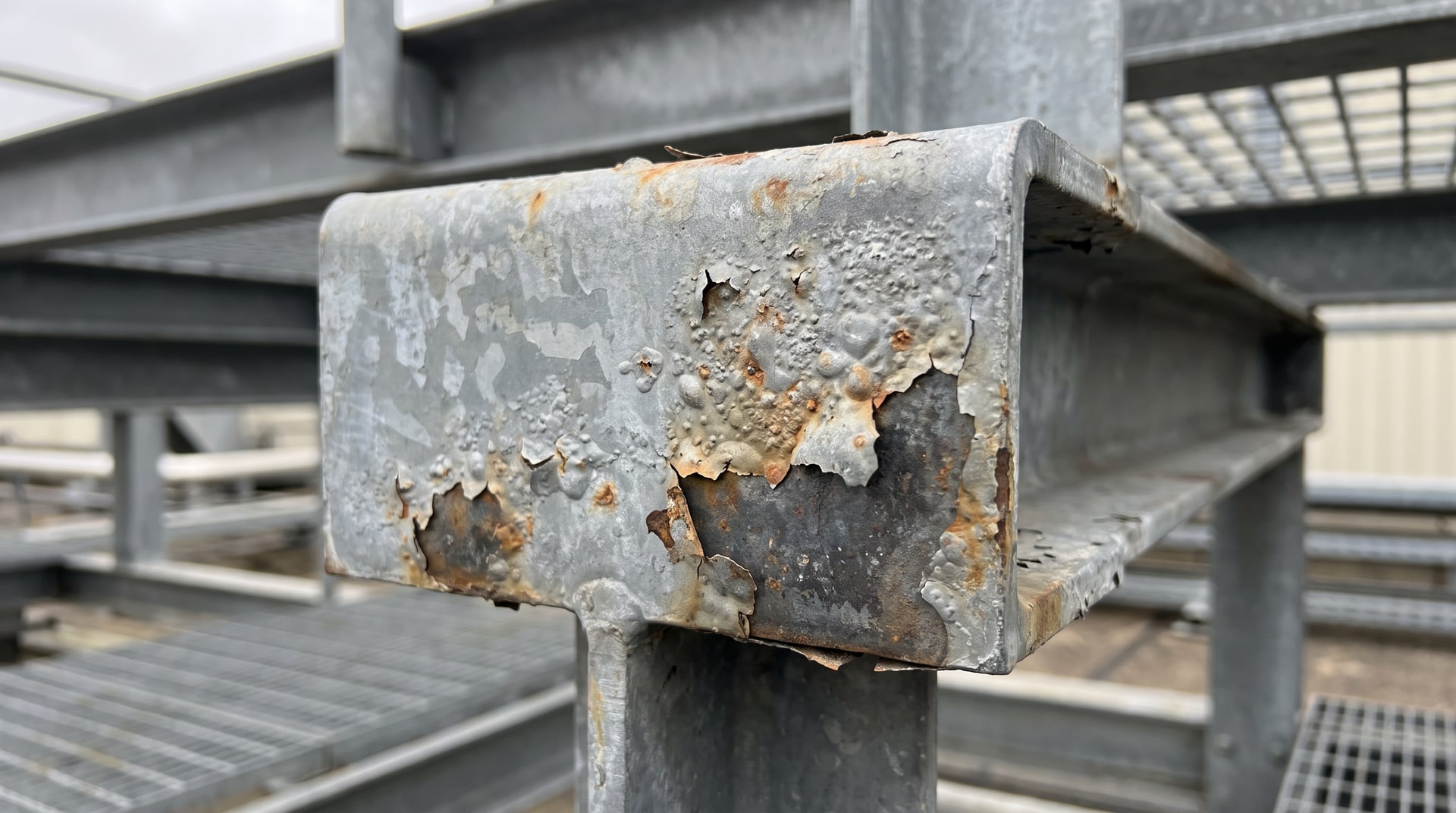
When a project involves structural supports near an industrial furnace, a store oven, or any environment with sustained elevated heat, the material selection conversation usually comes around to galvanizing. It is an intuitive choice: galvanized steel is widely available, cost-effective, and has an excellent corrosion protection track record across a broad range of environments. But elevated temperatures introduce a failure mode that most engineers and fabricators have not encountered in typical outdoor or atmospheric service, and the consequences are difficult to reverse once the steel is in place.
The scenario comes up more often than you might expect. A contractor sources galvanized tube steel for oven rack supports. A fabrication shop specifies galvanized angle for a furnace room enclosure. An engineer approves galvanized hardware near a kiln because the steel itself is not directly in the flame. In each case, the assumption is that galvanizing's durability will translate to a high-heat environment. That assumption is wrong at temperatures approaching 475 degrees Fahrenheit, and the consequences show up as physical coating failure rather than gradual corrosion.
The American Galvanizers Association addresses this directly in their article on galvanizing application at store/furnace environments. At V&S Galvanizing, we expand on that foundation to explain what is actually happening at the material level, how sustained temperature influences zinc-iron alloy layer behavior, and why this is often misunderstood in the field.
What the AGA's Guidance Actually Says
The AGA's position is unambiguous: galvanized material will generally not work well at 475 degrees Fahrenheit. The coating will peel, leaving only a fraction of the original zinc on the surface. This is not a gray area or a marginal performance reduction. It is a categorical statement that this application type is a poor match for hot-dip galvanized steel.
Importantly, the AGA cites research conducted by the Canadian government specifically on high-temperature peeling of coatings. That body of research reinforces what the metallurgy of the zinc-iron system would predict: at certain temperature thresholds, the physical structure of a galvanized coating undergoes changes that cause mechanical delamination. The result is not discoloration or minor surface oxidation. The coating literally separates and falls away from the steel substrate.
This guidance matters because it is often treated as a nuance rather than a hard rule. We regularly hear from engineers who interpret "high-temperature performance" as a gradient, where a little heat causes a little degradation and more heat causes more. The peeling failure mode does not work that way. It is a threshold behavior driven by the metallurgy of zinc-iron alloys, and once you cross it, the coating is compromised in a way that cannot be recovered without stripping and recoating.
The Metallurgy Behind the Failure
To understand why 475 degrees Fahrenheit is so significant, it helps to understand what a hot-dip galvanized coating actually is at the microstructural level. Galvanizing is not simply a layer of zinc sitting on the surface of steel. It is a series of zinc-iron intermetallic alloy layers that form during the galvanizing process itself, with a relatively pure zinc outer layer on top.
These intermetallic layers, from the steel outward, are the Gamma, Delta, and Zeta phases, each with a different zinc-to-iron ratio and different physical properties. The outermost layer is the Eta phase, which is nearly pure zinc and the most ductile of the layers. The entire coating structure is metallurgically bonded to the steel substrate, which is why galvanizing resists mechanical damage so well under normal service conditions.
The problem at elevated temperatures is that the zinc-iron system continues to react. At room temperature, this reaction is essentially stopped. But as temperature climbs, diffusion rates increase and the alloy phases continue to grow and transform. In the range approaching 475 degrees Fahrenheit, the outer zinc layer can become embrittled, the intermetallic layers can grow disproportionately, and the thermal expansion mismatch between the various phases can create internal stresses. When those stresses exceed the adhesion strength of the coating, the result is exactly what the AGA describes: peeling.
This is a fundamentally different failure mechanism from the gradual corrosion that galvanizing is designed to prevent. Corrosion is an electrochemical process. Thermal peeling is a mechanical process driven by phase transformation and differential thermal expansion. No amount of coating thickness compensates for it, and no post-treatment prevents it once the temperature exceeds the threshold.
Why "Near a Furnace" Is Still a Problem
One of the most common justifications we hear for using galvanized steel in furnace-adjacent applications is that the steel is not directly in the heat zone. The logic goes: if the flame or heating element does not directly contact the galvanized component, the temperature the steel sees is lower and therefore acceptable.
This reasoning underestimates how heat moves through an industrial or commercial setting. Furnace rooms, oven enclosures, and kiln structures often have ambient temperatures well above 200 degrees Fahrenheit even in areas that appear to be peripheral. Supports, brackets, and structural members that carry the load of oven equipment or furnace enclosures are often in sustained contact with radiated or convected heat for hours at a time during operation cycles.
The relevant temperature is not the peak flame temperature. It is the sustained temperature that the zinc coating experiences over the full service life of the installation. Zinc begins to change behavior at temperatures far below 475 degrees Fahrenheit in extended service. The 475-degree figure represents a threshold for more acute failure, but the long-term reliability of a galvanized coating degrades meaningfully well before that point in high-heat environments.
If there is any realistic pathway for a structural member to reach or approach 475 degrees Fahrenheit during normal operation, the application should not be specified with hot-dip galvanizing as the corrosion protection system.
How This Failure Presents in the Field
When galvanized coatings fail in high-temperature environments, the physical signs are distinct from typical corrosion damage. Rather than the white zinc oxide deposits or red rust that signal atmospheric corrosion failure, thermal peeling looks like paint delamination: flaking sections of coating lifting away from the steel surface, often in irregular patches.
In early stages, the coating may show discoloration and a dull, matte surface texture that differs from the characteristic metallic sheen of sound galvanizing. As the failure progresses, sections of the intermetallic alloy layers separate and fall away, exposing the bare steel substrate. Once that happens, the steel is unprotected and will begin corroding, which creates a compounding maintenance problem in addition to the original coating failure.
The fraction of zinc that remains after peeling, as the AGA notes, is a small fraction of the original coating thickness. What stays adhered to the surface tends to be irregular and poorly bonded, offering minimal cathodic protection to the surrounding steel. The coating cannot be relied on to protect the base metal once peeling has begun.
What Engineers and Fabricators Should Specify Instead
The answer to a high-temperature furnace application is not a thicker galvanized coating or a different galvanizing process. The failure mechanism is fundamental to zinc-iron metallurgy at elevated temperature, so no variation within the hot-dip galvanizing family resolves it.
For structural steel supports in furnace and high-heat environments, alternative corrosion protection strategies need to reflect the actual service conditions. High-temperature resistant paints and coatings formulated specifically for industrial heat service are one path. Stainless steel or other alloy selections may be appropriate depending on the corrosion environment beyond just the temperature. In some cases, bare carbon steel with a maintenance painting program makes more sense than a corrosion protection system that will fail on a timeline driven by thermal exposure rather than atmospheric conditions.
The right answer depends on the full picture: the actual sustained temperature, the corrosive species present in the environment (furnace exhaust gases, for example, may carry sulfur compounds or other aggressive chemistries), the structural loads, and the maintenance access available over the life of the installation. Our team at V&S Galvanizing is straightforward about when galvanizing is not the right tool for the job, and this is one of those situations.
The Broader Lesson About Temperature and Zinc Coatings
The furnace application question surfaces a broader principle that is worth understanding for any project where temperature variations are a factor. Zinc coatings, whether hot-dip galvanized, zinc-rich paint, or thermal spray zinc, all have performance envelopes defined by both the electrochemical environment and the thermal environment. Most of the engineering guidance around galvanizing focuses on moisture, chloride exposure, pH, and atmospheric conditions. Temperature is sometimes treated as a secondary variable when in certain applications it is the primary one.
For most outdoor and atmospheric service, temperature variation is not an issue. Steel that is galvanized and installed outdoors in a temperate or even subtropical climate will experience temperatures well within the range where galvanizing performs as expected. The same coating on a furnace support bracket sees a completely different thermal history, and the specification process needs to account for that.
When we review submittals or answer questions from engineers early in the design phase, we ask about service temperature as a routine part of the application review. It is not a complicated question, but it is one that changes the recommendation significantly when the answer is in the range of several hundred degrees Fahrenheit.
Why This Comes Up More in Commercial and Light Industrial Settings
Heavy industrial facilities with blast furnaces or industrial kilns typically employ mechanical engineers and materials engineers who understand high-temperature metallurgy. The application failure the AGA describes is more likely to appear in lighter commercial and light-industrial settings: commercial kitchen equipment, small-scale industrial ovens, store display rack supports near heating equipment, retail or food service environments where structural steel is in proximity to ovens or warmers.
In those settings, the galvanizing specification often comes from a fabricator or general contractor who is working from a standard materials list rather than a site-specific engineering analysis. The galvanized steel is chosen because it is available, familiar, and cost-effective for everything else on the job. The furnace-proximity issue does not get flagged because no one in the procurement chain is thinking about sustained temperature as a coating performance variable.
This is exactly the kind of gap that technical guidance from the AGA and from galvanizers with applied experience helps to close. A quick question early in the design process, asking whether any of the galvanized components will be near a heat source that could sustain 400 degrees Fahrenheit or more, can redirect a specification toward a more appropriate material before any steel is processed or installed.
Work With a Team That Gives You the Honest Answer
Understanding where galvanizing excels and where it does not is part of what makes a galvanizing partner genuinely useful to engineers, fabricators, and contractors. Hot-dip galvanizing through our galvanizing services is an exceptional corrosion protection solution for a wide range of structural, industrial, and infrastructure applications. But the value we bring is not in saying yes to every specification. It is in helping project teams understand which environments and service conditions align with galvanizing's performance characteristics and which ones call for a different approach.
For furnace and high-heat applications approaching 475 degrees Fahrenheit, the technical guidance is clear: galvanized coatings will peel, leaving the steel inadequately protected and the project team managing an avoidable failure. That answer is better delivered before fabrication than after installation.
If you are working through a specification decision and have questions about whether your application environment is a good fit for hot-dip galvanizing, reach out through our contact page. We are glad to work through the details with you and give you a straight answer based on the actual service conditions.
Frequently Asked Questions About Galvanizing in High-Temperature Furnace Applications
Why does galvanizing fail at 475 degrees Fahrenheit specifically?
At temperatures approaching 475 degrees Fahrenheit, the zinc-iron intermetallic alloy layers that make up a hot-dip galvanized coating experience accelerated phase transformation and differential thermal expansion. These changes create mechanical stress within the coating that causes it to delaminate and peel from the steel surface. The failure is structural rather than corrosive, and it cannot be prevented by increasing coating thickness.
Can you use a thicker galvanized coating to compensate for high-temperature exposure?
No. The peeling failure at elevated temperatures is a metallurgical phenomenon inherent to the zinc-iron system, not a function of coating thickness. A thicker coating does not change the phase transformation behavior or the thermal expansion dynamics that drive delamination. Coating thickness is an important variable for atmospheric corrosion resistance, but it does not address high-temperature performance limitations.
What fraction of the zinc coating typically remains after high-temperature peeling?
According to the AGA, only a fraction of the original zinc coating remains after thermal peeling occurs. The specific amount varies by exposure conditions, but the remaining coating is insufficient to provide meaningful corrosion protection and is often poorly bonded, making it unreliable as a barrier or cathodic protection system.
Does this apply to zinc-rich paint coatings as well, or only hot-dip galvanizing?
The AGA's guidance addresses hot-dip galvanized coatings specifically. However, all zinc-based coatings have elevated-temperature performance limits because the underlying issue involves zinc chemistry and behavior at high temperatures. The specific failure temperature may vary by coating type and formulation, but engineers should evaluate any zinc-based coating against its manufacturer's rated temperature range before specifying it for furnace-adjacent applications.
At what temperature does galvanizing begin to degrade, and is 475 degrees Fahrenheit a safe upper limit?
The AGA identifies 475 degrees Fahrenheit as a temperature at which galvanized coatings will peel and fail in service. This is not a safe upper limit; it is a failure threshold. Zinc coatings experience performance degradation in sustained heat well before reaching that point in long-term service. Engineers should treat any sustained temperature exposure above a few hundred degrees Fahrenheit as a potential concern requiring evaluation rather than assuming performance holds until 475 degrees is reached.
What corrosion protection systems are appropriate for steel near industrial furnaces?
The AGA guidance does not prescribe a specific alternative, but appropriate alternatives generally include high-temperature resistant coatings formulated for industrial heat service, stainless steel or heat-resistant alloy selection, or site-specific engineering analysis that accounts for the full service environment including temperature, corrosive species, and maintenance access. The right system depends on the sustained operating temperature, the chemical environment, and the structural requirements of the application.
How is thermal peeling failure different from ordinary galvanizing corrosion failure?
Ordinary galvanizing corrosion failure is an electrochemical process where zinc gradually reacts with moisture and atmospheric agents over years of service, eventually exposing the underlying steel. Thermal peeling is a mechanical failure driven by phase transformation and differential thermal expansion within the coating layers. It can occur relatively quickly under sustained heat exposure, presents as physical flaking rather than rust, and is not related to the corrosive aggressiveness of the surrounding atmosphere.
Is galvanizing suitable for steel that only briefly reaches 475 degrees Fahrenheit during process cycles?
Brief, infrequent excursions to elevated temperature present a lower risk than sustained exposure, but repeated thermal cycling through high temperatures creates cumulative stress on the coating. The AGA guidance focuses on applications where the normal operating temperature is around 475 degrees Fahrenheit, which implies sustained exposure. For applications with intermittent thermal spikes, the cumulative effect over the service life of the installation should be evaluated against the coating's expected performance before specifying galvanizing.
