
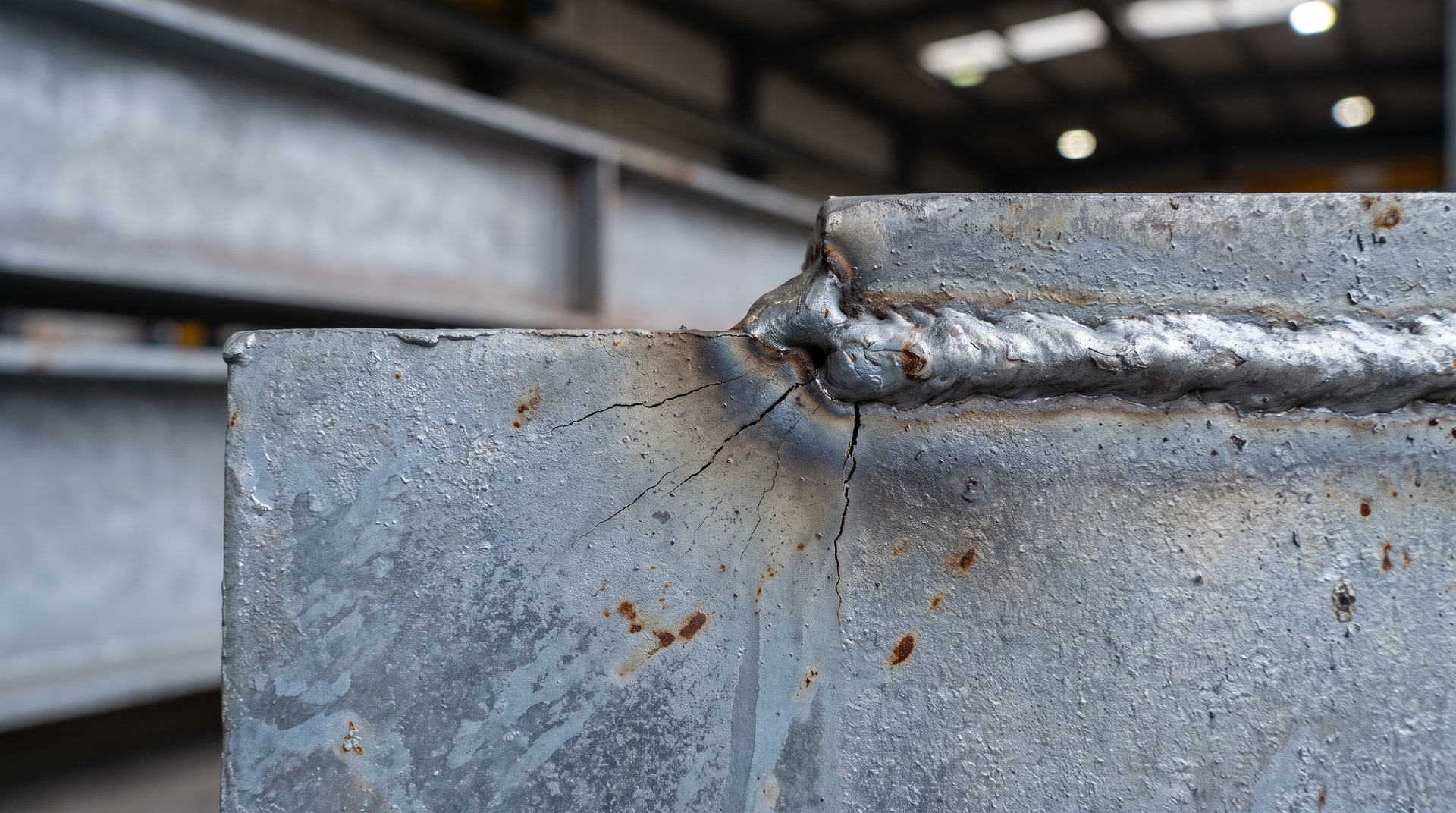
When a fabricated structure comes out of the galvanizing kettle cracked, the reaction is almost always the same: confusion, concern, and a search for someone to blame. The galvanizer assumes the steel was defective. The fabricator assumes the galvanizer did something wrong. The structural engineer wonders whether the entire piece needs to be scrapped. The reality is usually more technical, and more preventable, than any of those explanations suggest. Cracking in the weld zone of hot-dip galvanized steel is a metallurgical problem with identifiable causes rooted in fabrication decisions made well before the part ever reaches the galvanizing line.
The American Galvanizers Association addresses this directly in their article on cracking of HDG steel in the area of the weld. At V&S Galvanizing, we expand on that foundation to explain what is actually happening at the material level, how hardness in the heat-affected zone influences embrittlement risk, and why this failure mode is often misunderstood in the field.
Why Weld Zones Are Structurally Different From the Rest of the Steel
To understand why cracking concentrates in and around welds, it helps to think about what welding actually does to the base metal. The weld deposit itself is typically harder and stronger than the surrounding steel. That difference in mechanical properties is intentional to some degree, but it creates a transition zone where stresses concentrate rather than distribute evenly across the section.
The region immediately adjacent to the weld bead, commonly referred to as the heat-affected zone (HAZ), undergoes a rapid thermal cycle during welding. Temperatures in the HAZ can reach levels that alter the microstructure of the steel, increasing hardness and reducing ductility. Unlike the base metal, which was rolled and processed under controlled conditions, the HAZ is essentially re-heat-treated in an uncontrolled way. The result is a localized zone that is harder, more brittle, and more sensitive to imposed stresses than virtually anywhere else in the fabrication.
That brittleness matters because hot-dip galvanizing is not a passive coating process. The steel is immersed in molten zinc at temperatures around 840 degrees Fahrenheit, and that thermal event imposes real physical stresses on the structure. As the steel heats unevenly and then cools, sections of different thicknesses expand and contract at different rates. Where those differential movements intersect with an already-stressed, already-hardened weld zone, something has to give.
The Role of Hardness in Embrittlement Susceptibility
Hardness and tensile strength are directly proportional in steel, and both relate directly to embrittlement risk. The threshold that matters most in this context is 35 Rockwell C. Research cited by the AGA indicates that steels exceeding this hardness value are highly susceptible to cracking, particularly under load. A Rockwell C hardness of 35 corresponds to a tensile strength of approximately 160,000 psi (160 ksi), which is meaningfully higher than the tensile strength of most common structural steels.
Weld metal and heat-affected zones can readily exceed that 35 HRC threshold, especially when the welding parameters are aggressive or when the base metal is higher-strength to begin with. This is not a hypothetical edge case. It is a predictable outcome of certain welding conditions applied to certain steel specifications. When a fabricator welds two pieces of steel together and those weld zones reach hardness values above the critical threshold, the resulting part carries elevated embrittlement risk before it even arrives at the galvanizing plant.
The harder the steel, the more susceptible it is to hydrogen embrittlement specifically, which is the other mechanism at work here. Atomic hydrogen, which can be introduced during acid pickling as part of the galvanizing pretreatment sequence, tends to diffuse into the steel lattice. In softer, more ductile steels, this is rarely consequential. In harder steels, particularly in the HAZ where the microstructure is already compromised, hydrogen accumulation at grain boundaries can trigger or accelerate cracking under stress. The combination of residual welding stress, elevated hardness, and hydrogen uptake creates a convergence of failure conditions.
How Differential Section Thickness Amplifies the Problem
One detail from the sign structure example that the AGA article highlights is particularly instructive: the cracking occurred at junctions where two different thicknesses of steel were welded together. This is not incidental. It is a key contributing factor in its own right.
When a thick section and a thin section are connected by a weld, they do not heat and cool at the same rate during galvanizing. Thicker steel takes longer to reach bath temperature and longer to cool after withdrawal. Thinner steel responds much faster. As a result, the two sections are at different temperatures for much of the immersion and withdrawal cycle, and the weld connecting them is subjected to differential thermal expansion and contraction at precisely the location where residual stress from welding is already highest.
This is a stress amplification problem. The galvanizing kettle does not create the failure condition from scratch. It partially relieves the welding stresses that were locked into the fabrication, and that partial relief, combined with the differential thermal movement between sections of unequal thickness, produces net stresses that the HAZ, with its reduced ductility, cannot accommodate. The result is visible cracking that originates in the weld zone.
Reading the Failure Pattern as Diagnostic Information
One of the more useful observations in the AGA article is that all of the cracking in the sign structure originated in the weld area, specifically in the heat-affected zones. That spatial pattern is actually diagnostic. If cracking appeared randomly across the base metal, a different set of causes would need to be investigated, including steel chemistry, cold working, or improper kettle conditions. When cracking is consistently localized to the HAZ and the weld boundaries, the failure signature points clearly to residual welding stress combined with elevated hardness in those zones.
For engineers reviewing failed or cracked galvanized structures in the field, this pattern recognition matters. It narrows the root cause, it informs the corrective action, and it helps establish whether the problem is isolated to the specific fabrication or whether it reflects a systematic issue with how welded assemblies are being detailed and fabricated before galvanizing.
What ASTM A143 Requires for Stress Relief
The standard most directly applicable to this situation is ASTM A143, titled Standard Practice for Safeguarding Against Embrittlement of Hot-Dip Galvanized Structural Steel Products and Procedure for Detecting Embrittlement. While the standard does not address welding stresses by name, it does establish a procedure for stress relief that applies to cold-formed steel and, by extension, to stresses introduced by welding.
Section 5.3 of ASTM A143 specifies that stress relief should be conducted at a maximum temperature of 1,100 degrees Fahrenheit (595 degrees Celsius) for approximately one hour per inch (25.4 mm) of section thickness. This thermal treatment, applied to the fabricated assembly prior to galvanizing, accomplishes several things simultaneously. It reduces residual stress locked in by the welding process. It tempers the hardened microstructure of the weld metal and the HAZ, reducing hardness values toward levels below the critical embrittlement threshold. And it restores some measure of ductility to regions that welding had made brittle.
The temperature ceiling of 1,100 degrees Fahrenheit is deliberate. Exceeding that value would begin to approach the lower end of the galvanizing bath temperature and could introduce its own set of microstructural concerns. The one-hour-per-inch duration ensures that the thermal treatment penetrates evenly through heavier sections rather than just affecting the surface.
It is worth noting that this stress relief step requires coordination between the fabricator and the galvanizer. The fabricator must plan for the additional thermal processing step and deliver material that has been properly treated. The galvanizer needs to know that the material has or has not been stress relieved so that any residual risk can be assessed. That communication gap, where neither party assumes responsibility for flagging the issue, is where many of these cracking failures actually originate.
Design Decisions That Reduce Risk Upstream
Stress relief prior to galvanizing is the corrective answer for fabrications already committed to a particular design. But the more efficient solution is to reduce stress concentration potential through design choices made before fabrication begins. Zones of high stress potential do not arise randomly. They are created by specific geometric conditions: abrupt transitions between section thicknesses, highly restrained weld joints, joints welded in multiple passes without interpass temperature control, and connections that create triaxial stress states.
When engineers and detailers understand that galvanizing imposes a real thermal event on the structure, they can design connections to minimize those risks. Gradual transitions between different section thicknesses reduce the magnitude of differential thermal movement. Proper weld joint design and sequence can reduce the total residual stress locked into the fabrication. Specifying controlled interpass temperatures during welding can limit how hard the HAZ becomes. None of these are exotic requirements. They reflect standard good practice for fabrications that will see any kind of demanding service.
At V&S Galvanizing, we work with engineers and fabricators who are still in the design phase specifically because upstream decisions have a disproportionate effect on the quality of the final galvanized product. Catching potential stress concentration problems before steel is cut and welded is always less costly than addressing cracking after the fact.
The Persistent Misconception: Blaming the Galvanizer
Perhaps the most common misunderstanding surrounding weld-zone cracking in HDG steel is the assumption that the galvanizer caused the failure. The logic seems intuitive: the part was fine before galvanizing, the cracks appeared after galvanizing, therefore galvanizing cracked it. But that reasoning ignores what the galvanizing process actually reveals rather than creates.
The stresses responsible for the failure were introduced during welding. They were locked into the steel as residual stress. The heat of the galvanizing kettle did not create those stresses, but it did partially redistribute them while simultaneously imposing differential thermal loads at the sections that were already most vulnerable. The galvanizing process acted as a proof test that the fabrication failed. That distinction matters enormously, both for assigning responsibility and for developing the right corrective action.
A galvanizer who receives welded steel with heat-affected zones at 40 HRC and no prior stress relief cannot fully compensate for that condition at the kettle. The process parameters are not adjustable in a way that eliminates the risk once the steel arrives in that state. Prevention has to happen earlier in the fabrication chain.
Work With a Team That Understands the Full Process Chain
Cracking in the weld zone of hot-dip galvanized steel is not a random or unpredictable failure. It follows a clear metallurgical logic: elevated hardness in the heat-affected zone, residual welding stress, differential thermal response between connected sections of different thickness, and in some cases hydrogen uptake during pretreatment all converge at the most vulnerable location in the fabrication. Understanding that logic is the foundation for preventing the failure from occurring in the first place.
ASTM A143 provides the framework for stress relief when the design and fabrication have already created elevated risk. Applied correctly at 1,100 degrees Fahrenheit for one hour per inch of section thickness, that thermal treatment can meaningfully reduce hardness in the weld zone, restore ductility to the HAZ, and lower the probability of cracking during galvanizing. But the better path is designing connections with galvanizing in mind, controlling welding parameters, and communicating openly between fabricator and galvanizer before the first piece of steel is processed.
If you are working on a project that involves welded assemblies, mixed section thicknesses, or high-strength steels scheduled for hot-dip galvanizing, we encourage you to reach out before fabrication is complete. Our team can help you identify potential stress concentration concerns and determine whether pre-galvanizing stress relief is warranted. Visit our contact page to start that conversation.
Frequently Asked Questions About Weld Zone Cracking in Hot-Dip Galvanized Steel
Why does cracking in galvanized steel concentrate specifically in the weld zone rather than the base metal?
The weld zone and the adjacent heat-affected zone (HAZ) undergo rapid, uncontrolled heating and cooling during welding. This increases hardness and reduces ductility in those areas compared to the surrounding base metal. When the galvanizing thermal cycle imposes additional stress through differential expansion and contraction, the HAZ is the location least capable of accommodating that stress without cracking.
What hardness value marks the threshold for hydrogen embrittlement risk in galvanized steel?
Research cited by the AGA indicates that steels exceeding 35 Rockwell C hardness are highly susceptible to hydrogen embrittlement. This threshold corresponds to a tensile strength of approximately 160,000 psi (160 ksi). Weld metal and heat-affected zones can readily exceed this value depending on welding conditions and base metal specification.
Does hydrogen embrittlement always cause cracking during galvanizing, or only under certain conditions?
Hydrogen embrittlement is most consequential when the steel is both hard (above 35 HRC) and under load or residual stress. In softer, more ductile steels, atomic hydrogen absorbed during acid pickling typically diffuses back out without causing failure. In harder steels with residual welding stress, the combination of hydrogen at grain boundaries and imposed stress can initiate or accelerate cracking.
What does ASTM A143 specify for stress relieving welded steel before galvanizing?
ASTM A143 Section 5.3 describes a stress relief procedure applicable to cold-formed steel that can be applied to welding stresses as well. It specifies heat treatment at a maximum of 1,100 degrees Fahrenheit (595 degrees Celsius) for approximately one hour per inch (25.4 mm) of section thickness. This treatment reduces residual stress, lowers hardness in the HAZ, and restores ductility before the part enters the galvanizing process.
Why does connecting two different steel thicknesses increase the risk of cracking during galvanizing?
Sections of different thickness heat and cool at different rates during galvanizing immersion and withdrawal. The weld connecting those sections is subjected to differential thermal movement at exactly the location where residual stress from welding is already highest. That combination of high residual stress and differential thermal strain is what drives cracking in joints where section thicknesses change abruptly.
Can the galvanizer adjust the process to prevent weld-zone cracking once the fabricated part arrives?
In most cases, no. If the heat-affected zone already has hardness values above the critical threshold and the part carries significant residual welding stress, the galvanizer has limited ability to compensate at the kettle. Process parameters are not adjustable in a way that eliminates the embrittlement risk introduced during fabrication. Prevention requires stress relief or design modifications before the part reaches the galvanizing line.
How can engineers reduce weld-zone cracking risk during the design phase?
Designing gradual transitions between sections of different thickness reduces the magnitude of differential thermal movement during galvanizing. Specifying controlled interpass welding temperatures limits how hard the HAZ becomes. Using joint geometries that minimize restraint reduces locked-in residual stress. These design choices, combined with pre-galvanizing stress relief when needed, represent the most reliable approach to preventing weld-zone cracking.
Is weld-zone cracking in HDG steel a sign that the galvanizer made an error?
Not typically. The stresses responsible for this failure mode are introduced during welding and exist in the steel before it arrives at the galvanizing plant. The heat of the galvanizing kettle partially redistributes those stresses and adds differential thermal loading, which reveals a failure condition that was already present. Cracking after galvanizing more often reflects a fabrication or design issue than a process error by the galvanizer.
