

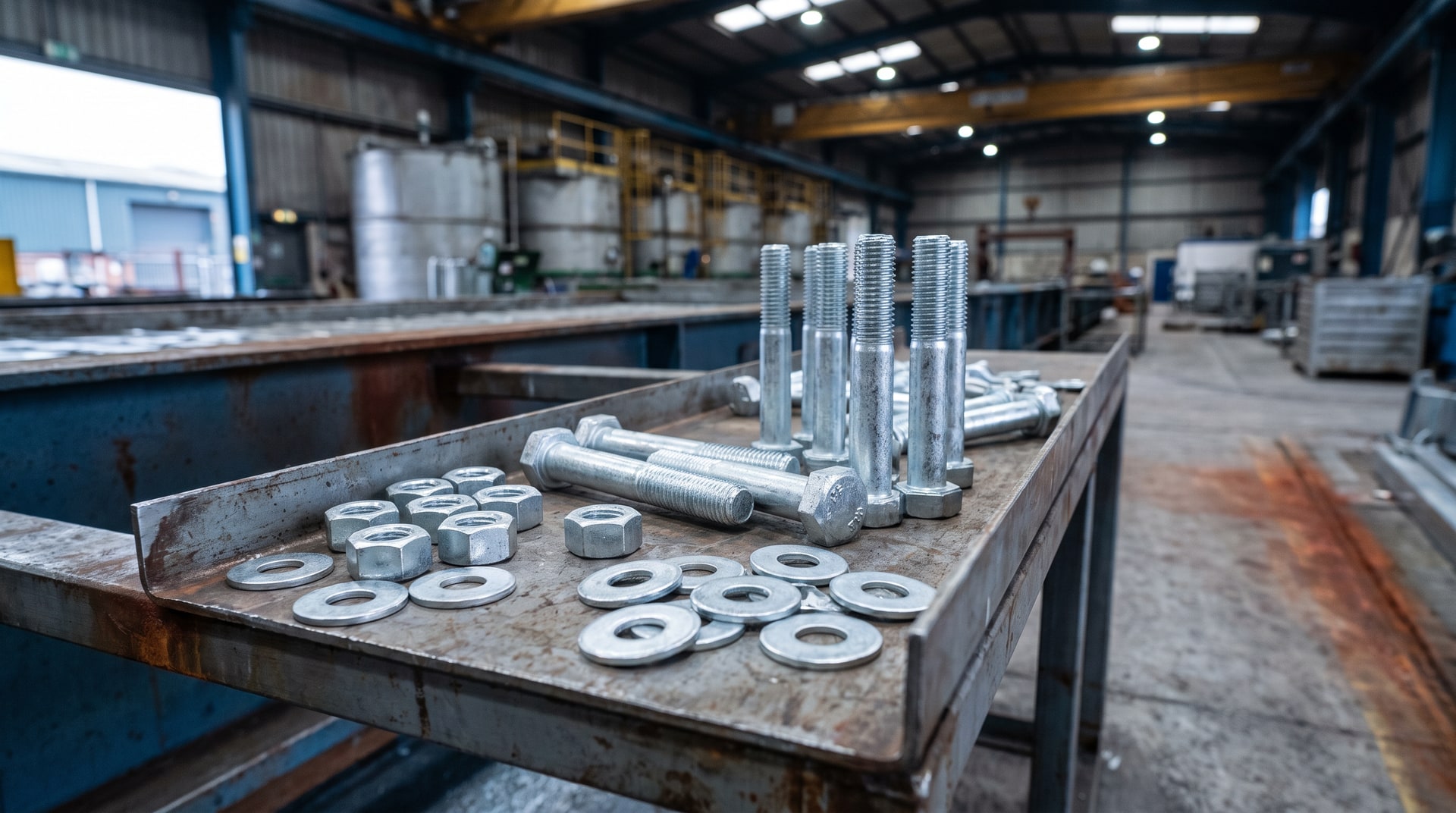
When a structural fabricator specifies hot-dip galvanized bolts for a bridge connection or a contractor orders galvanized hardware for a precast concrete embed, they are usually relying on a single ASTM standard to define what they will actually receive. That standard is ASTM A153, and while it governs a wide range of small iron and steel hardware, it is also frequently misread, misquoted, or conflated with the better-known ASTM A123 standard that applies to structural steel fabrications. The differences are not trivial. They affect coating thickness expectations, what constitutes an acceptable finish, how threads are treated, and what steps the galvanizer must take during processing.
Hardware and fasteners present a specific challenge in hot-dip galvanizing: small geometry, tight tolerances, and threaded surfaces mean that excess zinc is not just an aesthetic problem but a functional one. A bolt coated too heavily on its threads cannot mate with a nut. A washer with a heavy zinc drip on one face will not seat flush. The process accommodates this through centrifuging or spinning, which is the defining mechanical difference in how these articles are handled relative to structural steel. The American Galvanizers Association addresses this directly in their article on hot-dip galvanizing small parts, hardware, and fasteners to ASTM A153. At V&S Galvanizing, we expand on that foundation to explain what is actually happening at the material level, how coating class and geometry influence performance, and why the appearance requirements in this standard are often misunderstood in the field.
What ASTM A153 Actually Covers and Why It Exists Separately
ASTM A153 governs zinc coatings applied by the hot-dip process to iron and steel hardware: castings, fasteners, rolled products, pressed and forged articles, and miscellaneous threaded objects. The reason a separate standard exists for these items is not bureaucratic redundancy. It reflects a genuine difference in process and product geometry.
Structural steel galvanized to ASTM A123 is withdrawn from the zinc bath and allowed to drain. Excess zinc runs off by gravity, and any remaining drips are typically acceptable given the larger geometry of beams, angles, and plates. Hardware is different. A one-inch bolt withdrawn from a zinc bath will carry molten zinc in its thread roots, and that zinc will freeze before it drains. The result is an unusable fastener. ASTM A153 resolves this by requiring that hardware be centrifuged, spun, or otherwise handled to remove excess zinc immediately after withdrawal from the bath. This is not optional and is not simply a quality preference; it is a process requirement written into the standard itself.
Beyond the centrifuging step, the underlying galvanizing chemistry is identical to A123. The steel is cleaned through degreasing, pickling in hydrochloric acid, and fluxing before immersion in the molten zinc bath. The zinc-iron intermetallic layers that form at the steel surface are the same. What differs is the handling after withdrawal, the coating weight classes that apply, and some specific provisions around threaded surfaces.
Reading the Coating Class System Correctly
One of the most practically important parts of ASTM A153 is its classification system, which assigns minimum coating thickness and weight requirements based on material type and physical dimensions. There are four classes, and selecting the right one requires understanding what category a given piece of hardware actually falls into.
Class A covers castings, both malleable iron and steel. These require the heaviest coating in the standard: a minimum average of 2.00 oz/ft² (610 g/m²), with any individual specimen measuring at least 1.80 oz/ft² (550 g/m²). In thickness terms, that translates to a minimum average of 3.4 mils (86 microns), with any individual specimen at least 3.1 mils (79 microns). Cast iron and steel often have surface conditions that can support a robust zinc-iron alloy layer, but they also carry higher embrittlement risk, which we will address separately.
Class B is the broadest category and is itself divided into three subclasses based on thickness and length. B-1 covers rolled, pressed, and forged articles greater than 5/8 inch thick and greater than 15 inches in length, requiring the same 2.00 oz/ft² average as Class A castings. B-2 applies to thinner material (under 5/8 inch) in longer lengths, with a reduced minimum average of 1.5 oz/ft² (458 g/m²). B-3 applies to any thickness when the piece is under 15 inches long, with a minimum average of 1.30 oz/ft² (397 g/m²). The length dimension in all three B subclasses refers to the finished dimension of the piece after fabrication, not a raw stock length.
Class C covers fasteners larger than 3/8 inch in diameter and washers thicker than 3/16 inch. The minimum average here is 1.25 oz/ft² (381 g/m²), with a 1.00 oz/ft² (305 g/m²) floor for any individual specimen. Class D covers smaller fasteners, rivets, nails, and similar articles, with the lightest requirement in the standard: 1.00 oz/ft² (305 g/m²) average and 0.85 oz/ft² (259 g/m²) minimum for any individual piece.
| Class of Material | Avg. Weight oz/ft² (g/m²) | Min. Individual Weight oz/ft² (g/m²) | Avg. Thickness mils (microns) | Min. Individual Thickness mils (microns) |
|---|---|---|---|---|
| Class A - Castings (Malleable Iron, Steel) | 2.00 (610) | 1.80 (550) | 3.4 (86) | 3.1 (79) |
| Class B-1 - Rolled, Pressed, Forged: > 5/8" thick and > 15" long | 2.00 (610) | 1.80 (550) | 3.5 (85) | 3.1 (79) |
| Class B-2 - Rolled, Pressed, Forged: < 5/8" thick and > 15" long | 1.5 (458) | 1.25 (381) | 2.6 (66) | 2.1 (53) |
| Class B-3 - Rolled, Pressed, Forged: any thickness and < 15" long | 1.30 (397) | 1.10 (336) | 2.2 (56) | 1.9 (48) |
| Class C - Fasteners > 3/8" dia.; Washers > 3/16" thick | 1.25 (381) | 1.00 (305) | 2.1 (53) | 1.7 (43) |
| Class D - Fasteners < 3/8" dia.; Rivets, nails; Washers < 3/16" thick | 1.00 (305) | 0.85 (259) | 1.7 (43) | 1.4 (36) |
| Note 1: Length dimensions for Classes B-1, B-2, and B-3 refer to finished dimensions of the piece after fabrication. | ||||
These minimums exist because thinner sections and smaller hardware carry less base metal. A thinner zinc coating still delivers meaningful corrosion protection, but the geometry simply cannot support the same zinc mass as a heavier structural section. This is not a compromise in quality; it is calibration to what the product can realistically carry after centrifuging.
How Centrifuging Shapes the Final Coating Appearance
The centrifuging step is where the appearance of ASTM A153 hardware diverges most visibly from structural galvanizing. When molten zinc is spun off a basket of bolts or a batch of small castings, the coating that remains is thinner and smoother than the gravity-drained coating on structural steel. The surface often appears brighter and more uniform right out of the bath, with less of the spangle texture that characterizes larger galvanized fabrications.
That brightness, however, can be misleading. The spangled or matte appearance of structural galvanizing reflects the development of the zinc-iron intermetallic layer system: eta (pure zinc), zeta, delta, and gamma layers building outward from the steel surface. Centrifuged hardware goes through the same metallurgical process during immersion, but the spinning removes much of the outer eta layer along with the excess zinc. What remains is often a surface dominated by the harder, duller intermetallic phases, which can look different from a freshly galvanized structural beam but represents the same corrosion-protection mechanism.
In service, both surfaces will weather similarly. The bright zinc will oxidize to a matte gray patina as zinc carbonate forms on the surface. This patina is not a sign of degradation; it is the stable surface chemistry that gives galvanizing its long-term corrosion resistance. Hardware galvanized to A153 will follow the same weathering curve.
What the Appearance Requirements in ASTM A153 Actually Prohibit
The appearance requirements in ASTM A153 are performance-driven, not cosmetic. The standard requires that coated articles be free from uncoated areas, blisters, flux deposits, and gross dross inclusions, and must have no heavy zinc deposits that would interfere with intended use. Each of these terms has a specific meaning in the context of the galvanizing process.
Uncoated areas, sometimes called bare spots, indicate locations where the zinc did not bond to the steel. This can result from surface contamination that survived the cleaning process, mill scale that was not fully removed by pickling, or areas where flux was insufficient. Any uncoated area on a galvanized fastener is a direct path for corrosion to the base steel and constitutes cause for rejection under the standard.
Blisters occur when gases are trapped between the zinc coating and the steel surface during immersion. This typically points to a surface chemistry issue, often contamination or prior surface treatments that outgassed during bath immersion. A blister that ruptures leaves a small exposed steel area and, more importantly, can indicate adhesion problems in the surrounding coating.
Flux deposits are residues from the flux bath that were not fully removed or incorporated during galvanizing. They appear as white, powdery or crystalline spots on the surface. Beyond aesthetics, flux deposits prevent zinc adhesion in the areas where they sit and can accelerate localized corrosion by acting as moisture traps.
Gross dross inclusions are particles of zinc-iron intermetallic compounds that have settled out of the zinc bath and become entrapped in the coating surface during withdrawal. In small quantities these are generally benign, but gross inclusions can create surface irregularities that interfere with coating continuity.
Heavy zinc deposits that interfere with intended use is the one appearance criterion tied directly to functionality rather than coating integrity. For threaded fasteners, this is where the standard gets specific: areas with threads are not subject to the general coating thickness requirement. The reasoning is straightforward. If threads were held to the same minimum coating weight as the shank and head, the result after plating would often be a bolt whose threads are too thick to engage a nut. The standard instead accepts whatever zinc thickness remains on the thread form after centrifuging, provided it does not prevent functional engagement.
The Thread Engagement Problem and How the Standard Resolves It
Anyone who has worked with galvanized hardware has likely encountered the practical frustration of a nut that will not thread onto a galvanized bolt. This is not a defect in the coating; it is a predictable consequence of applying a zinc layer to already-tight thread tolerances. The standard addresses this head-on.
The solution specified in ASTM A153 is that the internal threads of a nut should be over-tapped after the zinc coating is applied. This means the nut threads are cut slightly larger post-galvanizing to accommodate the coating thickness added to the bolt threads. The zinc remains on the bolt threads, providing the corrosion protection for the assembly. The nut threads, though uncoated after over-tapping, receive sacrificial cathodic protection from the zinc on the bolt shank and threads immediately adjacent to them. This is galvanic protection working at the fastener scale.
Fabricators and contractors who attempt to force unmodified nuts onto galvanized bolts often damage both the coating and the thread form. The correct approach is to specify over-tapped nuts whenever ordering galvanized bolt assemblies. This is standard practice in any well-run fastener supply chain, but it is worth confirming when sourcing from suppliers unfamiliar with A153 requirements.
Embrittlement Risk in High-Strength Fasteners and Castings
ASTM A153 explicitly calls out embrittlement as a concern for two categories of hardware: high tensile strength fasteners (those exceeding 150 ksi) and castings. Understanding why these categories are flagged requires some background on what happens to steel during the galvanizing process.
The hot-dip galvanizing process involves pickling in hydrochloric acid, which removes scale but can also introduce hydrogen into the steel's grain structure. Under normal circumstances this hydrogen diffuses out harmlessly during the high-temperature zinc bath immersion, which typically occurs around 840 degrees Fahrenheit (449 degrees Celsius). However, in steels that have been cold-worked, surface hardened, or manufactured through processes that introduce residual tensile stress, the hydrogen may not diffuse quickly enough before the zinc seals the surface. This is hydrogen embrittlement, and it can lead to brittle fracture under load, sometimes days after galvanizing.
High-strength fasteners above 150 ksi are particularly vulnerable because the manufacturing processes used to achieve that strength level often introduce the exact microstructural conditions that inhibit hydrogen diffusion. Castings, especially malleable iron, carry their own risk from fabrication stresses and carbon distribution within the metal.
ASTM A153 points to ASTM A143 for the precautions that should be taken to prevent embrittlement. Selecting steels with appropriate chemistries is also identified as a mitigating strategy, particularly for malleable castings. In practice this means working with the galvanizer early in the specification process when high-strength fasteners are involved, not after the hardware is already in hand.
Fabrication Steps That Affect the Coating After Galvanizing
ASTM A153 acknowledges a reality that often surprises specifiers: there are fabrication steps that may impair the corrosion protection of the hot-dip galvanized coating, but flaking or damage from these steps is not grounds for rejection under the standard. This is a nuanced position that reflects the practical reality of how hardware gets assembled in the field.
The underlying logic is that the coating is applied after fabrication is complete. The intent is that the galvanized article goes from the galvanizer to service without further processing. When further fabrication does occur, whether that is cutting, bending, punching, or mechanical assembly, the coating in affected areas may crack or flake. The standard does not treat this as a galvanizing failure because the galvanizer had no control over what happened downstream.
This does not mean those damaged areas are simply ignored in service. Depending on the size and location of coating damage, touch-up or repair may be warranted using zinc-rich paint or other approved methods. What it does mean is that a contractor who receives A153-galvanized hardware showing small coating disturbances from field assembly operations cannot send those pieces back to the galvanizer as rejects on that basis alone.
Good steel selection remains one of the most effective tools for producing a high-quality galvanized finish in the first place. Silicon content, phosphorus levels, and carbon distribution in the base steel all influence how the zinc-iron intermetallic layers develop during bath immersion. Steels with reactive chemistries can produce thicker, more brittle coatings, while steels within controlled silicon ranges tend to produce smoother, tighter coatings. This matters especially for hardware where surface smoothness and coating uniformity directly affect functionality.
Comparing ASTM A153 to Related Standards: Where the Boundaries Are
ASTM A153 does not operate in isolation. Specifiers working with galvanized hardware will also encounter ASTM A123, ASTM F2329, and ASTM A143 in related contexts, and knowing where each standard begins and ends prevents specification errors that can be costly to resolve after fabrication.
ASTM A123 governs zinc coatings on structural steel fabrications and wire products. It does not apply to the hardware categories covered by A153. When a hardware assembly contains both structural steel components and fasteners, A123 applies to the structural elements while A153 governs the fasteners. The AGA has published guidance specifically on this mixed-standard scenario, which is worth consulting when specifying hardware assemblies.
ASTM F2329 is the standard specifically for hot-dip zinc coatings on threaded fasteners, and it references A153 extensively. The key distinction is that F2329 focuses narrowly on threaded fasteners and incorporates additional requirements around hydrogen embrittlement testing that A153 addresses in general terms. For high-strength structural fasteners in critical applications, F2329 may be the more appropriate specification to cite explicitly.
ASTM A143 is not a galvanizing standard; it is a practice for safeguarding against embrittlement of hot-dip galvanized structural steel products. A153 points to A143 for its embrittlement precautions, which means understanding A153 fully requires at least a working familiarity with A143's provisions on stress-relief heat treatment and steel selection.
Work With a Team That Knows Small Hardware Is Its Own Engineering Problem
Galvanizing fasteners and hardware to ASTM A153 is not simply a scaled-down version of galvanizing structural steel. The centrifuging requirement, the coating class system, the thread engagement provisions, and the embrittlement considerations make it a genuinely distinct process with its own engineering logic. Getting it right requires understanding not just the minimum numbers in the standard but what those numbers mean in terms of zinc-iron layer development, functional performance, and long-term corrosion protection.
At V&S Galvanizing, our team works with engineers, fabricators, and contractors who need accurate answers before hardware goes into production, not troubleshooting calls after a bolt order ships with the wrong specification. Whether the question is which coating class applies to a specific fastener geometry, how to handle over-tapping requirements for nut assemblies, or what steel chemistry will produce the best coating on a malleable casting, we bring that technical depth to every conversation. If you have a hardware galvanizing project or a specification question, reach out through our contact page and we will work through it with you.
Frequently Asked Questions About ASTM A153 Hardware and Fastener Galvanizing
What is the difference between ASTM A153 and ASTM A123 for galvanized hardware?
ASTM A123 governs zinc coatings on structural steel fabrications, while ASTM A153 governs coatings on hardware items including castings, fasteners, and rolled or forged articles. The key process difference is that A153 requires centrifuging or spinning to remove excess zinc, which is not required under A123. Coating weight classes and minimum thickness requirements also differ between the two standards.
Why are threaded areas exempt from the coating thickness requirement in ASTM A153?
Applying a minimum coating thickness to threaded surfaces would result in fasteners whose thread geometry is too thick to engage with a nut. The standard exempts thread areas from thickness requirements and instead addresses this through the over-tapping of nut threads after galvanizing. The zinc that remains on bolt threads after centrifuging still provides corrosion protection to the thread roots of over-tapped nuts through galvanic action.
How do I determine which ASTM A153 coating class applies to my hardware?
Class A applies to malleable iron and steel castings. Class B applies to rolled, pressed, and forged articles and is subdivided by thickness and length: B-1 for pieces over 5/8 inch thick and over 15 inches long, B-2 for thinner pieces over 15 inches long, and B-3 for any thickness under 15 inches. Class C covers fasteners larger than 3/8 inch diameter and thicker washers. Class D covers smaller fasteners, rivets, nails, and thin washers. Length dimensions refer to finished dimensions after fabrication.
What causes hydrogen embrittlement in galvanized fasteners and how is it prevented?
Hydrogen introduced during acid pickling can become trapped in the steel's grain structure if it does not diffuse out during bath immersion. High-strength fasteners above 150 ksi are most at risk because their manufacturing processes often introduce residual tensile stress that inhibits hydrogen diffusion. Prevention involves steel selection, stress-relief treatments before galvanizing following ASTM A143 guidance, and in some cases specifying ASTM F2329 which includes additional embrittlement testing requirements.
What appearance defects are grounds for rejection under ASTM A153?
ASTM A153 requires hardware to be free from uncoated areas, blisters, flux deposits, and gross dross inclusions. Heavy zinc deposits that interfere with the intended use of the article are also cause for rejection. Coating damage resulting from subsequent fabrication steps after galvanizing is specifically noted as not a basis for rejection under the standard.
Why do galvanized bolts sometimes look different from galvanized structural steel?
Centrifuging removes the outer pure zinc (eta) layer along with excess molten zinc, leaving a surface dominated by the harder zinc-iron intermetallic phases. This typically produces a smoother, brighter, or more matte surface compared to the spangled appearance of gravity-drained structural galvanizing. Both surfaces weather to the same stable zinc carbonate patina in service and provide equivalent corrosion protection through the same metallurgical mechanism.
Does coating damage from field assembly operations constitute a galvanizing failure under A153?
No. ASTM A153 explicitly states that flaking or coating damage resulting from fabrication steps after galvanizing is not grounds for rejection. The standard recognizes that further processing can impair the coating but places responsibility for that outcome on downstream operations, not on the galvanizing process itself. Significant damage in critical areas may still warrant touch-up using zinc-rich paint or other approved repair methods.
What is the minimum coating thickness for Class C fasteners under ASTM A153?
Class C fasteners, which are those greater than 3/8 inch in diameter and thicker washers over 3/16 inch, require a minimum average coating weight of 1.25 oz/ft² (381 g/m²) across specimens tested, with no individual specimen falling below 1.00 oz/ft² (305 g/m²). In thickness terms, the minimum average is 2.1 mils (53 microns) with any individual specimen at least 1.7 mils (43 microns).
