

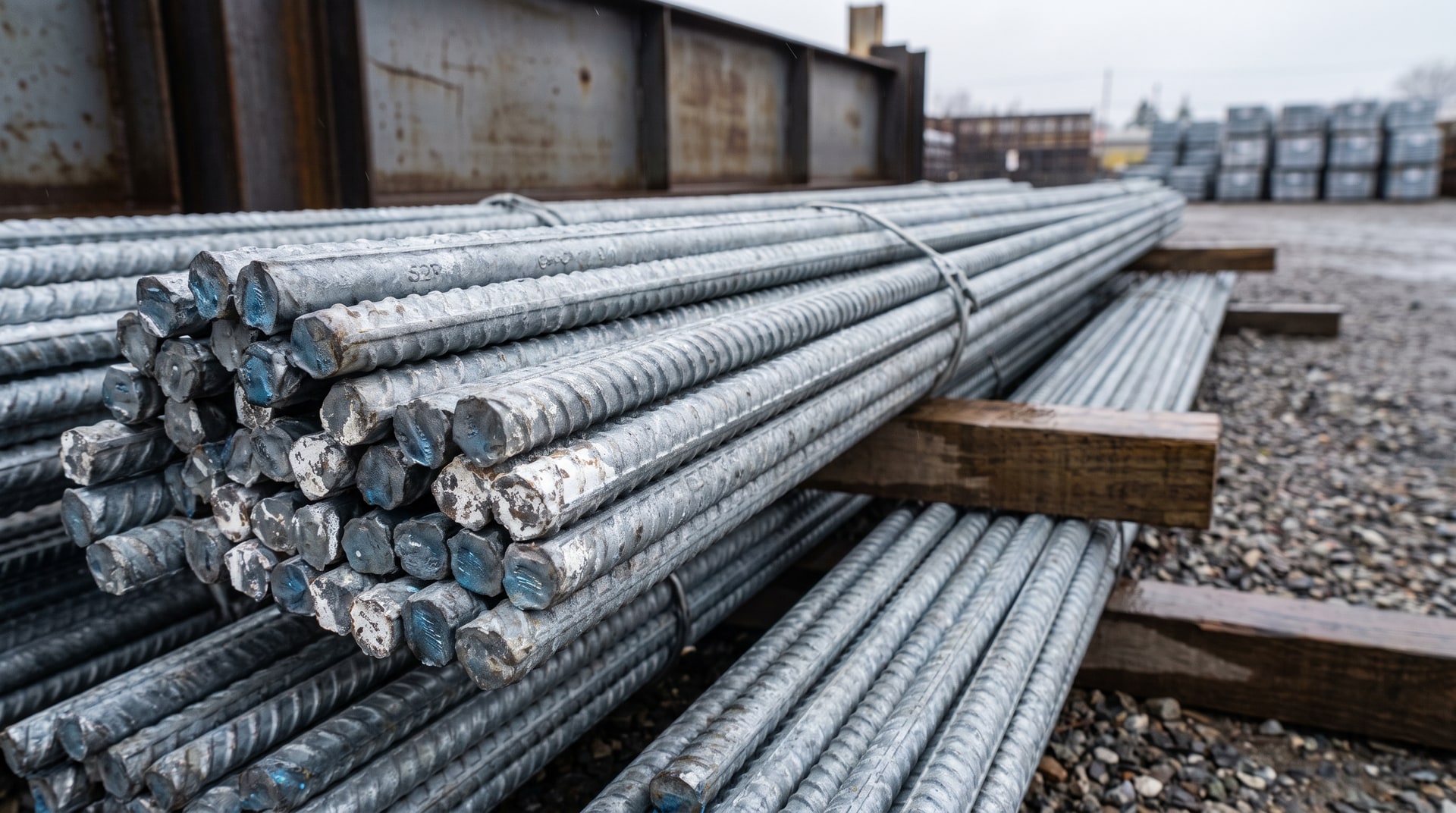
When a bridge deck starts to spall, or a parking structure develops rust staining along its soffits, the failure rarely traces back to the concrete mix design or the structural calculations. It traces back to the rebar. Embedded steel in reinforced concrete exists in a chemically complex environment, and when chlorides penetrate that environment, whether from deicing salts, marine spray, or seawater-mixed cement, the coating system on the reinforcement becomes the last line of defense. The choice between hot-dip galvanized (HDG) rebar and epoxy-coated rebar is not a minor specification detail. It is a decision that shapes the maintenance trajectory of a structure for decades.
The American Galvanizers Association addresses this directly in their article on galvanized vs. epoxy-coated rebar. At V&S Galvanizing, we expand on that foundation to explain what is actually happening at the material level, how chloride exposure influences corrosion initiation, and why the performance gap between these two coating systems is often underestimated in the field.
Why the Coating on Rebar Matters More Than Most Engineers Expect
Reinforcing steel embedded in concrete benefits from the naturally alkaline environment the cement paste provides. The high pH of fresh concrete, typically above 12, forms a passive oxide layer on bare steel that temporarily inhibits corrosion. The problem is that this passive layer is not permanent. Carbonation slowly lowers the pH over time, and chloride ions accelerate the process by locally disrupting the passive film at specific sites, even when the bulk pH remains high.
Once chloride-induced depassivation occurs at a point on the rebar surface, active corrosion begins. The iron oxides that form occupy roughly 10% more volume than the original steel, as the AGA notes in their source data. In a confined space like a concrete cover zone, that expansion generates internal tensile stress that the concrete simply cannot resist. The result is cracking, delamination, and spalling, the visible failure mode that road crews and bridge inspectors encounter on aging infrastructure.
A coating system on the rebar does not eliminate this chemistry. It delays it. The question is how long the delay lasts, and whether the coating remains intact long enough to matter structurally.
The Real-World Track Record of Galvanized Rebar
Hot-dip galvanized reinforcement has been in service since the 1950s. The earliest documented example is the Longbird Bridge in Bermuda, built in 1953. Bermuda sits in a marine environment with persistently high chloride levels, making it a genuinely demanding test case rather than an idealized laboratory condition. When the Construction Technology Labs inspected the bridge in 1978, they found chloride concentrations in the concrete reaching 7.3 lbs/yd³ (4.3 kg/m³). Crucially, the analysis suggested the cement was likely mixed with seawater during construction, meaning the galvanized rebar was exposed to elevated chloride levels from the moment of placement.
Despite those conditions, the galvanized coating remained 98% intact after nearly 50 years of service. That is not a minor margin. At chloride levels well above the threshold that drives active corrosion on bare steel, the zinc coating had continued to perform without significant degradation.
A second case study reinforces this pattern. The Athens Bridge in Pennsylvania, built in 1973 by a state DOT that has specified galvanized rebar for decades, was cored and inspected eight years after construction. Chloride levels at the rebar depth ranged from 1.8 to 7.9 lbs/yd³. The upper end of that range substantially exceeds the recognized threshold for active corrosion on unprotected steel. What the inspectors found instead was galvanized rebar retaining over 15 mils of coating with no signs of active corrosion. Follow-up inspections in 1991 and 2001 produced the same finding. The AGA projects additional service life of 40 or more years beyond those inspections.
These are not isolated anecdotes. Across more than 500 bridges estimated to use HDG as the primary corrosion protection system, current inspection reports consistently return excellent results. Most structures carry maintenance-free service estimates of at least 75 years.
How Epoxy Coating Entered the Market and Why It Fell Short
By the 1960s, the New York State Thruway Authority (NYSTA) was already confronting the effects of widespread deicing salt use. Freeze-thaw cycling combined with chloride infiltration was accelerating the deterioration of bridge decks across the system. The corrosion products of steel rebar, expanding volumetrically as noted above, were rupturing concrete surfaces in large spalling sections. A protective solution for embedded reinforcement was needed at scale.
The barrier coating concept had been working reasonably well in the underground pipe industry, and by the early 1980s, the NYSTA began applying it to rebar in the form of fusion-bonded epoxy. For roughly a decade, epoxy-coated rebar was the specified solution. After ten years of extensive use, however, the NYSTA initiated a search for an alternative, and the reasons were specific enough to be instructive.
The first problem was the nature of barrier coatings themselves. A barrier coating protects by physically excluding moisture and chlorides from the steel substrate. This only works when the film is continuous and intact. Pits or discontinuities in the epoxy, whether from manufacturing variation or damage, expose bare steel directly to the concrete environment. At those sites, corrosion initiates immediately and without the benefit of any cathodic protection from the surrounding coating. The steel beneath an epoxy coating offers no sacrificial protection to adjacent damaged zones the way zinc does.
The second problem was practical: epoxy-coated rebar lacks meaningful abrasion resistance. Rebar moves through a construction site in bundles, on flatbed trucks, through bar-bending equipment, and into form work at close tolerances. Each handling event is an opportunity for the coating to be scratched, abraded, or nicked. By the time epoxy-coated bars are placed and concrete is poured, the coating integrity is often already compromised at multiple points. The very environment the coating was meant to exclude now has direct access to the steel.
Zinc's Electrochemical Advantage Over Epoxy
Understanding why HDG rebar outperforms epoxy-coated rebar over time requires understanding the difference between barrier protection and sacrificial protection. Epoxy is purely a barrier system. It works by isolating the steel from the environment. When the barrier is breached, protection at that location ends.
Zinc, by contrast, is electrochemically active. It is anodic relative to steel in most environments, meaning that when zinc and steel are electrically connected and exposed to an electrolyte, the zinc corrodes preferentially while the steel is protected. This is cathodic protection. In the context of embedded rebar, this means that even where the galvanized coating sustains minor damage or develops small discontinuities, the surrounding zinc continues to protect the underlying steel by sacrificial action.
Additionally, zinc reacts with the alkaline concrete environment to form a tightly adherent zinc hydroxychloride layer, a stable corrosion product that actually slows further zinc consumption. This passivation within the concrete matrix helps explain why the Longbird Bridge coating remained so largely intact after exposure to chloride levels that would have driven aggressive corrosion on bare steel long before the 1978 inspection.
Bond Strength and What It Means for Design Quantities
One objection sometimes raised against galvanized rebar is the question of bond strength between the coating and concrete. It is a legitimate engineering concern, and the lifecycle cost analysis the NYSTA conducted speaks directly to it. The analysis confirmed that the initial per-pound cost of HDG rebar is slightly higher than epoxy-coated rebar. That cost gap, however, does not exist in isolation.
Epoxy-coated rebar has inferior bond strength relative to galvanized rebar in concrete. Because bond strength influences the development length required for reinforcement to achieve its rated tensile contribution, a reduction in bond strength translates directly into more rebar required per structure. You need more bars, placed at closer spacing or longer embedment lengths, to achieve the same structural performance. When the NYSTA factored this into their lifecycle cost analysis, HDG rebar moved to a highly competitive cost position even on an initial-cost basis, before any maintenance savings were considered.
Over the full life of the structure, the maintenance-free service life of HDG rebar is, as the AGA documents, unmatched among the coating options evaluated. The compounding effect of no maintenance interventions over a 75-plus-year design life represents a cost advantage that first-cost comparisons simply cannot capture.
State DOT Adoption and What It Signals to Specifiers
The adoption patterns of state transportation departments are worth noting here because they reflect conclusions drawn from long-term field data rather than laboratory testing or short-term trials. The NYSTA's progression from uncoated steel to epoxy to HDG rebar was not driven by marketing material. It was driven by inspections of their own structures showing what held up and what did not.
The Pennsylvania DOT made a parallel decision independently, specifying galvanized rebar not as an experiment but as a standing practice for bridge construction spanning decades. The Athens Bridge inspections gave them three separate data points over 28 years confirming that the coating system was performing as intended under real-world chloride exposures.
When two major state DOTs with large, heavily-salted highway networks converge on the same coating specification through separate evaluations, the engineering basis for that convergence is worth taking seriously. Specifiers working on bridges, parking structures, marine platforms, or any reinforced concrete application in a chloride-rich environment are working with a substantial body of field evidence when they write hot-dip galvanized rebar into their project documents.
Practical Handling Durability on the Job Site
Galvanized coatings are meaningfully harder and more abrasion-resistant than fusion-bonded epoxy. This has direct consequences for what happens between the galvanizing plant and the concrete form. Rebar is a construction material that gets dropped, dragged, bundled with tie wire, bent at the job site, and sometimes stored outdoors for weeks before placement. A coating that cannot survive those conditions reliably will have a degraded starting condition by the time concrete encases it.
The zinc-iron alloy layers that form at the steel surface during the hot-dip galvanizing process are bonded metallurgically to the substrate, not just adhered as a film. The outer eta-zinc layer adds additional thickness and provides the sacrificial protection. Together, these layers resist the kind of surface damage that epoxy coatings sustain during normal construction handling. This durability at the job site is not a secondary benefit. For a coating system whose performance depends on continuity, it is directly tied to whether the coating does what it was specified to do.
Work With a Team That Understands Reinforcing Steel Requirements
Choosing a coating system for reinforcing steel is ultimately a question about how long a structure is expected to remain in service and how much corrosion risk the environment introduces. The field record for hot-dip galvanized rebar across marine, freeze-thaw, and high-chloride environments is extensive and consistently positive. The documented limitations of epoxy-coated rebar under those same conditions are equally well-established. For chloride-exposed reinforced concrete structures with 75-plus-year design lives, the technical evidence points clearly toward galvanized reinforcement.
At V&S Galvanizing, our team works with engineers, fabricators, and contractors to help ensure reinforcing steel is processed to meet project specifications and performance expectations. If you are working on a bridge, marine structure, or any application where embedded steel corrosion is a design concern, we are glad to discuss your project in detail. Reach out through our contact page to connect with our technical team.
Frequently Asked Questions About Galvanized vs. Epoxy-Coated Rebar
How long has hot-dip galvanized rebar been used in bridge construction?
Hot-dip galvanized rebar has been used in bridge construction since at least the 1950s. The Longbird Bridge in Bermuda, constructed in 1953, is one of the earliest documented examples. An inspection in 1978 found the coating 98% intact despite severe chloride exposure from what appears to have been seawater-mixed cement.
Why does epoxy-coated rebar fail in chloride environments?
Epoxy is a barrier coating that relies entirely on film continuity to protect the steel. Any pit, scratch, or discontinuity in the epoxy exposes bare steel directly to chlorides with no electrochemical protection from the surrounding coating. Epoxy also lacks abrasion resistance, so damage during transport, bending, and placement further compromises the barrier before concrete is even poured.
Does zinc provide cathodic protection to rebar inside concrete?
Yes. Zinc is electrochemically anodic relative to steel, so where the galvanized coating sustains minor damage, the surrounding zinc sacrificially protects the exposed steel by preferential oxidation. This is fundamentally different from a barrier system like epoxy, which provides no cathodic protection once it is breached.
What chloride levels were present at the Athens Bridge inspection, and how did galvanized rebar perform?
Cores drilled eight years after the 1973 construction showed chloride levels ranging from 1.8 to 7.9 lbs/yd³ at rebar depth. The upper value substantially exceeded the threshold for active corrosion on bare steel. Despite this, inspectors found galvanized rebar retaining over 15 mils of coating with no active corrosion present. Follow-up inspections in 1991 and 2001 confirmed the same result.
Is galvanized rebar more expensive than epoxy-coated rebar?
On a per-pound basis, HDG rebar carries a slightly higher initial cost than epoxy-coated rebar. However, epoxy-coated rebar requires greater quantities per structure because its inferior bond strength with concrete demands longer development lengths or closer bar spacing. When the NYSTA conducted a lifecycle cost analysis, HDG rebar reached a highly competitive initial cost position, and its maintenance-free service life made the long-term cost comparison decisively favorable.
What makes zinc coatings more durable during rebar handling and installation?
The zinc-iron alloy layers formed during hot-dip galvanizing are metallurgically bonded to the steel substrate, not simply adhered as a surface film. This bond and the inherent hardness of the alloy layers make galvanized coatings significantly more resistant to abrasion, scraping, and impact than fusion-bonded epoxy. A galvanized bar arrives at the placement location with its coating substantially intact, whereas epoxy-coated bars routinely sustain damage during bundling, transport, cutting, and bending.
How many bridges currently use hot-dip galvanized rebar as their primary corrosion protection system?
According to AGA data, it is estimated that over 500 bridges use hot-dip galvanized reinforcement as their primary corrosion protection system. Current inspections across these structures report excellent performance, with most carrying maintenance-free service estimates of at least 75 years.
Why did the New York State Thruway Authority move away from epoxy-coated rebar toward HDG rebar?
After roughly a decade of extensive epoxy-coated rebar use beginning in the early 1980s, the NYSTA found two persistent failure mechanisms: coating discontinuities that allowed immediate corrosion at unprotected sites, and inadequate abrasion resistance that led to coating damage during construction handling. A lifecycle cost analysis comparing coating options placed HDG rebar in a competitive financial position while also offering a maintenance-free service life that epoxy could not match.
