
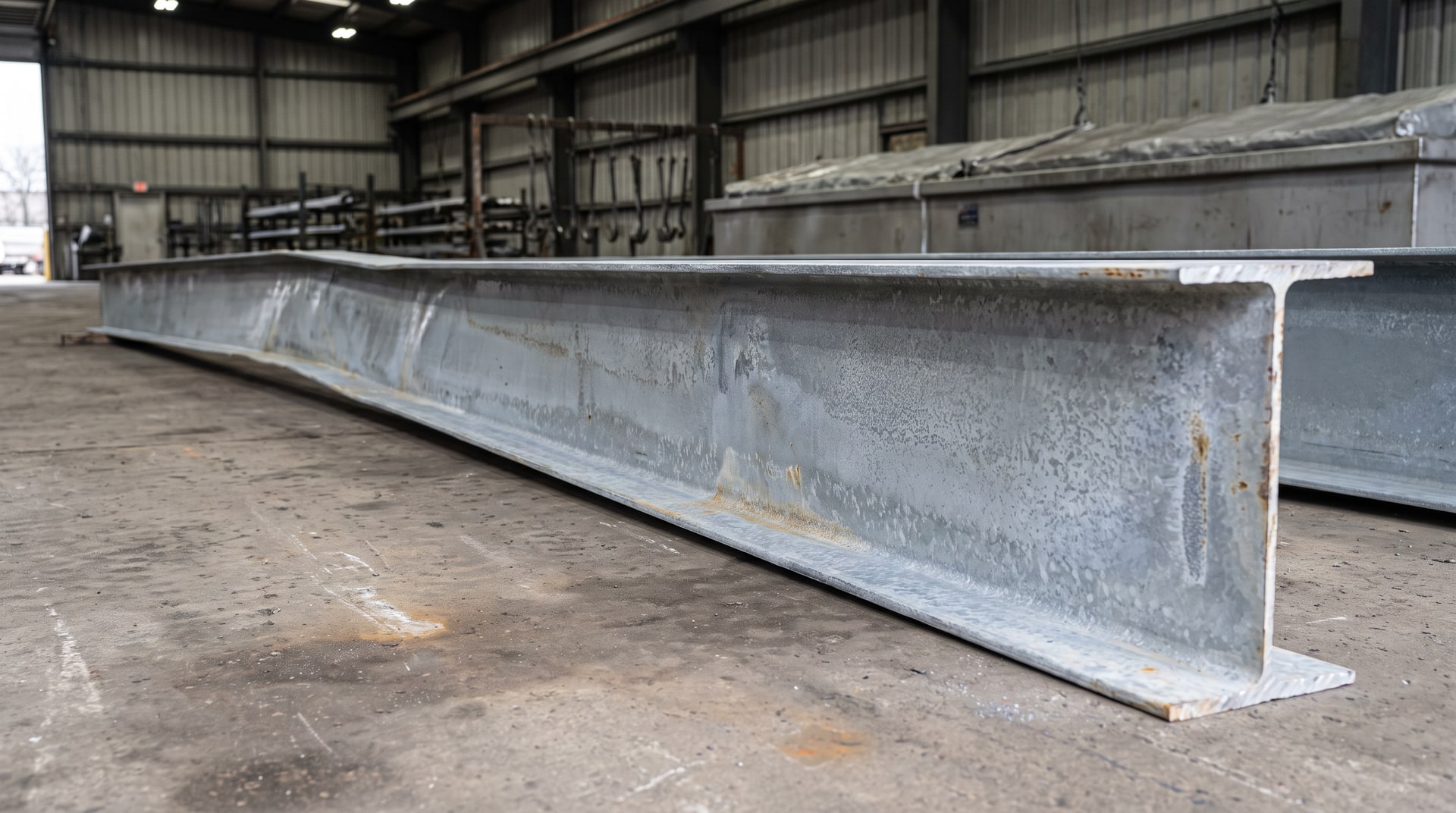
Steel does not enter a galvanizing kettle rigid and unchanging. It enters as a material with internal stresses, uneven cross-sections, and welds that have already introduced their own thermal history. When that assembly is immersed in molten zinc at roughly 850 degrees Fahrenheit, every element of the fabrication responds to that heat in its own way. Thicker sections absorb heat slowly. Thinner sections reach temperature almost instantly. That differential, playing out across a single piece of steel, is where warpage and distortion begin.
This is not a rare failure mode. It is a predictable consequence of thermal mechanics, and it is one that fabricators and engineers can largely avoid with the right design decisions made before a piece ever reaches the galvanizing plant. The American Galvanizers Association addresses this directly in their article on avoiding warpage and distortion of hot-dip galvanized articles. At V&S Galvanizing, we expand on that foundation to explain what is actually happening at the material level, how thermal gradient influences deformation, and why this is often misunderstood in the field.
The Thermal Mechanics Behind Shape Change
To understand why steel distorts during galvanizing, you have to think about what heat does to metal at a structural level. Steel expands when heated and contracts when cooled. In a perfectly uniform section, that expansion and contraction happens symmetrically, and the piece returns to something close to its original geometry. The problem arises when different parts of the same assembly heat and cool at different rates.
When one element of a fabrication reaches temperature significantly ahead of another, it expands while the adjacent, cooler section resists that expansion. That resistance creates compressive stress in the faster-heating element and tensile stress in the slower one. If those stresses exceed the yield strength of the material at elevated temperature, which is lower than at room temperature, the steel deforms permanently. No amount of cooling afterward will undo that plastic deformation. The result is a piece that comes out of the kettle with a bow, twist, or camber change that was not there when it went in.
The zinc bath itself does not cause this. The zinc is the medium. The cause is the thermal event, and the severity of that event depends almost entirely on the geometry and mass distribution of the fabricated assembly.
Why Light Gauge Material Welded to Heavier Sections Is Particularly Vulnerable
ASTM A384, Standard Practice for Safeguarding Against Warpage and Distortion During Hot-Dip Galvanizing of Steel Assemblies, specifically identifies light gauge material ranging from 20 gauge up to less than one-quarter inch, when it is welded or riveted to plate, bars, or angles, as one of the primary risk configurations. This makes intuitive sense when you think through the physics.
A thin sheet attached to a thick plate will reach galvanizing temperature many times faster than the plate it is connected to. The sheet tries to expand freely, but the plate holds it in check. That restraint forces the sheet to buckle or bow. As the assembly eventually reaches a uniform temperature, the stresses redistribute, but the light gauge material has often already passed its yield point and taken a permanent set. When everything cools, the distortion is locked in.
The weld or rivet connecting these two elements is not just a mechanical fastener in this context. It is a rigid link between two materials that want to move at different rates. The more of those rigid links present, and the more asymmetrically they are distributed, the more unpredictable the deformation becomes.
Non-Symmetrical Sections and the Channel Problem
Structural channels are a textbook example of a shape prone to distortion. A standard channel has a web and two flanges, but those flanges are on one side only. The cross-section is not symmetric about the horizontal axis, which means when it is heated, the web and flanges do not expand uniformly in all directions. The thicker portions heat more slowly than the thinner ones, and because the geometry is not balanced, the thermal gradient drives the section to bow or twist in a predictable but difficult-to-control direction.
This is a fundamentally different problem from the light-gauge-on-heavy-plate scenario. In that case, the issue is two connected elements with very different masses. In the channel case, the issue is a single extruded or rolled shape that has inherently unequal cross-sectional distribution. Both problems trace back to differential thermal response, but they require different design strategies to mitigate.
Non-symmetrical sections like channels, angles, and Z-shapes all carry some inherent distortion risk. The degree of risk scales with the size of the section, the length of the piece, and how it is fabricated into a larger assembly. A short channel welded into a heavily braced structure behaves very differently from a long, unsupported channel welded to a light gauge skin.
Large Assemblies and the Progressive Dipping Challenge
Some fabrications are simply too large to fit entirely within a galvanizing kettle in a single immersion. These pieces require what is called progressive dipping: one end is immersed first, withdrawn, then the piece is turned around or flipped so the other end can be dipped. This technique allows galvanizers to coat assemblies that would otherwise be impossible to process, but it introduces a thermal gradient along the length of the piece that does not exist in single-dip work.
When the first end is immersed, it heats rapidly and expands. The second end, still at ambient temperature, has not yet begun to respond. That longitudinal thermal differential creates bending moment along the length of the piece, effectively acting like a load applied at one end of a beam. If the piece has any pre-existing camber or residual stress from fabrication, the progressive dip can amplify it significantly. After the second end is dipped and the assembly returns to equilibrium, the camber change may be permanent.
This is one of the more challenging distortion scenarios to predict because it depends on the specific geometry, the length of the piece, the time between dips, and the residual stress state of the steel. Large structural shapes, long fabrications, and assemblies with complex welded connections are all at elevated risk when progressive dipping is required.
Residual Stress from Fabrication: The Variable That Enters the Kettle Before the Steel Does
Warpage during galvanizing is not always caused by what happens in the zinc bath. Sometimes the distortion was already waiting to happen, and the galvanizing process simply releases it. Cutting, welding, punching, and forming all introduce residual stresses into steel. A weld, for example, locally heats the base metal to very high temperatures and then contracts as it cools, leaving tensile stresses in the weld zone and compressive stresses in the surrounding material. These stresses are locked in place at room temperature because the steel is stiff enough to resist movement.
In the galvanizing bath, the steel softens slightly and its yield strength drops. Stresses that the material could hold at room temperature now find release. The piece moves to a lower-energy configuration, and that movement is permanent. This mechanism explains why some distortion appears even in sections that would not seem geometrically at risk. The problem was in the fabrication, not the galvanizing itself, though the heat of galvanizing is what reveals it.
Fabricators who understand this dynamic will take steps to reduce residual stress before sending assemblies to the galvanizer. Balanced welding sequences, minimizing overwelding, and avoiding unnecessary restraint during assembly all contribute to a more stable piece at the point of immersion.
Design Choices That Reduce Distortion Risk
The most effective interventions happen at the design stage, not at the galvanizing plant. Once a piece is fabricated with a configuration that is thermally unstable, there is limited room to correct the outcome. Designing with galvanizing in mind means thinking about how heat will move through the assembly and how different elements will respond to that heat.
Symmetric cross-sections are inherently more stable than asymmetric ones. When the geometry of a section is balanced about its neutral axes, the thermal expansion during galvanizing is also more balanced, reducing the net bending moment generated by differential heating. Where asymmetric sections are unavoidable, understanding the direction of likely distortion allows engineers to design in compensating features or to accept and account for the expected shape change.
For assemblies that combine light gauge material with heavy plate, the connection method and pattern matter significantly. Continuous welds create more rigid restraint than stitch welds, which can allow some relative movement between elements as they heat. This does not mean stitch welding is always preferable, since structural requirements govern connection design, but it illustrates how weld detailing choices carry thermal consequences.
Material selection also plays a role. Sections with more uniform thickness throughout an assembly heat more uniformly. Avoiding extreme mismatches in section thickness within a single fabrication is one of the more straightforward ways to reduce distortion risk without changing the structural intent of the design.
The Galvanizer's Role and Why Early Communication Matters
There is a limit to what a galvanizer can do to prevent distortion that is built into the geometry of a piece. The kettle temperature is determined by the zinc chemistry and the requirements of the coating specification. The immersion angle can be adjusted to influence how the piece heats and how flux gases and zinc drain from internal cavities, but it cannot fundamentally alter the thermal response of a piece with a severe mass mismatch.
What the galvanizer can offer is experience-based insight into which configurations have historically caused problems and how to adjust design or fabrication details to reduce risk. This is why ASTM A384 and the AGA both emphasize early contact with the galvanizer as a central part of the strategy. When engineers and fabricators engage with the galvanizing operation during the design phase rather than after fabrication is complete, there is genuine opportunity to catch and address distortion-prone configurations before they become expensive problems.
Our team at V&S Galvanizing regularly works with fabricators and structural engineers to review assemblies for galvanizability, including distortion risk assessment. The conversations that happen before a piece is cut and welded are the ones that actually prevent rework. By the time an assembly arrives at the plant, the outcome is largely already determined by the decisions made at the drawing board.
If you are working on a project that involves complex welded assemblies, large fabrications requiring progressive dipping, or sections with significant variation in material thickness, reviewing the design against the guidance in our hot-dip galvanizing process and connecting with our technical team early is the most reliable path to a dimensionally stable result.
Work With a Team That Understands the Full Thermal Picture
Warpage and distortion in hot-dip galvanized steel are not random events. They are predictable responses to thermal gradients acting on geometries that were not optimized for uniform heating and cooling. ASTM A384 provides the framework for understanding which configurations carry the most risk, and the underlying physics explains why those configurations behave the way they do. Light gauge material welded to heavy sections, non-symmetrical shapes like channels, large assemblies requiring progressive dipping, and fabrications carrying high residual weld stress from production are all scenarios that deserve careful engineering attention before the steel ever approaches a galvanizing kettle.
The good news is that most distortion-related failures are preventable with the right knowledge applied at the right stage of the project. Designing for symmetry, managing weld sequences, choosing appropriate section combinations, and engaging the galvanizer early in the design process are all actions that sit within the control of the engineering and fabrication team. When those steps are taken, galvanizing delivers exactly what it is supposed to: a durable, tightly adhered zinc coating on steel that retains its intended geometry.
If your project involves fabrications with complex geometry, mixed section weights, or any of the configurations described above, we encourage you to reach out before fabrication begins. Our technical team is available to review drawings, flag potential distortion risks, and work through design modifications that preserve both structural intent and dimensional stability. Visit our contact page to start that conversation.
Frequently Asked Questions About Warpage and Distortion in Hot-Dip Galvanizing
What is ASTM A384 and what does it cover?
ASTM A384 is the Standard Practice for Safeguarding Against Warpage and Distortion During Hot-Dip Galvanizing of Steel Assemblies. It identifies the types of fabrications and configurations that are most prone to shape change during the galvanizing process, including light gauge material welded to heavier sections, non-symmetrical shapes, and large assemblies requiring progressive dipping. It serves as the primary reference standard for engineers and fabricators designing steel for hot-dip galvanizing.
Why does hot-dip galvanizing cause steel to warp?
Warpage occurs because different elements of a fabricated assembly heat and cool at different rates when immersed in the molten zinc bath. Thinner sections reach temperature faster than thicker ones, creating thermal gradients across the piece. Those gradients generate internal stresses that, if they exceed the material's yield strength at elevated temperature, cause permanent deformation. The zinc itself is not the cause; the thermal event driving unequal expansion and contraction is.
Which types of steel assemblies are most at risk for galvanizing distortion?
Assemblies most at risk include light gauge material (20 gauge to less than 1/4 inch) welded or riveted to heavier plate, bars, or angles; non-symmetrical sections such as channels that have two different material thicknesses heating and cooling at different rates; and very large fabrications that require progressive dipping because they cannot be immersed in a single dip. Assemblies with high residual weld stress from fabrication are also vulnerable.
What is progressive dipping and why does it increase distortion risk?
Progressive dipping is a technique used when a fabrication is too large to fit entirely in the galvanizing kettle in one immersion. One end is dipped first, then the piece is turned and the other end is dipped. This creates a longitudinal thermal gradient along the length of the piece, with one end already heated and expanded while the other is still at ambient temperature. That gradient generates bending forces that can permanently alter the camber of the assembly, particularly in large structural shapes.
Can residual stress from welding cause distortion during galvanizing even if the geometry looks symmetric?
Yes. Welding introduces residual tensile and compressive stresses into the base metal as the weld zone heats and then contracts on cooling. At room temperature, the steel is stiff enough to hold those stresses in place. During galvanizing, the elevated temperature reduces the steel's yield strength, allowing those locked-in stresses to release and the piece to move toward a lower-energy configuration. This movement is permanent and can cause visible distortion even in geometrically balanced sections.
How can engineers reduce the risk of distortion in steel fabrications intended for galvanizing?
Key strategies include designing for symmetry in cross-sections where possible, avoiding extreme mismatches in section thickness within a single assembly, using balanced weld sequences to minimize residual stress, and minimizing overwelding. Engaging the galvanizer early in the design phase is also critical. The galvanizer can identify thermally unstable configurations before fabrication begins, when changes are still practical and inexpensive.
Is there anything the galvanizer can do to prevent distortion once a piece is fabricated?
Options are limited once fabrication is complete. The galvanizer can adjust the immersion angle and entry speed to influence how the assembly heats, which may reduce the severity of thermal gradients in some cases. However, if the fabrication geometry includes severe mass mismatches or high residual stress, those underlying conditions cannot be fully compensated for at the plant. Prevention is far more effective than correction, which is why early collaboration between the engineer, fabricator, and galvanizer is emphasized in ASTM A384 and industry practice.
Do non-symmetrical sections like channels always distort during galvanizing?
Not always, but they carry inherent risk because their geometry causes differential thermal response. The web and flanges of a channel heat at different rates, and because the cross-section is not balanced about the horizontal axis, the resulting expansion forces the section to bow or twist. The actual outcome depends on the size of the section, its length, how it is incorporated into the assembly, and the degree of external restraint. Short, heavily braced channels in a rigid frame may show little distortion, while long, unsupported ones are significantly more vulnerable.
