

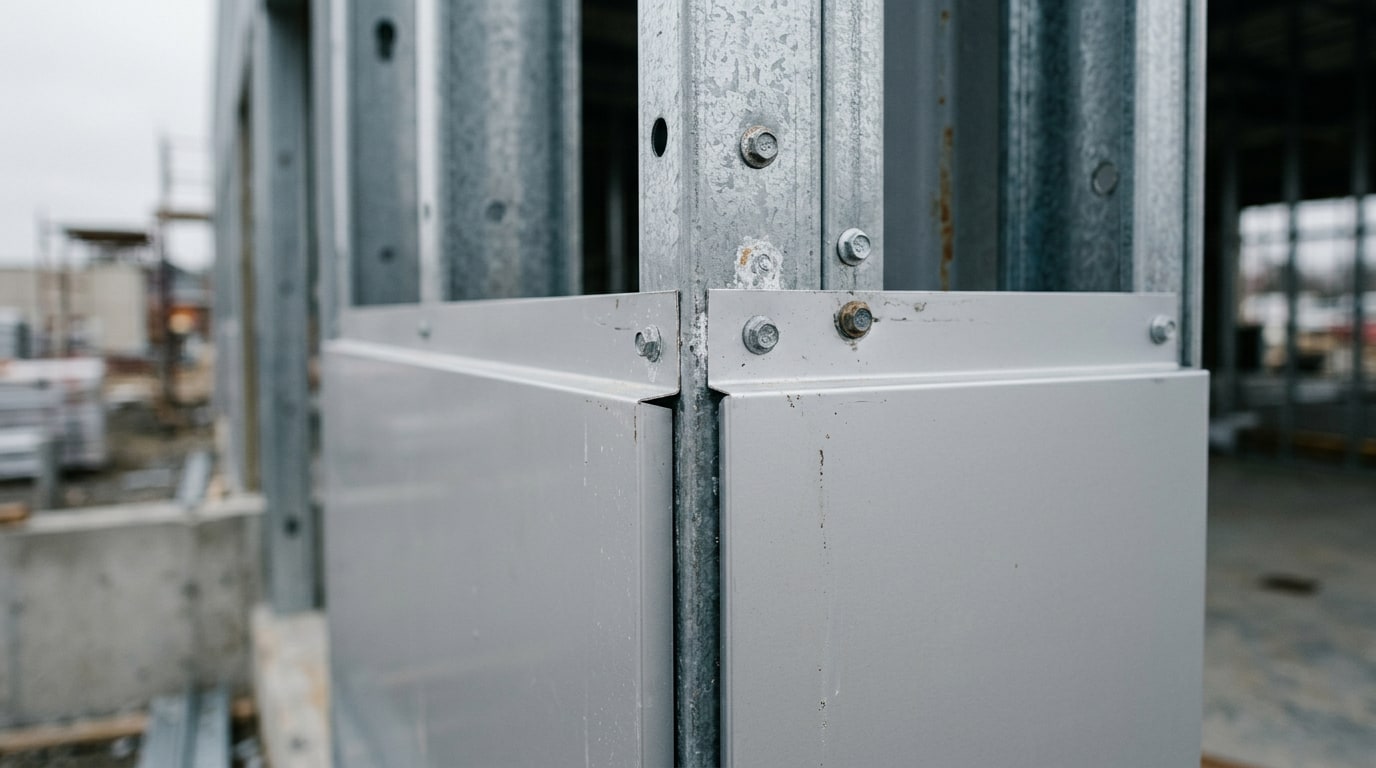
When a project calls for aluminum cladding on galvanized steel studs, or when aluminum hardware gets bolted to a hot-dip galvanized frame, the question almost inevitably comes up: are these two materials going to corrode each other? It is a reasonable concern, and the answer is not as simple as yes or no. The behavior at the interface between zinc-coated steel and aluminum depends on electrochemical potential differences, the geometry of the joint, the conductivity of any moisture present, and whether an oxide film has had a chance to form. Getting these factors wrong in the design phase can lead to premature corrosion failures that are expensive to address after the fact.
The American Galvanizers Association addresses this directly in their article on galvanized steel with aluminum parts. At V&S Galvanizing, we expand on that foundation to explain what is actually happening at the material level, how area ratio and environmental conductivity influence performance, and why this combination is often misunderstood in the field.
The Electrochemical Basis of Galvanic Corrosion
Galvanic corrosion is not random or unpredictable. It follows well-established electrochemical principles. When two metals with different electrode potentials make contact in the presence of a conductive electrolyte, current flows between them. The metal with the more negative (anodic) potential gives up electrons and corrodes, while the more positive (cathodic) metal is protected. This is, in fact, the same mechanism that makes hot-dip galvanizing work so well as a coating for steel: zinc is anodic to iron, so it sacrifices itself to protect the underlying substrate.
The electrode potentials measured in seawater give us a useful reference scale for comparing metals. Magnesium sits at -1.55 V, well below zinc at -1.10 V, which in turn sits below aluminum at -0.86 V. Aluminum is more negative than cadmium (-0.77 V), cast iron and carbon steel (both at -0.68 V), stainless steel in its active state (-0.61 V), and on down to aluminum bronze at -0.41 V.
| Material | Potential (Volts) |
|---|---|
| Magnesium | -1.55 |
| Zinc | -1.10 |
| Aluminium | -0.86 |
| Cadmium | -0.77 |
| Cast Iron | -0.68 |
| Carbon Steel | -0.68 |
| Stainless Steel 18% Cr / 8% Ni (active) | -0.61 |
| Lead | -0.57 |
| Solder (50Pb / 50Sn) | -0.52 |
| Tin | -0.49 |
| Copper | -0.43 |
| Aluminium Bronze | -0.41 |
What this table tells us in practical terms is that the greater the voltage gap between two metals in contact, the more aggressive the galvanic cell. A large potential difference drives a stronger electrochemical reaction, accelerating the corrosion of the anodic member. The pairing of magnesium and copper, for example, represents a severe mismatch. Zinc and aluminum, however, sit relatively close together on this scale, with a separation of only about 0.24 V. That proximity matters.
Why Zinc and Aluminum Are a Relatively Benign Pairing
The 0.24 V potential difference between zinc (-1.10 V) and aluminum (-0.86 V) places this combination in a category that carries only slight galvanic risk under most conditions. This is a meaningful distinction from pairings like zinc and copper or aluminum and stainless steel, where the potential gaps are larger and corrosion rates correspondingly higher.
Beyond the voltage gap itself, aluminum brings an additional natural defense to the equation: it forms a thin, tightly adherent aluminum oxide film on its surface almost immediately upon exposure to air. This passive layer is electrically insulating. It interrupts the conductive path needed to sustain a galvanic cell, effectively suppressing the reaction even when contact with zinc is direct. In many real-world applications, this film is stable enough that galvanic exchange between the two metals remains negligible throughout the service life of the assembly.
That said, the oxide film is not indestructible. Certain environments, particularly those with chlorides, acids, or alkaline conditions, can disrupt it. In those scenarios, the passive protection disappears and the small but real potential difference between zinc and aluminum becomes the controlling factor. This is one reason why the service environment must be factored into any assessment of galvanic risk, not just the material pairing alone.
Area Ratio: The Factor That Engineers Often Underestimate
Electrode potential differences establish whether a galvanic couple is possible. But the area ratio between the two metals in contact determines how severe the resulting corrosion will actually be. This distinction is critical and is frequently overlooked in practice.
When a large cathode is in contact with a small anode, corrosion concentrates on the anode. The cathodic surface drives the reaction, and if that surface area is large relative to the anodic member, the corrosion current density at the anode becomes very high. In plain terms: a small anodic material corrodes very fast when it is overwhelmed by a large cathodic partner.
The reverse geometry is much more forgiving. A small cathode in contact with a large anode distributes the corrosion current over a much greater area, lowering the corrosion rate per unit area on the anode to a manageable level. The galvanic couple still exists, but the practical damage is minimal.
For galvanized steel in contact with aluminum, this means the geometry of the connection really matters. If aluminum fasteners are used to join large galvanized steel panels, the aluminum is a small anode against a large zinc cathode: a problematic configuration. If, on the other hand, galvanized steel studs support aluminum sheet cladding, the large aluminum surface relative to the limited galvanized contact points works in a more favorable direction. Designers should think through this geometry explicitly before finalizing connection details.
The Role of Moisture and Electrolyte Conductivity
A galvanic cell requires three things: two metals of different potential, a physical connection between them, and a conductive medium bridging both. Remove any one of these, and the corrosion reaction cannot proceed. This is why electrolyte conductivity is just as important a variable as the metals themselves.
In many real-world assemblies, the moisture that accumulates at a metal-to-metal joint is condensation rather than standing water. Condensed water is often relatively pure and carries very low dissolved ion concentrations. Low conductivity means the electrolyte cannot carry significant current between the two metals, and the galvanic reaction either does not start or proceeds at an extremely slow rate. This is a nuance worth knowing: not all moisture creates equal galvanic risk.
Seawater, on the other hand, is a highly conductive electrolyte loaded with dissolved salts, and the electrode potential tables are specifically calibrated in seawater to represent a near-worst-case scenario. Industrial atmospheres with sulfur compounds, deicing salt environments, and coastal zones all raise the conductivity of any moisture present, which in turn raises the galvanic risk. Interior building applications with only occasional condensation sit at the opposite end of the spectrum.
This is an important point when evaluating whether galvanized steel and aluminum can be used together without a barrier. In a controlled indoor environment with low humidity, the combination is frequently acceptable with no additional protective measures. In a coastal marine environment, the same joint demands more careful treatment.
Insulating Barriers: The Recommended Engineering Control
When the service environment cannot be reliably assessed, or when it is aggressive enough to sustain a conductive electrolyte, the most effective engineering control is physical separation. Placing an insulating barrier between the dissimilar metals breaks the electrical circuit and eliminates the galvanic cell entirely, regardless of potential differences or area ratios.
This is not a complicated intervention. Neoprene gaskets, plastic washers, non-conductive coatings, and isolation tape are all used in practice to achieve separation at contact points. The key requirement is that the barrier remain intact and maintain its insulating properties throughout the design service life of the structure. A degraded or damaged barrier that allows metal-to-metal contact to re-establish itself at one spot can concentrate the galvanic reaction at that point, sometimes producing localized corrosion that is worse than if no barrier had been used at all.
For painted or coated assemblies, the coating system itself can serve as the insulator, provided both surfaces are coated at the contact zone. Leaving one metal bare at the interface and relying on the other's coating does not provide reliable protection, since the uncoated metal will become an exposed electrode at any pinhole, scratch, or edge condition in the coating.
Reading the Bimetallic Effect Table in Context
The AGA source references a bimetallic effect table that maps how galvanized steel performs in contact with various other metals across different application types and environments. While we cannot reproduce every cell of that table here, the underlying logic is consistent with what we have described: the severity of the interaction scales with potential difference, area geometry, and electrolyte conductivity acting together rather than independently.
What the table communicates in a practical sense is that galvanized steel is not uniformly compatible or incompatible with all other metals. The outcome depends heavily on the specific combination and the conditions under which it is used. Zinc in contact with aluminum in a dry interior application might warrant no special precaution at all. The same pairing in a submerged or spray-zone marine environment may require full electrical isolation. The table provides a framework for making that judgment systematically, rather than relying on intuition alone.
Engineers specifying hot-dip galvanized steel for mixed-material assemblies should treat this kind of data as a starting point for analysis, not a final verdict. Local conditions, joint geometry, and maintenance access all modify the picture in ways that a general table cannot fully capture.
Common Misapplications and Field Misunderstandings
One of the most common errors we see is treating zinc and aluminum as either universally compatible or universally incompatible, when the reality is neither. The "they are close on the galvanic series so it is always fine" reasoning ignores the area ratio problem entirely. The "dissimilar metals always corrode each other" reasoning leads to over-engineering that adds cost without proportional benefit in benign environments.
A second frequent misunderstanding involves aluminum fasteners on galvanized steel. Because aluminum is anodic to the zinc coating on galvanized steel, aluminum fasteners used in large galvanized assemblies can experience accelerated corrosion due to the unfavorable area ratio described earlier. Switching to stainless steel fasteners, which are cathodic to zinc and aluminum but present a much smaller surface area, often represents a better trade-off when properly insulated at the contact point.
A third issue arises when designers assume that because galvanized steel performs well in contact with aluminum in architectural cladding applications, the same assumption holds in submerged or highly conductive environments. The aqueous environment shifts the electrochemical activity dramatically. What works on a dry wall stud does not automatically translate to a marine structural application.
Work With a Team That Understands the Full Picture
The interaction between galvanized steel and aluminum is manageable in the vast majority of applications, but it requires a clear-eyed look at potential differences, joint geometry, and service environment acting together. When those factors are favorable, as they often are in interior or low-humidity applications, the pairing performs reliably without special intervention. When conditions are more aggressive, a well-chosen insulating barrier eliminates the risk at low cost and complexity. The key is making that assessment deliberately, not by assumption.
At V&S Galvanizing, our team works with engineers, fabricators, and contractors on exactly these kinds of material compatibility questions during project planning. If you are working through a design that involves galvanized steel in contact with aluminum or other dissimilar metals and want to talk through the specifics, reach out through our contact page.
Frequently Asked Questions About Galvanized Steel and Aluminum Contact
Does zinc corrode aluminum when they are in direct contact?
Not necessarily. Zinc and aluminum have a relatively small electrode potential difference of approximately 0.24 V in seawater, which limits galvanic activity. Aluminum also forms a naturally insulating oxide film that further suppresses the reaction. In dry or low-humidity environments, direct contact between galvanized steel and aluminum typically causes negligible corrosion. In conductive electrolyte environments such as marine or industrial atmospheres, the risk increases and an insulating barrier is advisable.
What is the electrode potential of zinc versus aluminum?
In seawater, zinc has an electrode potential of -1.10 V and aluminum has an electrode potential of -0.86 V. This makes zinc the anode and aluminum the cathode in the pairing, meaning the zinc coating would preferentially corrode. However, the relatively small difference of 0.24 V, combined with aluminum's passive oxide film, means the galvanic driving force is modest compared to many other dissimilar metal combinations.
Why does the area ratio between dissimilar metals matter so much?
When a large cathodic surface is in contact with a small anodic surface, the corrosion current concentrates on the small anode, dramatically increasing its corrosion rate. The inverse configuration, a small cathode paired with a large anode, spreads the current over more surface area and reduces per-unit-area corrosion significantly. For galvanized steel and aluminum assemblies, this means that aluminum fasteners in large galvanized structures carry higher risk than galvanized fasteners in large aluminum panels.
Does condensation cause galvanic corrosion between zinc and aluminum?
Condensed water is often low in dissolved ions and therefore has low electrical conductivity. Because a conductive electrolyte is required to sustain a galvanic cell, condensation alone may not provide enough conductance to initiate meaningful corrosion between zinc and aluminum. This is notably different from seawater or chloride-laden moisture, which are highly conductive and create a much more active electrolytic environment.
When should an insulating barrier be used between galvanized steel and aluminum?
An insulating barrier is the recommended solution whenever the service environment is expected to be consistently wet, marine, or otherwise conductive. It is also appropriate when the joint geometry creates an unfavorable area ratio, such as aluminum fasteners on large galvanized members. In low-humidity interior applications where condensation is infrequent and non-conductive, a barrier may not be necessary, but it is never a harmful precaution.
Are aluminum fasteners safe to use with galvanized steel?
Aluminum fasteners are anodic to zinc in a galvanic couple, and they represent a small anode in contact with the larger cathodic zinc coating surface. This is an unfavorable area ratio that can accelerate corrosion of the aluminum fastener. In many structural and exterior applications, stainless steel fasteners with appropriate insulation at the contact point are a more durable choice. The decision should account for the specific environment and the relative surface areas involved.
Does the passive oxide film on aluminum always prevent galvanic corrosion with zinc?
Not always. The aluminum oxide film is an effective insulating layer under normal atmospheric conditions, but it can be disrupted by chloride-rich environments, strong acids, or alkaline conditions. Once the passive film breaks down, the electrochemical potential difference between zinc and aluminum becomes the operative factor, and corrosion can proceed. In aggressive environments, the film should not be relied upon as the sole protective mechanism.
How does the service environment change the risk level when combining galvanized steel and aluminum?
Environment is one of the three controlling variables in galvanic corrosion, alongside potential difference and area ratio. A dry interior setting with infrequent condensation presents very low risk, and the zinc-aluminum pairing is generally compatible without special precautions. A coastal marine environment introduces a highly conductive electrolyte continuously, which activates the galvanic cell and requires electrical isolation between the two metals to prevent progressive corrosion damage.
