
Every galvanized coating begins as a clean steel surface. The zinc-iron metallurgical bond that makes hot-dip galvanizing one of the most durable corrosion protection systems available depends entirely on bare, reactive steel coming into contact with molten zinc at temperature. When something gets in the way of that contact, the zinc cannot bond. The result is an ungalvanized area, sometimes called a bare spot, sitting in the middle of an otherwise intact coating. These failures are not random. They trace back directly to surface contaminants that were present before or during the galvanizing process and were not fully eliminated in pretreatment.
The American Galvanizers Association addresses this directly in their article on surface contaminants in hot-dip galvanizing. At V&S Galvanizing, we expand on that foundation to explain what is actually happening at the material level, how contaminant type influences the severity of the problem, and why this issue is more common and more consequential than many fabricators and engineers expect when they first encounter it in the field.
What Counts as a Surface Contaminant in the Galvanizing Context
The term "surface contaminant" covers a range of materials that share one defining characteristic: they prevent molten zinc from wetting and bonding to the steel substrate. In the galvanizing industry, the most frequently encountered offenders are paint, oil, wax, and lacquer. Each of these materials behaves differently in the pretreatment process, which is part of why they create problems.
Paint is perhaps the most obvious. Fabrication yards handle steel that has been marked, coated for temporary protection, or salvaged from prior service. Even small painted areas, a layout mark, a stenciled part number, a patch of primer from a previous project, can survive the alkaline cleaning bath if the paint is not fully saponifiable or if the film is thick enough to resist the chemistry. If any paint remains when the part enters the zinc kettle, the zinc simply cannot reach the steel beneath it.
Oils and greases come from machining, forming, welding setup, or handling. These are generally addressed by the degreasing stage of pretreatment, but certain cutting fluids, heavy greases, and silicone-based lubricants are more resistant to standard alkaline cleaners. If a fabricator applies a release agent, thread lubricant, or drawing compound and does not flag it, the galvanizer's cleaning chemistry may not fully remove it.
Waxes and lacquers show up in less obvious ways. Some steel arrives from service centers with a light lacquer or wax coating applied for cosmetic or handling protection. These coatings are not always visible to the naked eye under shop lighting, and they may not be identified before the part enters the pretreatment line. The galvanizer's cleaning chemistry is designed to remove common contaminants, but it has limits, especially against materials that were not disclosed upfront.
What Actually Happens Inside the Zinc Kettle
To understand why surface contaminants produce ungalvanized areas rather than some other kind of coating defect, it helps to think through the galvanizing reaction itself. When steel enters the molten zinc bath, which operates at roughly 830 degrees Fahrenheit, the zinc wets the steel surface and begins reacting with the iron in the steel to form a series of zinc-iron alloy layers. This reaction is thermally driven and proceeds very rapidly across a clean steel surface.
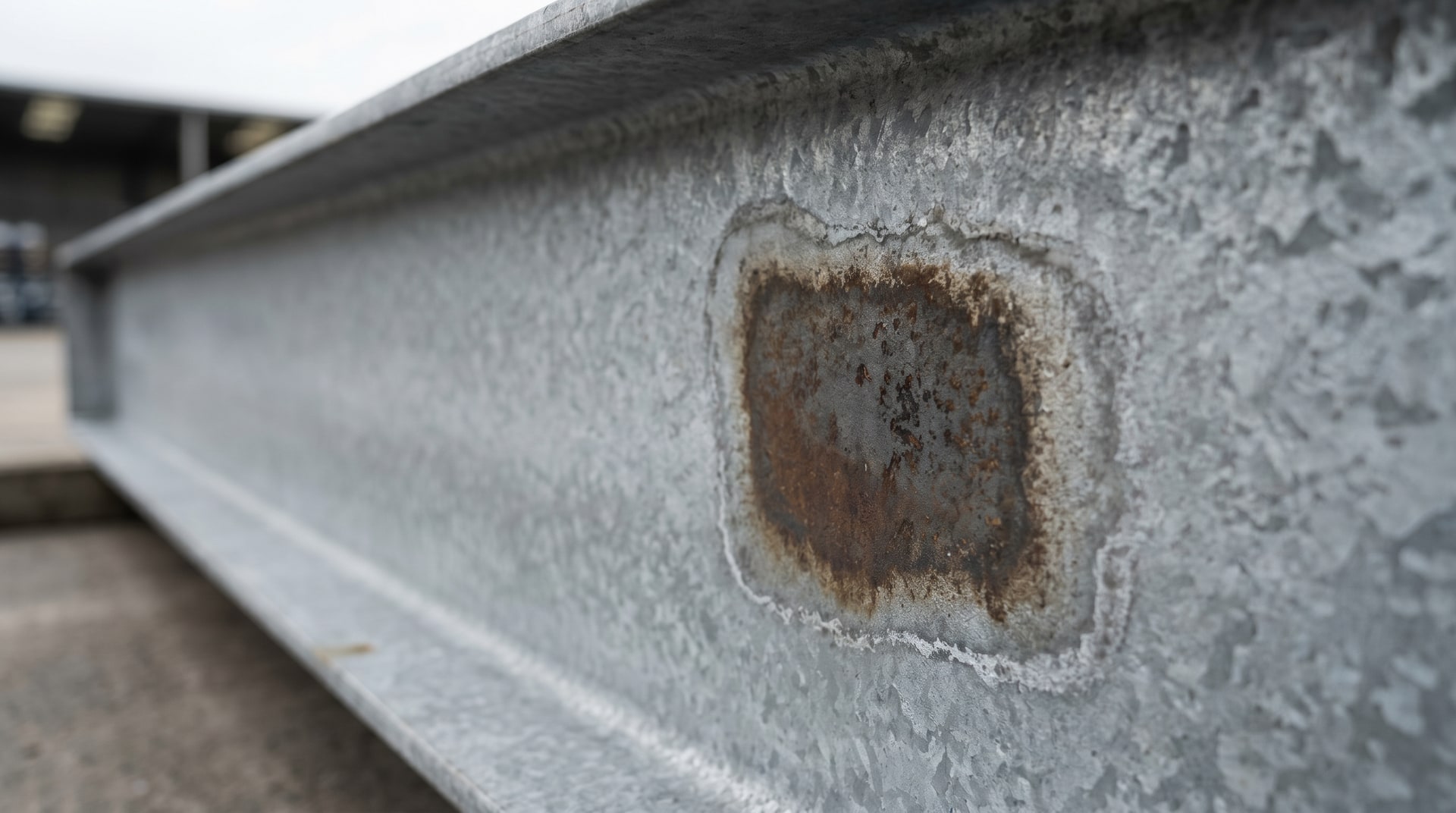
A surface contaminant interrupts this process at the point of contact. If paint or wax is present on a localized area of the steel, it acts as a physical and chemical barrier. The molten zinc cannot wet the contaminated zone, so no alloy reaction occurs there. When the part is withdrawn from the kettle, that zone emerges without a zinc coating. The surrounding steel carries a normal galvanized coating, but the contaminated area is bare steel, fully exposed to the environment.
This is not the same mechanism as a flux inclusion or a drainage problem. A flux spot, for example, usually leaves a dull or rough surface because flux residue interferes with zinc drainage rather than preventing adhesion entirely. A contaminant-caused bare spot is typically cleaner-edged, corresponding to the actual footprint of the contaminant that was present before immersion. This distinction matters for diagnosis when inspecting a finished part.
Why Pretreatment Does Not Catch Every Contaminant
A standard hot-dip galvanizing pretreatment sequence moves the steel through degreasing, pickling, and fluxing before immersion. Each step targets a different class of surface condition. Degreasing removes oils and greases. Pickling in hydrochloric acid removes mill scale and rust. Fluxing applies a zinc ammonium chloride layer that protects the cleaned surface until immersion and promotes wetting by the molten zinc.
The problem is that this sequence is designed for steel as it normally arrives, not for every possible contaminant a fabrication shop might introduce. Alkaline degreasing is effective against mineral oils and most petroleum-based lubricants, but it has limited effect on cross-linked epoxy paints, silicone compounds, and certain wax formulations. Acid pickling does not dissolve organic coatings at all. Fluxing cannot bond to a surface that still carries a contaminating film.
This means that if a contaminant survives the degreasing stage, it will likely survive the entire pretreatment sequence and arrive at the zinc kettle intact. The galvanizer is not simply "missing" the contaminant due to carelessness. The chemistry has a defined scope, and materials outside that scope require mechanical removal before the part enters the cleaning line.
The Role of Mechanical Removal Before Galvanizing
Because chemical pretreatment has limits, the AGA and standard galvanizing practice call for surface contaminants to be mechanically removed prior to the galvanizing process. This is not a secondary step or an optional precaution. It is a prerequisite for a sound coating.
Mechanical removal typically means grinding, wire brushing, abrasive blasting, or hand-tool cleaning, depending on the type and extent of the contaminant. The goal is to expose bare steel in every area that will be galvanized. For fabricators, this responsibility generally rests with the steel fabrication team before parts are shipped to the galvanizer. For galvanizers, it means identifying and flagging contaminated areas when parts arrive and communicating with the customer about what mechanical preparation is needed.
In practice, communication between fabricator and galvanizer is the most effective preventive measure. If a fabricator knows that certain areas carry paint, wax, or marking lacquer, those areas can be cleaned before the part ships. If the galvanizer can inspect incoming steel and identify contaminants visually or through tactile inspection before parts enter the cleaning line, problems can be caught early rather than discovered after immersion.
How Bare Areas Are Evaluated After Galvanizing
When a part emerges from the zinc kettle with a bare area caused by a surface contaminant, the next question is practical: what happens to that part? The answer depends on the size of the affected area and follows established repair and rejection criteria.
Small bare areas can be repaired after galvanizing using approved repair methods. The most common approaches include zinc-based paint, zinc-filled epoxy compounds, or low-temperature soldering with zinc alloy rod. Each of these methods provides a degree of corrosion protection to the exposed steel, though none of them replicates the metallurgical bond of the hot-dip galvanized coating. Repaired areas do provide cathodic protection through the surrounding zinc, which helps limit corrosion at the repair site, but the durability of a repair is not equivalent to the original coating.
Large bare areas are a different matter. When the ungalvanized zone is too large to be addressed by repair, the part is rejected and must be regalvanized entirely. This means stripping the existing zinc coating, thoroughly cleaning the steel including mechanical removal of whatever contaminant caused the original failure, and running the part through the galvanizing process again. Regalvanizing is time-consuming and adds cost to the project, which underscores why preventing contaminant-related failures through proper preparation is far more efficient than addressing them after the fact.
The distinction between a repairable area and a rejectable area is governed by the applicable specification for the project. Engineers and fabricators working with specific ASTM standards for hot-dip galvanizing should confirm the size limits and repair criteria in those documents and in their project specifications.
Contaminants That Are Easy to Miss
Some of the most problematic surface contaminants are not the obvious ones. A heavy coat of spray paint is visible and identifiable. A thin layer of wax applied to a steel structural member at a service center, or a faint residue of drawing compound left inside a tube, may be nearly invisible under normal shop conditions.
Hollow sections and tubes present a particular risk. If the interior of a structural tube has been lubricated during forming, that lubricant may not be visible from the outside, and the galvanizer may have no way to identify it before processing. When the part is immersed, the interior contaminant can cause ungalvanized areas on internal surfaces, which are both harder to detect and harder to repair after the fact.
Temporary protective coatings applied during shipping or storage are another source of hidden contamination. Some of these coatings are designed to be easily removed, but others are more tenacious. If a fabricator receives steel that has been protected in transit and does not fully strip that coating before fabrication, residue can remain on the surface even after the part has been cut, welded, and prepared for galvanizing.
Weld-through primers are a related concern. These primers are marketed as compatible with welding, but many of them are not compatible with galvanizing pretreatment chemistry. If a weld-through primer has been applied to joints that will not be welded, or if overspray has reached areas away from the weld zone, those areas may arrive at the galvanizer with a residue that resists standard cleaning.
Practical Steps for Fabricators and Project Teams
Preventing contaminant-related bare spots is straightforward in principle, though it requires discipline and communication across the project team. The fabricator is in the best position to control what goes onto the steel before it ships to the galvanizer. This means reviewing every material applied to the steel during fabrication and storage, from layout fluids and marking paints to forming lubricants, protective coatings, and temporary fastener compounds.
When a contaminant is identified, mechanical removal before shipping is the most reliable path. Grinding or abrasive blasting to bare metal in the affected area, followed by a visual check to confirm the contaminant is fully removed, gives the pretreatment process the best chance of producing a sound coating across the entire part.
Providing advance notice to the galvanizer when specific contaminants are present or suspected is also valuable. Our team at V&S Galvanizing can adjust handling and inspection procedures when we know what to look for. That kind of coordination, early and direct, prevents the delays and added costs that come from discovering problems after parts have already been processed.
Architects and specifying engineers should also consider the downstream galvanizing requirements when selecting temporary protective products, marking systems, and shipping coatings for steel that will be galvanized. A product that is convenient for the fabrication phase can become a source of field problems if it is not compatible with galvanizing pretreatment. Specifying galvanizing-compatible materials upstream avoids the problem entirely.
Work With a Team That Understands the Full Process
Surface contaminants are one of the more preventable causes of galvanizing defects, but preventing them requires attention at every stage of the process, from steel selection and fabrication through shipping and pretreatment. When contaminants are present and not addressed, the result is ungalvanized steel that either requires repair or triggers regalvanizing, both of which add time and cost to a project that could have been avoided with earlier action.
At V&S Galvanizing, we work with fabricators, engineers, and contractors to identify potential issues before parts enter the galvanizing process. Understanding the material history of the steel, communicating about surface conditions, and confirming that mechanical preparation has addressed any contaminants before arrival are all part of how we help customers get quality coatings on the first pass. If you have a project where surface condition or prior coatings are a concern, reach out through our contact page and let us help you work through the details before processing begins.
Frequently Asked Questions About Surface Contaminants in Hot-Dip Galvanizing
What types of surface contaminants most commonly cause bare spots in hot-dip galvanized coatings?
Paint, oil, wax, and lacquer are the most common surface contaminants that produce ungalvanized areas. These materials prevent molten zinc from wetting and bonding to the steel surface during immersion, leaving bare steel wherever the contaminant was present.
Why doesn't the galvanizing pretreatment process remove all surface contaminants?
Standard pretreatment chemistry, including alkaline degreasing and acid pickling, is effective against mill scale, rust, and most petroleum-based oils, but it has limited ability to remove cross-linked paints, silicone-based compounds, certain waxes, and lacquers. Materials outside the scope of the cleaning chemistry must be mechanically removed before the part enters the pretreatment line.
How is a bare spot caused by a surface contaminant different from other galvanizing defects?
Contaminant-caused bare spots tend to have relatively clean, defined edges that correspond to the footprint of the contaminant. This distinguishes them from flux inclusions, which produce dull or rough surface textures, or drainage-related bare spots, which typically appear at low points on the part. The edge definition and location of the bare area can help diagnose the root cause during inspection.
When is a bare spot repairable versus grounds for rejection and regalvanizing?
Small bare areas resulting from surface contaminants can be repaired using zinc-based paint, zinc-filled epoxy compounds, or low-temperature zinc alloy soldering. Large bare areas exceed what repair methods can adequately address, and in those cases the part must be rejected and regalvanized entirely after thorough mechanical cleaning to remove the original contaminant.
Are repaired bare spots as durable as the surrounding hot-dip galvanized coating?
No. Repair methods provide meaningful corrosion protection, including cathodic protection from the surrounding zinc, but they do not replicate the metallurgical zinc-iron alloy bond produced by hot-dip galvanizing. The durability and long-term performance of a repaired area is not equivalent to the original galvanized coating, which is why preventing contaminant-related defects through proper preparation is preferable to relying on repair.
What responsibility does the fabricator have for surface contaminants before shipping to the galvanizer?
The fabricator is responsible for mechanically removing surface contaminants prior to the galvanizing process. This means reviewing every material applied to the steel during fabrication and storage, including layout fluids, marking paints, lubricants, weld-through primers, and temporary protective coatings, and grinding or blasting contaminated areas to bare metal before the part is shipped.
Can weld-through primers cause galvanizing problems even if they are applied only near weld joints?
Yes. Many weld-through primers are not compatible with galvanizing pretreatment chemistry. Overspray that reaches areas away from the intended weld zone can leave residue that survives cleaning and causes bare spots during galvanizing. Fabricators should confirm that any primer used on steel intended for galvanizing is fully removable by the galvanizer's pretreatment process, or restrict application to areas that will actually be welded.
How can a specifying engineer reduce the risk of surface contaminant problems on a galvanizing project?
Specifying engineers can reduce risk by requiring galvanizing-compatible materials for any temporary coatings, marking systems, or protective treatments applied to steel before galvanizing. Including a requirement for mechanical removal of incompatible coatings in the fabrication specification, and coordinating with the galvanizer early in the project, helps ensure that surface condition requirements are understood and met before parts arrive for processing.
