

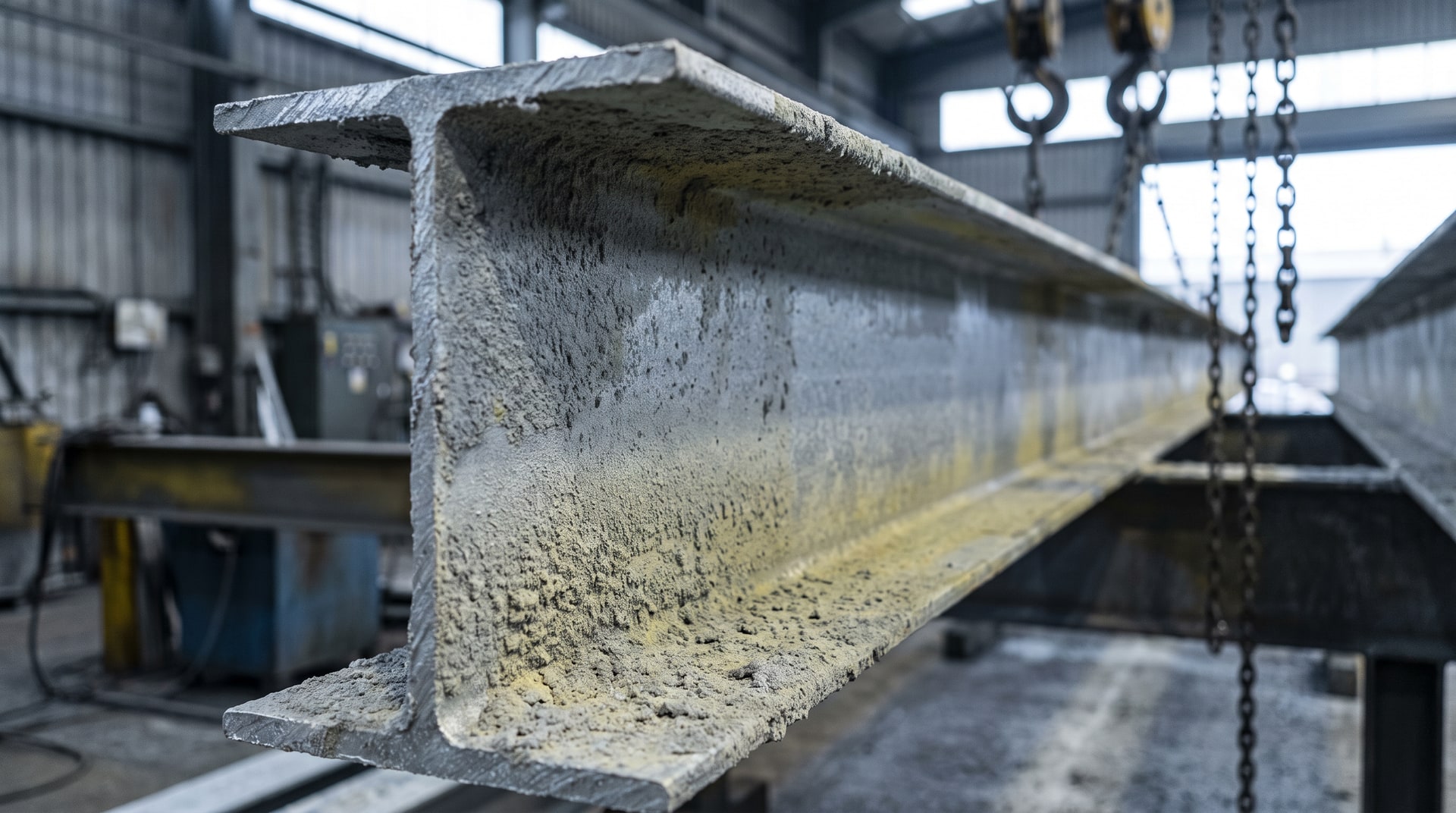
When galvanized steel comes out of the kettle, it does not always emerge with a perfectly uniform silver surface. Operators, inspectors, and project owners regularly encounter surface deposits that raise questions: Is this a defect? Does it affect the coating's performance? Should this lot be rejected? The answers depend entirely on what type of deposit you are looking at, and the two most commonly confused are flux residues and zinc skimmings. They can look similar at a glance, but they behave very differently in service, and treating them as equivalent leads to unnecessary rejections on one hand and missed real defects on the other.
The American Galvanizers Association addresses this directly in their article on the difference between flux and skimmings on galvanized steel. At V&S Galvanizing, we expand on that foundation to explain what is actually happening at the material level, how each type of inclusion influences long-term performance, and why this distinction is so frequently misunderstood in the field.
Where These Deposits Come From: A Process-Level View
To understand why two different surface deposits can result from the same dipping operation, it helps to trace what happens to steel as it moves through the galvanizing line. Before a fabricated steel part ever touches the zinc bath, it travels through a pretreatment sequence: alkaline cleaning, pickling in hydrochloric acid, and then fluxing. The flux bath, typically an aqueous zinc ammonium chloride solution, serves a specific purpose: it cleans any remaining oxides from the steel surface and deposits a thin protective layer that prevents re-oxidation during the brief interval before immersion in the molten zinc.
That flux coating is supposed to burn off completely during dipping, allowing the molten zinc to react directly and continuously with the steel substrate. When it does burn off cleanly, you get the layered intermetallic structure that defines a proper galvanized coating. When it does not, it gets trapped. The result is a flux inclusion embedded in the coating rather than a continuous zinc layer.
Skimmings are a different phenomenon entirely. The surface of a zinc kettle operating at roughly 450 degrees Celsius is not inert. It reacts with ambient oxygen, forming a thin film of zinc oxide across the bath surface. This film, combined with other bath constituents, is what galvanizers refer to as skimmings. Operators routinely skim this film back before immersing steel and after withdrawing it. If the skimming operation is not timed correctly during the withdrawal stage, some of that surface film can adhere to the freshly galvanized part as it is pulled from the bath.
Recognizing Each Deposit by Appearance
Distinguishing these two types of deposits by eye is possible once you know what to look for, though it requires some experience in the field.
Zinc skimmings appear as gray or yellowish deposits on the galvanized surface. Their composition is primarily a mixture of zinc oxide and zinc chloride, carried over from the bath surface during withdrawal. On the bright zinc background of a freshly galvanized part, these deposits tend to show up as dark patches, often described as black against the metallic surface. They are typically localized, sometimes textured or slightly raised, and do not have a sharp, well-defined edge.
Flux residues are deposits composed primarily of zinc chloride and appear in a broader range of colors: black, gray, white, or yellowish. This color variability makes flux deposits harder to identify on appearance alone, which is one reason the material-level distinction matters more than color matching. Flux deposits can look similar to skimmings in some conditions, and that overlap in appearance is precisely where misidentification tends to occur. The critical difference is not how they look on the surface but what lies beneath them.
What the Coating Looks Like Underneath Each Deposit
This is where the real engineering distinction lies, and it is the reason these two defect types carry such different consequences for the steel beneath them.
Beneath a zinc skimming deposit, a fully intact galvanized coating is still present. The delta and zeta alloy layers, the intermetallic phases that form through the iron-zinc reaction at the steel surface, remain continuous and uninterrupted. The skimming sits entirely on top of the free zinc layer, either enclosed within it or just visible at the surface. In other words, the skimming is an inclusion in the outermost layer of the coating, not a disruption of the coating itself. The steel beneath is fully protected.
Flux inclusions tell a very different story at the cross-section level. Where flux has been trapped in the coating, the zeta layer and the bath metal (free zinc) layer are disrupted around the inclusion. The delta alloy layer may still be present, but the coating architecture above it is compromised. The trapped flux also creates voids in the coating, which form because gases in the flux expand during the galvanizing process. These voids are not superficial; they represent discontinuities in the barrier that is supposed to protect the steel.
The practical implication is significant. A skimming deposit does not remove or weaken the protective coating beneath it. A flux inclusion does, and it does so in a way that opens the door to a specific failure mode described below.
Why Flux Inclusions Are an Actual Performance Risk
Flux residues are not merely cosmetic concerns. The zinc chloride-rich composition of flux makes it hygroscopic and chemically reactive in the presence of moisture. When a flux deposit is exposed to atmospheric moisture, the combination generates hydrochloric acid. That acid attacks the steel directly at the site of the inclusion, where the coating is already disrupted and the voids already exist. The result is premature, localized coating failure: corrosion initiating well before the surrounding galvanized coating has exhausted its protective capacity.
This failure mode is particularly insidious because it can begin before the part ever enters service if it is stored in humid conditions. A steel fabrication sitting in a staging yard through a rainy season with undetected flux inclusions in the coating may already have active corrosion sites by the time it is installed. The coating surrounding those sites may look entirely normal, which makes the damage easy to miss until it progresses.
ASTM A123 explicitly addresses this. The standard states that galvanized articles shall be free from uncoated areas, blisters, flux deposits, and dross inclusions. Flux deposits are named specifically as a basis for rejection, not because of how they look but because of what they do to the steel beneath them. That is the relevant performance-based standard, and it draws a clear line between flux (reject) and skimmings (evaluate separately).
Why Skimmings Are Not a Basis for Rejection
Given that skimmings can look alarming on a freshly galvanized part, it is understandable that customers sometimes push for rejection when they see them. But the technical basis for that position is not supported by the coating behavior or the governing standard.
ASTM A123 permits zinc deposits that do not interfere with the intended use or appearance of the product. Lumps, projections, globules, or heavy zinc deposits are only disallowed when they create a functional problem. A skimming deposit that sits on top of an intact coating, causes no adhesion failure, and does not interfere with fit-up or downstream processing is not cause for rejection under the standard.
More practically, the skimming will not stay there indefinitely. As the galvanized coating weathers and the zinc surface undergoes its natural patination process, skimming deposits tend to disappear. The zinc carbonate patina that forms on weathered galvanized steel essentially incorporates or obscures these surface-level inclusions over time. A coating that looked troubling in the plant often looks perfectly uniform after a few months of outdoor exposure.
This does not mean skimmings should be ignored in all circumstances. If they are heavy enough to create a raised surface that interferes with mating surfaces, bearing areas, or threaded connections, that is a legitimate functional concern. Similarly, if the appearance is critical to the application, such as an architectural element with specified finish requirements, the extent of the skimmings may need evaluation against the project specification. But the baseline technical answer remains: the steel beneath a skimming deposit is fully protected.
How Galvanizers Control These Variables in the Kettle
Understanding why these deposits occur also clarifies what can be done to minimize them. Flux residues in the coating are generally a sign that pretreatment was insufficient, that the flux bath chemistry was off, that the steel spent too long between fluxing and dipping, or that the dipping temperature caused localized flux entrapment rather than clean burnoff. Good process control, including consistent flux bath concentration, appropriate steel temperature at immersion, and correct withdrawal speed, reduces flux inclusion rates significantly.
Skimmings are managed through timing and technique during the dip cycle. The operator skims the bath surface before introducing the steel and again before withdrawing it. If withdrawal is not coordinated with a clean bath surface, the oxide film re-forms fast enough to contaminate the part as it exits. The solution is attentive process management, not a fundamental process change. Experienced operators in a well-run galvanizing facility keep skimming rates low through consistent practice, though some skimming pickup is an inherent characteristic of the batch hot-dip process rather than a controllable defect in the strictest sense.
At V&S Galvanizing, our hot-dip galvanizing process prioritizes pretreatment quality and bath management precisely because these upstream variables determine what the finished surface looks like and how the coating performs. Getting the pretreatment right is not just about aesthetics; it is directly tied to long-term corrosion performance.
Practical Guidance for Inspectors and Fabricators
When you encounter a dark or discolored deposit on a galvanized surface, the first question to ask is not "does this look like a defect" but rather "what is this deposit made of and what does the coating look like beneath it." That question separates a performance problem from an appearance variation.
In a production inspection context, distinguishing flux from skimmings often requires more than a visual check. Cross-sectional examination under magnification can reveal whether the alloy layers beneath the deposit are intact or disrupted. Flux inclusions show characteristic voids and layer discontinuities. Skimmings do not affect the underlying layer structure.
If a customer is pushing for rejection based on visual surface deposits, the conversation should focus on what ASTM A123 actually requires and what the deposit composition actually is. Bringing a cross-sectional analysis to that conversation tends to resolve it quickly. Where skimmings are present on a part that is otherwise fully coated to specification, the appropriate response is to explain that the steel is protected and that the deposit will diminish as the coating weathers, not to concede a rejection that is not warranted by the standard or the material condition.
Work With a Team That Knows the Difference
The distinction between flux inclusions and zinc skimmings is one of the more consequential misunderstandings in galvanized steel inspection. Getting it wrong in either direction creates problems: accepting flux deposits that represent real corrosion risk, or rejecting acceptable parts that carry intact protective coatings. Both errors have real costs, whether in premature field failures or in unnecessary project delays and material disputes.
Technical clarity on this topic comes from understanding the galvanizing process well enough to trace a surface condition back to its origin: what happened in the pretreatment line, what happened at the bath surface, and what the coating cross-section reveals. That kind of process knowledge is what separates a galvanizing partner from a commodity coating operation.
If you are working through a coating quality question on a current project or need technical support during specification and inspection, reach out to us through our contact page. Our team can help you evaluate surface conditions accurately and move forward with confidence.
Frequently Asked Questions About Flux and Skimmings on Galvanized Steel
What is the main structural difference between a flux inclusion and a zinc skimming in a galvanized coating?
A zinc skimming sits on or within the outermost free zinc layer and does not disrupt the underlying alloy layers. The delta and zeta intermetallic layers beneath a skimming remain intact, meaning the steel is fully protected. A flux inclusion, by contrast, disrupts the zeta and free zinc layers and creates voids within the coating caused by gas expansion from trapped flux. This means the coating architecture is compromised at the inclusion site, leaving the steel beneath it vulnerable.
Can flux deposits cause corrosion even before the part goes into service?
Yes. Flux residues contain zinc chloride, which is hygroscopic. When exposed to moisture during storage or transportation, the reaction between flux and moisture generates hydrochloric acid. This acid can attack the steel at the disrupted coating site before the part is ever installed, making early detection and rejection of flux-affected parts important for long-term performance.
Does ASTM A123 require rejection of parts with zinc skimmings?
Not automatically. ASTM A123 requires that galvanized articles be free from flux deposits, dross inclusions, and uncoated areas, but it permits zinc deposits such as lumps, projections, and globules as long as they do not interfere with the intended use of the material. Zinc skimmings that do not affect function or violate specific appearance requirements in a project specification are not a basis for rejection under ASTM A123.
How can I tell whether a dark deposit on galvanized steel is flux or skimmings without cutting a cross-section?
Visual inspection alone is not always reliable because both deposit types can appear dark against the zinc background. Flux deposits can be black, gray, white, or yellowish; skimmings are typically gray or yellowish. The most reliable method is cross-sectional metallographic examination, which reveals whether the underlying alloy layers are intact (skimmings) or disrupted with voids (flux). In the field, the location of the deposit relative to drainage points and the overall pretreatment history of the lot can also inform the assessment.
Will zinc skimmings affect the long-term corrosion protection of the steel?
No. Because the galvanized coating beneath a skimming deposit is fully intact, the cathodic protection and barrier protection provided by the zinc remain unaffected. As the coating weathers and develops its zinc carbonate patina, skimming deposits typically diminish or disappear entirely. The corrosion timeline of the underlying coating is not shortened by the presence of skimmings.
What process variables most commonly lead to flux inclusions in the finished coating?
Flux inclusions typically result from insufficient pretreatment leaving surface oxides that prevent clean flux burnoff, incorrect flux bath chemistry or concentration, excessive time between fluxing and immersion allowing the flux layer to degrade, or process conditions that cause localized entrapment rather than complete combustion of the flux during dipping. Consistent pretreatment quality and controlled dipping parameters are the primary controls for minimizing flux inclusion rates.
If a project specification requires a specific surface finish, do skimmings need to be evaluated differently?
Yes. While ASTM A123 sets the baseline, project-specific specifications may impose additional appearance requirements, particularly for architectural or exposed structural applications. In those cases, the extent and distribution of skimming deposits should be evaluated against the stated finish criteria in the contract documents, not just the minimum standard. Where appearance requirements are strict, it is worth discussing surface quality expectations with the galvanizer before fabrication begins.
Is it possible to remove skimming deposits from a galvanized surface without damaging the coating?
Light skimming deposits can sometimes be addressed through careful mechanical means, though this should be done with caution to avoid damaging the underlying zinc layer. Any repair work that removes zinc below the specified minimum thickness would require touch-up in accordance with the applicable standard. In most practical cases, since skimmings do not affect corrosion protection and diminish with weathering, removal is unnecessary unless a specific functional or appearance requirement demands it.
