

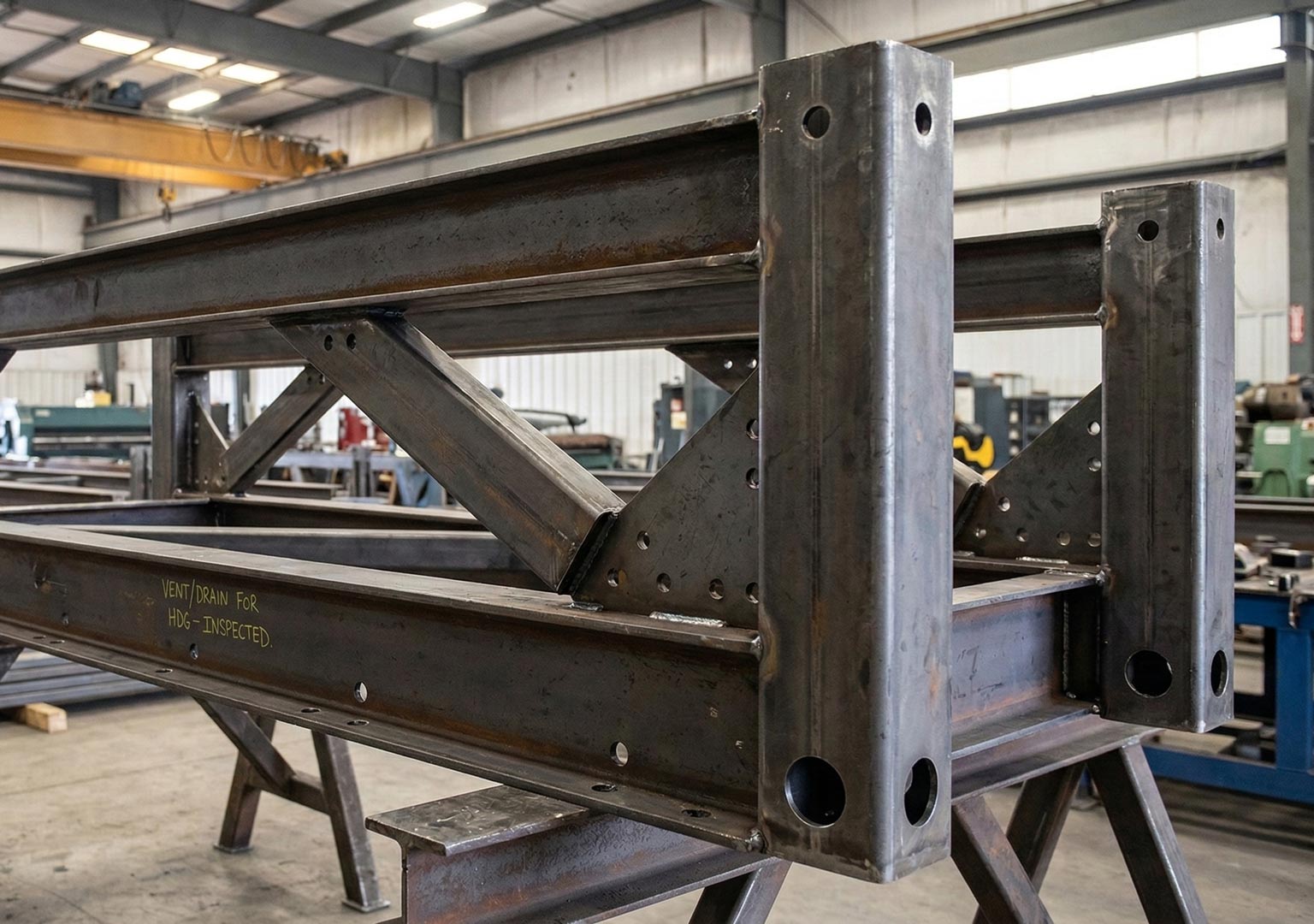
Hot dip galvanizing is a total immersion process. Steel is chemically cleaned, fluxed, and submerged into molten zinc, allowing metallurgical bonding across all exposed surfaces. Because the process involves full immersion and elevated temperatures, design and fabrication decisions directly influence coating quality, safety, and dimensional stability.
The Galvanize It article on design considerations for fabricating steel to be hot dip galvanized provides foundational guidance on this topic. Building on that technical base, this article expands into detailed engineering principles related to venting, drainage, distortion control, weld quality, steel chemistry, and specification alignment.
Design for Complete Immersion
All steel intended for galvanizing must allow:
- Free flow of cleaning solutions
- Complete drainage prior to immersion
- Proper venting of trapped air
- Full access of molten zinc
If air is trapped inside sealed cavities during immersion, coating voids or safety hazards can occur.
Designers must ensure that:
- Hollow sections are properly vented
- Enclosed cavities have adequate vent and drain holes
- Overlapping surfaces are sealed or avoided
Venting and drainage holes should be located at high and low points based on immersion orientation.
Failure to provide proper venting is one of the most common causes of galvanizing complications.
Vent and Drain Hole Sizing
Vent holes must be large enough to allow rapid air escape and zinc flow. Undersized holes may restrict drainage and create coating defects.
Engineering best practices include:
- Locating vents at the highest point of enclosed sections
- Providing drainage at the lowest points
- Ensuring hole diameters are sufficient relative to member size
- Avoiding partial obstructions inside hollow sections
Design drawings should clearly indicate vent and drain requirements rather than leaving interpretation to fabrication.
Early coordination prevents costly rework.
Controlling Distortion
Galvanizing exposes steel to temperatures near 840 F. While this temperature does not degrade structural steel properties, thermal expansion and stress relief can result in distortion.
Distortion risk increases when:
- Asymmetric sections are used
- Welding creates residual stress imbalances
- Thin sections are combined with heavy sections
- Large flat plates are not adequately stiffened
Mitigation strategies include:
- Balanced welding procedures
- Symmetrical fabrication where possible
- Adequate bracing and stiffening
- Avoiding unnecessary restraint during cooling
Distortion is a function of fabrication stress and geometry, not coating quality.
Welding Considerations
Weld quality significantly affects galvanizing results.
Key recommendations include:
- Continuous welds for overlapping surfaces
- Removal of weld slag prior to galvanizing
- Avoidance of silicone based sealants
- Minimization of excessive weld spatter
Intermittent welds can create crevices that trap cleaning solutions or prevent zinc penetration.
Weld chemistry may also influence coating appearance due to localized alloy growth.
Fabricators should ensure weld surfaces are clean and smooth prior to galvanizing.
Steel Chemistry Effects
Silicon and phosphorus content influence coating growth rates.
Certain reactive chemistry ranges can result in:
- Thicker coatings
- Matte or gray appearance
- Increased brittleness in extreme cases
Understanding steel chemistry allows engineers to anticipate coating characteristics.
When specifying steel, awareness of galvanizing reactivity helps manage appearance expectations and coating thickness outcomes.
Surface Preparation Compatibility
Surface contaminants interfere with galvanizing.
Designers and fabricators should avoid:
- Oil based coatings not removable by alkaline cleaning
- Silicone sealants
- Excessive paint on areas intended for galvanizing
- Closed assemblies that prevent pickling access
Proper fabrication preparation supports effective chemical cleaning and uniform coating formation.
Lifting and Handling Design
Fabricated assemblies must be designed to withstand lifting during galvanizing.
Considerations include:
- Structural rigidity during immersion
- Attachment points for lifting hooks
- Avoidance of deformation under suspended load
Large assemblies may require temporary bracing.
Failure to consider handling loads may result in distortion or stress during processing.
Specification Coordination
Clear specification alignment reduces ambiguity.
Specifications should address:
- Applicable ASTM standard such as ASTM A123
- Coating thickness requirements
- Repair procedures
- Inspection criteria
Designers should confirm that fabrication details are compatible with galvanizing requirements prior to finalizing drawings.
We frequently review fabrication drawings for venting, drainage, and distortion risk prior to processing. If you would like technical input during the design phase, please reach out via our contact page.
Early consultation improves efficiency and reduces the risk of post fabrication modification.
Lifecycle Performance Perspective
Designing properly for galvanizing not only improves processing efficiency but also enhances long term durability.
Well designed assemblies ensure:
- Complete coating coverage
- Uniform thickness distribution
- Reduced corrosion risk in crevices
- Predictable service life
Fabrication decisions made during design have direct implications for decades of performance.
Hot dip galvanizing is highly effective when steel is designed with immersion, venting, drainage, and stress balance in mind. Attention to fabrication details such as weld quality, steel chemistry, and cavity venting ensures coating continuity and structural integrity. Coordinated design and galvanizer communication during early project stages prevents costly revisions and improves long term corrosion protection.
If you would like technical review of your project drawings prior to galvanizing, please contact us here.
Frequently Asked Questions About Designing Steel for Hot Dip Galvanizing
Why are vent and drain holes required in galvanized steel assemblies?
Vent and drain holes allow air to escape and molten zinc to flow freely during immersion. Without proper venting, trapped air can prevent coating coverage and may create safety hazards due to pressure buildup inside enclosed sections.
How large should vent holes be?
Vent hole size depends on member dimensions, but they must be large enough to allow rapid air escape and zinc flow. Undersized holes can restrict drainage and lead to coating defects or incomplete coverage.
Does galvanizing cause distortion?
Distortion can occur due to thermal expansion and stress relief, particularly in asymmetrical or heavily welded assemblies. Proper fabrication techniques and balanced welding help minimize this risk.
Should overlapping steel surfaces be sealed?
Yes. Overlapping surfaces should be continuously welded to prevent crevice corrosion and allow proper cleaning and coating formation.
How does steel chemistry affect galvanizing results?
Silicon and phosphorus content influence coating growth rate and appearance. Reactive steels may produce thicker coatings and darker finishes.
Can large assemblies be galvanized in one piece?
It depends on kettle dimensions and handling considerations. Design should account for immersion size limitations and lifting requirements.
When should the galvanizer be consulted during design?
Consultation is recommended during the design phase, particularly when assemblies include hollow sections, enclosed cavities, unusual geometries, or strict dimensional tolerances.
