

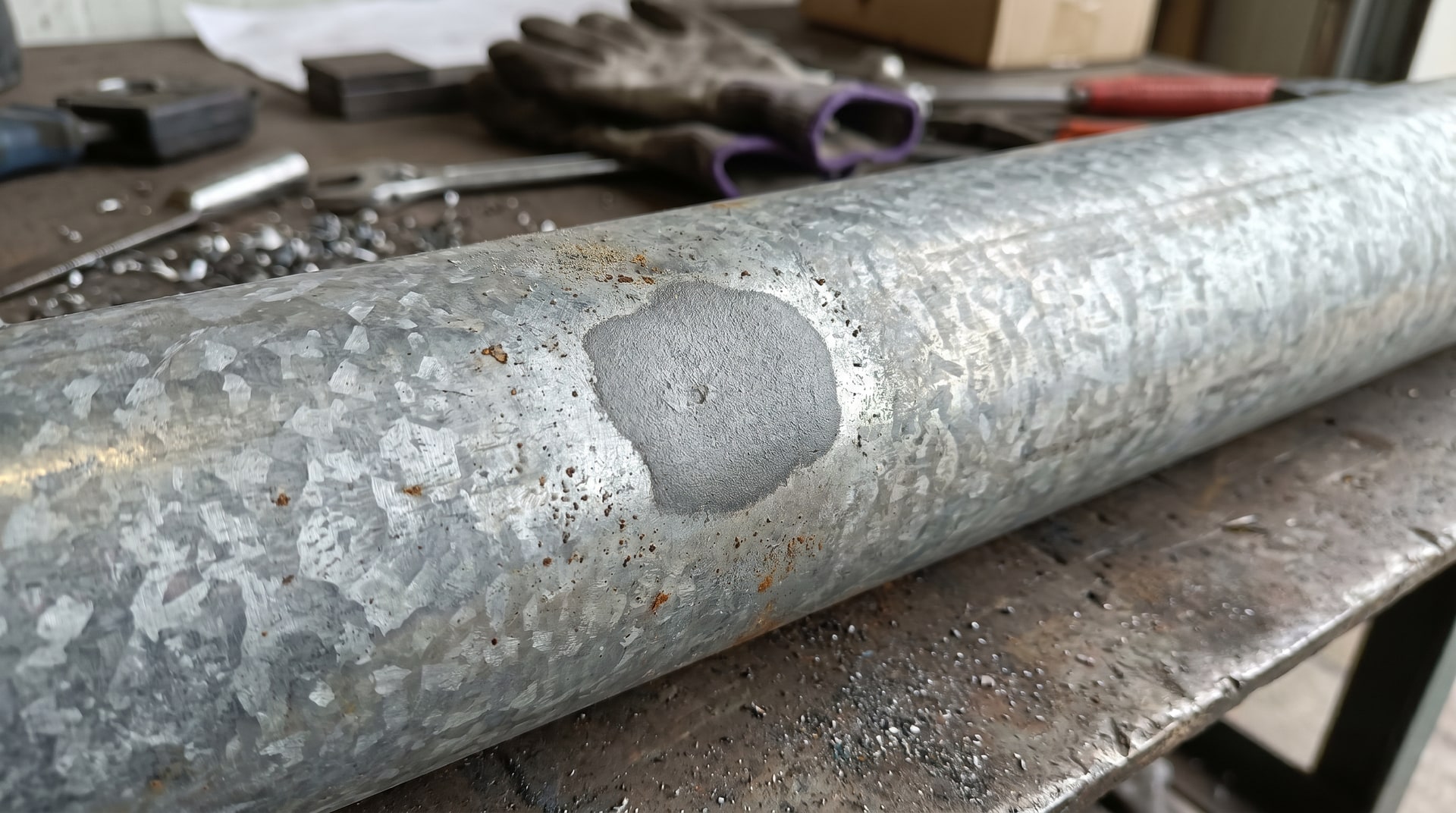
In hot-dip galvanizing, the chemistry of the pre-treatment process is what makes the metallurgical bond between zinc and steel possible. Every step, from degreasing to pickling to fluxing, prepares the steel surface so that when it enters the molten zinc bath, the reaction can proceed cleanly and uniformly. When any part of that chain breaks down, the coating suffers. One of the more consequential failure modes that can occur during this sequence is a flux inclusion: a situation where residual flux material traps itself between the steel surface and the forming zinc coating, preventing proper bonding in that area entirely.
Flux inclusions are not the most common defect in galvanizing, but they are among the most serious when they occur, particularly on hollow structural sections like pipes and tubes. The American Galvanizers Association addresses this directly in their article on flux inclusions. At V&S Galvanizing, we expand on that foundation to explain what is actually happening at the material level, how flux behavior influences coating formation, and why this defect is often misunderstood by fabricators and specifiers encountering it for the first time.
The Role of Flux in the Galvanizing Process
Before steel enters the zinc kettle, it goes through a fluxing stage. The flux, typically a zinc ammonium chloride solution, serves a precise chemical purpose: it cleans the steel surface of any remaining oxides that formed after pickling, and it protects that cleaned surface from re-oxidizing during the brief transition between the pre-treatment line and the molten zinc bath. Without flux, the steel surface would begin to oxidize almost immediately on contact with ambient air, and that oxide layer would prevent the iron-zinc reaction from initiating properly.
In standard practice, the flux dries on the steel surface before the part is lowered into the zinc. As the steel enters the bath at roughly 840 degrees Fahrenheit (450 degrees Celsius), the flux volatilizes, meaning it burns off and releases from the surface. This release is what allows the molten zinc to make direct contact with the clean iron, triggering the formation of the intermetallic alloy layers that constitute the galvanized coating. The entire sequence depends on the flux releasing completely and at the right moment. When it does not, the problem we call a flux inclusion results.
What Actually Happens During a Flux Inclusion Event
A flux inclusion occurs when flux residue fails to release from the steel surface as the part enters the molten zinc. Instead of volatilizing cleanly, the flux becomes trapped. This can happen as a discrete spot or across a broader area depending on the quantity of flux involved and the geometry of the part. In either case, the result is the same: wherever the flux remains adhered during immersion, the zinc cannot reach the steel underneath it. The coating forms around the inclusion but not beneath it, leaving an uncoated zone directly under or around the flux deposit.
On the surface of a finished part, a flux inclusion typically appears as a dull, grayish, or chalky spot, sometimes with a slightly raised or rough texture at its edges where the zinc coating transitions abruptly from coated to uncoated steel. The flux residue itself may still be visible as a crusty or powdery deposit. What is not immediately visible is the bare steel underneath, which, if left unaddressed, is vulnerable to corrosion in the same way as any uncoated surface would be.
It is worth clarifying a common misconception here. Flux inclusions are not the same as flux ash on the surface of a zinc bath, which is a normal operational byproduct that galvanizers skim off before and during immersion. Flux inclusions are specifically about flux that was adhered to the steel itself failing to release during the dip. The two are related in origin but distinct in their effect on the finished product.
Why Flux Sometimes Fails to Release
Several conditions can contribute to flux retention on steel entering the zinc bath. One common factor is excessive flux application. If flux is applied too heavily or if the steel is withdrawn from the flux tank too slowly, the dried flux layer can become thick enough that its outer layer volatilizes before the layer directly against the steel has a chance to release. This effectively seals the inner flux in place, at least briefly, and that brief window is enough for zinc to begin forming around it rather than beneath it.
Another contributing factor is flux that has degraded in the tank over time. Flux solution chemistry requires regular monitoring and adjustment. A contaminated or pH-imbalanced flux bath may not apply evenly, leaving spots where the flux is inconsistent in density or adhesion. When these areas enter the zinc bath, they behave unpredictably and are more likely to retain rather than release.
Part geometry also plays a role. Areas with tight internal angles, recesses, or restricted cavities can trap flux and prevent it from drying evenly or volatilizing completely. This is why hollow sections like pipes and tubes carry a higher risk for flux inclusion problems, and it is also why the consequences for those parts are more severe, as we will address below.
Evaluating the Severity: Small Area Versus Large Area Inclusions
Not all flux inclusions result in automatic rejection of a part. The appropriate response depends heavily on the size and location of the affected area. When a flux inclusion is small and located on an accessible exterior surface, the galvanizer can clean the inclusion, remove the flux residue and any surrounding contamination, and apply a repair coating to restore corrosion protection to that spot.
Repair methods for small flux inclusions follow the same general approach used for other minor galvanizing coating discontinuities. The area must be thoroughly cleaned before any repair coating is applied, because adhesion to flux residue or corroded steel will not produce a durable result. Once the surface is properly prepared, a zinc-rich paint or cold-galvanizing compound can be applied to bridge the uncoated area and restore continuity of protection.
When a flux inclusion covers a large area, the situation changes. A large uncoated zone cannot be adequately repaired by touch-up methods alone without compromising the overall performance of the coating system. In those cases, the part must be rejected. The AGA is direct on this point, and our team operates by the same standard: if the inclusion is too large for a compliant repair, the part does not leave the facility as an acceptable product.
The Special Problem of Interior Flux Deposits
Interior flux deposits in hollow sections represent the most difficult scenario associated with this defect. When flux collects inside a pipe or tube during pre-treatment and then fails to release during galvanizing, the resulting uncoated zone is inside the part where it cannot be accessed for cleaning or repair. This is not a situation where the galvanizer has discretion about repair feasibility. As the AGA confirms, flux deposits on the interior of hollow parts cannot be repaired, and the part must be rejected outright.
This reality underscores why design and fabrication decisions matter upstream of the galvanizing process itself. Pipes and tubes submitted for hot-dip galvanizing need to be designed with adequate vent and drain holes that allow flux to drain out of cavities during pre-treatment and allow zinc to flow freely during immersion. A part without proper drainage is not just at risk for flux inclusions. It also creates safety hazards during immersion due to steam pressure buildup, and it tends to accumulate ash and dross internally in ways that compound quality problems.
When a hollow part is rejected for an interior flux deposit, the situation is not necessarily permanent. Both the AGA and our own operational experience confirm that rejected parts can be stripped of their zinc coating and submitted for regalvanizing. Stripping removes the zinc that did form, and the part goes back through the full pre-treatment sequence with the interior conditions corrected where possible. Whether regalvanizing is feasible depends on what caused the interior flux retention in the first place: if it was a draining or venting issue, that must be corrected before resubmission.
Detection During Inspection
Flux inclusions are visually detectable in most cases, which puts them in a category of defects that a trained inspector can identify during post-galvanizing visual examination. The characteristic appearance, a dull or chalky deposit on or within the coating with bare or lightly coated steel beneath, is distinctive enough that experienced inspectors recognize it without specialized instrumentation.
However, the challenge is that visual inspection alone does not always reveal the full extent of the uncoated zone, particularly at the edges of an inclusion where the zinc coating transitions gradually. A magnetic thickness gauge can help map the boundary of an inclusion by identifying areas where coating thickness drops sharply toward zero, but the flux residue itself can sometimes interfere with accurate gauge readings. For this reason, our inspection approach combines visual assessment with thickness measurement in any area where an inclusion is suspected.
Interior inclusions in hollow sections are by nature invisible to direct visual inspection. When a fabricator submits hollow parts, our team evaluates the part geometry and drainage provisions before galvanizing and notes any configurations that present elevated risk. Post-galvanizing, parts with interior cavities may be weighed against pre-galvanizing weight records to detect unexpectedly large internal deposits, though this is not a standard practice for every part and is more relevant when specific concerns are noted before the run.
What Fabricators and Specifiers Should Understand
For engineers and fabricators specifying or submitting steel for hot-dip galvanizing, flux inclusions carry a practical lesson: part design and surface condition before galvanizing have a direct bearing on coating quality outcomes. The galvanizing process cannot compensate for part geometries that trap flux or prevent it from draining. A part that arrives at the galvanizing plant with recesses, blind holes, or sealed cavities that hold liquid is a part that is already at elevated risk for flux-related problems, among other issues.
Engaging with the galvanizer during the design phase, particularly for complex fabrications involving hollow sections, curved members, or heavily recessed geometry, allows potential flux retention risks to be identified and addressed before steel is cut. A relatively small modification, an additional vent hole, an adjusted orientation, a change in drain plug location, can be the difference between a clean galvanized result and a rejection that requires costly rework.
It is also worth understanding that flux inclusions, while sometimes attributed to galvanizer error, are not always the result of process failure at the plant. Part geometry that makes complete flux drainage physically impossible will produce flux inclusions regardless of how carefully the pre-treatment is managed. This does not eliminate the galvanizer's responsibility to monitor flux bath chemistry and application technique, but it does mean the quality outcome is genuinely a shared responsibility between fabricator and galvanizer.
Work With a Team That Understands the Full Process Chain
Flux inclusions are one of the more nuanced defects in hot-dip galvanizing because they sit at the intersection of process chemistry, part geometry, and material handling. Identifying them accurately, assessing whether repair is appropriate, and determining whether a rejected part can be regalvanized all require direct experience with how the defect actually manifests in production conditions. At V&S Galvanizing, our team brings that experience to every job, with inspection protocols and process controls designed to catch flux-related problems before parts leave the plant.
If you are working on a project involving hollow sections, complex fabrications, or structural steel where coating quality is a specification requirement, we encourage you to reach out early. Visit our contact page to connect with our team directly.
Frequently Asked Questions About Flux Inclusions in Hot-Dip Galvanizing
What is a flux inclusion in hot-dip galvanizing?
A flux inclusion occurs when flux applied during pre-treatment fails to release from the steel surface when the part enters the molten zinc bath. The trapped flux prevents zinc from bonding to the steel beneath it, leaving an uncoated zone in the finished galvanized coating.
Can a part with a flux inclusion be repaired?
It depends on the size and location of the inclusion. Small flux inclusions on accessible exterior surfaces can be cleaned and repaired using zinc-rich paint or cold-galvanizing compound. Large inclusions or any inclusion on the interior of a hollow part cannot be repaired and require the part to be rejected.
What happens to parts rejected for flux inclusions?
Parts rejected due to flux deposits can be stripped of their existing zinc coating and resubmitted for regalvanizing. Before regalvanizing, the conditions that caused the flux retention, such as inadequate drainage in hollow sections, must be corrected where possible.
Why are flux inclusions inside pipes and tubes impossible to repair?
Interior flux deposits in hollow sections like pipes or tubes are located in areas that cannot be accessed after galvanizing. Because proper surface preparation is required before any repair coating can adhere, and that preparation cannot be performed inside a sealed or inaccessible cavity, repair is not a viable option. Rejection is the required outcome.
What causes flux to fail to release during galvanizing?
Common contributing factors include overly heavy flux application, degraded or chemically imbalanced flux solution, and part geometries that trap flux in recesses or prevent uniform drying. Any of these conditions can cause flux to remain adhered to the steel surface as it enters the zinc bath rather than volatilizing cleanly.
How can fabricators reduce the risk of flux inclusions?
The most effective design measures include providing adequate vent and drain holes in hollow sections, avoiding recesses and blind cavities that trap liquids, and coordinating with the galvanizer before fabrication is finalized. These steps allow flux to drain completely during pre-treatment and zinc to flow freely during immersion.
How are flux inclusions identified during inspection?
Flux inclusions are typically visible as dull, grayish, or chalky spots on the galvanized surface, sometimes with a rough transition zone at the edges. Magnetic thickness gauges can help map the extent of the uncoated area by detecting sharp drops in coating thickness. Interior inclusions in hollow parts are not visible directly and require other assessment approaches such as weight comparison.
Are flux inclusions always the galvanizer's fault?
Not necessarily. While the galvanizer is responsible for maintaining flux bath chemistry and application technique, part geometries that make complete flux drainage physically impossible will produce inclusions regardless of process care. Flux inclusions are often a shared responsibility between fabricator and galvanizer, which is why early design coordination is valuable.
