

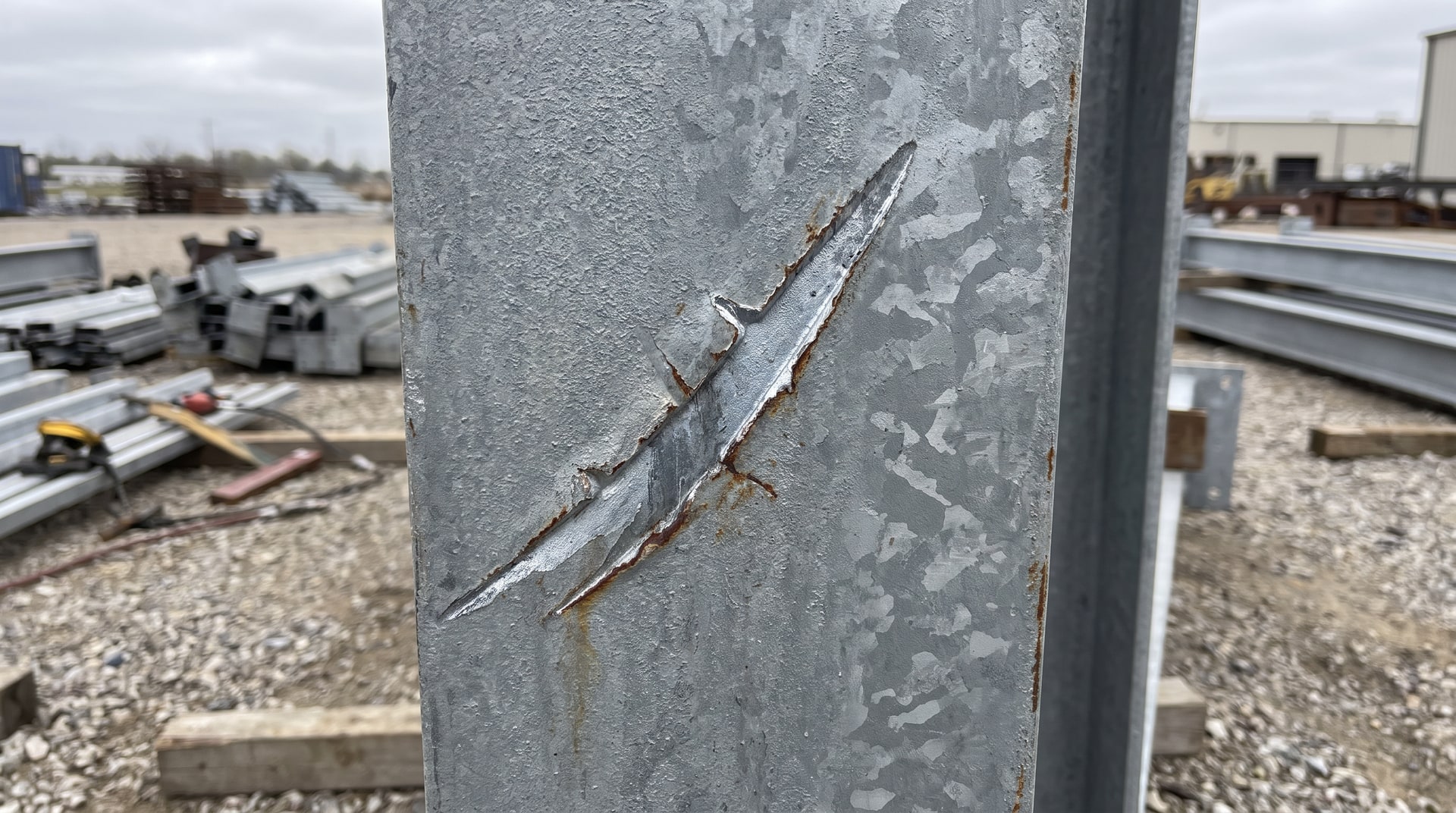
It happens more often than most people expect. A fabricated steel assembly arrives on site looking sharp, and then someone notices it: a scratch, a chain mark, a scuff from rough handling during transport. The galvanized coating has been broken. The question that follows is almost always the same one: do we need to fix this, or will the zinc take care of it on its own?
The answer is more nuanced than a simple yes or no, and it depends on understanding what galvanizing actually does at a material level, not just what it looks like. There are two fundamentally different corrosion protection mechanisms at work in a hot-dip galvanized coating, and conflating them leads to poor decisions in both directions: unnecessary repair work on one end, and dangerous neglect on the other.
The American Galvanizers Association addresses this directly in their article on damaged galvanized steel and storage. At V&S Galvanizing, we expand on that foundation to explain what is actually happening at the material level, how the width of the damage and the surrounding environment influence cathodic protection performance, and why this question is often misunderstood by contractors and engineers working in the field.
Two Layers of Defense: Barrier and Cathodic Protection
Hot-dip galvanizing provides corrosion protection through two distinct mechanisms, and it is worth being precise about each one because they behave very differently when the coating is damaged.
The first is barrier protection. When steel is immersed in molten zinc during the galvanizing process, it develops a tightly bonded coating that completely envelops the steel surface. This zinc layer physically separates the steel from moisture, oxygen, and other corrosive elements in the environment. As long as the barrier is intact, corrosion essentially cannot initiate at the steel surface. In this respect, galvanizing behaves similarly to a paint system: it keeps the bad stuff out by covering the good stuff up.
The second mechanism is cathodic protection, and this is where galvanizing parts ways with most paint-based systems. Zinc is electrochemically more active than steel. When zinc and steel are in electrical contact and an electrolyte (moisture) is present, the two metals form a galvanic couple. In that couple, zinc acts as the anode and steel acts as the cathode. The anode material sacrifices itself through oxidation, which drives electrons toward the cathode and suppresses corrosion at the steel surface. This is the same principle behind sacrificial zinc anodes on marine vessels or underground pipelines.
The critical point here is that cathodic protection only activates after the barrier has been broken. Scratches, gouges, and chain marks from handling and transport are precisely the kind of damage that removes barrier protection and forces the galvanizing system to rely on cathodic action alone. Understanding what that protection can and cannot do is essential for making good repair decisions.
What the Research Actually Says About Protection Distance
Cathodic protection does not extend infinitely from the edge of undamaged zinc. There is a finite distance over which the zinc anode can drive enough current to suppress corrosion on exposed steel. This is what researchers call the protection distance, and its limits are more constrained than many in the field assume.
Research by Gregory Zhang (Teck Cominco) and Anquin Xing (X-Numerical), presented at Galvatech 2004, quantified these limits in a zinc-steel bimetallic couple. Under conditions of moderate zinc surface activity and a thin electrolyte layer, the maximum protection distance was found to be slightly greater than 1/4 inch (7 mm) from the zinc edge into the exposed steel area. That is the upper bound under favorable conditions.
| Condition | Protection Distance (approx.) | Notes |
|---|---|---|
| Moderate zinc surface activity, thin electrolyte layer, narrow damage | Slightly greater than 1/4 in. (7 mm) | Maximum protection distance under favorable conditions |
| Damage width exceeds critical threshold | Drops to just over 1/8 in. (4 mm) | Protection distance decreases once exposed area exceeds the critical width |
| Passive (low activity) zinc surface | Essentially zero | Fully weathered, passivated zinc provides minimal cathodic protection |
| High-conductivity electrolyte (e.g., saltwater) | Greater than dry/rural environments | Larger protection area, but zinc consumed faster; shorter overall coating life |
| High-resistance electrolyte (dry/rural environment) | Smaller than saltwater environments | Protection distance limited, but zinc consumed more slowly; longer overall coating life |
However, the relationship between scratch width and protection distance is not linear. Once the width of the exposed steel exceeds that critical threshold, the protection distance actually drops to a minimum of just over 1/8 inch (4 mm). In other words, a wider scratch does not simply receive less protection proportionally; it hits a threshold beyond which the zinc's electrochemical reach becomes significantly reduced. This is why large scratches behave categorically differently from small ones, not just quantitatively worse.
The practical implication is straightforward. A hairline scratch or a surface scuff well under 1/8 inch wide is likely within the zone of effective cathodic protection. A gash that exposes a wide band of bare steel may extend well beyond what the surrounding zinc can protect, even under optimal environmental conditions.
Surface Activity: Why the Zinc's Condition Matters as Much as the Damage
The effectiveness of cathodic protection is not fixed over time. It depends heavily on the electrochemical activity of the zinc surface itself, and that activity changes as the coating weathers.
Freshly galvanized steel has a relatively active zinc surface. As the coating is exposed to the atmosphere, zinc reacts with oxygen, carbon dioxide, and moisture to form zinc carbonate, a stable, low-solubility patina that gives weathered galvanizing its characteristic matte gray appearance. This patina is highly beneficial for long-term barrier protection because it slows the corrosion of the zinc coating itself. But it comes at a cost: as the zinc surface passivates, its electrochemical activity decreases.
The Zhang and Xing study found that surface activity plays a large role in determining how much cathodic protection the zinc can provide. A highly active zinc surface extends the protection distance. A passive, fully weathered zinc surface may provide essentially zero cathodic protection. This means that an older galvanized structure with a well-developed patina, if it sustains new damage, should not be assumed to self-protect the way freshly galvanized steel might.
This is a common misconception we encounter from engineers and contractors who have seen galvanized steel perform well for years without repair. The observed durability often reflects the integrity of the barrier, not cathodic protection doing heavy lifting. Once the barrier is compromised on aged, passivated steel, the situation is closer to bare exposed steel than it is to a fresh galvanized coating absorbing minor damage.
The Role of Environment: Electrolyte Conductivity and Its Double-Edged Consequences
Of all the variables that influence cathodic protection distance, the nature of the surrounding environment may be the most dominant factor. The electrolyte, specifically its electrical conductivity, controls how effectively the ionic current flows between the zinc anode and the exposed steel cathode.
A low-resistance electrolyte allows current to flow more easily, which extends the protection distance. This is why galvanized steel exposed to saltwater environments benefits from a larger cathodic protection radius: seawater is highly conductive. In a dry or arid climate, there may be so little electrolyte present that cathodic protection is minimal or negligible regardless of how active the zinc surface is.
But this is where the analysis gets more complicated. The same high-conductivity environment that extends cathodic protection also accelerates zinc consumption. Zinc is sacrificing itself to protect the exposed steel, and the faster that sacrifice occurs, the faster the overall coating depletes. Marine or industrial environments with high salt content therefore present a genuine trade-off: better immediate protection of small damaged areas, but shorter total coating life.
In a rural or dry environment, the cathodic protection distance may be smaller, but the zinc coating corrodes at a much slower rate. A small scratch in that environment may form a thin layer of zinc corrosion products over the exposed steel that actually provides some passive protection, and the surrounding zinc will last far longer overall.
This means the repair decision cannot be decoupled from the deployment environment. What is a tolerable scratch on a rural structural element may not be tolerable on a coastal infrastructure component, even if the scratch dimensions are identical.
Reading the Damage: Practical Guidelines for Repair Decisions
Knowing the underlying mechanisms makes it possible to form a principled approach to repair decisions rather than relying on gut feel or blanket policies.
Small scratches narrower than 1/8 inch, in mildly corrosive environments, generally do not require repair. The cathodic protection provided by the surrounding zinc is sufficient to prevent significant steel corrosion over the service life of the structure. This does not mean those scratches are unimportant; it means the electrochemical behavior of the coating compensates adequately for the breach.
Large scratches should always be repaired, regardless of environment. The reasoning is straightforward: once the width of exposed steel exceeds the protection distance, there is bare steel that the zinc simply cannot reach electrochemically. Leaving it exposed is equivalent to leaving bare steel unprotected, which will corrode at a rate determined entirely by the environment rather than by the zinc coating.
In highly corrosive environments such as coastal, marine, or industrial chemical exposures, the threshold for repair should be lowered. Even scratches that might be acceptable in benign conditions should be repaired when the consequences of steel corrosion are significant, whether for structural, aesthetic, or longevity reasons. When corrosion protection is paramount, the conservative decision is always to repair.
It is also worth noting that repairing any damage, regardless of size or environment, will extend the overall service life of the steel. The question of whether repair is strictly necessary is an economic one. The question of whether it is beneficial is not.
What Acceptable Repair Actually Looks Like
For engineers and contractors managing field repairs to hot-dip galvanized steel, the choice of repair method matters. The goal is to restore both barrier protection and, where possible, some degree of cathodic continuity with the surrounding zinc.
Zinc-rich paints and cold-galvanizing compounds are the most common field repair materials. They contain zinc dust in concentrations high enough to provide both a barrier and a degree of galvanic protection at the repaired area. Touch-up with zinc-based solder or zinc spray can also restore metallic zinc continuity at the damaged zone. The specific approach will depend on the size of the damaged area, the accessibility of the component, and the environmental exposure class of the installation.
The key principle is that no repair material performs as well as the original galvanized coating at the substrate-zinc interface. Hot-dip galvanizing produces a series of intermetallic alloy layers bonded directly to the steel, which gives it adhesion and abrasion resistance that field-applied repairs cannot replicate. Repairs restore function; they do not replicate the original coating's full performance envelope. That is one of the strongest reasons to handle galvanized steel carefully during transport and installation in the first place.
Handling and Storage: Prevention Is Cheaper Than Repair
The scenario described at the beginning of this article, fresh galvanized steel arriving with scratch marks from rough handling, is avoidable with proper attention to storage and transport protocols. Chain marks on galvanized members are one of the most common causes of coating damage and are almost always preventable.
Galvanized steel should be lifted and secured with nylon slings or padded rigging rather than bare chains or wire rope wherever possible. When chains are used operationally, contact points with the galvanized surface should be protected with rubber or plastic sheathing. During transport, members should be separated by wooden dunnage or rubber-tipped spacers to prevent surface-to-surface abrasion. Storage yards should keep galvanized steel elevated off bare ground to prevent entrapment of moisture and soil, which accelerates both zinc corrosion and the onset of wet storage stain (white rust).
These precautions matter not just for aesthetics. Every scratch that penetrates to bare steel is a point where the coating's service life calculation changes. Minimizing damage during handling is not a soft concern; it is part of protecting the corrosion protection investment.
Work With a Team That Understands the Full Picture
The decision to repair or accept minor damage on a galvanized coating is not one-size-fits-all. It requires understanding the type of damage, the age and condition of the zinc surface, the electrolyte environment the steel will face, and the structural or service consequences of corrosion initiating at that point. Getting that analysis wrong in either direction has real costs: unnecessary repair work wastes resources, and under-repaired coatings in aggressive environments can fail far earlier than expected.
Our team at V&S Galvanizing works with engineers, fabricators, and contractors at every stage of the galvanizing process, from pre-fabrication design guidance through post-galvanizing inspection and quality assurance. If you have questions about coating condition, repair standards, or whether a specific damage scenario needs to be addressed before a structure goes into service, reach out through our contact page and we will give you a technically grounded answer.
Frequently Asked Questions About Damaged Galvanized Steel and Cathodic Protection
How wide does a scratch have to be before cathodic protection from zinc becomes insufficient?
Research presented at Galvatech 2004 found a maximum cathodic protection distance of slightly over 1/4 inch (7 mm) under favorable conditions. Once the width of the exposed steel exceeds this threshold, protection distance drops to a minimum of just over 1/8 inch (4 mm). Scratches narrower than 1/8 inch are generally within the zone of effective cathodic protection in mild environments.
Does the age of the galvanized coating affect how well it can protect a scratched area?
Yes, significantly. As a galvanized coating weathers, the zinc surface passivates and its electrochemical activity decreases. A fully passivated zinc surface may provide essentially zero cathodic protection to exposed steel. Older galvanized structures with well-developed patina should not be assumed to self-protect damaged areas the way fresh coatings can.
Why does saltwater exposure increase cathodic protection distance but also reduce coating life?
Saltwater is a high-conductivity electrolyte that allows ionic current to travel farther between the zinc anode and exposed steel cathode, which extends the protection distance. However, the same conductivity causes zinc to be consumed more rapidly. More area is protected, but the zinc sacrifices itself faster, reducing the overall service life of the coating compared to low-conductivity, dry environments.
In what situations should small scratches always be repaired, regardless of size?
In highly corrosive environments such as coastal, marine, or industrial chemical exposure, all scratches that expose bare steel should be repaired. The accelerated corrosion rates in these environments mean the margin for leaving damage unaddressed is much smaller, and the consequences of steel corrosion initiating at an unrepaired point are more severe.
Does cathodic protection begin immediately when a scratch occurs, or only under certain conditions?
Cathodic protection requires an electrolyte to be present. In completely dry conditions, there is no ionic path between the zinc anode and the exposed steel, so cathodic protection does not function. It activates when moisture is present at the zinc-steel interface. In persistently dry environments, a scratched galvanized coating may receive little to no cathodic protection at all, though the dry conditions also slow any corrosion that might initiate.
What repair methods are appropriate for field-applied touch-up of damaged galvanized coatings?
Zinc-rich paints and cold-galvanizing compounds with high zinc dust content are the standard field repair options. They restore barrier protection and provide some galvanic protection at the repaired area. Zinc-based solder or thermal spray zinc can also be used where metallic continuity is critical. No field repair fully replicates the intermetallic bond of the original hot-dip coating, so repairs restore function but not the complete performance profile of the original coating.
Can zinc corrosion products that form over a scratch provide any useful protection?
In low-corrosivity, dry environments, zinc corrosion products can gradually migrate over and partially cover small areas of exposed steel, offering some passive barrier-like protection. This is a secondary effect and not a substitute for intentional repair, but it contributes to the overall durability of minor surface scratches in benign conditions. In aggressive or wet environments, this self-healing mechanism is not reliable enough to depend on.
How should galvanized steel be handled during transport to avoid coating damage?
Use nylon slings or padded rigging instead of bare chains or wire rope. Protect any chain contact points with rubber or plastic sheathing. Separate members in transit with wooden dunnage or rubber-tipped spacers to prevent abrasion. Store galvanized steel elevated off bare ground to avoid trapping moisture, which can cause wet storage stain and accelerate zinc corrosion at contact points.
