

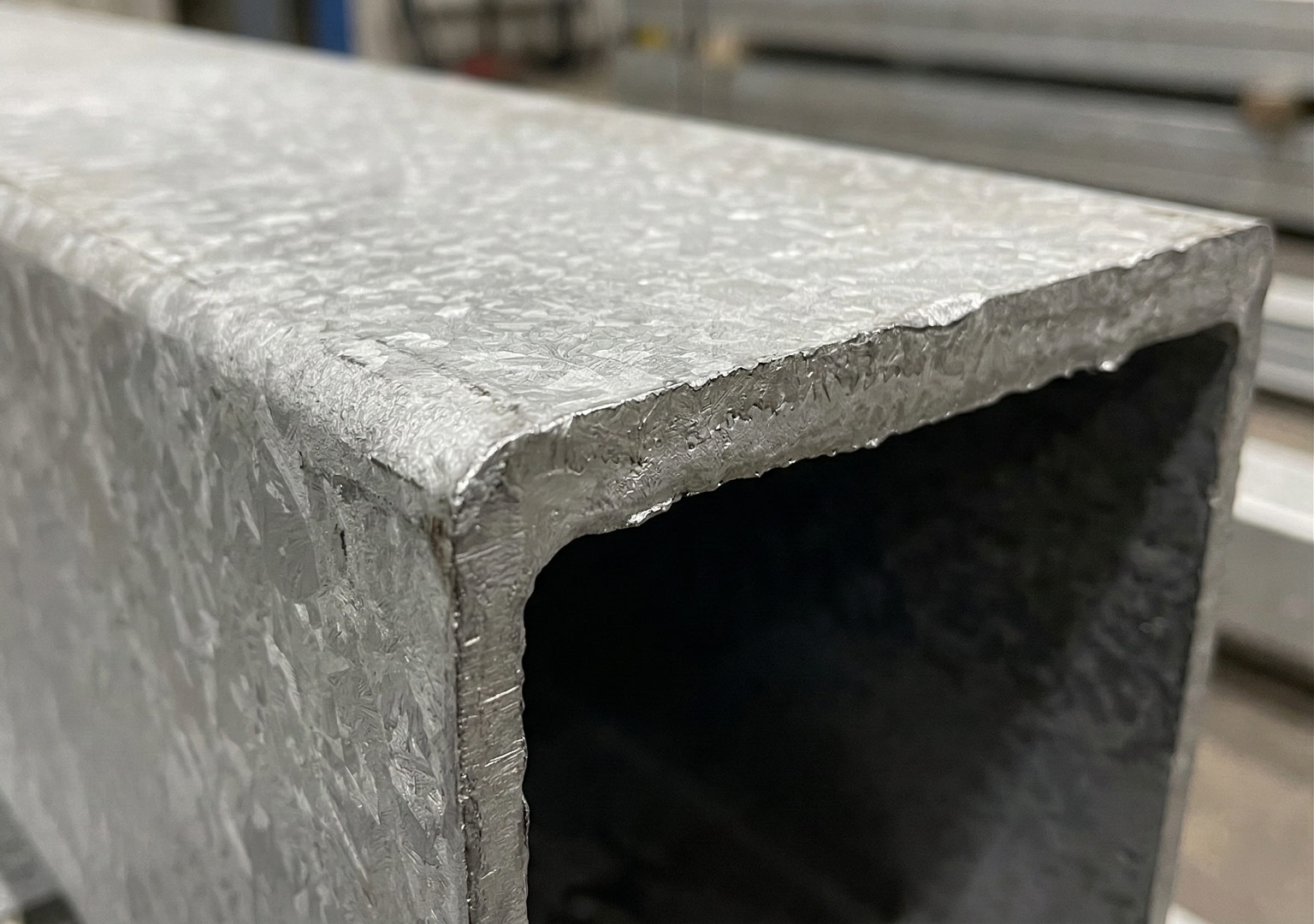
Coating thickness is one of the most critical performance variables in hot dip galvanizing. Because service life in atmospheric exposure is directly related to zinc thickness, it is common for engineers or owners to request coatings thicker than standard minimum requirements. However, requesting unusually thick coatings requires understanding how galvanizing actually forms and what variables control thickness growth.
This Galvanize It article on thick coating requests provides foundational insight into this topic. Building on that technical framework, this article examines the metallurgical factors influencing coating thickness, the limitations of intentional thickness manipulation, and the structural and performance implications of excessive coating growth.
How Galvanized Coatings Form
Hot dip galvanizing produces a series of zinc iron alloy layers through diffusion between molten zinc and the steel substrate. The coating grows outward as iron and zinc react during immersion.
Coating thickness is influenced primarily by:
- Steel chemistry
- Steel thickness
- Surface condition
- Immersion time
- Bath temperature
The most significant variable is steel chemistry, particularly silicon and phosphorus content.
Because coating growth is diffusion controlled, thickness cannot simply be increased arbitrarily without affecting alloy structure.
ASTM Minimum Thickness Versus Requested Thickness
ASTM A123 specifies minimum coating thickness requirements based on steel thickness categories. These minimums are established to provide predictable corrosion protection.
Requests for coating thickness above ASTM minimums often arise when:
- Long service life is desired
- Exposure conditions are aggressive
- Maintenance access is limited
- Lifecycle cost modeling favors additional zinc
However, ASTM A123 defines minimums, not maximums. That does not mean there are no practical upper limits.
Excessively thick coatings may exhibit:
- Increased brittleness
- Greater susceptibility to mechanical damage
- Appearance variation
- Dimensional interference in tight tolerance assemblies
Engineering judgment is required when specifying above minimum thickness.
Role of Steel Chemistry in Heavy Coatings
Silicon content significantly influences galvanizing reactivity.
Steels within reactive silicon ranges may experience accelerated alloy growth, producing heavier coatings without intentional process modification.
These coatings may:
- Appear matte gray
- Contain a higher proportion of intermetallic layers
- Exhibit reduced outer eta layer thickness
In reactive steels, requesting additional thickness may not produce predictable results.
Coating growth is not controlled solely by immersion time.
Immersion Time and Thickness Control
It is a misconception that simply leaving steel in the zinc bath longer guarantees significantly thicker coatings.
While immersion time influences growth to some extent, diffusion kinetics slow as alloy layers develop.
Excessive immersion may:
- Increase alloy layer brittleness
- Affect surface smoothness
- Introduce stress in complex assemblies
Thickness increases are therefore not linear with time.
Process parameters must remain within controlled ranges to maintain coating integrity.
Performance Implications of Very Thick Coatings
Thicker coatings generally provide longer corrosion protection, assuming environmental exposure remains consistent.
However, extremely thick coatings may:
- Crack under mechanical stress
- Chip during handling
- Interfere with threaded connections
- Create dimensional tolerance issues
In structural applications requiring tight fit up, excessive coating buildup may require grinding or rework.
Balance between durability and mechanical compatibility is essential.
When Thick Coating Requests Are Appropriate
In certain environments, requesting coatings above ASTM minimums may be justified, such as:
- Marine atmospheres
- Industrial pollutant exposure
- Infrastructure with limited maintenance access
- Utility structures with long design life
Rather than specifying arbitrary thickness values, engineers should:
- Evaluate environmental classification
- Model corrosion rate data
- Align coating thickness with time to first maintenance goals
Service life modeling provides a rational basis for thickness decisions. Collaborative planning ensures coating performance aligns with durability expectations.
Inspection and Acceptance Considerations
When heavier coatings are present, inspection should verify:
- Minimum thickness compliance
- Coating adhesion
- Absence of flaking or delamination
- Dimensional suitability
Thickness measurement using calibrated magnetic gauges remains the governing acceptance criterion.
Appearance variation alone does not indicate non compliance.
Managing Expectations
It is important to recognize that coating thickness is influenced by metallurgical variables beyond full operator control.
Specifying a target significantly above ASTM minimum without considering steel chemistry may result in:
- Inconsistent outcomes
- Appearance concerns
- Increased brittleness
Successful thick coating applications require coordination between designer, fabricator, and galvanizer.
Requesting thicker than standard galvanized coatings can be appropriate when justified by environmental exposure and lifecycle planning. However, coating growth is controlled primarily by steel chemistry and diffusion kinetics, not simply immersion duration. Excessively heavy coatings may introduce brittleness or dimensional challenges. A performance based approach that integrates corrosion rate data and specification standards provides the most reliable path to achieving long term durability.
If you are evaluating increased coating thickness for a specific project environment, we recommend discussing exposure conditions and specification goals with us directly. Please reach out via our contact page.
Frequently Asked Questions About Thick Galvanized Coating Requests
Can I request a coating thicker than ASTM A123 minimums?
Yes. ASTM A123 establishes minimum thickness requirements, but thicker coatings may develop depending on steel chemistry and processing conditions. However, requesting extreme thickness values may introduce brittleness or dimensional concerns.
Does longer immersion time guarantee a thicker coating?
Not necessarily. Coating growth is diffusion controlled and influenced primarily by steel chemistry. Increasing immersion time alone does not always produce proportionally thicker coatings.
Are thicker coatings always better?
Thicker coatings generally increase corrosion protection, but excessively thick coatings may become brittle or interfere with tight tolerance assemblies.
How does silicon content affect coating thickness?
Silicon influences galvanizing reactivity. Certain silicon ranges accelerate alloy growth and can produce heavier coatings without intentional process changes.
Should thick coating requests be based on corrosion modeling?
Yes. Environmental classification and zinc corrosion rate data should inform coating thickness decisions rather than arbitrary thickness targets.
Can thick coatings crack or flake?
In some cases, very heavy alloy layer growth may increase brittleness, particularly at sharp edges or under mechanical stress.
How is thick coating verified during inspection?
Coating thickness is measured using calibrated magnetic gauges. Compliance is based on minimum thickness requirements, not appearance.
