

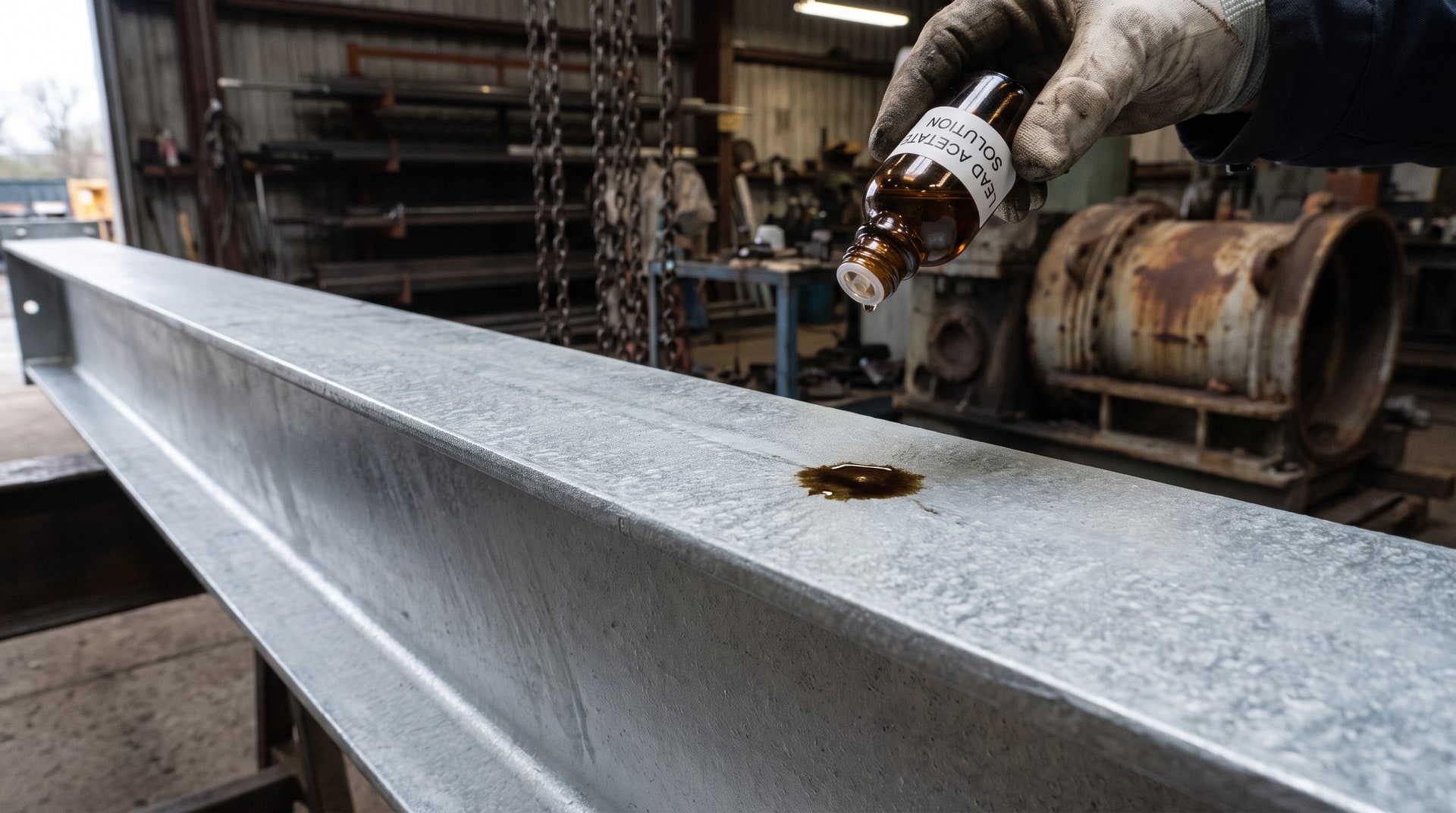
When a project specification calls for chromate passivation on hot-dip galvanized steel, or when an inspector needs to verify that a treatment is still active on a zinc surface, the question becomes a practical one fast: how do you actually check? The galvanized coating looks the same whether chromate is present or not. There is no visual shortcut, no color difference you can rely on by eye. That is exactly why a standardized chemical test exists, and understanding what it measures, how to read its results, and where it can mislead you is essential knowledge for anyone involved in inspection, specification, or fabrication of galvanized steel.
The American Galvanizers Association addresses this directly in their article on chromate testing. At V&S Galvanizing, we expand on that foundation to explain what is actually happening at the material level, how the presence or absence of chromate influences the zinc surface's behavior, and why this is often misunderstood in the field.
What Chromate Passivation Is and Why It Gets Applied
Hot-dip galvanizing produces a zinc coating that is metallurgically bonded to the base steel. That coating is highly effective at corrosion protection, but freshly galvanized zinc is also chemically reactive in the short term. When a newly galvanized surface is exposed to moisture, particularly condensation or rain, before the zinc has had a chance to form its stable carbonate layer through normal weathering, it can develop what is commonly called wet storage stain: a white or grey powdery deposit that forms when zinc hydroxide and zinc oxide accumulate on the surface.
Chromate passivation treatments are applied after galvanizing specifically to slow this initial reactivity. A chromate coating forms a thin conversion layer on the zinc surface that chemically inhibits the early-stage oxidation reactions. It does not change the long-term corrosion protection provided by the zinc itself, but it gives the coating time to stabilize before it encounters wet conditions. This matters most during transport, staging, and storage, when galvanized steel may be stacked, bundled, or covered in ways that trap moisture against the surface.
The Chemistry Behind the Lead Acetate Test
The test defined in ASTM B201, Standard Practice for Testing Chromate Coatings on Zinc and Cadmium Surfaces, works by exploiting the electrochemical relationship between lead acetate and reactive zinc. When lead acetate solution contacts bare, unpassivated zinc, a displacement reaction occurs: zinc displaces lead from the acetate compound, and metallic lead precipitates on the surface as a dark or black deposit. This is not a stain from the solution itself; it is elemental lead forming in place through a redox reaction.
When a chromate passivation coating is present on the zinc surface, it acts as a barrier that prevents the lead acetate from contacting the reactive zinc directly. The displacement reaction cannot occur, so no dark deposit forms. The surface under the blotted drop remains clear or shows no significant change. The logic of the test is therefore straightforward: a dark result means unpassivated zinc is present, and a clear result means the chromate layer is intact and active in that location.
The test procedure itself is deliberately simple. You place one drop of the lead acetate testing solution, prepared according to Section 6.3.2 of ASTM B201, on the surface of the galvanized coating. After exactly five seconds, you gently blot the remaining liquid away, taking care not to disturb any deposit that may have formed beneath the drop. If a dark or black stain remains, the test is positive for unpassivated zinc, meaning no chromate is present at that location. If the surface remains clean under the drop, the chromate coating is confirmed present.
Reading Results Correctly: What Positive and Negative Actually Mean
One of the more common errors in field interpretation is treating a negative result, meaning no chromate detected, as confirmation that chromate was never applied. That conclusion is not supported by the test. ASTM B201 does not tell you what happened historically; it tells you what is present on the surface right now at the moment of testing.
This distinction matters because chromate treatments are not permanent. According to the AGA, chromate coatings on galvanized surfaces typically last up to six weeks. In particularly wet or humid environments, they can be consumed significantly faster than that. Once the chromate has been depleted through reaction with atmospheric moisture or other environmental exposure, the zinc surface reverts to its unpassivated state. At that point, a lead acetate test will show the same dark deposit you would see on zinc that never received a chromate treatment at all. The absence of chromate at the time of testing says nothing definitive about whether it was applied earlier.
This is why the AGA recommendation includes a verification step: apply the lead acetate solution to a galvanized surface that is known not to have received chromate treatment. If that known-unpassivated reference surface shows the expected dark deposit, you have confirmed the test is working correctly. If both the test surface and the reference show clear results, something is wrong with the test setup, not the coating.
Where Environmental Conditions Accelerate Chromate Consumption
Understanding the roughly six-week service life of a chromate passivation coating as a general guideline is useful, but that number assumes relatively normal atmospheric conditions. In practice, the actual duration can vary considerably based on how the galvanized material is stored and handled after treatment.
High humidity environments are the primary accelerant. When zinc is exposed to persistent moisture, particularly in coastal storage yards, covered but poorly ventilated warehouses, or during rainy seasons in tropical climates, the chromate conversion layer reacts more rapidly. The chromate is chemically consumed as it does its intended job of suppressing zinc oxidation, so higher moisture exposure means faster depletion. This is a feature of the system, not a failure; the chromate is working as intended. But it does mean that steel stored in harsh pre-installation conditions may arrive on site with its passivation already exhausted, even if it was treated correctly after galvanizing.
This has direct implications for inspection scheduling. If a project specification requires verification of chromate passivation, the testing should occur while the treatment is still likely to be active. Waiting until steel arrives on site after extended outdoor storage may produce negative results that reflect natural weathering rather than a failure to apply the treatment in the first place. Coordinators and inspectors familiar with hot-dip galvanizing processes understand that documentation of when chromate was applied can sometimes provide more reliable evidence of compliance than late-stage surface testing.
Why the Galvanized Surface Appearance Gives No Indication on Its Own
A persistent misconception among contractors and even some engineers is that the visual condition of a galvanized surface can indicate whether chromate passivation is present. This assumption does not hold up. A bright, spangled, silvery galvanized coating and a matte grey one can both have active chromate, or neither might. The chromate layer itself is extremely thin and optically transparent. It produces no characteristic color shift or sheen that the naked eye can reliably detect.
The galvanized surface appearance that people most often associate with freshness or quality, the bright metallic shine of a newly processed beam, reflects the alloy structure of the zinc coating itself, specifically the presence of free zinc at the surface. That appearance changes as the coating weathers, but those changes are driven by carbonate formation, not by chromate presence or absence. Even the early stages of white rust, the whitish bloom that indicates wet storage stain is forming, are not reliably prevented or indicated by visual inspection alone.
This is exactly why a chemical test is the correct tool for this question. Relying on appearance to make a passivation determination is not a defensible inspection practice, and specifications that require chromate verification should always reference the ASTM B201 test method rather than leaving room for visual judgment.
Practical Considerations for Preparing and Using the Test Solution
ASTM B201 Section 6.3.2 provides directions for preparing the lead acetate testing solution, and working from the specification directly rather than from memory or informal recipes is important for repeatable results. The concentration and formulation of the solution affect how reliably it reacts with zinc, so a solution prepared incorrectly may produce ambiguous results: a deposit that is too faint to interpret clearly, or no deposit even on a surface that should show one.
Storage and shelf life of the prepared solution also warrant attention. Lead acetate solutions can degrade over time, particularly if contaminated or exposed to light. Using a fresh, properly prepared solution and verifying its behavior against a known reference surface before each testing session eliminates one potential source of error. Inspectors who perform this test infrequently should treat solution preparation as a critical step, not a detail to shortcut.
The blotting step after the five-second contact period is equally important to execute carefully. The instruction is to blot gently without disturbing any deposit that has formed. If you wipe the surface rather than blot, you risk smearing or removing the lead deposit before you can observe it clearly. A clean absorbent material, used with a straight lifting motion rather than a lateral wipe, gives the most legible result.
How This Test Fits Into a Broader Inspection Framework
Chromate testing sits within a broader set of inspection practices for hot-dip galvanized coatings. Coating thickness measurement using calibrated magnetic gauges, visual inspection for surface defects or drainage spikes, and adhesion testing each address different aspects of the galvanized system's quality. The lead acetate chromate test is specifically scoped to one question: is a chromate passivation layer present on the zinc surface right now?
That narrow scope is actually a strength. When you understand exactly what a test is and is not designed to measure, you can use its results confidently without overreading them. A positive dark deposit tells you unambiguously that no active chromate is present at that test location. A clear result confirms the chromate is present and active. Neither result tells you anything about zinc coating thickness, adhesion quality, or the long-term corrosion performance of the underlying galvanized system.
For projects where chromate passivation is specified, we recommend that inspection records document the test date relative to the galvanizing date so reviewers can evaluate whether results are consistent with the known six-week service life. That context turns a binary pass/fail result into meaningful, defensible documentation.
Work With a Team That Understands Chromate Passivation in Practice
The lead acetate test described in ASTM B201 is a reliable, low-cost method for determining whether chromate passivation is active on a hot-dip galvanized surface. It works through a well-understood redox reaction, its interpretation is straightforward when understood correctly, and its limitations are well-defined. The most significant source of confusion in field use is not the test itself but the expectation that a negative result proves chromate was never applied. Given that chromate coatings are consumed over time, particularly in humid or wet environments, test timing relative to galvanizing and storage conditions must inform how results are interpreted.
At V&S Galvanizing, our team works regularly with engineers, fabricators, and inspectors who need to understand not just what a specification requires, but what it actually means in practice. If you have questions about chromate passivation, inspection methods for galvanized coatings, or how environmental conditions affect coating performance on your specific project, reach out through our contact page and we will be glad to help.
Frequently Asked Questions About Chromate Testing on Hot-Dip Galvanized Steel
What does the lead acetate test actually measure on a galvanized surface?
The lead acetate test measures whether a chromate passivation coating is currently active on the zinc surface. It does not measure zinc coating thickness, adhesion, or long-term corrosion resistance. When lead acetate contacts unpassivated zinc, a redox reaction deposits metallic lead as a dark stain. If chromate is present, it blocks this reaction and the surface remains clear.
What standard governs chromate testing on galvanized steel?
ASTM B201, Standard Practice for Testing Chromate Coatings on Zinc and Cadmium Surfaces, governs this test. Section 6.3 covers the type of chromate coatings most commonly applied in the galvanizing industry, and Section 6.3.2 provides instructions for preparing the lead acetate testing solution.
How long does chromate passivation last on a hot-dip galvanized coating?
Chromate coatings on galvanized steel typically remain active for up to six weeks under normal atmospheric conditions. In very wet or humid environments, they can be consumed significantly faster. Once the chromate is depleted, the zinc surface behaves as unpassivated zinc and will produce a dark result on the lead acetate test.
If the lead acetate test shows no chromate, does that mean chromate was never applied?
Not necessarily. A negative result, meaning a dark deposit forms, only confirms that no active chromate is present at the time of testing. If the chromate was applied but has since been consumed through normal environmental exposure, the test will show the same result as zinc that was never passivated. Test timing relative to the galvanizing date is critical context for interpreting results.
How should I verify that the lead acetate test is working correctly before relying on results?
ASTM B201 recommends applying the lead acetate solution to a galvanized surface that is known not to have received chromate treatment. This reference surface should produce a dark deposit. If it does, the test solution and procedure are functioning correctly. If both the test surface and the known-unpassivated reference show clear results, the test setup should be reviewed before drawing conclusions.
Can you determine chromate presence by looking at the galvanized surface?
No. Chromate passivation coatings are optically transparent and extremely thin. They produce no visible color change, sheen, or surface texture that can be reliably distinguished by eye. Visual inspection of the zinc surface cannot substitute for the lead acetate chemical test when chromate verification is required by a specification.
Why does humidity accelerate chromate depletion on galvanized steel?
Chromate passivation works by chemically reacting with the zinc surface to suppress early-stage oxidation. In high-humidity environments, moisture drives that reaction faster, consuming the chromate layer more quickly than it would deplete under dry or moderate conditions. This is the intended mechanism of the treatment, but it means steel stored in wet conditions may arrive on site with its passivation already exhausted even if it was properly treated after galvanizing.
What should inspection documentation include when chromate testing is performed?
Useful chromate test documentation should record the test date, the galvanizing date, the storage conditions between galvanizing and testing, the test solution preparation details, whether a reference surface was used for verification, and the location on the part where testing was performed. Recording the test date relative to the galvanizing date allows reviewers to assess whether a negative result is consistent with natural chromate depletion rather than failure to apply the treatment.
