

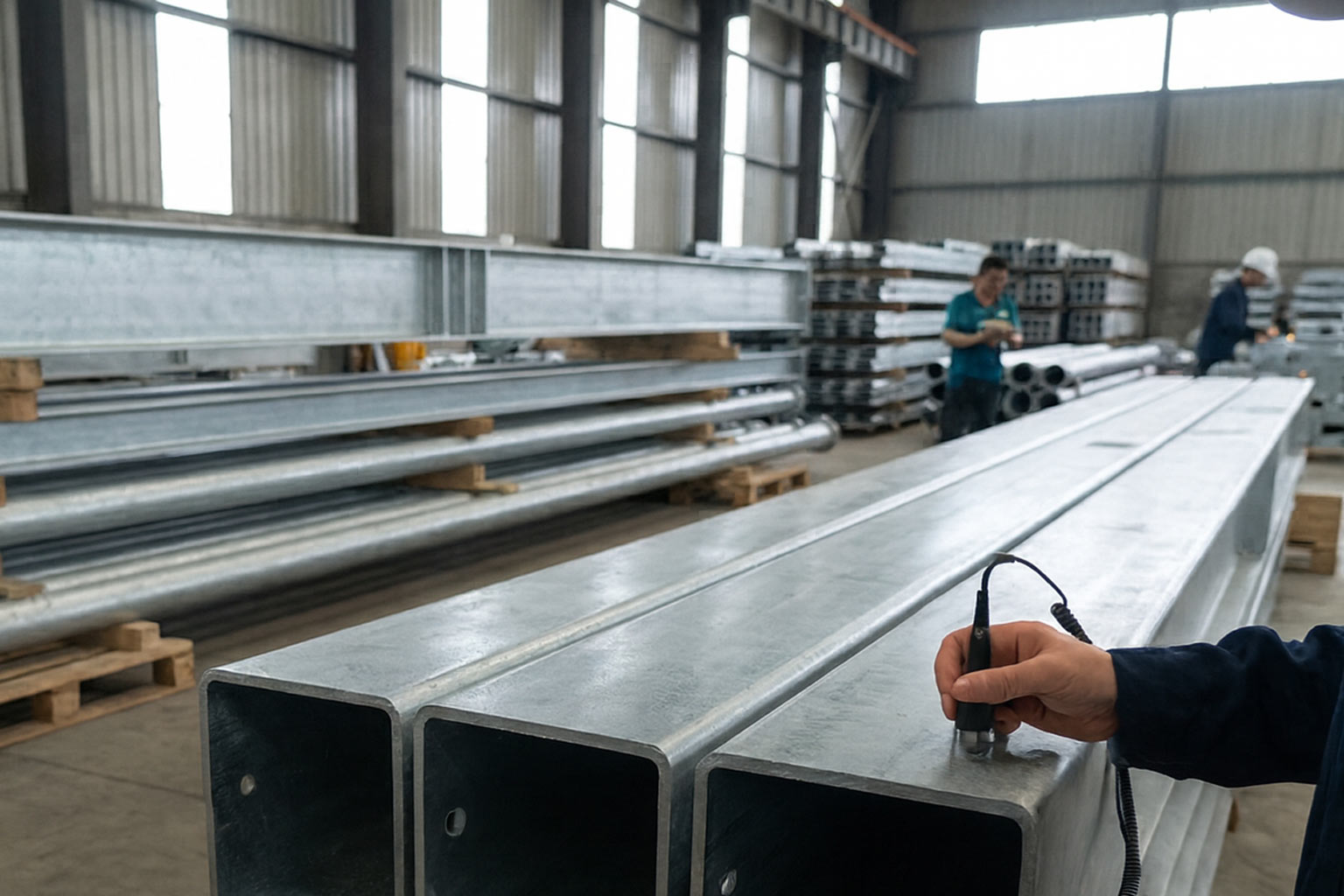
Statistical Sampling for Coating Thickness Verification
Hot-dip galvanizing quality assurance relies on statistical sampling protocols recognizing that measuring coating thickness on every galvanized article in production lots containing hundreds or thousands of pieces proves economically and practically infeasible. ASTM A123, "Standard Specification for Zinc (Hot-Dip Galvanized) Coatings on Iron and Steel Products," establishes systematic sampling methodologies where randomly selected representative specimens undergo thorough coating thickness measurement, with results statistically extrapolated to entire production lots. This approach balances comprehensive quality verification against practical inspection resource constraints.
However, ASTM A123 inspection protocols differentiate between simple single-specimen test articles (small items like individual fasteners or simple brackets) and complex multi-specimen test articles (large fabrications or assemblies containing multiple material types or thickness ranges). Understanding this critical distinction—particularly the 160 square inch surface area threshold triggering enhanced inspection requirements—ensures proper acceptance determination while preventing both inappropriate rejection of conforming material and inadvertent acceptance of deficient coatings.
Fundamental Inspection Terminology
ASTM A123 employs specific hierarchical terminology establishing relationships between production units, sampling groups, and measurement locations:
Lot
Definition: The unit of production or shipment from which samples are taken for testing.
Practical Application:
A lot typically comprises:
- All articles of same design galvanized in single processing batch
- Multiple batches of identical articles processed on same day/shift
- Shipment of same article type to single customer/project
Lot Size Determination:
Critical factor determining sample size requirements. May be defined by:
- Count: Number of individual pieces (fasteners, brackets, small parts)
- Weight: Short tons or metric tons (structural members, large fabrications)
- Contractual agreement: Customer and galvanizer negotiated definition
Sample
Definition: A group of individual articles from the lot tested to determine conformance to specification requirements.
Sample Size:
ASTM A123 Section 7.3 establishes sample size based on lot size:
Number of Pieces in Lot Number of Test Articles Required
3 or less All
4 to 500 3
501 to 1,200 5
1,201 to 3,200 8
3,201 to 10,000 13
10,001 and over 20
Selection Methodology:
Test articles selected randomly from throughout lot:
- Avoid clustering from single basket or location
- Represent different processing positions
- True random selection (not "cherry-picking")
Test Article
Definition: An individual article from the sample examined for conformance to specification requirements.
Relationship:
Test articles are the physical galvanized pieces selected for inspection. Each test article may contain one or multiple specimens depending on size and complexity.
Specimen
Definition: The surface of an individual test article, or portion of a test article, where thickness measurements are performed.
Key Concept:
A specimen represents the measurement zone—the specific area where five or more thickness readings are taken and averaged. Simple test articles contain one specimen; complex articles may contain multiple specimens requiring separate evaluation.
Single-Specimen vs. Multi-Specimen Classification
The critical threshold distinguishing inspection approaches:
Single-Specimen Test Articles
Definition:
Articles meeting BOTH criteria:
- Surface area ≤ 160 in² (1,032 cm²)
- Comprised of only one material category AND one steel thickness range per ASTM A123 Table 1
Examples:
- Small brackets (3" × 4" × 8" = 112 in² total surface)
- Individual fasteners
- Simple plates under 160 in²
- Small tubular sections
Inspection Approach:
Entire article constitutes single specimen:
- Five measurements distributed across entire article surface
- Single average calculated representing article
- Straightforward inspection
Multi-Specimen Test Articles
Definition:
Articles meeting ANY of following criteria:
- Surface area > 160 in² for any single material category or thickness range
- Contains multiple material categories per ASTM A123 Table 1
- Contains multiple thickness ranges per ASTM A123 Table 1
Examples:
- Structural beams (large surface area)
- Fabricated assemblies combining plate and tube
- Assemblies with 1/4" and 1/2" thick components
- Complex welded structures
Inspection Approach:
Article subdivided into multiple specimens each requiring separate measurement and evaluation—significantly more complex inspection protocol.
The 160 Square Inch Threshold
Rationale
The 160 in² (1,032 cm²) threshold represents:
- Approximate surface area where five measurement locations provide adequate statistical representation
- Practical limit for simple visual assessment of coating uniformity
- Balance between inspection thoroughness and resource efficiency
Beyond 160 in²:
Larger surface areas require subdivision ensuring:
- Adequate measurement density across entire article
- Detection of localized coating thickness variations
- Representative sampling of different coating zones
Surface Area Calculation
Obtaining Surface Area:
From Engineering Drawings:
- Most accurate method
- Design drawings typically specify surface area
- Includes all accessible surfaces to be coated
Geometric Calculation:
For simple shapes, calculate manually:
Flat Plate: Surface Area = 2 × (Length × Width) + Perimeter × Thickness
Example: 12" × 24" × 1/4" plate = 2(12 × 24) + 2[(12 + 24) × 0.25] = 576 + 18 = 594 in² → Multi-specimen
Beam/Channel: Sum all surface areas (flanges, web, both sides)
Tube: External surface: π × Diameter × Length Internal surface (if coated): π × (Diameter - 2×Wall) × Length
Complex Fabrications:
- Request from fabricator or engineer
- Use CAD software surface area function
- Conservative estimation if calculation difficult
Material Category and Thickness Range Separation
ASTM A123 Table 1 establishes minimum coating thickness requirements varying by:
Material Category
Categories per ASTM A123:
- Structural Shapes: Beams (W, S, HP shapes), channels, angles
- Plate: Flat plate stock
- Pipe and Tubing: Round or rectangular hollow sections
- Wire, Strip, Bar, Rod
- Castings and Forgings
Inspection Requirement:
Different material categories within single test article must be evaluated as separate specimens even if coating requirement is identical.
Rationale:
Different categories exhibit different coating reactivity:
- Plate vs. pipe may have different silicon content
- Different surface conditions affect coating formation
- Separate evaluation ensures each category meets requirements
Thickness Range
ASTM A123 Table 1 Ranges:
Material thickness significantly affects coating thickness:
- <1/16" (1.6 mm)
- 1/16" to <1/8" (1.6 to 3.2 mm)
- 1/8" to <3/16" (3.2 to 4.8 mm)
- 3/16" to <5/16" (4.8 to 7.9 mm)
- ≥5/16" (≥7.9 mm)
Minimum Coating Grades:
Thinner steel = lower minimum coating requirement:
- <1/16" steel: 3.5 mils minimum (Grade 85)
- ≥5/16" steel: 2.0 mils minimum (Grade 50)
Inspection Requirement:
Different thickness ranges require separate specimen evaluation even if same material category.
Example:
Assembly containing:
- 1/4" thick plate (Grade 75 required)
- 3/4" thick plate (Grade 65 required)
Despite both being plate category, different thickness ranges mandate separate specimen inspection.
Multi-Specimen Inspection Procedures
Scenario 1: Large Single Material/Thickness
Description: Test article >160 in² comprised of single material category and thickness range
Example: W8×15 beam, 10 feet long
- Material category: Structural shape
- Thickness range: 1/4"-5/8" (flange and web within single range)
- Surface area: ~4,300 in² (far exceeds 160 in²)
Subdivision Protocol:
Divide article into three continuous sections of equal surface area:
- Section 1 (Specimen 1): 0-40 inches of length
- Section 2 (Specimen 2): 40-80 inches of length
- Section 3 (Specimen 3): 80-120 inches of length
Measurement:
Each specimen receives five or more measurements:
- Distributed across flanges, web, and length within section
- Avoid clustering measurements
- Calculate average for each specimen
Acceptance:
Each specimen average must meet: Minimum - 1 grade All three specimen averages must meet: Required minimum when averaged together
Scenario 2: Multiple Categories/Ranges, Small Areas
Description: Test article containing multiple material categories or thickness ranges, but each individual category/range ≤160 in²
Example: Fabricated assembly containing:
- 6" × 12" × 1/4" plate (144 in²) - Grade 75 required
- 4" × 6" × 3/4" plate (72 in²) - Grade 65 required
- 2" diameter × 24" long tube (151 in²) - Grade 75 required
Subdivision Protocol:
Divide by material category and thickness range:
- Specimen 1: 1/4" plate (144 in² - no further subdivision needed)
- Specimen 2: 3/4" plate (72 in² - no further subdivision needed)
- Specimen 3: Tube (151 in² - no further subdivision needed)
Measurement:
Each specimen receives five measurements within its respective area.
Acceptance:
Each specimen average must meet: Minimum - 1 grade
Critical Final Average:
Because each category/range ≤160 in², average ALL specimens of same category/range across ALL test articles in sample:
- Average all 1/4" plate specimens from all test articles together
- Average all 3/4" plate specimens from all test articles together
- Average all tube specimens from all test articles together
Each category/range average must meet required minimum.
Scenario 3: Multiple Categories/Ranges, Large Areas
Description: Test article containing material categories or thickness ranges where individual category/range >160 in²
Example: Pipe assembly containing:
- 3" diameter, 1/4" wall pipe: 48" long (surface area = 470 in²) - Grade 75 required
- 6" diameter, 1/2" wall pipe: 36" long (surface area = 679 in²) - Grade 65 required
Subdivision Protocol:
Step 1: Separate by material category/thickness range
- Section A: 3" diameter pipe
- Section B: 6" diameter pipe
Step 2: Further subdivide sections >160 in² into three equal parts
- Section A (470 in² > 160): Divide into thirds
- Specimen 1: 0-16 inches (157 in²)
- Specimen 2: 16-32 inches (157 in²)
- Specimen 3: 32-48 inches (157 in²)
- Section B (679 in² > 160): Divide into thirds
- Specimen 4: 0-12 inches (226 in²)
- Specimen 5: 12-24 inches (226 in²)
- Specimen 6: 24-36 inches (226 in²)
Total: Six specimens per test article
Measurement:
Each of six specimens receives five measurements distributed within its zone.
Acceptance:
Each specimen average must meet: Minimum - 1 grade
Average three specimens for each material/thickness category:
- Average specimens 1, 2, 3 (3" pipe sections)
- Average specimens 4, 5, 6 (6" pipe sections)
Each category/range average within each test article must meet required minimum.
Acceptance Criteria Hierarchy
Understanding the layered acceptance structure:
Level 1: Individual Measurements
Requirement: No specified minimum for individual spot readings
Caveat: Bare areas (uncoated spots) not permitted regardless of other measurements
Practical Reality:
Individual readings vary widely:
- May range from 2-10 mils on same article
- Variability from coating thickness variations, measurement location, gauge accuracy
- Individual readings alone don't determine acceptance
Level 2: Specimen Average
Requirement: Average of five measurements per specimen must be ≥ (Required Minimum - 1 Grade)
Grade Steps (ASTM A123 Table 2): 50, 55, 60, 65, 70, 75, 80, 85, 90, 95, 100 (in mils)
Example:
- Required minimum: Grade 75 (3.9 mils)
- Specimen acceptable if average ≥ Grade 70 (3.5 mils)
Rationale:
Allows individual specimen variation while ensuring no specimen drastically deficient.
Level 3: Test Article Average (Multi-Specimen)
Requirement for Single Material/Thickness >160 in²:
Average of three specimen measurements must meet required minimum.
Example:
- Specimen 1 average: 3.6 mils
- Specimen 2 average: 4.1 mils
- Specimen 3 average: 4.0 mils
- Test article average: 3.9 mils
- Required: 3.9 mils (Grade 75) → Passes
Level 4: Sample Average
For Single-Specimen Test Articles:
Average of all test articles in sample must meet required minimum.
For Multi-Specimen with Categories ≤160 in²:
Average of all specimens of same category/range across all test articles must meet required minimum.
Best Practices for Accurate Inspection
Adequate Measurement Density
Minimum Requirement: Five measurements per specimen
Best Practice Consideration:
Complex specimens with multiple faces or components may require more than five measurements adequately representing entire specimen:
Example: Tubular frame section (one specimen)
- Five measurements technically adequate
- Better practice: 8-10 measurements sampling front, back, top, bottom, and ends proportionally
- Ensures all orientations represented
Principle: Measurement density should reflect specimen complexity
Gauge Calibration and Verification
Calibration:
Formal calibration by manufacturer or qualified laboratory:
- Frequency: Annually or per manufacturer recommendation
- Documentation: Calibration certificate with traceability
Daily Verification:
Before each use, verify gauge accuracy:
- Use calibration shims or coated standards
- Check zero on uncoated steel
- Verify readings at expected thickness range (e.g., 3-5 mils for typical galvanizing)
- Adjust if readings deviate from standard values
Re-verification:
During use, re-verify after:
- Dropping or rough handling
- Extended measurement session (every 50-100 readings)
- Unusual or suspicious readings
Critical:
Inaccurate gauge measurements leading to incorrect rejection or acceptance far more problematic than effort invested in proper verification.
Consistent Unit System
Recommendation:
Select either metric or imperial units and maintain throughout inspection:
- Surface area calculations
- Material thickness determinations
- Coating thickness measurements and requirements
Avoid:
Unit conversions during inspection process increase error risk and confusion.
Common Inspection Errors
Error 1: Incorrect Subdivision Sequence
Wrong Approach: Divide large article into three equal areas FIRST, then separate by material category
Correct Approach: Separate by material category and thickness range FIRST, then subdivide any section >160 in²
Impact:
Incorrect sequence leads to:
- Specimens mixing different categories/ranges
- Inappropriate averaging
- Potential acceptance of deficient material
Error 2: Combining Different Thickness Ranges
Scenario: Assembly with 1/4" and 1/2" pipe both requiring same coating grade (due to different categories)
Common Error: "Both need Grade 75, so inspect together as single specimen"
Correct Approach:
Different thickness ranges per Table 1 require separate specimens even if minimum requirement happens to be same grade.
Rationale:
Table 1 separates by thickness range for metallurgical reasons—thinner steel typically develops slightly thicker coating. Must verify each range meets requirement independently.
Error 3: Insufficient Sample Across Categories
Scenario: Multi-specimen test articles with small category/range areas (≤160 in²)
Requirement: Average all specimens of same category/range across ALL test articles in sample
Common Error: Averaging only within individual test articles
Result:
Missing the cross-article averaging requirement leading to incorrect acceptance determination.
Specification Clarification Note
2022 Update Context
ASTM A123 terminology using "specimen" and "test article" interchangeably for single-specimen articles created marketplace confusion regarding multi-specimen inspection protocols. Two different yet common interpretations emerged:
Interpretation A: Average all specimens within each test article separately
Interpretation B: Average all specimens of same category across entire sample
Resolution:
ASTM Subcommittee A05.13 reviewing specification language and figures for clarification in 2023 revision addressing:
- Clearer terminology distinctions
- Revised inspection flow diagrams
- Explicit multi-specimen averaging protocols
Current Practice:
Until revised specification released, follow manufacturer interpretation or project specification requirements while maintaining documentation of applied methodology.
ASTM A123 multi-specimen test article inspection methodology requires systematic subdivision of complex fabrications exceeding 160 square inch surface area threshold or containing multiple material categories and thickness ranges, with articles divided into separate specimens receiving independent five-measurement averaging and acceptance evaluation. Single-specimen test articles (≤160 in² with single material category and thickness range) undergo straightforward five-measurement averaging with sample-wide averaging determining lot acceptance, while multi-specimen articles demand hierarchical evaluation where individual specimens must average minimum-minus-one-grade, test articles containing large single categories subdivided into three equal-area specimens must average to required minimum, and small categories (≤160 in²) require cross-article specimen averaging across entire sample. Critical inspection protocol elements include proper subdivision sequence separating by material category and thickness range before area-based division, recognition that different thickness ranges require separate evaluation even when minimum coating grade requirements coincidentally match, adequate measurement density with five-plus readings proportionally distributed across complex specimen geometries, and daily gauge calibration verification using traceable standards preventing systematic measurement errors causing inappropriate acceptance or rejection. The fundamental principle governing multi-specimen inspection recognizes that large surface area articles and complex assemblies require enhanced statistical sampling ensuring coating thickness uniformity across diverse article zones, multiple material types exhibiting different coating reactivity characteristics, and varying thickness ranges where metallurgical factors influence coating development—necessitating specimen subdivision and independent evaluation rather than simple whole-article averaging appropriate only for small, homogeneous single-specimen test articles under 160 square inches. To view the original AGA resource article, click this link.
